
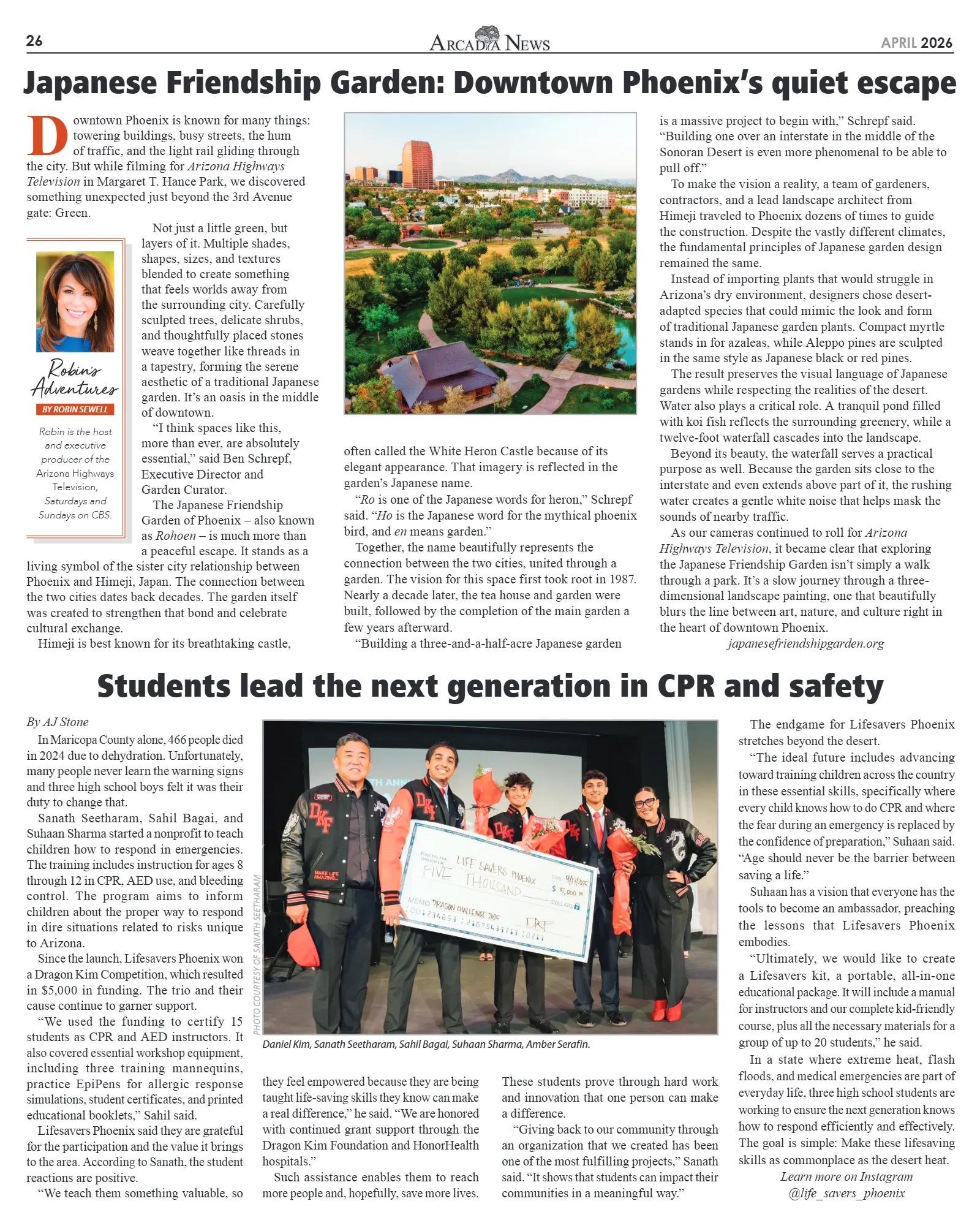
26 APRIL 2026 D owntown Phoenix is known for many things: towering buildings, busy streets, the hum of traffic, and the light rail gliding through the city. But while filming for Arizona Highways Television in Margaret T. Hance Park, we discovered something unexpected just beyond the 3rd Avenue gate: Green. Not just a little green, but layers of it. Multiple shades, shapes, sizes, and textures blended to create something that feels worlds away from the surrounding city. Carefully sculpted trees, delicate shrubs, and thoughtfully placed stones weave together like threads in a tapestry, forming the serene aesthetic of a traditional Japanese garden. It’s an oasis in the middle of downtown. “I think spaces like this, more than ever, are absolutely essential,” said Ben Schrepf, Executive Director and Garden Curator. The Japanese Friendship Garden of Phoenix – also known as Rohoen – is much more than a peaceful escape. It stands as a living symbol of the sister city relationship between Phoenix and Himeji, Japan. The connection between the two cities dates back decades. The garden itself was created to strengthen that bond and celebrate cultural exchange. Himeji is best known for its breathtaking castle, often called the White Heron Castle because of its elegant appearance. That imagery is reflected in the garden’s Japanese name. “ Ro is one of the Japanese words for heron,” Schrepf said. “ Ho is the Japanese word for the mythical phoenix bird, and en means garden.” Together, the name beautifully represents the connection between the two cities, united through a garden. The vision for this space first took root in 1987. Nearly a decade later, the tea house and garden were built, followed by the completion of the main garden a few years afterward. “Building a three-and-a-half-acre Japanese garden is a massive project to begin with,” Schrepf said. “Building one over an interstate in the middle of the Sonoran Desert is even more phenomenal to be able to pull off.” To make the vision a reality, a team of gardeners, contractors, and a lead landscape architect from Himeji traveled to Phoenix dozens of times to guide the construction. Despite the vastly different climates, the fundamental principles of Japanese garden design remained the same. Instead of importing plants that would struggle in Arizona’s dry environment, designers chose desert- adapted species that could mimic the look and form of traditional Japanese garden plants. Compact myrtle stands in for azaleas, while Aleppo pines are sculpted in the same style as Japanese black or red pines. The result preserves the visual language of Japanese gardens while respecting the realities of the desert. Water also plays a critical role. A tranquil pond filled with koi fish reflects the surrounding greenery, while a twelve-foot waterfall cascades into the landscape. Beyond its beauty, the waterfall serves a practical purpose as well. Because the garden sits close to the interstate and even extends above part of it, the rushing water creates a gentle white noise that helps mask the sounds of nearby traffic. As our cameras continued to roll for Arizona Highways Television , it became clear that exploring the Japanese Friendship Garden isn’t simply a walk through a park. It’s a slow journey through a three- dimensional landscape painting, one that beautifully blurs the line between art, nature, and culture right in the heart of downtown Phoenix. japanesefriendshipgarden.org Japanese Friendship Garden: Downtown Phoenix’s quiet escape Robin is the host and executive producer of the Arizona Highways Television , Saturdays and Sundays on CBS. BY ROBIN SEWELL By AJ Stone In Maricopa County alone, 466 people died in 2024 due to dehydration. Unfortunately, many people never learn the warning signs and three high school boys felt it was their duty to change that. Sanath Seetharam, Sahil Bagai, and Suhaan Sharma started a nonprofit to teach children how to respond in emergencies. The training includes instruction for ages 8 through 12 in CPR, AED use, and bleeding control. The program aims to inform children about the proper way to respond in dire situations related to risks unique to Arizona. Since the launch, Lifesavers Phoenix won a Dragon Kim Competition, which resulted in $5,000 in funding. The trio and their cause continue to garner support. “We used the funding to certify 15 students as CPR and AED instructors. It also covered essential workshop equipment, including three training mannequins, practice EpiPens for allergic response simulations, student certificates, and printed educational booklets,” Sahil said. Lifesavers Phoenix said they are grateful for the participation and the value it brings to the area. According to Sanath, the student reactions are positive. “We teach them something valuable, so they feel empowered because they are being taught life-saving skills they know can make a real difference,” he said. “We are honored with continued grant support through the Dragon Kim Foundation and HonorHealth hospitals.” Such assistance enables them to reach more people and, hopefully, save more lives. These students prove through hard work and innovation that one person can make a difference. “Giving back to our community through an organization that we created has been one of the most fulfilling projects,” Sanath said. “It shows that students can impact their communities in a meaningful way.” The endgame for Lifesavers Phoenix stretches beyond the desert. “The ideal future includes advancing toward training children across the country in these essential skills, specifically where every child knows how to do CPR and where the fear during an emergency is replaced by the confidence of preparation,” Suhaan said. “Age should never be the barrier between saving a life.” Suhaan has a vision that everyone has the tools to become an ambassador, preaching the lessons that Lifesavers Phoenix embodies. “Ultimately, we would like to create a Lifesavers kit, a portable, all-in-one educational package. It will include a manual for instructors and our complete kid-friendly course, plus all the necessary materials for a group of up to 20 students,” he said. In a state where extreme heat, flash floods, and medical emergencies are part of everyday life, three high school students are working to ensure the next generation knows how to respond efficiently and effectively. The goal is simple: Make these lifesaving skills as commonplace as the desert heat. Learn more on Instagram @life_savers_ phoenix Students lead the next generation in CPR and safety Daniel Kim, Sanath Seetharam, Sahil Bagai, Suhaan Sharma, Amber Serafin. PHOTO COURTESY OF SANATH SEETHARAM
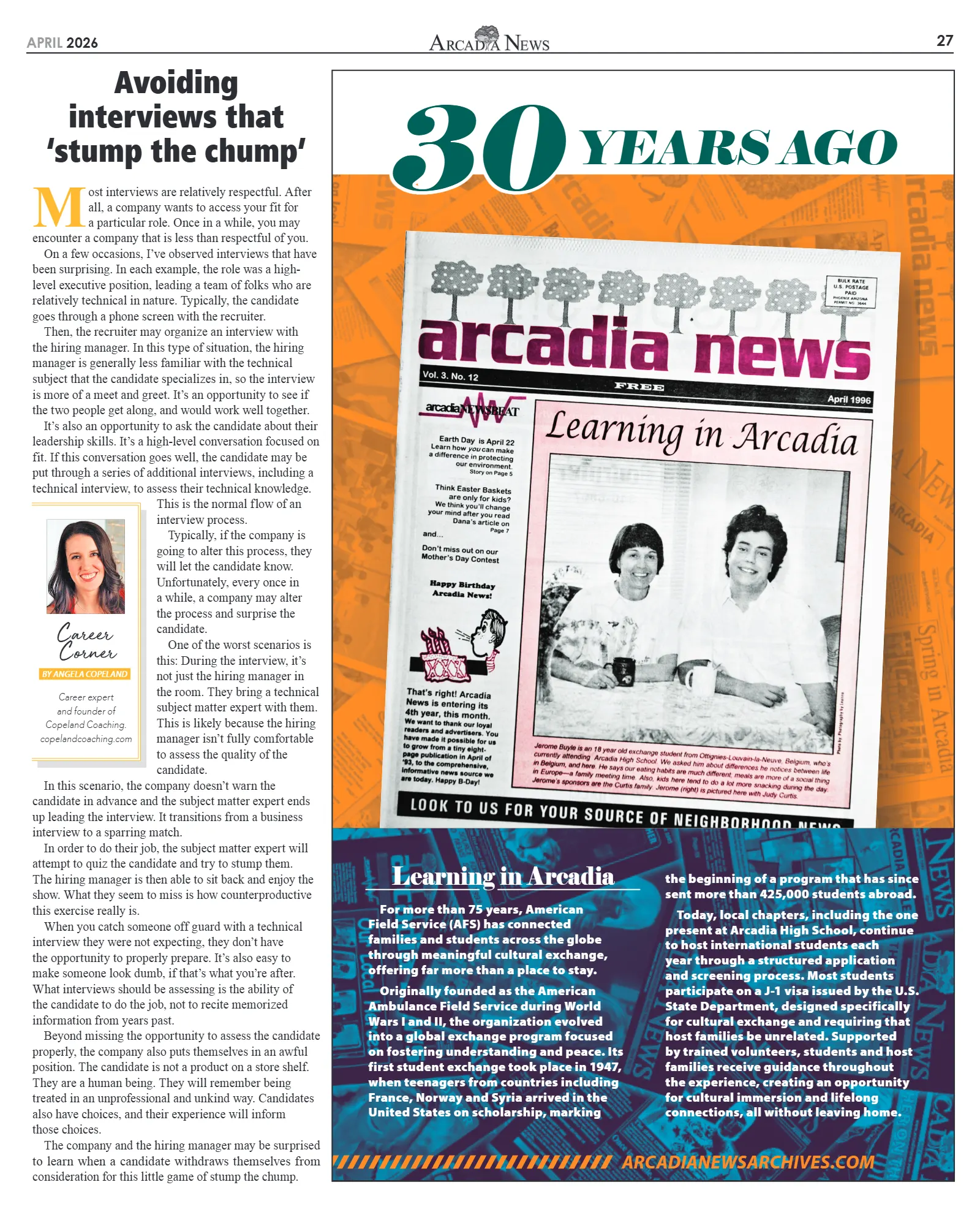
27 APRIL 2026 M ost interviews are relatively respectful. After all, a company wants to access your fit for a particular role. Once in a while, you may encounter a company that is less than respectful of you. On a few occasions, I’ve observed interviews that have been surprising. In each example, the role was a high- level executive position, leading a team of folks who are relatively technical in nature. Typically, the candidate goes through a phone screen with the recruiter. Then, the recruiter may organize an interview with the hiring manager. In this type of situation, the hiring manager is generally less familiar with the technical subject that the candidate specializes in, so the interview is more of a meet and greet. It’s an opportunity to see if the two people get along, and would work well together. It’s also an opportunity to ask the candidate about their leadership skills. It’s a high-level conversation focused on fit. If this conversation goes well, the candidate may be put through a series of additional interviews, including a technical interview, to assess their technical knowledge. This is the normal flow of an interview process. Typically, if the company is going to alter this process, they will let the candidate know. Unfortunately, every once in a while, a company may alter the process and surprise the candidate. One of the worst scenarios is this: During the interview, it’s not just the hiring manager in the room. They bring a technical subject matter expert with them. This is likely because the hiring manager isn’t fully comfortable to assess the quality of the candidate. In this scenario, the company doesn’t warn the candidate in advance and the subject matter expert ends up leading the interview. It transitions from a business interview to a sparring match. In order to do their job, the subject matter expert will attempt to quiz the candidate and try to stump them. The hiring manager is then able to sit back and enjoy the show. What they seem to miss is how counterproductive this exercise really is. When you catch someone off guard with a technical interview they were not expecting, they don’t have the opportunity to properly prepare. It’s also easy to make someone look dumb, if that’s what you’re after. What interviews should be assessing is the ability of the candidate to do the job, not to recite memorized information from years past. Beyond missing the opportunity to assess the candidate properly, the company also puts themselves in an awful position. The candidate is not a product on a store shelf. They are a human being. They will remember being treated in an unprofessional and unkind way. Candidates also have choices, and their experience will inform those choices. The company and the hiring manager may be surprised to learn when a candidate withdraws themselves from consideration for this little game of stump the chump. Avoiding interviews that ‘stump the chump’ Career Corner Career expert and founder of Copeland Coaching. copelandcoaching.com BY ANGELA COPELAND ARCADIANEWSARCHIVES.COM For more than 75 years, American Field Service (AFS) has connected families and students across the globe through meaningful cultural exchange, offering far more than a place to stay. Originally founded as the American Ambulance Field Service during World Wars I and II, the organization evolved into a global exchange program focused on fostering understanding and peace. Its first student exchange took place in 1947, when teenagers from countries including France, Norway and Syria arrived in the United States on scholarship, marking the beginning of a program that has since sent more than 425,000 students abroad. Today, local chapters, including the one present at Arcadia High School, continue to host international students each year through a structured application and screening process. Most students participate on a J-1 visa issued by the U.S. State Department, designed specifically for cultural exchange and requiring that host families be unrelated. Supported by trained volunteers, students and host families receive guidance throughout the experience, creating an opportunity for cultural immersion and lifelong connections, all without leaving home. 30 30 YEARS AGO YEARS AGO Learning in Arcadia