
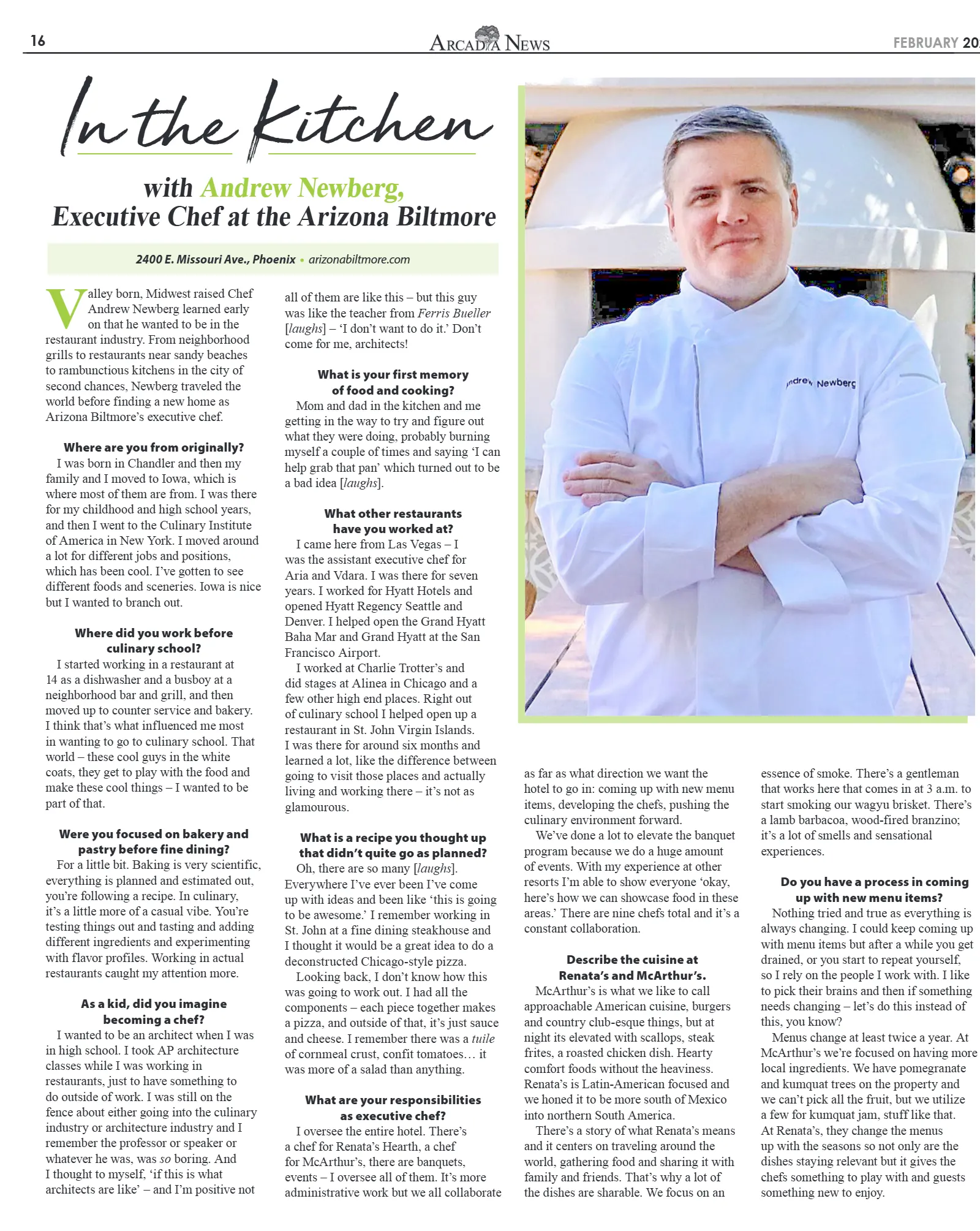
FEBRUARY 202 16 with Andrew Newberg, Executive Chef at the Arizona Biltmore 2400 E. Missouri Ave., Phoenix • arizonabiltmore.com In the Kitchen V alley born, Midwest raised Chef Andrew Newberg learned early on that he wanted to be in the restaurant industry. From neighborhood grills to restaurants near sandy beaches to rambunctious kitchens in the city of second chances, Newberg traveled the world before finding a new home as Arizona Biltmore’s executive chef. Where are you from originally? I was born in Chandler and then my family and I moved to Iowa, which is where most of them are from. I was there for my childhood and high school years, and then I went to the Culinary Institute of America in New York. I moved around a lot for different jobs and positions, which has been cool. I’ve gotten to see different foods and sceneries. Iowa is nice but I wanted to branch out. Where did you work before culinary school? I started working in a restaurant at 14 as a dishwasher and a busboy at a neighborhood bar and grill, and then moved up to counter service and bakery. I think that’s what influenced me most in wanting to go to culinary school. That world – these cool guys in the white coats, they get to play with the food and make these cool things – I wanted to be part of that. Were you focused on bakery and pastry before fine dining? For a little bit. Baking is very scientific, everything is planned and estimated out, you’re following a recipe. In culinary, it’s a little more of a casual vibe. You’re testing things out and tasting and adding different ingredients and experimenting with flavor profiles. Working in actual restaurants caught my attention more. As a kid, did you imagine becoming a chef? I wanted to be an architect when I was in high school. I took AP architecture classes while I was working in restaurants, just to have something to do outside of work. I was still on the fence about either going into the culinary industry or architecture industry and I remember the professor or speaker or whatever he was, was so boring. And I thought to myself, ‘if this is what architects are like’ – and I’m positive not all of them are like this – but this guy was like the teacher from Ferris Bueller [ laughs ] – ‘I don’t want to do it.’ Don’t come for me, architects! What is your first memory of food and cooking? Mom and dad in the kitchen and me getting in the way to try and figure out what they were doing, probably burning myself a couple of times and saying ‘I can help grab that pan’ which turned out to be a bad idea [ laughs ]. What other restaurants have you worked at? I came here from Las Vegas – I was the assistant executive chef for Aria and Vdara. I was there for seven years. I worked for Hyatt Hotels and opened Hyatt Regency Seattle and Denver. I helped open the Grand Hyatt Baha Mar and Grand Hyatt at the San Francisco Airport. I worked at Charlie Trotter’s and did stages at Alinea in Chicago and a few other high end places. Right out of culinary school I helped open up a restaurant in St. John Virgin Islands. I was there for around six months and learned a lot, like the difference between going to visit those places and actually living and working there – it’s not as glamourous. What is a recipe you thought up that didn’t quite go as planned? Oh, there are so many [ laughs ]. Everywhere I’ve ever been I’ve come up with ideas and been like ‘this is going to be awesome.’ I remember working in St. John at a fine dining steakhouse and I thought it would be a great idea to do a deconstructed Chicago-style pizza. Looking back, I don’t know how this was going to work out. I had all the components – each piece together makes a pizza, and outside of that, it’s just sauce and cheese. I remember there was a tuile of cornmeal crust, confit tomatoes… it was more of a salad than anything. What are your responsibilities as executive chef? I oversee the entire hotel. There’s a chef for Renata’s Hearth, a chef for McArthur’s, there are banquets, events – I oversee all of them. It’s more administrative work but we all collaborate as far as what direction we want the hotel to go in: coming up with new menu items, developing the chefs, pushing the culinary environment forward. We’ve done a lot to elevate the banquet program because we do a huge amount of events. With my experience at other resorts I’m able to show everyone ‘okay, here’s how we can showcase food in these areas.’ There are nine chefs total and it’s a constant collaboration. Describe the cuisine at Renata’s and McArthur’s. McArthur’s is what we like to call approachable American cuisine, burgers and country club-esque things, but at night its elevated with scallops, steak frites, a roasted chicken dish. Hearty comfort foods without the heaviness. Renata’s is Latin-American focused and we honed it to be more south of Mexico into northern South America. There’s a story of what Renata’s means and it centers on traveling around the world, gathering food and sharing it with family and friends. That’s why a lot of the dishes are sharable. We focus on an essence of smoke. There’s a gentleman that works here that comes in at 3 a.m. to start smoking our wagyu brisket. There’s a lamb barbacoa, wood-fired branzino; it’s a lot of smells and sensational experiences. Do you have a process in coming up with new menu items? Nothing tried and true as everything is always changing. I could keep coming up with menu items but after a while you get drained, or you start to repeat yourself, so I rely on the people I work with. I like to pick their brains and then if something needs changing – let’s do this instead of this, you know? Menus change at least twice a year. At McArthur’s we’re focused on having more local ingredients. We have pomegranate and kumquat trees on the property and we can’t pick all the fruit, but we utilize a few for kumquat jam, stuff like that. At Renata’s, they change the menus up with the seasons so not only are the dishes staying relevant but it gives the chefs something to play with and guests something new to enjoy.
FEBRUARY 2025 What are the most popular items? At Renata’s, the brisket is the most popular but what’s crazy is the next eight most popular dishes are all seafood – the octopus, the branzino, the Chilean sea bass, and so on. McArthur’s breakfast and lunch is the most popular but the turkey club and American burgers sell a lot, and for breakfast the citrus fruit bowl is a number one seller. What is one item in the kitchen you find yourself using most often? My brain [ laughs ]! No, for me, it’s tasting spoons. I think that’s one of the most important things that I try to impart on the chefs is that you should be constantly be tasting. Never leave hungry, that’s part of the job. If you’re constantly going around trying things, you’ll learn which dishes need salt, which ones are dry, which are too wet, which are losing flavor, you know? Who are some chefs that inspire you? John Pivar out in Seattle was great. I learned so much from Carlos Guia, who was the executive chef at Aria. I worked with him for years. I remember growing up I would watch PBS’s Great Chefs of the World – some of those chefs were inspirational. How do you stay calm when things get crazy in the kitchen? It’s a challenge. It’s part of the high- octane environment that is a kitchen. Everything is always last minute because you want to push things so the person gets the food the moment they’re supposed to get it. That also creates a level of stress. I have to keep reminding myself to relax and remember things won’t always go the way you want them to go. Trust the process. What’s the difference between working in Vegas and working at The Biltmore? It’s much smaller here, for sure. There aren’t a bunch of people under the influence wandering around [ laughs ]. There’s more freedom for some things out here because it’s not so massive. It’s easier to adopt things and there’s the local influence, which is important. If I want to change the menu and have it go live tomorrow, I can do that here. In Vegas, people who visit want the dishes from around the country or around the world, not the ‘local Nevada thing.’ The culinary team at Aria was 4,000 people. I was constantly involved in every aspect. When you’re not working, what are you doing? I enjoy reading and going out to new restaurants to try out new things. I typically don’t go to the same place twice and try to absorb as much as I can from each. I love traveling to see and experience different areas, cultures and food. I feel like everywhere I go I see something inspiring or meet people that I connect with. I try to go to at least one concert or comedy show or live event a month. Arizona has so many of them! Which famous person would you like to cook for? I should be cheesy and say ‘families are our own personal celebrities’ [ laughs ]. I would like to cook for my extended family, including late relatives, to get everyone together and have a good time and share stories and laugh and show them how far I have come. I am a little bit of a nerd and would love to cook for David Attenborough since he has been so many places and has so much wisdom and knowledge. Anthony Bourdain as well, with his knowledge and skills. He did such an amazing job shining a light on the hidden gems and the behind the scenes of restaurants where the everyday person goes. I would love to just sit and listen to both of them. What’s next for Chef Andrew? I’ve been at Biltmore for about a year so I’m continuously developing the program and teams. There’s a lot of great opportunities to showcase what we’ve got at our restaurants and get involved in the local scene, like doing something at farmer’s markets. We’re planning for upcoming holidays. We’re kind of secluded, so we want people to know we’re here and are excited to serve our community. That world – these cool guys in the white coats, they get to play with the food and make these cool things – I wanted to be part of that. THE ARCADIAN a r c a d i a n P H X . c o m STOP RENTING START OWNING Schedule a Tour! STARTING IN THE $600s PURCHASING A HOME IN ARCADIA IS EASIER THAN YOU MIGHT THINK!