
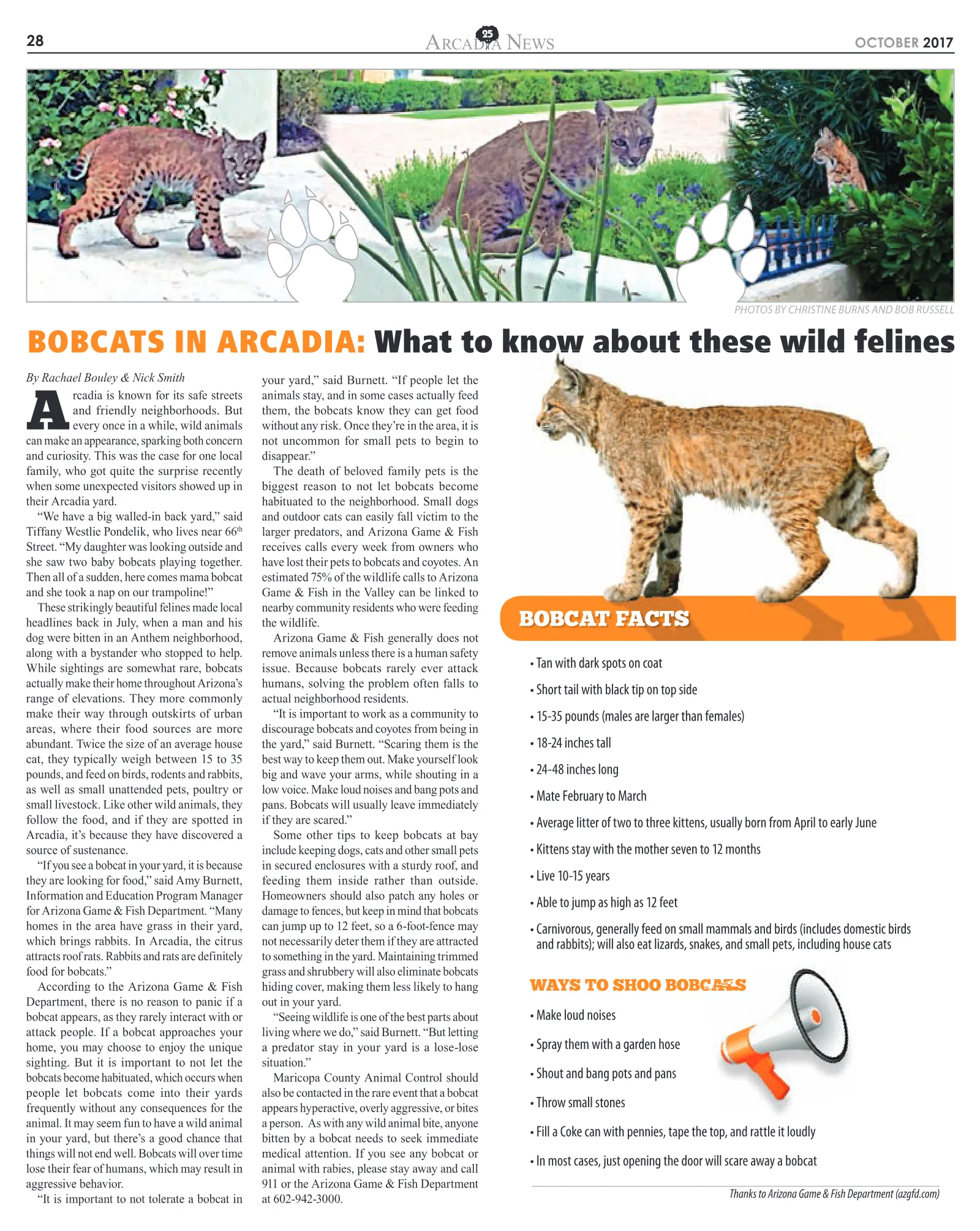

28 OCTOBER 2017 ArcAd A News By Rachael Bouley & Nick Smith A rcadia is known for its safe streets and friendly neighborhoods. But every once in a while, wild animals can make an appearance, sparking both concern and curiosity. This was the case for one local family, who got quite the surprise recently when some unexpected visitors showed up in their Arcadia yard. “We have a big walled-in back yard,” said Tiffany Westlie Pondelik, who lives near 66 th Street. “My daughter was looking outside and she saw two baby bobcats playing together. Then all of a sudden, here comes mama bobcat and she took a nap on our trampoline!” These strikingly beautiful felines made local headlines back in July, when a man and his dog were bitten in an Anthem neighborhood, along with a bystander who stopped to help. While sightings are somewhat rare, bobcats actually make their home throughout Arizona’s range of elevations. They more commonly make their way through outskirts of urban areas, where their food sources are more abundant. Twice the size of an average house cat, they typically weigh between 15 to 35 pounds, and feed on birds, rodents and rabbits, as well as small unattended pets, poultry or small livestock. Like other wild animals, they follow the food, and if they are spotted in Arcadia, it’s because they have discovered a source of sustenance. “If you see a bobcat in your yard, it is because they are looking for food,” said Amy Burnett, Information and Education Program Manager for Arizona Game & Fish Department. “Many homes in the area have grass in their yard, which brings rabbits. In Arcadia, the citrus attracts roof rats. Rabbits and rats are definitely food for bobcats.” According to the Arizona Game & Fish Department, there is no reason to panic if a bobcat appears, as they rarely interact with or attack people. If a bobcat approaches your home, you may choose to enjoy the unique sighting. But it is important to not let the bobcats become habituated, which occurs when people let bobcats come into their yards frequently without any consequences for the animal. It may seem fun to have a wild animal in your yard, but there’s a good chance that things will not end well. Bobcats will over time lose their fear of humans, which may result in aggressive behavior. “It is important to not tolerate a bobcat in your yard,” said Burnett. “If people let the animals stay, and in some cases actually feed them, the bobcats know they can get food without any risk. Once they’re in the area, it is not uncommon for small pets to begin to disappear.” The death of beloved family pets is the biggest reason to not let bobcats become habituated to the neighborhood. Small dogs and outdoor cats can easily fall victim to the larger predators, and Arizona Game & Fish receives calls every week from owners who have lost their pets to bobcats and coyotes. An estimated 75% of the wildlife calls to Arizona Game & Fish in the Valley can be linked to nearby community residents who were feeding the wildlife. Arizona Game & Fish generally does not remove animals unless there is a human safety issue. Because bobcats rarely ever attack humans, solving the problem often falls to actual neighborhood residents. “It is important to work as a community to discourage bobcats and coyotes from being in the yard,” said Burnett. “Scaring them is the best way to keep them out. Make yourself look big and wave your arms, while shouting in a low voice. Make loud noises and bang pots and pans. Bobcats will usually leave immediately if they are scared.” Some other tips to keep bobcats at bay include keeping dogs, cats and other small pets in secured enclosures with a sturdy roof, and feeding them inside rather than outside. Homeowners should also patch any holes or damage to fences, but keep in mind that bobcats can jump up to 12 feet, so a 6-foot-fence may not necessarily deter them if they are attracted to something in the yard. Maintaining trimmed grass and shrubbery will also eliminate bobcats hiding cover, making them less likely to hang out in your yard. “Seeing wildlife is one of the best parts about living where we do,” said Burnett. “But letting a predator stay in your yard is a lose-lose situation.” Maricopa County Animal Control should also be contacted in the rare event that a bobcat appears hyperactive, overly aggressive, or bites a person. As with any wild animal bite, anyone bitten by a bobcat needs to seek immediate medical attention. If you see any bobcat or animal with rabies, please stay away and call 911 or the Arizona Game & Fish Department at 602-942-3000. BOBCATS IN ARCADIA: What to know about these wild felines • Tan with dark spots on coat • Short tail with black tip on top side • 15-35 pounds (males are larger than females) • 18-24 inches tall • 24-48 inches long • Mate February to March • Average litter of two to three kittens, usually born from April to early June • Kittens stay with the mother seven to 12 months • Live 10-15 years • Able to jump as high as 12 feet • Carnivorous, generally feed on small mammals and birds (includes domestic birds and rabbits); will also eat lizards, snakes, and small pets, including house cats WAYS TO SHOO BOBCATS • Make loud noises • Spray them with a garden hose • Shout and bang pots and pans • Throw small stones • Fill a Coke can with pennies, tape the top, and rattle it loudly • In most cases, just opening the door will scare away a bobcat Thanks to Arizona Game & Fish Department (azgfd.com) What to know about these wild felines BOBCAT FACTS WAYS TO SHOO BOBCATS WAYS TO SHOO BOBCATS WAYS TO SHOO BOBCATS PHOTOS BY CHRISTINE BURNS AND BOB RUSSELL
s