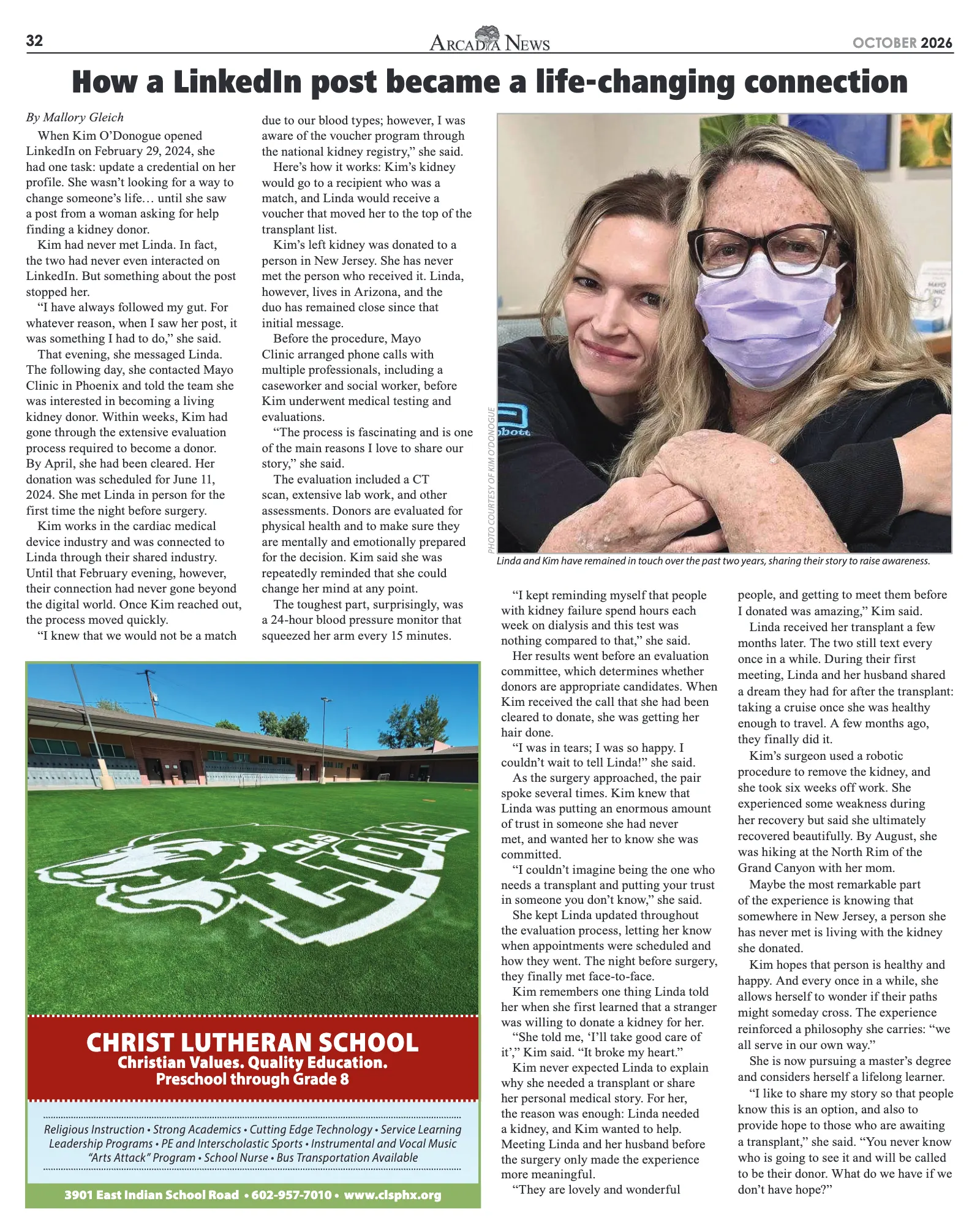
32 OCTOBER 2026 By Mallory Gleich When Kim O’Donogue opened LinkedIn on February 29, 2024, she had one task: update a credential on her profile. She wasn’t looking for a way to change someone’s life… until she saw a post from a woman asking for help finding a kidney donor. Kim had never met Linda. In fact, the two had never even interacted on LinkedIn. But something about the post stopped her. “I have always followed my gut. For whatever reason, when I saw her post, it was something I had to do,” she said. That evening, she messaged Linda. The following day, she contacted Mayo Clinic in Phoenix and told the team she was interested in becoming a living kidney donor. Within weeks, Kim had gone through the extensive evaluation process required to become a donor. By April, she had been cleared. Her donation was scheduled for June 11, 2024. She met Linda in person for the first time the night before surgery. Kim works in the cardiac medical device industry and was connected to Linda through their shared industry. Until that February evening, however, their connection had never gone beyond the digital world. Once Kim reached out, the process moved quickly. “I knew that we would not be a match due to our blood types; however, I was aware of the voucher program through the national kidney registry,” she said. Here’s how it works: Kim’s kidney would go to a recipient who was a match, and Linda would receive a voucher that moved her to the top of the transplant list. Kim’s left kidney was donated to a person in New Jersey. She has never met the person who received it. Linda, however, lives in Arizona, and the duo has remained close since that initial message. Before the procedure, Mayo Clinic arranged phone calls with multiple professionals, including a caseworker and social worker, before Kim underwent medical testing and evaluations. “The process is fascinating and is one of the main reasons I love to share our story,” she said. The evaluation included a CT scan, extensive lab work, and other assessments. Donors are evaluated for physical health and to make sure they are mentally and emotionally prepared for the decision. Kim said she was repeatedly reminded that she could change her mind at any point. The toughest part, surprisingly, was a 24-hour blood pressure monitor that squeezed her arm every 15 minutes. “I kept reminding myself that people with kidney failure spend hours each week on dialysis and this test was nothing compared to that,” she said. Her results went before an evaluation committee, which determines whether donors are appropriate candidates. When Kim received the call that she had been cleared to donate, she was getting her hair done. “I was in tears; I was so happy. I couldn’t wait to tell Linda!” she said. As the surgery approached, the pair spoke several times. Kim knew that Linda was putting an enormous amount of trust in someone she had never met, and wanted her to know she was committed. “I couldn’t imagine being the one who needs a transplant and putting your trust in someone you don’t know,” she said. She kept Linda updated throughout the evaluation process, letting her know when appointments were scheduled and how they went. The night before surgery, they finally met face-to-face. Kim remembers one thing Linda told her when she first learned that a stranger was willing to donate a kidney for her. “She told me, ‘I’ll take good care of it’,” Kim said. “It broke my heart.” Kim never expected Linda to explain why she needed a transplant or share her personal medical story. For her, the reason was enough: Linda needed a kidney, and Kim wanted to help. Meeting Linda and her husband before the surgery only made the experience more meaningful. “They are lovely and wonderful people, and getting to meet them before I donated was amazing,” Kim said. Linda received her transplant a few months later. The two still text every once in a while. During their first meeting, Linda and her husband shared a dream they had for after the transplant: taking a cruise once she was healthy enough to travel. A few months ago, they finally did it. Kim’s surgeon used a robotic procedure to remove the kidney, and she took six weeks off work. She experienced some weakness during her recovery but said she ultimately recovered beautifully. By August, she was hiking at the North Rim of the Grand Canyon with her mom. Maybe the most remarkable part of the experience is knowing that somewhere in New Jersey, a person she has never met is living with the kidney she donated. Kim hopes that person is healthy and happy. And every once in a while, she allows herself to wonder if their paths might someday cross. The experience reinforced a philosophy she carries: “we all serve in our own way.” She is now pursuing a master’s degree and considers herself a lifelong learner. “I like to share my story so that people know this is an option, and also to provide hope to those who are awaiting a transplant,” she said. “You never know who is going to see it and will be called to be their donor. What do we have if we don’t have hope?” How a LinkedIn post became a life-changing connection Linda and Kim have remained in touch over the past two years, sharing their story to raise awareness. PHOTO COURTESY OF KIM O’DONOGUE Religious Instruction • Strong Academics • Cutting Edge Technology • Service Learning Religious Instruction • Strong Academics • Cutting Edge Technology • Service Learning Leadership Programs • PE and Interscholastic Sports • Instrumental and Vocal Music Leadership Programs • PE and Interscholastic Sports • Instrumental and Vocal Music “Arts Attack” Program • School Nurse • Bus Transportation Available “Arts Attack” Program • School Nurse • Bus Transportation Available 3901 East Indian School Road • 602-957-7010 • www.clsphx.org CHRIST LUTHERAN SCHOOL Christian Values. Quality Education. Preschool through Grade 8