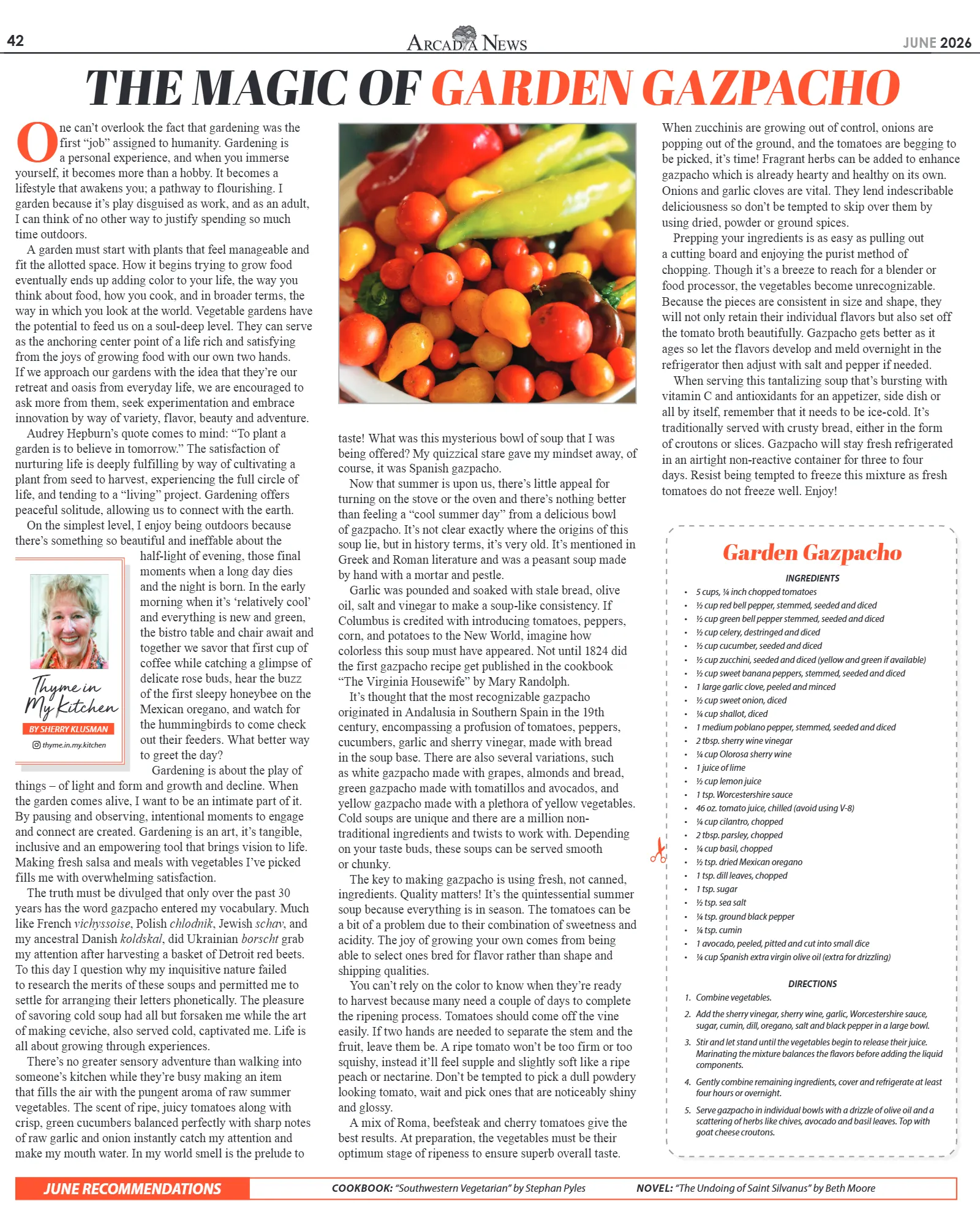

JUNE 2026 42 O ne can’t overlook the fact that gardening was the first “job” assigned to humanity. Gardening is a personal experience, and when you immerse yourself, it becomes more than a hobby. It becomes a lifestyle that awakens you; a pathway to flourishing. I garden because it’s play disguised as work, and as an adult, I can think of no other way to justify spending so much time outdoors. A garden must start with plants that feel manageable and fit the allotted space. How it begins trying to grow food eventually ends up adding color to your life, the way you think about food, how you cook, and in broader terms, the way in which you look at the world. Vegetable gardens have the potential to feed us on a soul-deep level. They can serve as the anchoring center point of a life rich and satisfying from the joys of growing food with our own two hands. If we approach our gardens with the idea that they’re our retreat and oasis from everyday life, we are encouraged to ask more from them, seek experimentation and embrace innovation by way of variety, flavor, beauty and adventure. Audrey Hepburn’s quote comes to mind: “To plant a garden is to believe in tomorrow.” The satisfaction of nurturing life is deeply fulfilling by way of cultivating a plant from seed to harvest, experiencing the full circle of life, and tending to a “living” project. Gardening offers peaceful solitude, allowing us to connect with the earth. On the simplest level, I enjoy being outdoors because there’s something so beautiful and ineffable about the half-light of evening, those final moments when a long day dies and the night is born. In the early morning when it’s ‘relatively cool’ and everything is new and green, the bistro table and chair await and together we savor that first cup of coffee while catching a glimpse of delicate rose buds, hear the buzz of the first sleepy honeybee on the Mexican oregano, and watch for the hummingbirds to come check out their feeders. What better way to greet the day? Gardening is about the play of things – of light and form and growth and decline. When the garden comes alive, I want to be an intimate part of it. By pausing and observing, intentional moments to engage and connect are created. Gardening is an art, it’s tangible, inclusive and an empowering tool that brings vision to life. Making fresh salsa and meals with vegetables I’ve picked fills me with overwhelming satisfaction. The truth must be divulged that only over the past 30 years has the word gazpacho entered my vocabulary. Much like French vichyssoise , Polish chlodnik , Jewish schav , and my ancestral Danish koldskal , did Ukrainian borscht grab my attention after harvesting a basket of Detroit red beets. To this day I question why my inquisitive nature failed to research the merits of these soups and permitted me to settle for arranging their letters phonetically. The pleasure of savoring cold soup had all but forsaken me while the art of making ceviche, also served cold, captivated me. Life is all about growing through experiences. There’s no greater sensory adventure than walking into someone’s kitchen while they’re busy making an item that fills the air with the pungent aroma of raw summer vegetables. The scent of ripe, juicy tomatoes along with crisp, green cucumbers balanced perfectly with sharp notes of raw garlic and onion instantly catch my attention and make my mouth water. In my world smell is the prelude to taste! What was this mysterious bowl of soup that I was being offered? My quizzical stare gave my mindset away, of course, it was Spanish gazpacho. Now that summer is upon us, there’s little appeal for turning on the stove or the oven and there’s nothing better than feeling a “cool summer day” from a delicious bowl of gazpacho. It’s not clear exactly where the origins of this soup lie, but in history terms, it’s very old. It’s mentioned in Greek and Roman literature and was a peasant soup made by hand with a mortar and pestle. Garlic was pounded and soaked with stale bread, olive oil, salt and vinegar to make a soup-like consistency. If Columbus is credited with introducing tomatoes, peppers, corn, and potatoes to the New World, imagine how colorless this soup must have appeared. Not until 1824 did the first gazpacho recipe get published in the cookbook “The Virginia Housewife” by Mary Randolph. It’s thought that the most recognizable gazpacho originated in Andalusia in Southern Spain in the 19th century, encompassing a profusion of tomatoes, peppers, cucumbers, garlic and sherry vinegar, made with bread in the soup base. There are also several variations, such as white gazpacho made with grapes, almonds and bread, green gazpacho made with tomatillos and avocados, and yellow gazpacho made with a plethora of yellow vegetables. Cold soups are unique and there are a million non- traditional ingredients and twists to work with. Depending on your taste buds, these soups can be served smooth or chunky. The key to making gazpacho is using fresh, not canned, ingredients. Quality matters! It’s the quintessential summer soup because everything is in season. The tomatoes can be a bit of a problem due to their combination of sweetness and acidity. The joy of growing your own comes from being able to select ones bred for flavor rather than shape and shipping qualities. You can’t rely on the color to know when they’re ready to harvest because many need a couple of days to complete the ripening process. Tomatoes should come off the vine easily. If two hands are needed to separate the stem and the fruit, leave them be. A ripe tomato won’t be too firm or too squishy, instead it’ll feel supple and slightly soft like a ripe peach or nectarine. Don’t be tempted to pick a dull powdery looking tomato, wait and pick ones that are noticeably shiny and glossy. A mix of Roma, beefsteak and cherry tomatoes give the best results. At preparation, the vegetables must be their optimum stage of ripeness to ensure superb overall taste. When zucchinis are growing out of control, onions are popping out of the ground, and the tomatoes are begging to be picked, it’s time! Fragrant herbs can be added to enhance gazpacho which is already hearty and healthy on its own. Onions and garlic cloves are vital. They lend indescribable deliciousness so don’t be tempted to skip over them by using dried, powder or ground spices. Prepping your ingredients is as easy as pulling out a cutting board and enjoying the purist method of chopping. Though it’s a breeze to reach for a blender or food processor, the vegetables become unrecognizable. Because the pieces are consistent in size and shape, they will not only retain their individual flavors but also set off the tomato broth beautifully. Gazpacho gets better as it ages so let the flavors develop and meld overnight in the refrigerator then adjust with salt and pepper if needed. When serving this tantalizing soup that’s bursting with vitamin C and antioxidants for an appetizer, side dish or all by itself, remember that it needs to be ice-cold. It’s traditionally served with crusty bread, either in the form of croutons or slices. Gazpacho will stay fresh refrigerated in an airtight non-reactive container for three to four days. Resist being tempted to freeze this mixture as fresh tomatoes do not freeze well. Enjoy! Thyme in My Kitchen BY SHERRY KLUSMAN thyme.in.my.kitchen INGREDIENTS • 5 cups, ¼ inch chopped tomatoes • ½ cup red bell pepper, stemmed, seeded and diced • ½ cup green bell pepper stemmed, seeded and diced • ½ cup celery, destringed and diced • ½ cup cucumber, seeded and diced • ½ cup zucchini, seeded and diced (yellow and green if available) • ½ cup sweet banana peppers, stemmed, seeded and diced • 1 large garlic clove, peeled and minced • ½ cup sweet onion, diced • ¼ cup shallot, diced • 1 medium poblano pepper, stemmed, seeded and diced • 2 tbsp. sherry wine vinegar • ¼ cup Olorosa sherry wine • 1 juice of lime • ½ cup lemon juice • 1 tsp. Worcestershire sauce • 46 oz. tomato juice, chilled (avoid using V-8) • ¼ cup cilantro, chopped • 2 tbsp. parsley, chopped • ¼ cup basil, chopped • ½ tsp. dried Mexican oregano • 1 tsp. dill leaves, chopped • 1 tsp. sugar • ½ tsp. sea salt • ¼ tsp. ground black pepper • ¼ tsp. cumin • 1 avocado, peeled, pitted and cut into small dice • ¼ cup Spanish extra virgin olive oil (extra for drizzling) DIRECTIONS 1. Combine vegetables. 2. Add the sherry vinegar, sherry wine, garlic, Worcestershire sauce, sugar, cumin, dill, oregano, salt and black pepper in a large bowl. 3. Stir and let stand until the vegetables begin to release their juice. Marinating the mixture balances the flavors before adding the liquid components. 4. Gently combine remaining ingredients, cover and refrigerate at least four hours or overnight. 5. Serve gazpacho in individual bowls with a drizzle of olive oil and a scattering of herbs like chives, avocado and basil leaves. Top with goat cheese croutons. Garden Gazpacho THE MAGIC OF GARDEN GAZPACHO JUNE RECOMMENDATIONS COOKBOOK: “Southwestern Vegetarian” by Stephan Pyles NOVEL: “The Undoing of Saint Silvanus” by Beth Moore