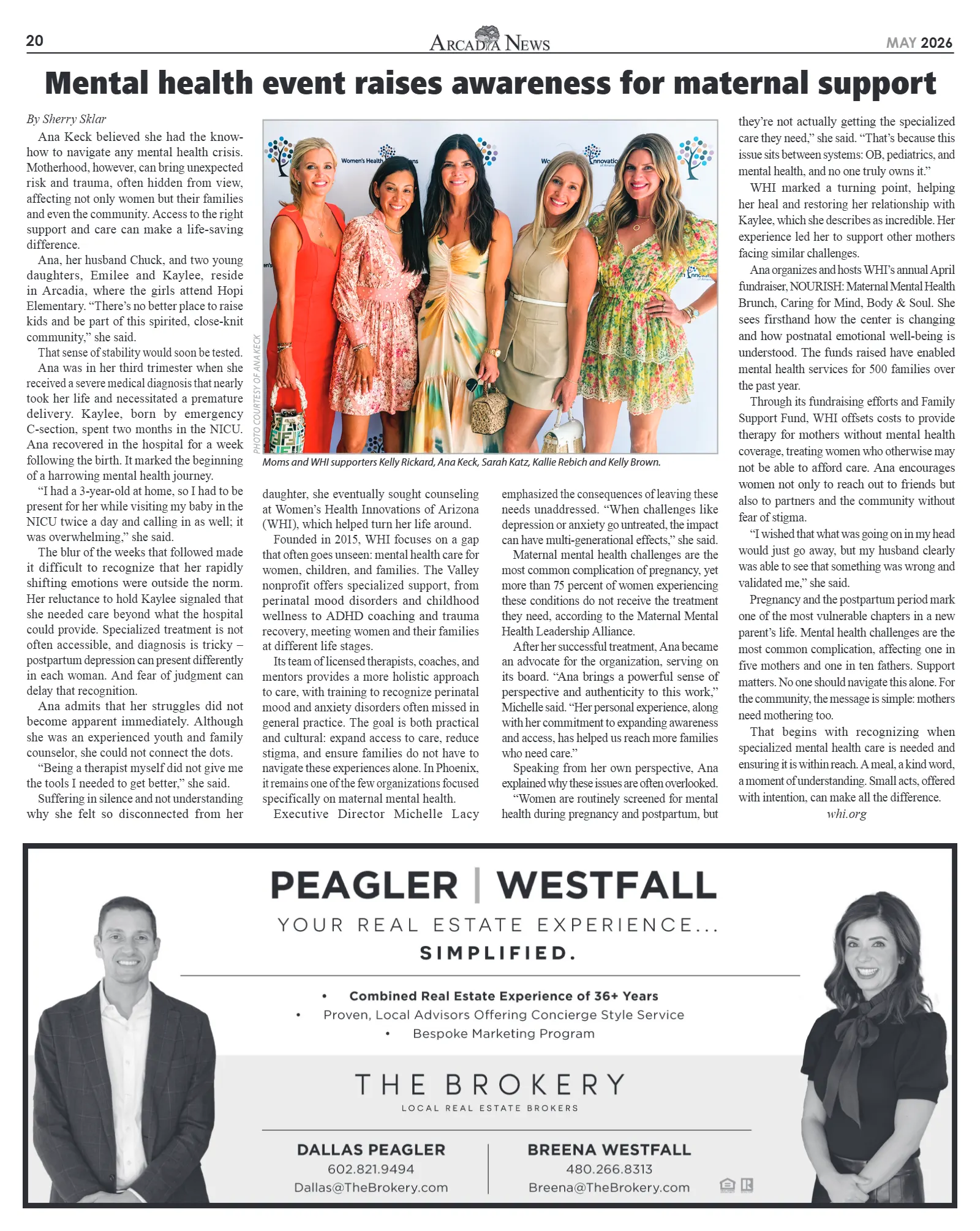

20 MAY 2026 By Sherry Sklar Ana Keck believed she had the know- how to navigate any mental health crisis. Motherhood, however, can bring unexpected risk and trauma, often hidden from view, affecting not only women but their families and even the community. Access to the right support and care can make a life-saving difference. Ana, her husband Chuck, and two young daughters, Emilee and Kaylee, reside in Arcadia, where the girls attend Hopi Elementary. “There’s no better place to raise kids and be part of this spirited, close-knit community,” she said. That sense of stability would soon be tested. Ana was in her third trimester when she received a severe medical diagnosis that nearly took her life and necessitated a premature delivery. Kaylee, born by emergency C-section, spent two months in the NICU. Ana recovered in the hospital for a week following the birth. It marked the beginning of a harrowing mental health journey. “I had a 3-year-old at home, so I had to be present for her while visiting my baby in the NICU twice a day and calling in as well; it was overwhelming,” she said. The blur of the weeks that followed made it difficult to recognize that her rapidly shifting emotions were outside the norm. Her reluctance to hold Kaylee signaled that she needed care beyond what the hospital could provide. Specialized treatment is not often accessible, and diagnosis is tricky – postpartum depression can present differently in each woman. And fear of judgment can delay that recognition. Ana admits that her struggles did not become apparent immediately. Although she was an experienced youth and family counselor, she could not connect the dots. “Being a therapist myself did not give me the tools I needed to get better,” she said. Suffering in silence and not understanding why she felt so disconnected from her daughter, she eventually sought counseling at Women’s Health Innovations of Arizona (WHI), which helped turn her life around. Founded in 2015, WHI focuses on a gap that often goes unseen: mental health care for women, children, and families. The Valley nonprofit offers specialized support, from perinatal mood disorders and childhood wellness to ADHD coaching and trauma recovery, meeting women and their families at different life stages. Its team of licensed therapists, coaches, and mentors provides a more holistic approach to care, with training to recognize perinatal mood and anxiety disorders often missed in general practice. The goal is both practical and cultural: expand access to care, reduce stigma, and ensure families do not have to navigate these experiences alone. In Phoenix, it remains one of the few organizations focused specifically on maternal mental health. Executive Director Michelle Lacy emphasized the consequences of leaving these needs unaddressed. “When challenges like depression or anxiety go untreated, the impact can have multi-generational effects,” she said. Maternal mental health challenges are the most common complication of pregnancy, yet more than 75 percent of women experiencing these conditions do not receive the treatment they need, according to the Maternal Mental Health Leadership Alliance. After her successful treatment, Ana became an advocate for the organization, serving on its board. “Ana brings a powerful sense of perspective and authenticity to this work,” Michelle said. “Her personal experience, along with her commitment to expanding awareness and access, has helped us reach more families who need care.” Speaking from her own perspective, Ana explained why these issues are often overlooked. “Women are routinely screened for mental health during pregnancy and postpartum, but they’re not actually getting the specialized care they need,” she said. “That’s because this issue sits between systems: OB, pediatrics, and mental health, and no one truly owns it.” WHI marked a turning point, helping her heal and restoring her relationship with Kaylee, which she describes as incredible. Her experience led her to support other mothers facing similar challenges. Ana organizes and hosts WHI’s annual April fundraiser, NOURISH: Maternal Mental Health Brunch, Caring for Mind, Body & Soul. She sees firsthand how the center is changing and how postnatal emotional well-being is understood. The funds raised have enabled mental health services for 500 families over the past year. Through its fundraising efforts and Family Support Fund, WHI offsets costs to provide therapy for mothers without mental health coverage, treating women who otherwise may not be able to afford care. Ana encourages women not only to reach out to friends but also to partners and the community without fear of stigma. “I wished that what was going on in my head would just go away, but my husband clearly was able to see that something was wrong and validated me,” she said. Pregnancy and the postpartum period mark one of the most vulnerable chapters in a new parent’s life. Mental health challenges are the most common complication, affecting one in five mothers and one in ten fathers. Support matters. No one should navigate this alone. For the community, the message is simple: mothers need mothering too. That begins with recognizing when specialized mental health care is needed and ensuring it is within reach. A meal, a kind word, a moment of understanding. Small acts, offered with intention, can make all the difference. whi.org Mental health event raises awareness for maternal support Moms and WHI supporters Kelly Rickard, Ana Keck, Sarah Katz, Kallie Rebich and Kelly Brown. PHOTO COURTESY OF ANA KECK