
ArcAdiA News SUMMER ’26
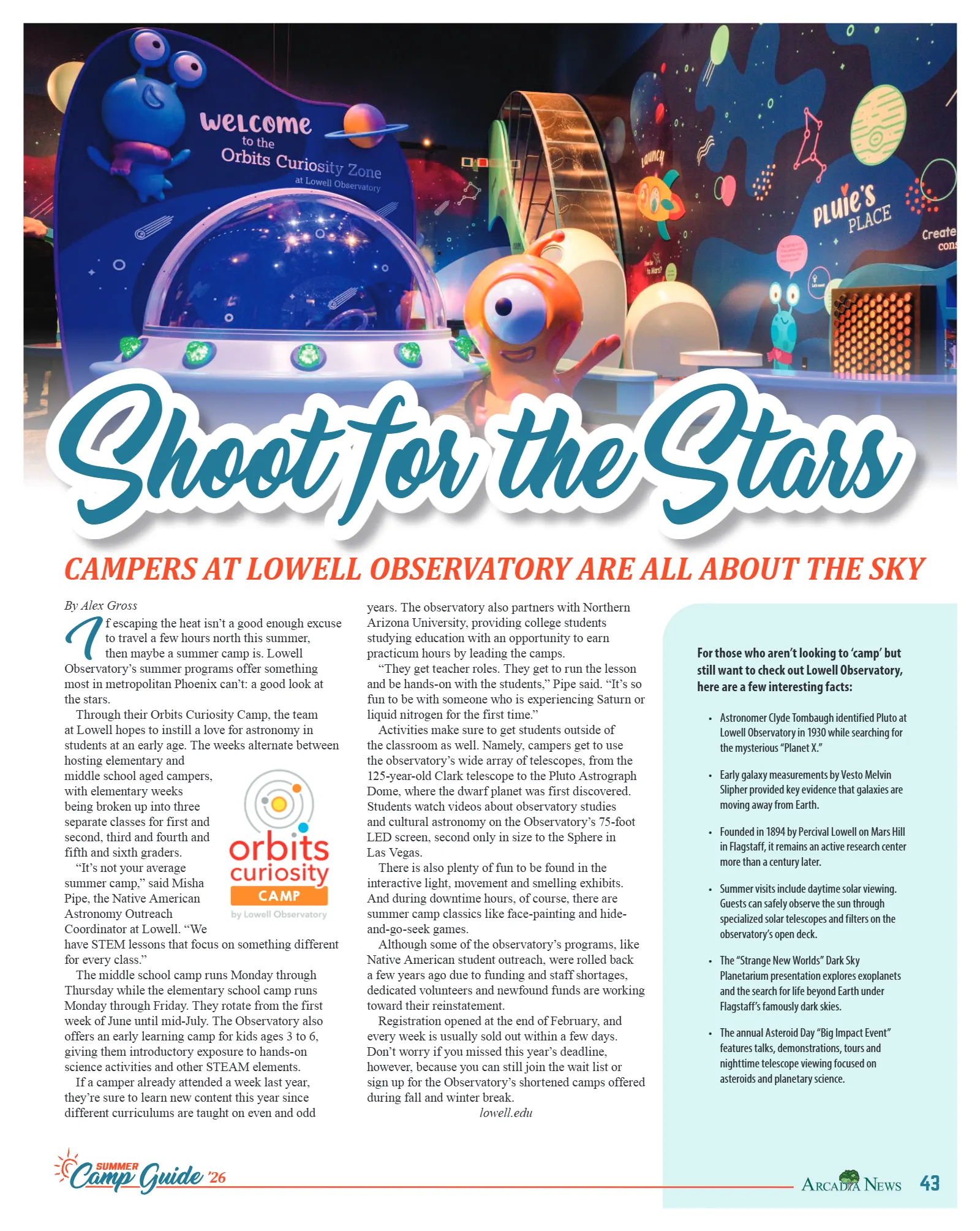
By Alex Gross I f escaping the heat isn’t a good enough excuse to travel a few hours north this summer, then maybe a summer camp is. Lowell Observatory’s summer programs offer something most in metropolitan Phoenix can’t: a good look at the stars. Through their Orbits Curiosity Camp, the team at Lowell hopes to instill a love for astronomy in students at an early age. The weeks alternate between hosting elementary and middle school aged campers, with elementary weeks being broken up into three separate classes for first and second, third and fourth and fifth and sixth graders. “It’s not your average summer camp,” said Misha Pipe, the Native American Astronomy Outreach Coordinator at Lowell. “We have STEM lessons that focus on something different for every class.” The middle school camp runs Monday through Thursday while the elementary school camp runs Monday through Friday. They rotate from the first week of June until mid-July. The Observatory also offers an early learning camp for kids ages 3 to 6, giving them introductory exposure to hands-on science activities and other STEAM elements. If a camper already attended a week last year, they’re sure to learn new content this year since different curriculums are taught on even and odd years. The observatory also partners with Northern Arizona University, providing college students studying education with an opportunity to earn practicum hours by leading the camps. “They get teacher roles. They get to run the lesson and be hands-on with the students,” Pipe said. “It’s so fun to be with someone who is experiencing Saturn or liquid nitrogen for the first time.” Activities make sure to get students outside of the classroom as well. Namely, campers get to use the observatory’s wide array of telescopes, from the 125-year-old Clark telescope to the Pluto Astrograph Dome, where the dwarf planet was first discovered. Students watch videos about observatory studies and cultural astronomy on the Observatory’s 75-foot LED screen, second only in size to the Sphere in Las Vegas. There is also plenty of fun to be found in the interactive light, movement and smelling exhibits. And during downtime hours, of course, there are summer camp classics like face-painting and hide- and-go-seek games. Although some of the observatory’s programs, like Native American student outreach, were rolled back a few years ago due to funding and staff shortages, dedicated volunteers and newfound funds are working toward their reinstatement. Registration opened at the end of February, and every week is usually sold out within a few days. Don’t worry if you missed this year’s deadline, however, because you can still join the wait list or sign up for the Observatory’s shortened camps offered during fall and winter break. lowell.edu CAMPERS AT LOWELL OBSERVATORY ARE ALL ABOUT THE SKY Shoot for the Stars Shoot for the Stars For those who aren’t looking to ‘camp’ but still want to check out Lowell Observatory, here are a few interesting facts: • Astronomer Clyde Tombaugh identified Pluto at Lowell Observatory in 1930 while searching for the mysterious “Planet X.” • Early galaxy measurements by Vesto Melvin Slipher provided key evidence that galaxies are moving away from Earth. • Founded in 1894 by Percival Lowell on Mars Hill in Flagstaff, it remains an active research center more than a century later. • Summer visits include daytime solar viewing. Guests can safely observe the sun through specialized solar telescopes and filters on the observatory’s open deck. • The “Strange New Worlds” Dark Sky Planetarium presentation explores exoplanets and the search for life beyond Earth under Flagstaff’s famously dark skies. • The annual Asteroid Day “Big Impact Event” features talks, demonstrations, tours and nighttime telescope viewing focused on asteroids and planetary science. 43 SUMMER ’26