
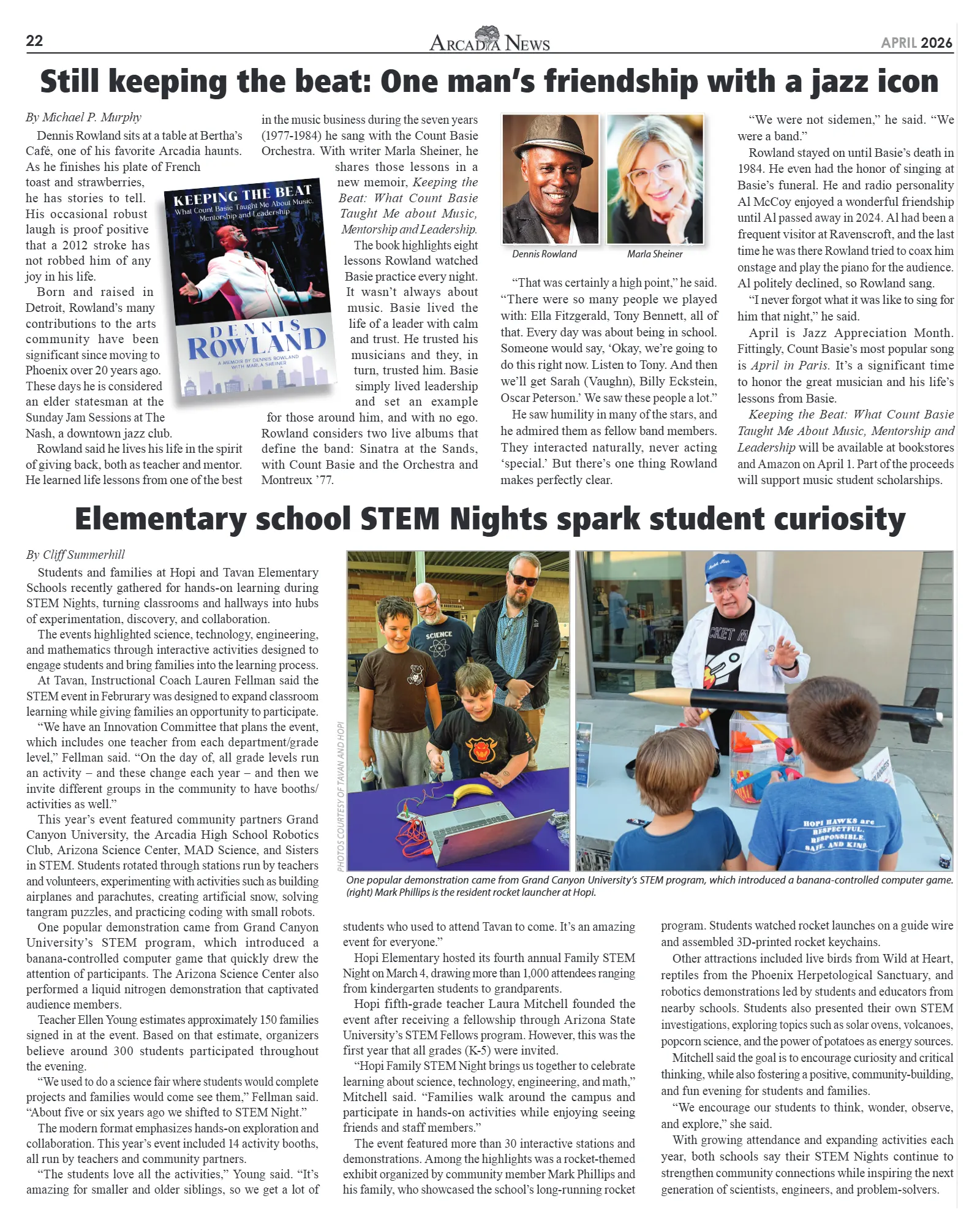

22 APRIL 2026 By Michael P. Murphy Dennis Rowland sits at a table at Bertha’s Café, one of his favorite Arcadia haunts. As he finishes his plate of French toast and strawberries, he has stories to tell. His occasional robust laugh is proof positive that a 2012 stroke has not robbed him of any joy in his life. Born and raised in Detroit, Rowland’s many contributions to the arts community have been significant since moving to Phoenix over 20 years ago. These days he is considered an elder statesman at the Sunday Jam Sessions at The Nash, a downtown jazz club. Rowland said he lives his life in the spirit of giving back, both as teacher and mentor. He learned life lessons from one of the best in the music business during the seven years (1977-1984) he sang with the Count Basie Orchestra. With writer Marla Sheiner, he shares those lessons in a new memoir, Keeping the Beat: What Count Basie Taught Me about Music, Mentorship and Leadership. The book highlights eight lessons Rowland watched Basie practice every night. It wasn’t always about music. Basie lived the life of a leader with calm and trust. He trusted his musicians and they, in turn, trusted him. Basie simply lived leadership and set an example for those around him, and with no ego. Rowland considers two live albums that define the band: Sinatra at the Sands, with Count Basie and the Orchestra and Montreux ’77. “That was certainly a high point,” he said. “There were so many people we played with: Ella Fitzgerald, Tony Bennett, all of that. Every day was about being in school. Someone would say, ‘Okay, we’re going to do this right now. Listen to Tony. And then we’ll get Sarah (Vaughn), Billy Eckstein, Oscar Peterson.’ We saw these people a lot.” He saw humility in many of the stars, and he admired them as fellow band members. They interacted naturally, never acting ‘special.’ But there’s one thing Rowland makes perfectly clear. “We were not sidemen,” he said. “We were a band.” Rowland stayed on until Basie’s death in 1984. He even had the honor of singing at Basie’s funeral. He and radio personality Al McCoy enjoyed a wonderful friendship until Al passed away in 2024. Al had been a frequent visitor at Ravenscroft, and the last time he was there Rowland tried to coax him onstage and play the piano for the audience. Al politely declined, so Rowland sang. “I never forgot what it was like to sing for him that night,” he said. April is Jazz Appreciation Month. Fittingly, Count Basie’s most popular song is April in Paris. It’s a significant time to honor the great musician and his life’s lessons from Basie. Keeping the Beat: What Count Basie Taught Me About Music, Mentorship and Leadership will be available at bookstores and Amazon on April 1. Part of the proceeds will support music student scholarships. Still keeping the beat: One man’s friendship with a jazz icon By Cliff Summerhill Students and families at Hopi and Tavan Elementary Schools recently gathered for hands-on learning during STEM Nights, turning classrooms and hallways into hubs of experimentation, discovery, and collaboration. The events highlighted science, technology, engineering, and mathematics through interactive activities designed to engage students and bring families into the learning process. At Tavan, Instructional Coach Lauren Fellman said the STEM event in Februrary was designed to expand classroom learning while giving families an opportunity to participate. “We have an Innovation Committee that plans the event, which includes one teacher from each department/grade level,” Fellman said. “On the day of, all grade levels run an activity – and these change each year – and then we invite different groups in the community to have booths/ activities as well.” This year’s event featured community partners Grand Canyon University, the Arcadia High School Robotics Club, Arizona Science Center, MAD Science, and Sisters in STEM. Students rotated through stations run by teachers and volunteers, experimenting with activities such as building airplanes and parachutes, creating artificial snow, solving tangram puzzles, and practicing coding with small robots. One popular demonstration came from Grand Canyon University’s STEM program, which introduced a banana-controlled computer game that quickly drew the attention of participants. The Arizona Science Center also performed a liquid nitrogen demonstration that captivated audience members. Teacher Ellen Young estimates approximately 150 families signed in at the event. Based on that estimate, organizers believe around 300 students participated throughout the evening. “We used to do a science fair where students would complete projects and families would come see them,” Fellman said. “About five or six years ago we shifted to STEM Night.” The modern format emphasizes hands-on exploration and collaboration. This year’s event included 14 activity booths, all run by teachers and community partners. “The students love all the activities,” Young said. “It’s amazing for smaller and older siblings, so we get a lot of students who used to attend Tavan to come. It’s an amazing event for everyone.” Hopi Elementary hosted its fourth annual Family STEM Night on March 4, drawing more than 1,000 attendees ranging from kindergarten students to grandparents. Hopi fifth-grade teacher Laura Mitchell founded the event after receiving a fellowship through Arizona State University’s STEM Fellows program. However, this was the first year that all grades (K-5) were invited. “Hopi Family STEM Night brings us together to celebrate learning about science, technology, engineering, and math,” Mitchell said. “Families walk around the campus and participate in hands-on activities while enjoying seeing friends and staff members.” The event featured more than 30 interactive stations and demonstrations. Among the highlights was a rocket-themed exhibit organized by community member Mark Phillips and his family, who showcased the school’s long-running rocket program. Students watched rocket launches on a guide wire and assembled 3D-printed rocket keychains. Other attractions included live birds from Wild at Heart, reptiles from the Phoenix Herpetological Sanctuary, and robotics demonstrations led by students and educators from nearby schools. Students also presented their own STEM investigations, exploring topics such as solar ovens, volcanoes, popcorn science, and the power of potatoes as energy sources. Mitchell said the goal is to encourage curiosity and critical thinking, while also fostering a positive, community-building, and fun evening for students and families. “We encourage our students to think, wonder, observe, and explore,” she said. With growing attendance and expanding activities each year, both schools say their STEM Nights continue to strengthen community connections while inspiring the next generation of scientists, engineers, and problem-solvers. Elementary school STEM Nights spark student curiosity Dennis Rowland Marla Sheiner One popular demonstration came from Grand Canyon University’s STEM program, which introduced a banana-controlled computer game. (right) Mark Phillips is the resident rocket launcher at Hopi. PHOTOS COURTESY OF TAVAN AND HOPI
23 APRIL 2026