
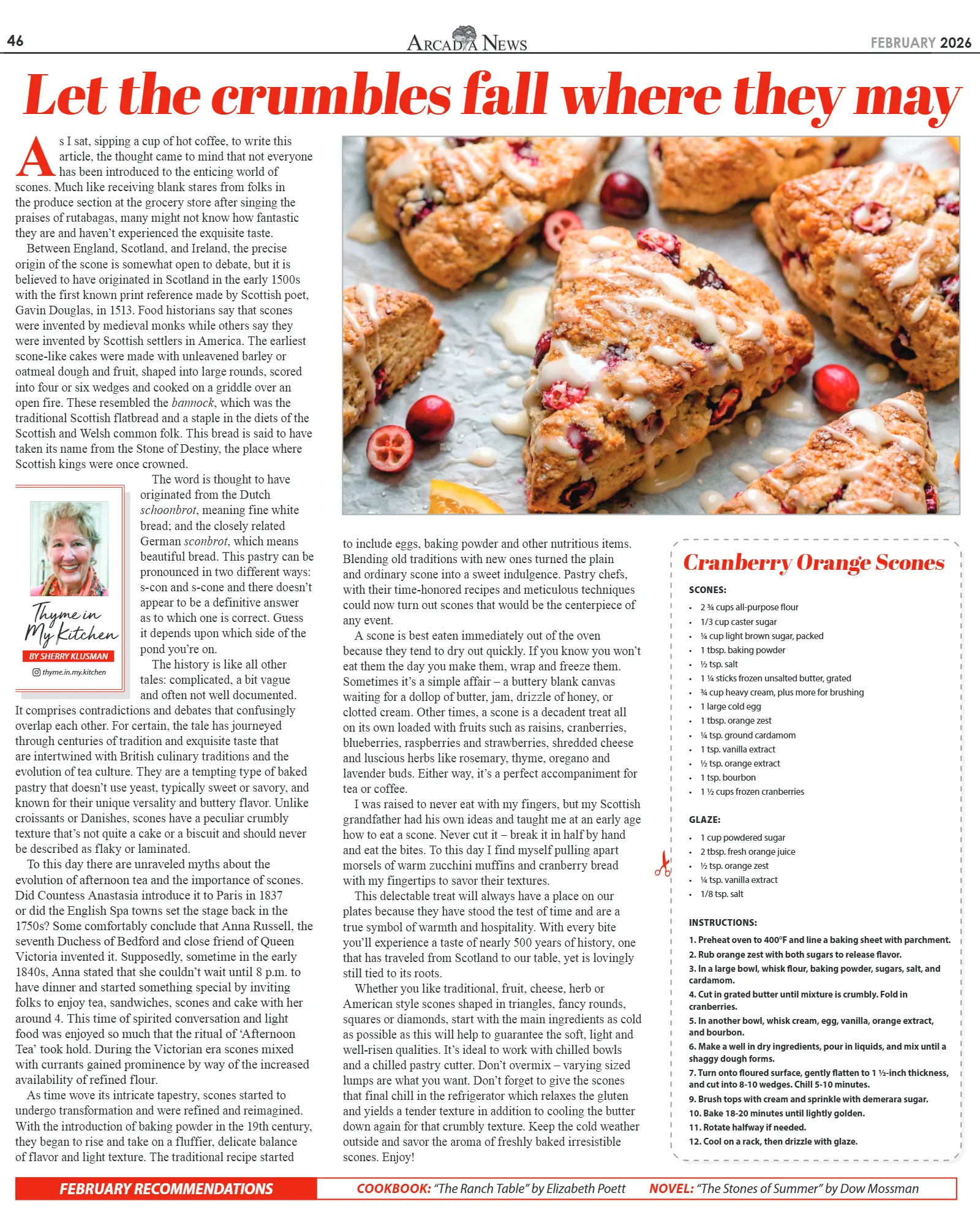

FEBRUARY 2026 46 A s I sat, sipping a cup of hot coffee, to write this article, the thought came to mind that not everyone has been introduced to the enticing world of scones. Much like receiving blank stares from folks in the produce section at the grocery store after singing the praises of rutabagas, many might not know how fantastic they are and haven’t experienced the exquisite taste. Between England, Scotland, and Ireland, the precise origin of the scone is somewhat open to debate, but it is believed to have originated in Scotland in the early 1500s with the first known print reference made by Scottish poet, Gavin Douglas, in 1513. Food historians say that scones were invented by medieval monks while others say they were invented by Scottish settlers in America. The earliest scone-like cakes were made with unleavened barley or oatmeal dough and fruit, shaped into large rounds, scored into four or six wedges and cooked on a griddle over an open fire. These resembled the bannock , which was the traditional Scottish flatbread and a staple in the diets of the Scottish and Welsh common folk. This bread is said to have taken its name from the Stone of Destiny, the place where Scottish kings were once crowned. The word is thought to have originated from the Dutch schoonbrot , meaning fine white bread; and the closely related German sconbrot , which means beautiful bread. This pastry can be pronounced in two different ways: s-con and s-cone and there doesn’t appear to be a definitive answer as to which one is correct. Guess it depends upon which side of the pond you’re on. The history is like all other tales: complicated, a bit vague and often not well documented. It comprises contradictions and debates that confusingly overlap each other. For certain, the tale has journeyed through centuries of tradition and exquisite taste that are intertwined with British culinary traditions and the evolution of tea culture. They are a tempting type of baked pastry that doesn’t use yeast, typically sweet or savory, and known for their unique versality and buttery flavor. Unlike croissants or Danishes, scones have a peculiar crumbly texture that’s not quite a cake or a biscuit and should never be described as flaky or laminated. To this day there are unraveled myths about the evolution of afternoon tea and the importance of scones. Did Countess Anastasia introduce it to Paris in 1837 or did the English Spa towns set the stage back in the 1750s? Some comfortably conclude that Anna Russell, the seventh Duchess of Bedford and close friend of Queen Victoria invented it. Supposedly, sometime in the early 1840s, Anna stated that she couldn’t wait until 8 p.m. to have dinner and started something special by inviting folks to enjoy tea, sandwiches, scones and cake with her around 4. This time of spirited conversation and light food was enjoyed so much that the ritual of ‘Afternoon Tea’ took hold. During the Victorian era scones mixed with currants gained prominence by way of the increased availability of refined flour. As time wove its intricate tapestry, scones started to undergo transformation and were refined and reimagined. With the introduction of baking powder in the 19th century, they began to rise and take on a fluffier, delicate balance of flavor and light texture. The traditional recipe started to include eggs, baking powder and other nutritious items. Blending old traditions with new ones turned the plain and ordinary scone into a sweet indulgence. Pastry chefs, with their time-honored recipes and meticulous techniques could now turn out scones that would be the centerpiece of any event. A scone is best eaten immediately out of the oven because they tend to dry out quickly. If you know you won’t eat them the day you make them, wrap and freeze them. Sometimes it’s a simple affair – a buttery blank canvas waiting for a dollop of butter, jam, drizzle of honey, or clotted cream. Other times, a scone is a decadent treat all on its own loaded with fruits such as raisins, cranberries, blueberries, raspberries and strawberries, shredded cheese and luscious herbs like rosemary, thyme, oregano and lavender buds. Either way, it’s a perfect accompaniment for tea or coffee. I was raised to never eat with my fingers, but my Scottish grandfather had his own ideas and taught me at an early age how to eat a scone. Never cut it – break it in half by hand and eat the bites. To this day I find myself pulling apart morsels of warm zucchini muffins and cranberry bread with my fingertips to savor their textures. This delectable treat will always have a place on our plates because they have stood the test of time and are a true symbol of warmth and hospitality. With every bite you’ll experience a taste of nearly 500 years of history, one that has traveled from Scotland to our table, yet is lovingly still tied to its roots. Whether you like traditional, fruit, cheese, herb or American style scones shaped in triangles, fancy rounds, squares or diamonds, start with the main ingredients as cold as possible as this will help to guarantee the soft, light and well-risen qualities. It’s ideal to work with chilled bowls and a chilled pastry cutter. Don’t overmix – varying sized lumps are what you want. Don’t forget to give the scones that final chill in the refrigerator which relaxes the gluten and yields a tender texture in addition to cooling the butter down again for that crumbly texture. Keep the cold weather outside and savor the aroma of freshly baked irresistible scones. Enjoy! Thyme in My Kitchen BY SHERRY KLUSMAN thyme.in.my.kitchen SCONES: • 2 ¾ cups all-purpose flour • 1/3 cup caster sugar • ¼ cup light brown sugar, packed • 1 tbsp. baking powder • ½ tsp. salt • 1 ¼ sticks frozen unsalted butter, grated • ¾ cup heavy cream, plus more for brushing • 1 large cold egg • 1 tbsp. orange zest • ¼ tsp. ground cardamom • 1 tsp. vanilla extract • ½ tsp. orange extract • 1 tsp. bourbon • 1 ½ cups frozen cranberries GLAZE: • 1 cup powdered sugar • 2 tbsp. fresh orange juice • ½ tsp. orange zest • ¼ tsp. vanilla extract • 1/8 tsp. salt INSTRUCTIONS: 1. Preheat oven to 400°F and line a baking sheet with parchment. 2. Rub orange zest with both sugars to release flavor. 3. In a large bowl, whisk flour, baking powder, sugars, salt, and cardamom. 4. Cut in grated butter until mixture is crumbly. Fold in cranberries. 5. In another bowl, whisk cream, egg, vanilla, orange extract, and bourbon. 6. Make a well in dry ingredients, pour in liquids, and mix until a shaggy dough forms. 7. Turn onto floured surface, gently flatten to 1 ½-inch thickness, and cut into 8-10 wedges. Chill 5-10 minutes. 9. Brush tops with cream and sprinkle with demerara sugar. 10. Bake 18-20 minutes until lightly golden. 11. Rotate halfway if needed. 12. Cool on a rack, then drizzle with glaze. Cranberry Orange Scones Let the crumbles fall where they may FEBRUARY RECOMMENDATIONS COOKBOOK: “The Ranch Table” by Elizabeth Poett NOVEL: “The Stones of Summer” by Dow Mossman
WHY ADVERTISE IN ARCADIA NEWS There is no better way to reach Arcadia and the surrounding area. For a detailed information kit about us and our market, go to arcadianews.com/advertise or send your email address to ads@arcadianews.com. copies per month. 14,000 mailed; 5,000 in strategically-placed racks. We are the only publication that covers the highly-desired communities of Arcadia, Biltmore and Camelback Corridor. regularly purchase products or services from ads seen in the Arcadia News .* 19,000 75% DIRECT MAIL AFFLUENT READERSHIP READERS READY TO BUY *Source: 2023-2024 CVC Publication Report Audit AWARD WINNING NEIGHBORHOOD NEWS SINCE 1993 602.840.6379 | arcadianews.com