
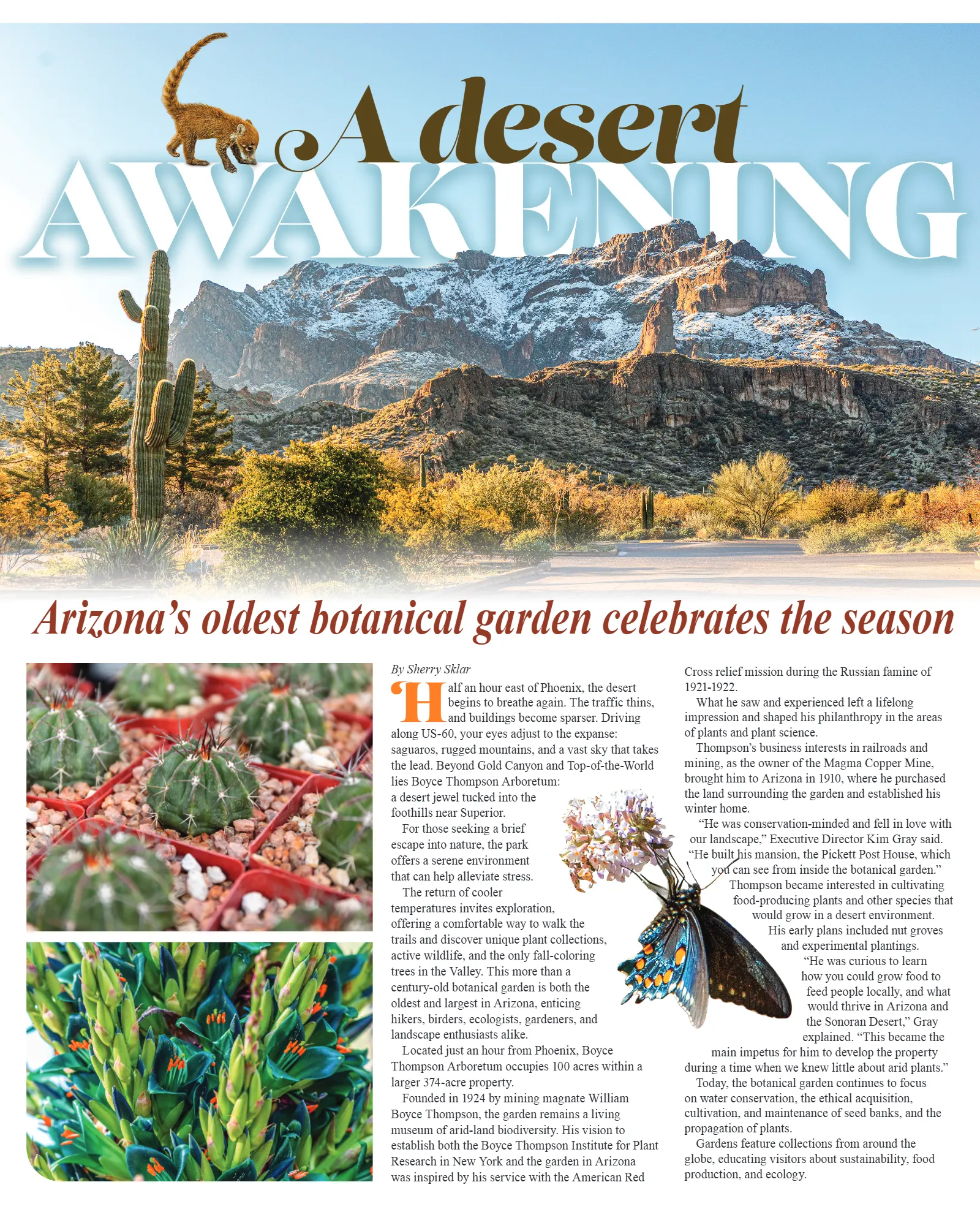
By Sherry Sklar alf an hour east of Phoenix, the desert begins to breathe again. The traffic thins, and buildings become sparser. Driving along US-60, your eyes adjust to the expanse: saguaros, rugged mountains, and a vast sky that takes the lead. Beyond Gold Canyon and Top-of-the-World lies Boyce Thompson Arboretum: a desert jewel tucked into the foothills near Superior. For those seeking a brief escape into nature, the park offers a serene environment that can help alleviate stress. The return of cooler temperatures invites exploration, offering a comfortable way to walk the trails and discover unique plant collections, active wildlife, and the only fall-coloring trees in the Valley. This more than a century-old botanical garden is both the oldest and largest in Arizona, enticing hikers, birders, ecologists, gardeners, and landscape enthusiasts alike. Located just an hour from Phoenix, Boyce Thompson Arboretum occupies 100 acres within a larger 374-acre property. Founded in 1924 by mining magnate William Boyce Thompson, the garden remains a living museum of arid-land biodiversity. His vision to establish both the Boyce Thompson Institute for Plant Research in New York and the garden in Arizona was inspired by his service with the American Red Cross relief mission during the Russian famine of 1921-1922. What he saw and experienced left a lifelong impression and shaped his philanthropy in the areas of plants and plant science. Thompson’s business interests in railroads and mining, as the owner of the Magma Copper Mine, brought him to Arizona in 1910, where he purchased the land surrounding the garden and established his winter home. “He was conservation-minded and fell in love with our landscape,” Executive Director Kim Gray said. “He built his mansion, the Pickett Post House, which you can see from inside the botanical garden.” Thompson became interested in cultivating food-producing plants and other species that would grow in a desert environment. His early plans included nut groves and experimental plantings. “He was curious to learn how you could grow food to feed people locally, and what would thrive in Arizona and the Sonoran Desert,” Gray explained. “This became the main impetus for him to develop the property during a time when we knew little about arid plants.” Today, the botanical garden continues to focus on water conservation, the ethical acquisition, cultivation, and maintenance of seed banks, and the propagation of plants. Gardens feature collections from around the globe, educating visitors about sustainability, food production, and ecology. A desert Arizona’s oldest botanical garden celebrates the season
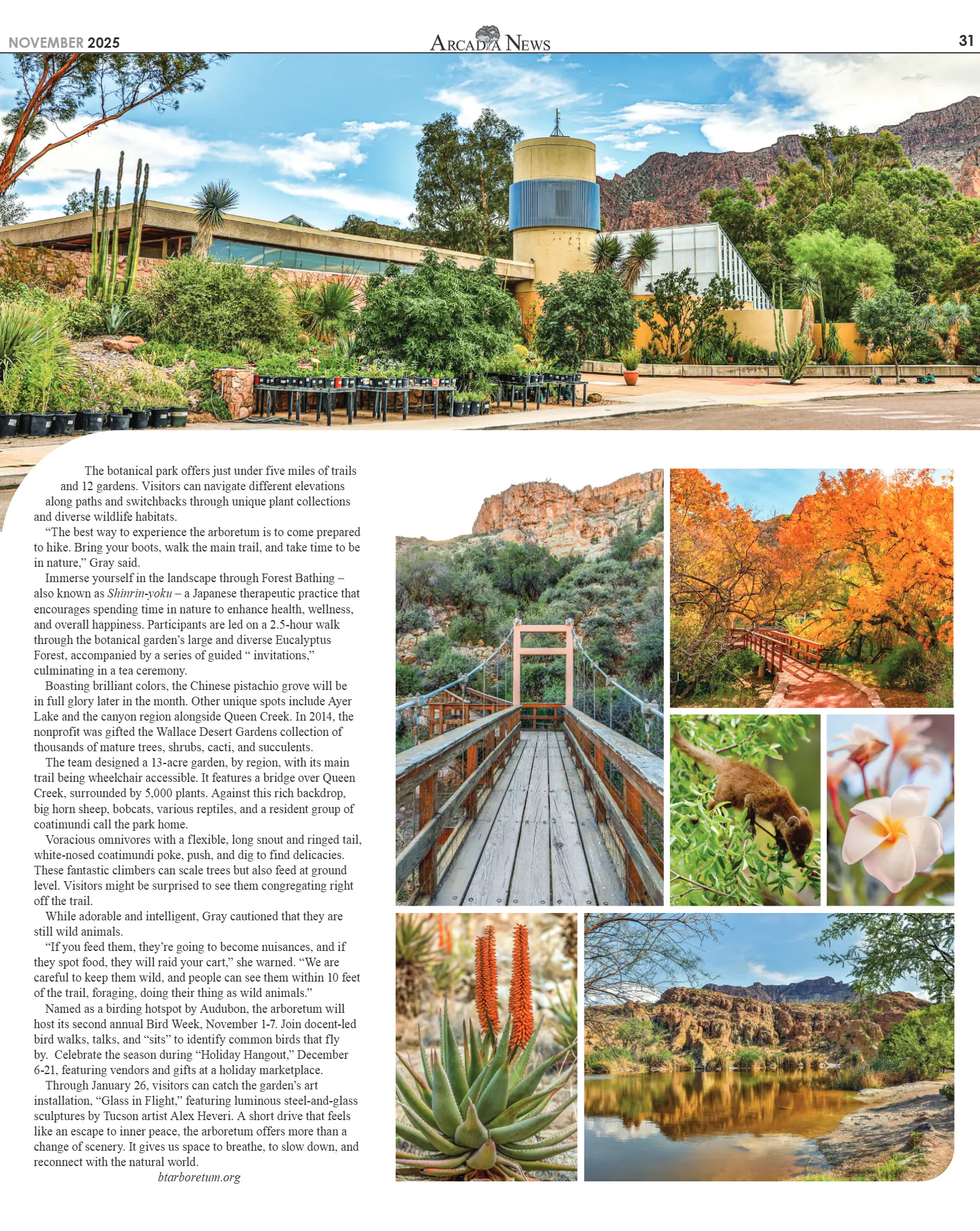
31 NOVEMBER 2025 The botanical park offers just under five miles of trails and 12 gardens. Visitors can navigate different elevations along paths and switchbacks through unique plant collections and diverse wildlife habitats. “The best way to experience the arboretum is to come prepared to hike. Bring your boots, walk the main trail, and take time to be in nature,” Gray said. Immerse yourself in the landscape through Forest Bathing – also known as Shinrin-yoku – a Japanese therapeutic practice that encourages spending time in nature to enhance health, wellness, and overall happiness. Participants are led on a 2.5-hour walk through the botanical garden’s large and diverse Eucalyptus Forest, accompanied by a series of guided “ invitations,” culminating in a tea ceremony. Boasting brilliant colors, the Chinese pistachio grove will be in full glory later in the month. Other unique spots include Ayer Lake and the canyon region alongside Queen Creek. In 2014, the nonprofit was gifted the Wallace Desert Gardens collection of thousands of mature trees, shrubs, cacti, and succulents. The team designed a 13-acre garden, by region, with its main trail being wheelchair accessible. It features a bridge over Queen Creek, surrounded by 5,000 plants. Against this rich backdrop, big horn sheep, bobcats, various reptiles, and a resident group of coatimundi call the park home. Voracious omnivores with a flexible, long snout and ringed tail, white-nosed coatimundi poke, push, and dig to find delicacies. These fantastic climbers can scale trees but also feed at ground level. Visitors might be surprised to see them congregating right off the trail. While adorable and intelligent, Gray cautioned that they are still wild animals. “If you feed them, they’re going to become nuisances, and if they spot food, they will raid your cart,” she warned. “We are careful to keep them wild, and people can see them within 10 feet of the trail, foraging, doing their thing as wild animals.” Named as a birding hotspot by Audubon, the arboretum will host its second annual Bird Week, November 1-7. Join docent-led bird walks, talks, and “sits” to identify common birds that fly by. Celebrate the season during “Holiday Hangout,” December 6-21, featuring vendors and gifts at a holiday marketplace. Through January 26, visitors can catch the garden’s art installation, “Glass in Flight,” featuring luminous steel-and-glass sculptures by Tucson artist Alex Heveri. A short drive that feels like an escape to inner peace, the arboretum offers more than a change of scenery. It gives us space to breathe, to slow down, and reconnect with the natural world. btarboretum.org