
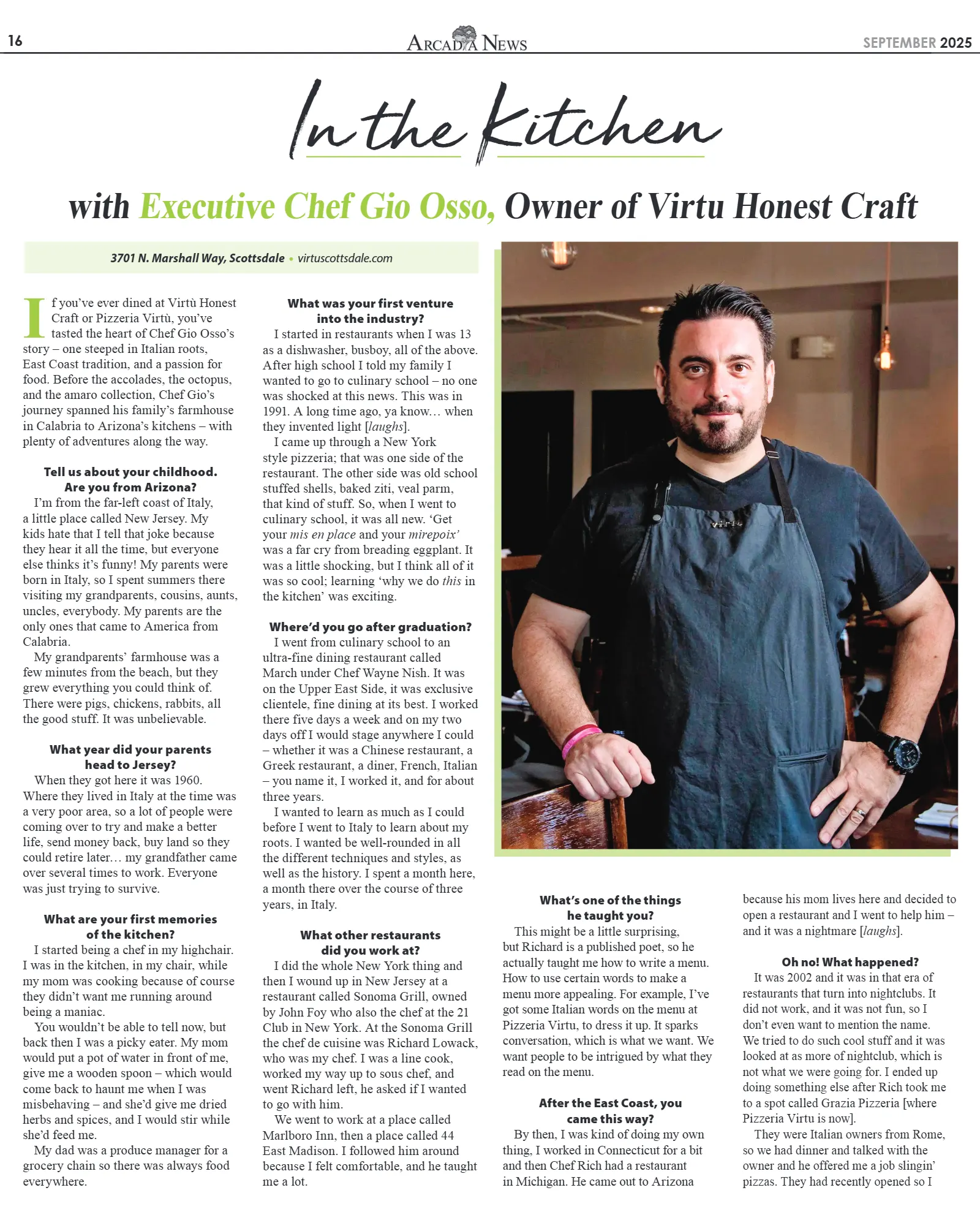
SEPTEMBER 2025 16 with Executive Chef Gio Osso, Owner of Virtu Honest Craft 3701 N. Marshall Way, Scottsdale • virtuscottsdale.com In the Kitchen I f you’ve ever dined at Virtù Honest Craft or Pizzeria Virtù, you’ve tasted the heart of Chef Gio Osso’s story – one steeped in Italian roots, East Coast tradition, and a passion for food. Before the accolades, the octopus, and the amaro collection, Chef Gio’s journey spanned his family’s farmhouse in Calabria to Arizona’s kitchens – with plenty of adventures along the way. Tell us about your childhood. Are you from Arizona? I’m from the far-left coast of Italy, a little place called New Jersey. My kids hate that I tell that joke because they hear it all the time, but everyone else thinks it’s funny! My parents were born in Italy, so I spent summers there visiting my grandparents, cousins, aunts, uncles, everybody. My parents are the only ones that came to America from Calabria. My grandparents’ farmhouse was a few minutes from the beach, but they grew everything you could think of. There were pigs, chickens, rabbits, all the good stuff. It was unbelievable. What year did your parents head to Jersey? When they got here it was 1960. Where they lived in Italy at the time was a very poor area, so a lot of people were coming over to try and make a better life, send money back, buy land so they could retire later… my grandfather came over several times to work. Everyone was just trying to survive. What are your first memories of the kitchen? I started being a chef in my highchair. I was in the kitchen, in my chair, while my mom was cooking because of course they didn’t want me running around being a maniac. You wouldn’t be able to tell now, but back then I was a picky eater. My mom would put a pot of water in front of me, give me a wooden spoon – which would come back to haunt me when I was misbehaving – and she’d give me dried herbs and spices, and I would stir while she’d feed me. My dad was a produce manager for a grocery chain so there was always food everywhere. What was your first venture into the industry? I started in restaurants when I was 13 as a dishwasher, busboy, all of the above. After high school I told my family I wanted to go to culinary school – no one was shocked at this news. This was in 1991. A long time ago, ya know… when they invented light [ laughs ]. I came up through a New York style pizzeria; that was one side of the restaurant. The other side was old school stuffed shells, baked ziti, veal parm, that kind of stuff. So, when I went to culinary school, it was all new. ‘Get your mis en place and your mirepoix’ was a far cry from breading eggplant. It was a little shocking, but I think all of it was so cool; learning ‘why we do this in the kitchen’ was exciting. Where’d you go after graduation? I went from culinary school to an ultra-fine dining restaurant called March under Chef Wayne Nish. It was on the Upper East Side, it was exclusive clientele, fine dining at its best. I worked there five days a week and on my two days off I would stage anywhere I could – whether it was a Chinese restaurant, a Greek restaurant, a diner, French, Italian – you name it, I worked it, and for about three years. I wanted to learn as much as I could before I went to Italy to learn about my roots. I wanted be well-rounded in all the different techniques and styles, as well as the history. I spent a month here, a month there over the course of three years, in Italy. What other restaurants did you work at? I did the whole New York thing and then I wound up in New Jersey at a restaurant called Sonoma Grill, owned by John Foy who also the chef at the 21 Club in New York. At the Sonoma Grill the chef de cuisine was Richard Lowack, who was my chef. I was a line cook, worked my way up to sous chef, and went Richard left, he asked if I wanted to go with him. We went to work at a place called Marlboro Inn, then a place called 44 East Madison. I followed him around because I felt comfortable, and he taught me a lot. What’s one of the things he taught you? This might be a little surprising, but Richard is a published poet, so he actually taught me how to write a menu. How to use certain words to make a menu more appealing. For example, I’ve got some Italian words on the menu at Pizzeria Virtu, to dress it up. It sparks conversation, which is what we want. We want people to be intrigued by what they read on the menu. After the East Coast, you came this way? By then, I was kind of doing my own thing, I worked in Connecticut for a bit and then Chef Rich had a restaurant in Michigan. He came out to Arizona because his mom lives here and decided to open a restaurant and I went to help him – and it was a nightmare [ laughs ]. Oh no! What happened? It was 2002 and it was in that era of restaurants that turn into nightclubs. It did not work, and it was not fun, so I don’t even want to mention the name. We tried to do such cool stuff and it was looked at as more of nightclub, which is not what we were going for. I ended up doing something else after Rich took me to a spot called Grazia Pizzeria [where Pizzeria Virtu is now]. They were Italian owners from Rome, so we had dinner and talked with the owner and he offered me a job slingin’ pizzas. They had recently opened so I
17 SEPTEMBER 2025 was there on the ground floor and worked there for two years. Twenty years later, the owner retired and I took over the space and turned it into Pizzeria Virtu. What about Virtu Honest Craft? I worked at Grazia and then at a whole bunch of other spots around town and ended up at the airport in 2010. Sky Harbor was transforming its restaurants and brands and bringing in Chelsea’s Kitchen and Olive and Ivy; I was part of that. I was the executive chef and helped with logistics, commissary, shipping, executing. Without that experience, I don’t think I’d be here today. I learned so much about the business side and met my business partner there. How Virtu came about was a phone call mentioning a new restaurant in Scottsdale. We went there for breakfast and the owners of The Bespoke Inn were on-site and recognized me and asked if I wanted to open a restaurant in that space [where Virtu is now]. They were like, ‘We’re not restaurant people. We don’t want to do this part’ [ laughs ]. That was 12 years ago. What is the inspiration behind the dishes? That’s a two answer question. How Virtu’s menu happened was a trip to Italy back in 2005. My friends and I would go to these mom and pop restaurants all over southern Italy, and you’d walk in and there would only be three tables. There’s a jug of wine on the table and, ‘Here’s the menu for the day.’ One antipasto, one entrée, one side – that’s it. The garden would be right outside the door. Whatever’s fresh that day is what’s on the menu; I wanted to do that. I wanted to change the menu every day – and we did when we first opened, and then I realized that was insane. Now, we change the menu once every couple of weeks. The other part is that I really wanted to try and do the ingredients I grew up with in Italy and elevate them. Calabria is by the ocean, and it’s a bunch of farms, so it’d be what people would call peasant food. I wanted to elevate the peasant food and incorporate different ingredients and present it nicely. Tell us about your awards and accolades. Right out the gate, we got an Appetizer of the Year award with the octopus – four point five out of five stars, and the critic said, ‘I’d have given you five if you would have put bread on the table!’ We had a disagreement on that part [ laughs ]. We got a call from Esquire that we were in the Top 20 Restaurants in the Country, and that was insane. I went to the awards show for that one and I was starstruck. It was amazing. I got a phone call and voicemail from AZ Republic’s Howard Seftel asking for a reaction from being nominated for Best New Restaurant under James Beard. I still have the voicemail. Twenty minutes later, when I gained my composure, I called him back to learn more about the award. I was blown away. Who are some other chefs that inspire you? A lot of my friends inspire me in many different ways. All the local guys, I love them all. Beau, Chris Gross, Matt Carter, Tarbell, Bernie, Stephen Jones, Jacob Cutino, Binkley… they’re all friends. They all have such a unique way of looking at food, I love it. The community that’s been built here over the past 20 years is so admirable. What is your favorite part of the restaurant industry? I’m not the guy who walks the dining room – I can, I will, I have, but I’m not out here shaking hands and kissing babies, you know? I want people to eat and enjoy themselves. I enjoy standing back and seeing customers love the food; seeing the pure joy and satisfaction. What’s your least favorite part? Oh boy, there’s a lot [ laughs ]. It’s the amateur food critics. Sometimes you walk up to a table and the first thing they say is, ‘You know what you should do?’ How I respond depends on my mood, but there have been times where I want to respond with, ‘Oh, do you do that at your restaurant?’ It’s frustrating. What’s your favorite comfort food meal? We cook a lot at home. One of the meals is breaded chicken cutlets with a tomato salad, and the other is red sauce with pasta and a side salad. Simple and delicious. Will your kids go into the industry? If they do follow in my footsteps – which they say they want to, but my wife is adamant that they don’t – I will make sure they go about it the right way and not fall into the traps, the dark side of the industry. In regard to the popularity of The Bear series and his ultimate goal of earning a Michelin star – is that a goal for any restaurateur? No – I think that’s a stretch. There are chefs out there that want a star, and that’s all they want…but that’s why there’s a dark side to the industry. They’ll do whatever it takes to get there. Don’t get me wrong, it’s a great aspiration to have, but there’s more to it. The awards are nice, but you still have to feed your family, provide for your staff, get butts in seats. The ultimate goal is to survive, make money and provide meals people love. Name a few places you’d suggest to a Valley newcomer to eat. Hush Public House and Fire at Will from Dom Ruggiero – he’s fantastic. He changes things quite often and I love what he does. In Arcadia, Nook Kitchen and Beckett’s Table!