
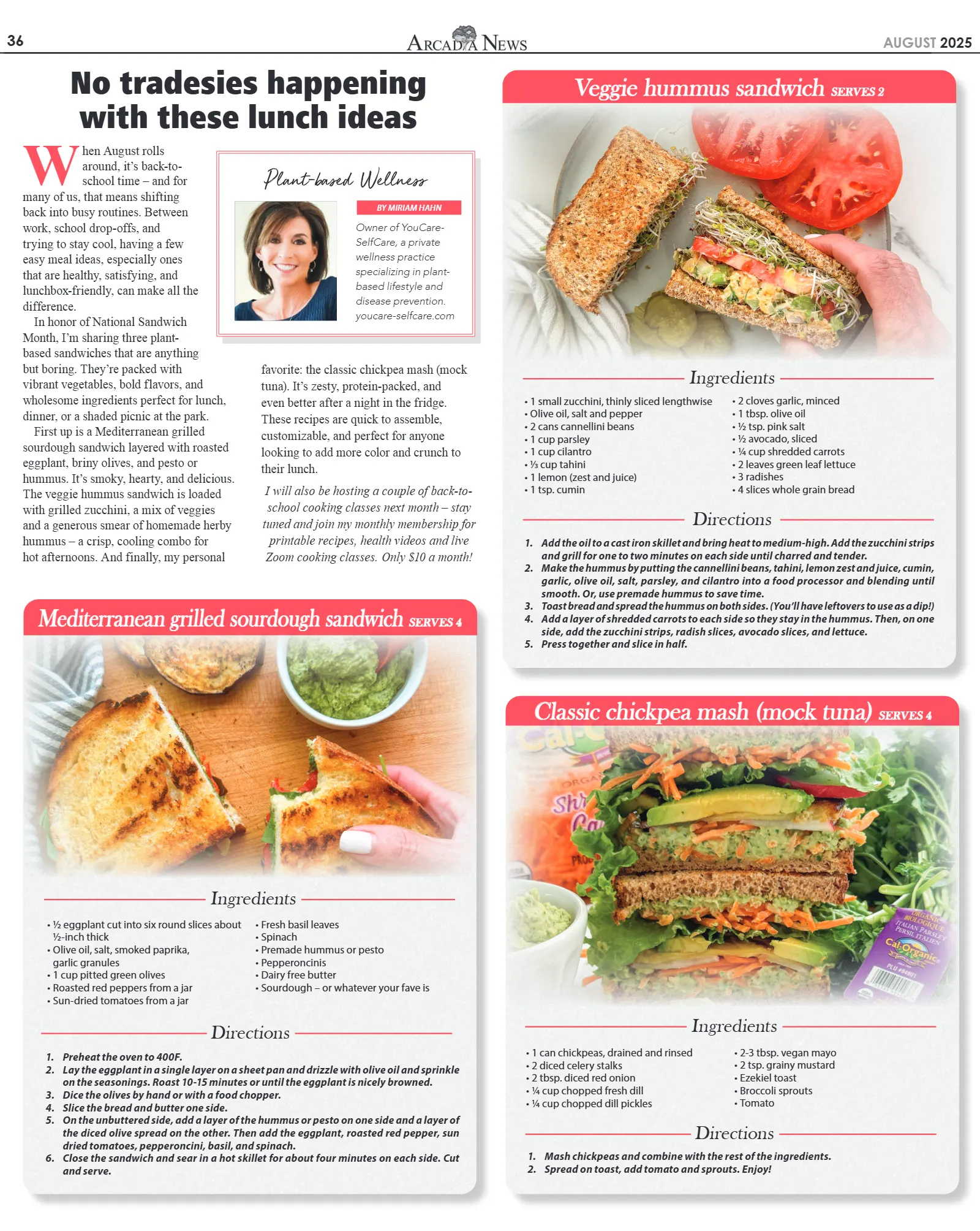

AUGUST 2025 36 W hen August rolls around, it’s back-to- school time – and for many of us, that means shifting back into busy routines. Between work, school drop-offs, and trying to stay cool, having a few easy meal ideas, especially ones that are healthy, satisfying, and lunchbox-friendly, can make all the difference. In honor of National Sandwich Month, I’m sharing three plant- based sandwiches that are anything but boring. They’re packed with vibrant vegetables, bold flavors, and wholesome ingredients perfect for lunch, dinner, or a shaded picnic at the park. First up is a Mediterranean grilled sourdough sandwich layered with roasted eggplant, briny olives, and pesto or hummus. It’s smoky, hearty, and delicious. The veggie hummus sandwich is loaded with grilled zucchini, a mix of veggies and a generous smear of homemade herby hummus – a crisp, cooling combo for hot afternoons. And finally, my personal favorite: the classic chickpea mash (mock tuna). It’s zesty, protein-packed, and even better after a night in the fridge. These recipes are quick to assemble, customizable, and perfect for anyone looking to add more color and crunch to their lunch. I will also be hosting a couple of back-to- school cooking classes next month – stay tuned and join my monthly membership for printable recipes, health videos and live Zoom cooking classes. Only $10 a month! No tradesies happening with these lunch ideas Classic chickpea mash (mock tuna) Classic chickpea mash (mock tuna) SERVES 4 SERVES 4 1. Mash chickpeas and combine with the rest of the ingredients. 2. Spread on toast, add tomato and sprouts. Enjoy! • 1 can chickpeas, drained and rinsed • 2 diced celery stalks • 2 tbsp. diced red onion • ¼ cup chopped fresh dill • ¼ cup chopped dill pickles • 2-3 tbsp. vegan mayo • 2 tsp. grainy mustard • Ezekiel toast • Broccoli sprouts • Tomato Directions Ingredients Veggie hummus sandwich Veggie hummus sandwich SERVES 2 SERVES 2 1. Add the oil to a cast iron skillet and bring heat to medium-high. Add the zucchini strips and grill for one to two minutes on each side until charred and tender. 2. Make the hummus by putting the cannellini beans, tahini, lemon zest and juice, cumin, garlic, olive oil, salt, parsley, and cilantro into a food processor and blending until smooth. Or, use premade hummus to save time. 3. Toast bread and spread the hummus on both sides. (You’ll have leftovers to use as a dip!) 4. Add a layer of shredded carrots to each side so they stay in the hummus. Then, on one side, add the zucchini strips, radish slices, avocado slices, and lettuce. 5. Press together and slice in half. Mediterranean grilled sourdough sandwich Mediterranean grilled sourdough sandwich SERVES 4 SERVES 4 Ingredients • ½ eggplant cut into six round slices about ½-inch thick • Olive oil, salt, smoked paprika, garlic granules • 1 cup pitted green olives • Roasted red peppers from a jar • Sun-dried tomatoes from a jar • Fresh basil leaves • Spinach • Premade hummus or pesto • Pepperoncinis • Dairy free butter • Sourdough – or whatever your fave is Directions Owner of YouCare- SelfCare, a private wellness practice specializing in plant- based lifestyle and disease prevention. youcare-selfcare.com BY MIRIAM HAHN 1. Preheat the oven to 400F. 2. Lay the eggplant in a single layer on a sheet pan and drizzle with olive oil and sprinkle on the seasonings. Roast 10-15 minutes or until the eggplant is nicely browned. 3. Dice the olives by hand or with a food chopper. 4. Slice the bread and butter one side. 5. On the unbuttered side, add a layer of the hummus or pesto on one side and a layer of the diced olive spread on the other. Then add the eggplant, roasted red pepper, sun dried tomatoes, pepperoncini, basil, and spinach. 6. Close the sandwich and sear in a hot skillet for about four minutes on each side. Cut and serve. Ingredients • 1 small zucchini, thinly sliced lengthwise • Olive oil, salt and pepper • 2 cans cannellini beans • 1 cup parsley • 1 cup cilantro • ⁄ cup tahini • 1 lemon (zest and juice) • 1 tsp. cumin • 2 cloves garlic, minced • 1 tbsp. olive oil • ½ tsp. pink salt • ½ avocado, sliced • ¼ cup shredded carrots • 2 leaves green leaf lettuce • 3 radishes • 4 slices whole grain bread Directions
37 AUGUST 2025 S age – recognized as culinary sage or common garden sage – is a medium sized, multipurpose, perennial shrub that can reach up to four feet in height and likes to grow in sandy or loamy soil. It is part of the mint family and has green branches, hairy elongated light gray-green colored leaves with a strong, almost winey, dominant flavor. Sage’s piney, lemony, camphor-like aroma capitalizes on our most memory-evoking sense and smell, and is slightly bitter. Its taste and the flowers that bloom in the summer awaken other senses. While acknowledging that basil leaves enchant me, the sage leaf is among my absolute favorite. I love its shape, color and especially its structure. Each leaf contains various minerals such as potassium, calcium and magnesium, which are important for the health of our body. Because sage leaves are dear to my heart, many bushes grow in the garden and new ones get planted every year. Sage has the oldest history among medicinal herbs. It’s not just folk tales that speak of the benefits, many do not realize what a rich history sage has had throughout the ages. Sage was used as a fertility treatment in ancient Egyptian times. Greeks used it for wound healing, women’s health, as a diuretic, for snakebites and as a meat preservative. They were the first to cultivate it and are the ones responsible for the herb we know today. During the Middle Ages it was used to treat maladies including fevers, liver disease, and epilepsy. The Romans considered it a sacred herb to be gathered with ceremony. In the ninth century, Charlemagne had sage included among the herbs grown on his imperial farm in Germany. During the 1600s, the Chinese exchanged the herb with Europeans. It was used in England to make tea. An Old-World herb, sage was brought to America by colonists for use in their gardens and kitchens. People use it to smudge and clear the atmosphere of their homes. One common belief is that sage strengthens the brain, the senses, and memory in addition to being an all-natural source of antioxidants with anti-inflammatory properties. In the United States, California, Nevada, Idaho, Montana, Wyoming, California, Utah, and North and South Dakota grow sage on farms and in orchards. Beyond their appeal in returning year after year, they are also frequently used in flower borders for their beautiful foliage and flowers. Throughout the summer and fall, they lend a wonderful palette of color and texture. In spring, they erupt in colorful blooms while many stay green year-round. Sage is said to love company, it’s unlucky to plant it in a pot or flowerbed by itself. It should be added during spring or fall as they will not establish themselves in summer heat. They form bubbly soft gray mounds that are hardy and can tolerate areas of little rainfall. Be mindful not to allow sage to compete with tree roots. Fresh sage leaves are thicker with a soft, downy feeling. They can be harvested as needed any time of year, although the most intensely flavored leaves are gathered prior to flowering. Fresh cut herbs have a limited shelf life and can get expensive depending on how many you need. Common sage is economical and timesaving, whereas variegated and purple sages are a tad bitter for cooking. Spring sage is tender in flavor and texture, but as the season progresses the flavor becomes more pronounced and the leaves sturdier. It’s one of the few herbs when, as its leaves grow larger, the flavor intensifies. The leaves are easily torn but are usually chopped or minced before adding to a dish. Today we’ve relegated the flavor of sage to heartier fall dishes, like Thanksgiving stuffing. Try diced leaves in omelets, soups, breads, sausages, fish, tomatoes, asparagus, brussels sprouts, cabbage, oranges, lemons, garlic, cheese and marinades. They can also be fried to a crispy texture for pasta and gnocchi. It’s a main component found in many poultry and Italian seasoning blends. If your plant is already in place don’t be tempted to start pruning it before you see fresh growth appearing at nodes along the stems. Choose a dry day without too much wind. Sage can only be propagated by cuttings and should be taken between the end of April and the beginning of June. At this time, the shoots are at the optimum stage of maturity, and not too soft. Experts suggest removing a sage plant after four to five years. The leaves are thought to lose their fresh flavor and develop a “woody” taste. It’s best to add dried sage toward the beginning of a recipe so it has time to mellow and blend with other flavors in the dish. There’s no dismissing the rewards of using fresh herbs and being able to gently press a leaf between your fingers to release the scent. Add fresh sage toward the end of cooking for nuance and complexity. If you have a lot of herbs and a food processor, homemade pesto is easy to make. Here lies a world of possibilities, the side of pesto’s improvisational nature rather than following a recipe. Pesto made with sage has a strong, penetrating smell released by brushing that’s intensified by tearing or chopping. It is also an astringent, which is what makes it excellent with meat, and fat, as well as with nuts such as pistachios or hazelnuts. The best pesto comes through innovation and are always made with fresh leaves and a variety of nuts and cheeses. Pistachios make a great base because they complement the strong flavor of the sage. A dollop on top of soups like roasted butternut squash, tomato, cauliflower, and minestrone give the ideal burst of flavor with its rich consistency and concentrated flavor. Consider it for steamed or grilled vegetables. Most white meats go beautifully with pistachio-sage pesto – think delicate scallops or halibut baked in foil with cherry tomatoes. It’s best on pasta or rice – heat wakes up the scent of the “secret ingredient.” The color is a softer, gentler green but the flavor is stand-up-and-be-noticed good – a full palate sensation! Blend the ingredients together at high-speed without the olive oil, then mix it in at the very end at a low speed. Remember the rich history of this herb as it was used throughout the ages, from family kitchens to monasteries to king’s castles. Enjoy! Thyme in My Kitchen BY SHERRY KLUSMAN thyme.in.my.kitchen Ingredients: • 1 ½ cups fresh basil • 10 medium tender young sage leaves, washed and dried (roughly half a cup) • 2-3 garlic cloves, peeled • ¼ tsp. kosher salt, or to taste • ¼ tsp. black pepper, or to taste • 1/3 cup lightly toasted pistachios • 1 tsp. fresh lemon juice • 2/3 cup extra-virgin olive oil • ¼ cup grated Romano cheese • ½ cup grated Parmigiano-Reggiano cheese Instructions: 1. Put the pistachios in a food processor and pulse until they are coarsely ground or hand chop to a fine consistency. 2. Add the basil, sage, garlic, cheeses and blend. 3. Slowly add in the olive oil and blend once again until smooth. 4. Scrape down the sides, season with lemon juice, salt and pepper. 5. Blend again. 6. Refrigerate the pesto with plastic pressed to the surface to prevent browning or freeze in small batches and defrost as needed. Pistachio-sage pesto COOKBOOK: “GARDENERS’ COMMUNITY COOKBOOK” by Victoria Wise NOVEL: “SONGS OF WILLOW FROST” by Jamie Ford AUGUST RECOMMENDATIONS Because sage leaves are dear to my heart, many bushes grow in the garden and new ones get planted every year. Sage Sage This is your moment, This is your moment, know it and grow it! know it and grow it!