
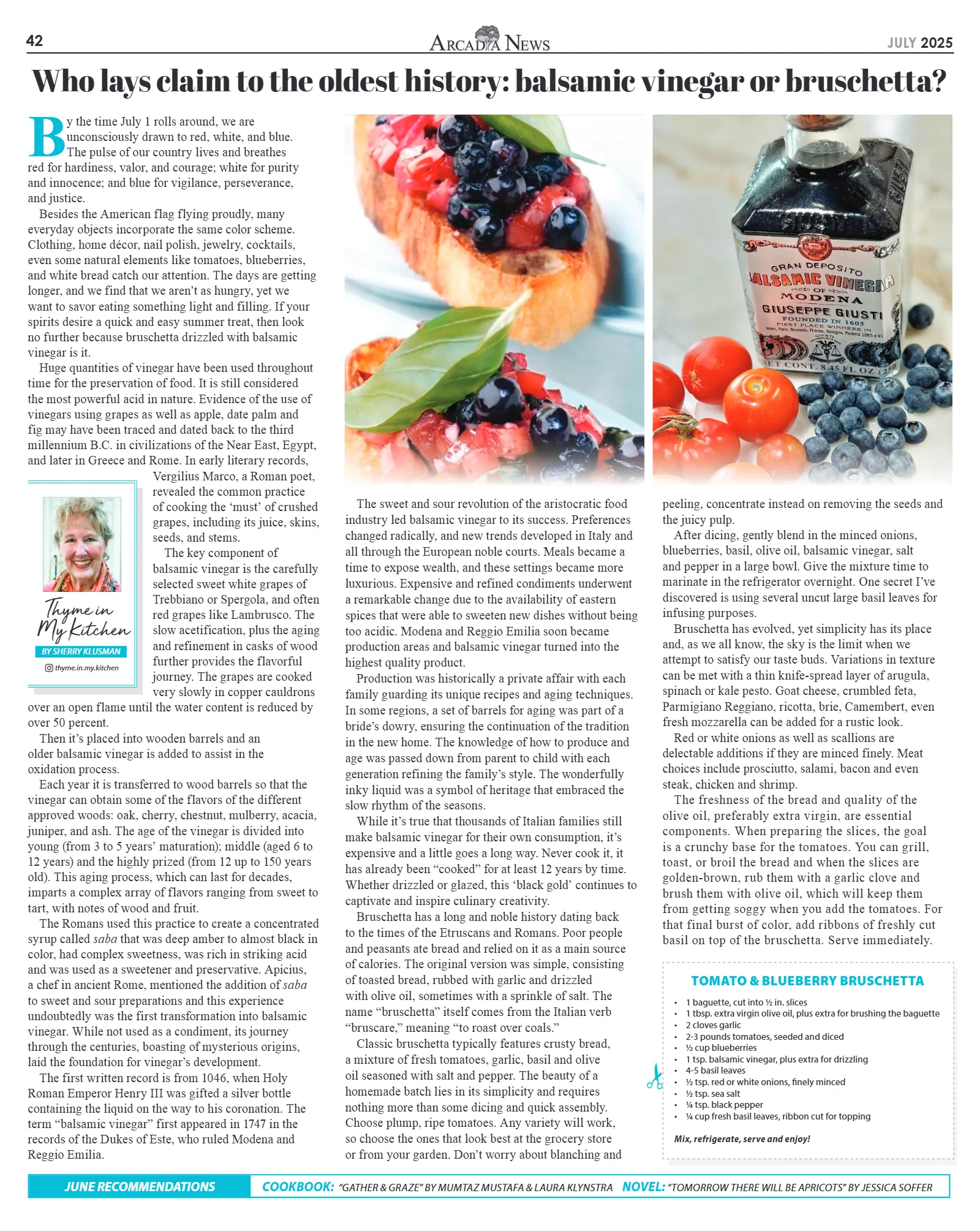

42 JULY 2025 B y the time July 1 rolls around, we are unconsciously drawn to red, white, and blue. The pulse of our country lives and breathes red for hardiness, valor, and courage; white for purity and innocence; and blue for vigilance, perseverance, and justice. Besides the American flag flying proudly, many everyday objects incorporate the same color scheme. Clothing, home décor, nail polish, jewelry, cocktails, even some natural elements like tomatoes, blueberries, and white bread catch our attention. The days are getting longer, and we find that we aren’t as hungry, yet we want to savor eating something light and filling. If your spirits desire a quick and easy summer treat, then look no further because bruschetta drizzled with balsamic vinegar is it. Huge quantities of vinegar have been used throughout time for the preservation of food. It is still considered the most powerful acid in nature. Evidence of the use of vinegars using grapes as well as apple, date palm and fig may have been traced and dated back to the third millennium B.C. in civilizations of the Near East, Egypt, and later in Greece and Rome. In early literary records, Vergilius Marco, a Roman poet, revealed the common practice of cooking the ‘must’ of crushed grapes, including its juice, skins, seeds, and stems. The key component of balsamic vinegar is the carefully selected sweet white grapes of Trebbiano or Spergola, and often red grapes like Lambrusco. The slow acetification, plus the aging and refinement in casks of wood further provides the flavorful journey. The grapes are cooked very slowly in copper cauldrons over an open flame until the water content is reduced by over 50 percent. Then it’s placed into wooden barrels and an older balsamic vinegar is added to assist in the oxidation process. Each year it is transferred to wood barrels so that the vinegar can obtain some of the flavors of the different approved woods: oak, cherry, chestnut, mulberry, acacia, juniper, and ash. The age of the vinegar is divided into young (from 3 to 5 years’ maturation); middle (aged 6 to 12 years) and the highly prized (from 12 up to 150 years old). This aging process, which can last for decades, imparts a complex array of flavors ranging from sweet to tart, with notes of wood and fruit. The Romans used this practice to create a concentrated syrup called saba that was deep amber to almost black in color, had complex sweetness, was rich in striking acid and was used as a sweetener and preservative. Apicius, a chef in ancient Rome, mentioned the addition of saba to sweet and sour preparations and this experience undoubtedly was the first transformation into balsamic vinegar. While not used as a condiment, its journey through the centuries, boasting of mysterious origins, laid the foundation for vinegar’s development. The first written record is from 1046, when Holy Roman Emperor Henry III was gifted a silver bottle containing the liquid on the way to his coronation. The term “balsamic vinegar” first appeared in 1747 in the records of the Dukes of Este, who ruled Modena and Reggio Emilia. The sweet and sour revolution of the aristocratic food industry led balsamic vinegar to its success. Preferences changed radically, and new trends developed in Italy and all through the European noble courts. Meals became a time to expose wealth, and these settings became more luxurious. Expensive and refined condiments underwent a remarkable change due to the availability of eastern spices that were able to sweeten new dishes without being too acidic. Modena and Reggio Emilia soon became production areas and balsamic vinegar turned into the highest quality product. Production was historically a private affair with each family guarding its unique recipes and aging techniques. In some regions, a set of barrels for aging was part of a bride’s dowry, ensuring the continuation of the tradition in the new home. The knowledge of how to produce and age was passed down from parent to child with each generation refining the family’s style. The wonderfully inky liquid was a symbol of heritage that embraced the slow rhythm of the seasons. While it’s true that thousands of Italian families still make balsamic vinegar for their own consumption, it’s expensive and a little goes a long way. Never cook it, it has already been “cooked” for at least 12 years by time. Whether drizzled or glazed, this ‘black gold’ continues to captivate and inspire culinary creativity. Bruschetta has a long and noble history dating back to the times of the Etruscans and Romans. Poor people and peasants ate bread and relied on it as a main source of calories. The original version was simple, consisting of toasted bread, rubbed with garlic and drizzled with olive oil, sometimes with a sprinkle of salt. The name “bruschetta” itself comes from the Italian verb “bruscare,” meaning “to roast over coals.” Classic bruschetta typically features crusty bread, a mixture of fresh tomatoes, garlic, basil and olive oil seasoned with salt and pepper. The beauty of a homemade batch lies in its simplicity and requires nothing more than some dicing and quick assembly. Choose plump, ripe tomatoes. Any variety will work, so choose the ones that look best at the grocery store or from your garden. Don’t worry about blanching and peeling, concentrate instead on removing the seeds and the juicy pulp. After dicing, gently blend in the minced onions, blueberries, basil, olive oil, balsamic vinegar, salt and pepper in a large bowl. Give the mixture time to marinate in the refrigerator overnight. One secret I’ve discovered is using several uncut large basil leaves for infusing purposes. Bruschetta has evolved, yet simplicity has its place and, as we all know, the sky is the limit when we attempt to satisfy our taste buds. Variations in texture can be met with a thin knife-spread layer of arugula, spinach or kale pesto. Goat cheese, crumbled feta, Parmigiano Reggiano, ricotta, brie, Camembert, even fresh mozzarella can be added for a rustic look. Red or white onions as well as scallions are delectable additions if they are minced finely. Meat choices include prosciutto, salami, bacon and even steak, chicken and shrimp. The freshness of the bread and quality of the olive oil, preferably extra virgin, are essential components. When preparing the slices, the goal is a crunchy base for the tomatoes. You can grill, toast, or broil the bread and when the slices are golden-brown, rub them with a garlic clove and brush them with olive oil, which will keep them from getting soggy when you add the tomatoes. For that final burst of color, add ribbons of freshly cut basil on top of the bruschetta. Serve immediately. Who lays claim to the oldest history: balsamic vinegar or bruschetta? Thyme in My Kitchen BY SHERRY KLUSMAN thyme.in.my.kitchen • 1 baguette, cut into ½ in. slices • 1 tbsp. extra virgin olive oil, plus extra for brushing the baguette • 2 cloves garlic • 2-3 pounds tomatoes, seeded and diced • ½ cup blueberries • 1 tsp. balsamic vinegar, plus extra for drizzling • 4-5 basil leaves • ½ tsp. red or white onions, finely minced • ½ tsp. sea salt • ¼ tsp. black pepper • ¼ cup fresh basil leaves, ribbon cut for topping Mix, refrigerate, serve and enjoy! TOMATO & BLUEBERRY BRUSCHETTA COOKBOOK: “GATHER & GRAZE” BY MUMTAZ MUSTAFA & LAURA KLYNSTRA NOVEL: “TOMORROW THERE WILL BE APRICOTS” BY JESSICA SOFFER JUNE RECOMMENDATIONS
WHY ADVERTISE IN ARCADIA NEWS There is no better way to reach Arcadia and the surrounding area. For a detailed information kit about us and our market, go to arcadianews.com/advertise or send your email address to ads@arcadianews.com. copies per month. 14,000 mailed; 5,000 in strategically-placed racks. We are the only publication that covers the highly-desired communities of Arcadia, Biltmore and Camelback Corridor. regularly purchase products or services from ads seen in the Arcadia News .* 19,000 75% DIRECT MAIL AFFLUENT READERSHIP READERS READY TO BUY *Source: 2023-2024 CVC Publication Report Audit AWARD WINNING NEIGHBORHOOD NEWS SINCE 1993 602.840.6370 | arcadianews.com