
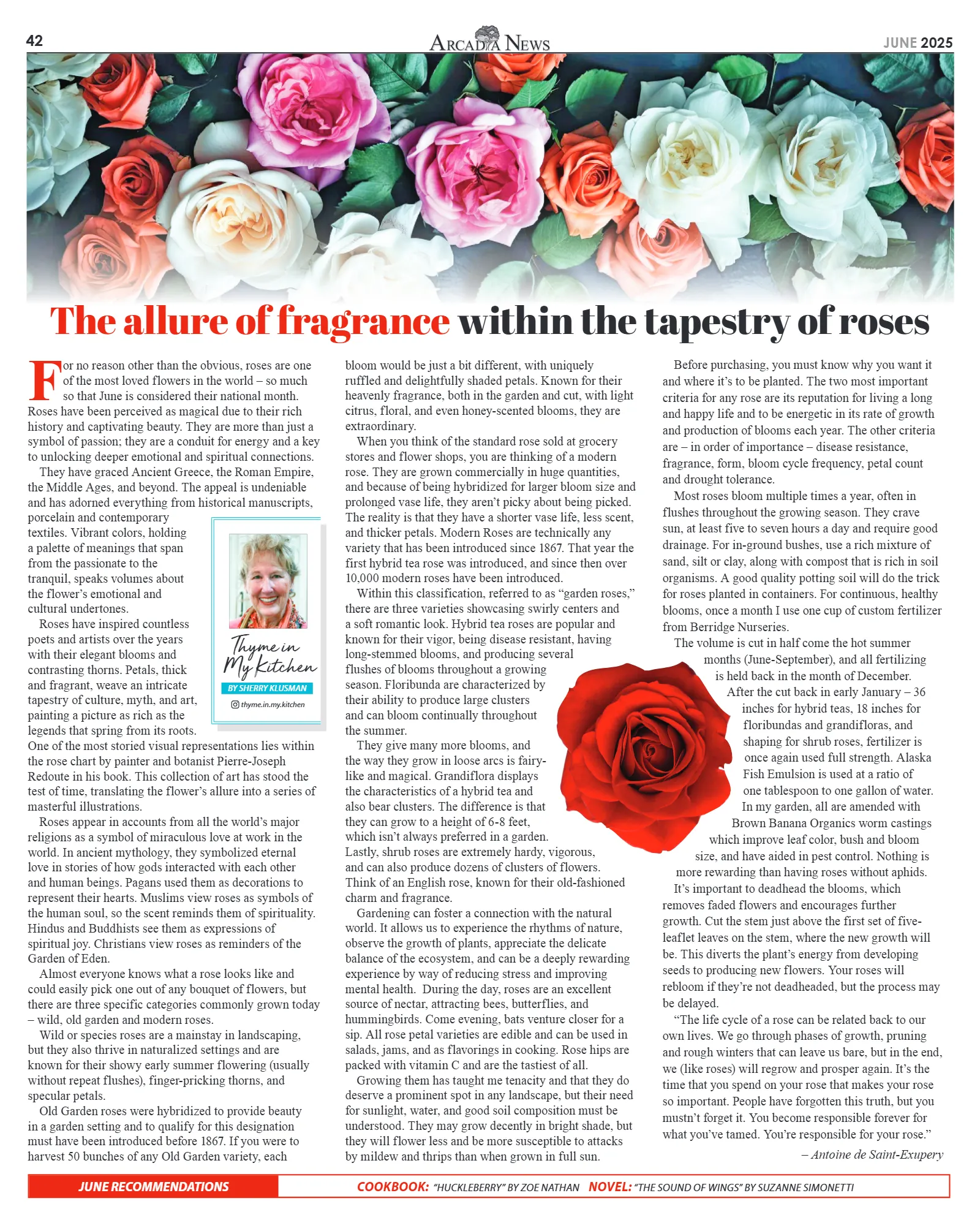

42 JUNE 2025 F or no reason other than the obvious, roses are one of the most loved flowers in the world – so much so that June is considered their national month. Roses have been perceived as magical due to their rich history and captivating beauty. They are more than just a symbol of passion; they are a conduit for energy and a key to unlocking deeper emotional and spiritual connections. They have graced Ancient Greece, the Roman Empire, the Middle Ages, and beyond. The appeal is undeniable and has adorned everything from historical manuscripts, porcelain and contemporary textiles. Vibrant colors, holding a palette of meanings that span from the passionate to the tranquil, speaks volumes about the flower’s emotional and cultural undertones. Roses have inspired countless poets and artists over the years with their elegant blooms and contrasting thorns. Petals, thick and fragrant, weave an intricate tapestry of culture, myth, and art, painting a picture as rich as the legends that spring from its roots. One of the most storied visual representations lies within the rose chart by painter and botanist Pierre-Joseph Redoute in his book. This collection of art has stood the test of time, translating the flower’s allure into a series of masterful illustrations. Roses appear in accounts from all the world’s major religions as a symbol of miraculous love at work in the world. In ancient mythology, they symbolized eternal love in stories of how gods interacted with each other and human beings. Pagans used them as decorations to represent their hearts. Muslims view roses as symbols of the human soul, so the scent reminds them of spirituality. Hindus and Buddhists see them as expressions of spiritual joy. Christians view roses as reminders of the Garden of Eden. Almost everyone knows what a rose looks like and could easily pick one out of any bouquet of flowers, but there are three specific categories commonly grown today – wild, old garden and modern roses. Wild or species roses are a mainstay in landscaping, but they also thrive in naturalized settings and are known for their showy early summer flowering (usually without repeat flushes), finger-pricking thorns, and specular petals. Old Garden roses were hybridized to provide beauty in a garden setting and to qualify for this designation must have been introduced before 1867. If you were to harvest 50 bunches of any Old Garden variety, each bloom would be just a bit different, with uniquely ruffled and delightfully shaded petals. Known for their heavenly fragrance, both in the garden and cut, with light citrus, floral, and even honey-scented blooms, they are extraordinary. When you think of the standard rose sold at grocery stores and flower shops, you are thinking of a modern rose. They are grown commercially in huge quantities, and because of being hybridized for larger bloom size and prolonged vase life, they aren’t picky about being picked. The reality is that they have a shorter vase life, less scent, and thicker petals. Modern Roses are technically any variety that has been introduced since 1867. That year the first hybrid tea rose was introduced, and since then over 10,000 modern roses have been introduced. Within this classification, referred to as “garden roses,” there are three varieties showcasing swirly centers and a soft romantic look. Hybrid tea roses are popular and known for their vigor, being disease resistant, having long-stemmed blooms, and producing several flushes of blooms throughout a growing season. Floribunda are characterized by their ability to produce large clusters and can bloom continually throughout the summer. They give many more blooms, and the way they grow in loose arcs is fairy- like and magical. Grandiflora displays the characteristics of a hybrid tea and also bear clusters. The difference is that they can grow to a height of 6-8 feet, which isn’t always preferred in a garden. Lastly, shrub roses are extremely hardy, vigorous, and can also produce dozens of clusters of flowers. Think of an English rose, known for their old-fashioned charm and fragrance. Gardening can foster a connection with the natural world. It allows us to experience the rhythms of nature, observe the growth of plants, appreciate the delicate balance of the ecosystem, and can be a deeply rewarding experience by way of reducing stress and improving mental health. During the day, roses are an excellent source of nectar, attracting bees, butterflies, and hummingbirds. Come evening, bats venture closer for a sip. All rose petal varieties are edible and can be used in salads, jams, and as flavorings in cooking. Rose hips are packed with vitamin C and are the tastiest of all. Growing them has taught me tenacity and that they do deserve a prominent spot in any landscape, but their need for sunlight, water, and good soil composition must be understood. They may grow decently in bright shade, but they will flower less and be more susceptible to attacks by mildew and thrips than when grown in full sun. Before purchasing, you must know why you want it and where it’s to be planted. The two most important criteria for any rose are its reputation for living a long and happy life and to be energetic in its rate of growth and production of blooms each year. The other criteria are – in order of importance – disease resistance, fragrance, form, bloom cycle frequency, petal count and drought tolerance. Most roses bloom multiple times a year, often in flushes throughout the growing season. They crave sun, at least five to seven hours a day and require good drainage. For in-ground bushes, use a rich mixture of sand, silt or clay, along with compost that is rich in soil organisms. A good quality potting soil will do the trick for roses planted in containers. For continuous, healthy blooms, once a month I use one cup of custom fertilizer from Berridge Nurseries. The volume is cut in half come the hot summer months (June-September), and all fertilizing is held back in the month of December. After the cut back in early January – 36 inches for hybrid teas, 18 inches for floribundas and grandifloras, and shaping for shrub roses, fertilizer is once again used full strength. Alaska Fish Emulsion is used at a ratio of one tablespoon to one gallon of water. In my garden, all are amended with Brown Banana Organics worm castings which improve leaf color, bush and bloom size, and have aided in pest control. Nothing is more rewarding than having roses without aphids. It’s important to deadhead the blooms, which removes faded flowers and encourages further growth. Cut the stem just above the first set of five- leaflet leaves on the stem, where the new growth will be. This diverts the plant’s energy from developing seeds to producing new flowers. Your roses will rebloom if they’re not deadheaded, but the process may be delayed. “The life cycle of a rose can be related back to our own lives. We go through phases of growth, pruning and rough winters that can leave us bare, but in the end, we (like roses) will regrow and prosper again. It’s the time that you spend on your rose that makes your rose so important. People have forgotten this truth, but you mustn’t forget it. You become responsible forever for what you’ve tamed. You’re responsible for your rose.” – Antoine de Saint-Exupery The allure of fragrance within the tapestry of roses Thyme in My Kitchen BY SHERRY KLUSMAN thyme.in.my.kitchen COOKBOOK: “HUCKLEBERRY” BY ZOE NATHAN NOVEL: “THE SOUND OF WINGS” BY SUZANNE SIMONETTI JUNE RECOMMENDATIONS
HOW DO YOU MATCHA? EATMINNOW.COM | @EATMINNOW MATCHA? MATCHA? MATCHA?