
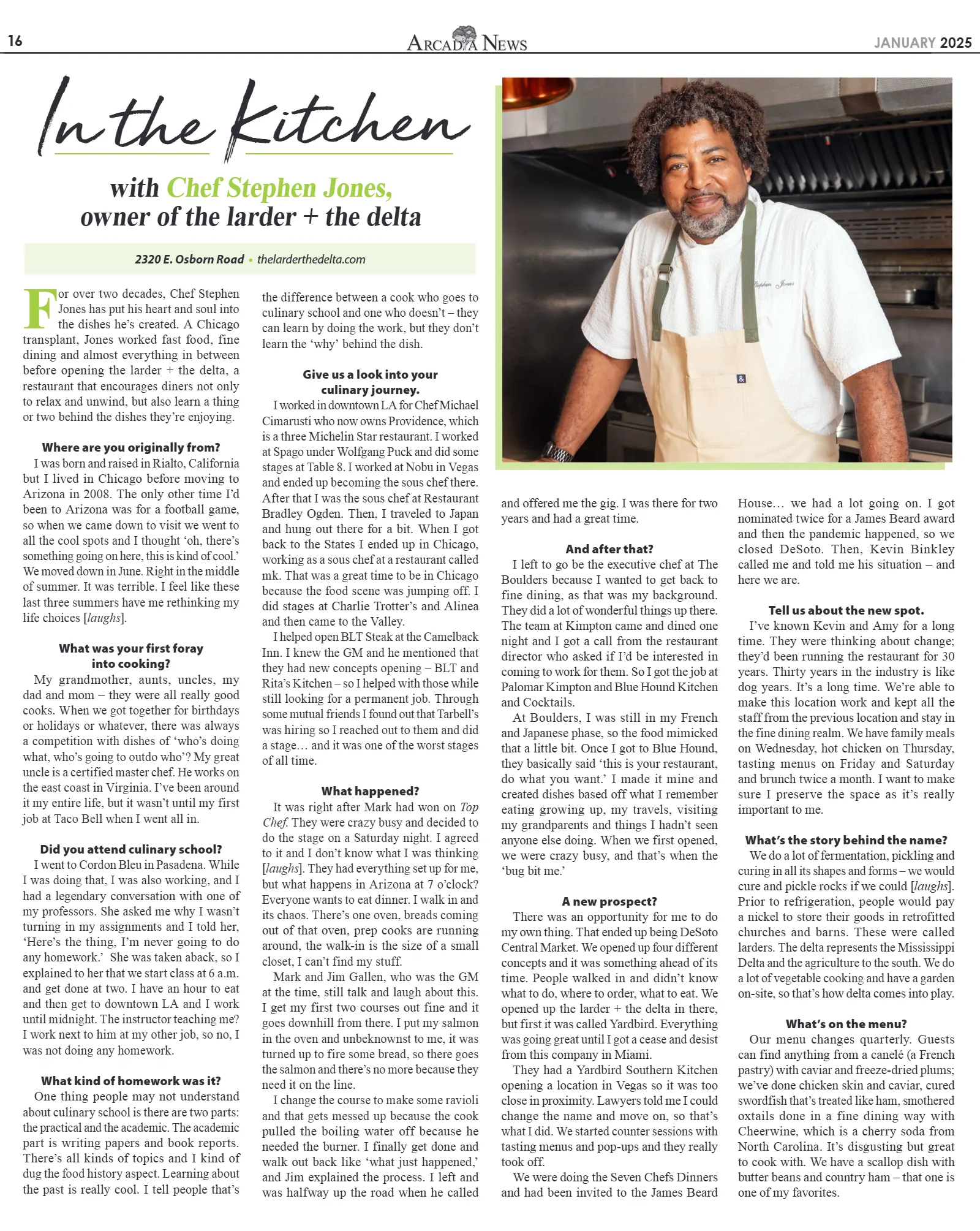
JANUARY 2025 16 with Chef Stephen Jones, owner of the larder + the delta 2320 E. Osborn Road • thelarderthedelta.com In the Kitchen F or over two decades, Chef Stephen Jones has put his heart and soul into the dishes he’s created. A Chicago transplant, Jones worked fast food, fine dining and almost everything in between before opening the larder + the delta, a restaurant that encourages diners not only to relax and unwind, but also learn a thing or two behind the dishes they’re enjoying. Where are you originally from? I was born and raised in Rialto, California but I lived in Chicago before moving to Arizona in 2008. The only other time I’d been to Arizona was for a football game, so when we came down to visit we went to all the cool spots and I thought ‘oh, there’s something going on here, this is kind of cool.’ We moved down in June. Right in the middle of summer. It was terrible. I feel like these last three summers have me rethinking my life choices [ laughs ]. What was your first foray into cooking? My grandmother, aunts, uncles, my dad and mom – they were all really good cooks. When we got together for birthdays or holidays or whatever, there was always a competition with dishes of ‘who’s doing what, who’s going to outdo who’? My great uncle is a certified master chef. He works on the east coast in Virginia. I’ve been around it my entire life, but it wasn’t until my first job at Taco Bell when I went all in. Did you attend culinary school? I went to Cordon Bleu in Pasadena. While I was doing that, I was also working, and I had a legendary conversation with one of my professors. She asked me why I wasn’t turning in my assignments and I told her, ‘Here’s the thing, I’m never going to do any homework.’ She was taken aback, so I explained to her that we start class at 6 a.m. and get done at two. I have an hour to eat and then get to downtown LA and I work until midnight. The instructor teaching me? I work next to him at my other job, so no, I was not doing any homework. What kind of homework was it? One thing people may not understand about culinary school is there are two parts: the practical and the academic. The academic part is writing papers and book reports. There’s all kinds of topics and I kind of dug the food history aspect. Learning about the past is really cool. I tell people that’s the difference between a cook who goes to culinary school and one who doesn’t – they can learn by doing the work, but they don’t learn the ‘why’ behind the dish. Give us a look into your culinary journey. I worked in downtown LA for Chef Michael Cimarusti who now owns Providence, which is a three Michelin Star restaurant. I worked at Spago under Wolfgang Puck and did some stages at Table 8. I worked at Nobu in Vegas and ended up becoming the sous chef there. After that I was the sous chef at Restaurant Bradley Ogden. Then, I traveled to Japan and hung out there for a bit. When I got back to the States I ended up in Chicago, working as a sous chef at a restaurant called mk. That was a great time to be in Chicago because the food scene was jumping off. I did stages at Charlie Trotter’s and Alinea and then came to the Valley. I helped open BLT Steak at the Camelback Inn. I knew the GM and he mentioned that they had new concepts opening – BLT and Rita’s Kitchen – so I helped with those while still looking for a permanent job. Through some mutual friends I found out that Tarbell’s was hiring so I reached out to them and did a stage… and it was one of the worst stages of all time. What happened? It was right after Mark had won on Top Chef . They were crazy busy and decided to do the stage on a Saturday night. I agreed to it and I don’t know what I was thinking [ laughs ]. They had everything set up for me, but what happens in Arizona at 7 o’clock? Everyone wants to eat dinner. I walk in and its chaos. There’s one oven, breads coming out of that oven, prep cooks are running around, the walk-in is the size of a small closet, I can’t find my stuff. Mark and Jim Gallen, who was the GM at the time, still talk and laugh about this. I get my first two courses out fine and it goes downhill from there. I put my salmon in the oven and unbeknownst to me, it was turned up to fire some bread, so there goes the salmon and there’s no more because they need it on the line. I change the course to make some ravioli and that gets messed up because the cook pulled the boiling water off because he needed the burner. I finally get done and walk out back like ‘what just happened,’ and Jim explained the process. I left and was halfway up the road when he called and offered me the gig. I was there for two years and had a great time. And after that? I left to go be the executive chef at The Boulders because I wanted to get back to fine dining, as that was my background. They did a lot of wonderful things up there. The team at Kimpton came and dined one night and I got a call from the restaurant director who asked if I’d be interested in coming to work for them. So I got the job at Palomar Kimpton and Blue Hound Kitchen and Cocktails. At Boulders, I was still in my French and Japanese phase, so the food mimicked that a little bit. Once I got to Blue Hound, they basically said ‘this is your restaurant, do what you want.’ I made it mine and created dishes based off what I remember eating growing up, my travels, visiting my grandparents and things I hadn’t seen anyone else doing. When we first opened, we were crazy busy, and that’s when the ‘bug bit me.’ A new prospect? There was an opportunity for me to do my own thing. That ended up being DeSoto Central Market. We opened up four different concepts and it was something ahead of its time. People walked in and didn’t know what to do, where to order, what to eat. We opened up the larder + the delta in there, but first it was called Yardbird. Everything was going great until I got a cease and desist from this company in Miami. They had a Yardbird Southern Kitchen opening a location in Vegas so it was too close in proximity. Lawyers told me I could change the name and move on, so that’s what I did. We started counter sessions with tasting menus and pop-ups and they really took off. We were doing the Seven Chefs Dinners and had been invited to the James Beard House… we had a lot going on. I got nominated twice for a James Beard award and then the pandemic happened, so we closed DeSoto. Then, Kevin Binkley called me and told me his situation – and here we are. Tell us about the new spot. I’ve known Kevin and Amy for a long time. They were thinking about change; they’d been running the restaurant for 30 years. Thirty years in the industry is like dog years. It’s a long time. We’re able to make this location work and kept all the staff from the previous location and stay in the fine dining realm. We have family meals on Wednesday, hot chicken on Thursday, tasting menus on Friday and Saturday and brunch twice a month. I want to make sure I preserve the space as it’s really important to me. What’s the story behind the name? We do a lot of fermentation, pickling and curing in all its shapes and forms – we would cure and pickle rocks if we could [ laughs ]. Prior to refrigeration, people would pay a nickel to store their goods in retrofitted churches and barns. These were called larders. The delta represents the Mississippi Delta and the agriculture to the south. We do a lot of vegetable cooking and have a garden on-site, so that’s how delta comes into play. What’s on the menu? Our menu changes quarterly. Guests can find anything from a canelé (a French pastry) with caviar and freeze-dried plums; we’ve done chicken skin and caviar, cured swordfish that’s treated like ham, smothered oxtails done in a fine dining way with Cheerwine, which is a cherry soda from North Carolina. It’s disgusting but great to cook with. We have a scallop dish with butter beans and country ham – that one is one of my favorites.
17 JANUARY 2025 We try to have fun with the menu. For years I did fine dining and I got kind of turned off with it because the dining room felt quiet, proper, stoic…it was like, relax! We’ve got hip-hop, jazz, neo-soul music playing. I want to hear joking, laughing and people having a good time. What’s the inspiration behind the dishes? My ancestors. I cooked American dishes when I was at Bradley’s, but it wasn’t the food I knew or that I grew up eating. I wanted to be able to do things that made my family proud, because when I first started they were wondering why this was the path I’d chosen. When I took my parents out to experience the food, they finally got it. I’m also a history buff when it comes to food. I want to know where it came from, where’d the name come from, who is credited with the dish. I want to tell the history of my ancestors. We’re not a soul food restaurant, I want people to know that. Our dishes pay homage to the south, there’s a story behind each of them. That’s why we do a lot of vegetables too, because we want to pay respects to all the farming that was done. What’s the most unique thing you’ve cooked? Rhinoceros – and that was wild. There was a guy who came into The Boulders who was an exotic animal importer. He would show up fully dressed in a three-piece suit in these wild colors and was such a character. He walked in one day with giraffe, rhinoceros, whale and camel tongue and goes ‘check it out, chef!’ My first thought was; is this legal? But I’ll try anything once, so I cooked the rhino and it was a thinner cut so it wasn’t tough and kind of tasted like wild boar. It was a little gamey and leaner than I thought it’d be. You were also on television for a time. I was on Beat Bobby Flay and beat him with our vegan version of Hoppin John, which is traditionally cooked with pork, rice and peas. I took the pork out. I won a tournament on Guy’s Grocery Games . I beat Robert Irvine in the final. I also got to do a show for the Travel Channel and meet Anthony Bourdain, but after three years I was ready to go home. What was Anthony like? It was talking to any other chef, because he’d been through so much and understood what I was going through. He was a great guy. There was no judgement from him. I still can’t watch any of his shows. It broke everyone’s hearts when he passed. I will always remember some of the things he told me. What is your favorite part of the industry? The people. The restaurant industry kind of has a negative connotation of being a dark place that’s just for misfits. And it is, there are more misfits in this business than I’ve seen in my entire life, but they’re really good misfits. No one is perfect and running a restaurant is hard and demanding. People that choose to get into restaurants and hospitality deal with all of those challenges and keep coming back. I like to surround myself with those people. Who are some chefs that inspire you? Toni Tipton-Martin, Edna Lewis – whose quotes are throughout the restaurant and on the menu; she’s a major influence in what I do. Erick Williams out of Chicago. Rodney Scott, Bernie Kantak, Gio Osso. There’s so many people who inspire me. Seeing what the younger kids are doing out there these days is inspiring – René from Bacanora, Armando from Tacos Chiwas, Devan Cunningham – I’m the old guy now so it’s wild to see what they’re doing. I take little tidbits from each person I meet. Will your kids follow in your footsteps as far as careers go? No, my oldest son is already in his profession. He’s a photographer for a motorcycle company. My youngest is nine and he grew up in the kitchen, but he’s now more in what I call ‘the family business,’ which is football. He plays year-round and his dream is to be in the NFL. If I’m not here at the restaurant, I’m coaching him. It’s my first love too and I love teaching the kids, so that’s what I’m doing. What’s next for Chef Jones? What I would really love is for the restaurant to get going on its own and seeing one of my guys take over; passing the torch. I have a few more years left and then I owe time back to my family. I’m also a history buff when it comes to food. I want to know where it came from, where’d the name come from, who is credited with the dish. I want to tell the history of my ancestors. THE ARCADIAN a r c a d i a n P H X . c o m STOP RENTING START OWNING Schedule a Tour! STARTING IN THE $600s PURCHASING A HOME IN ARCADIA IS EASIER THAN YOU MIGHT THINK!