
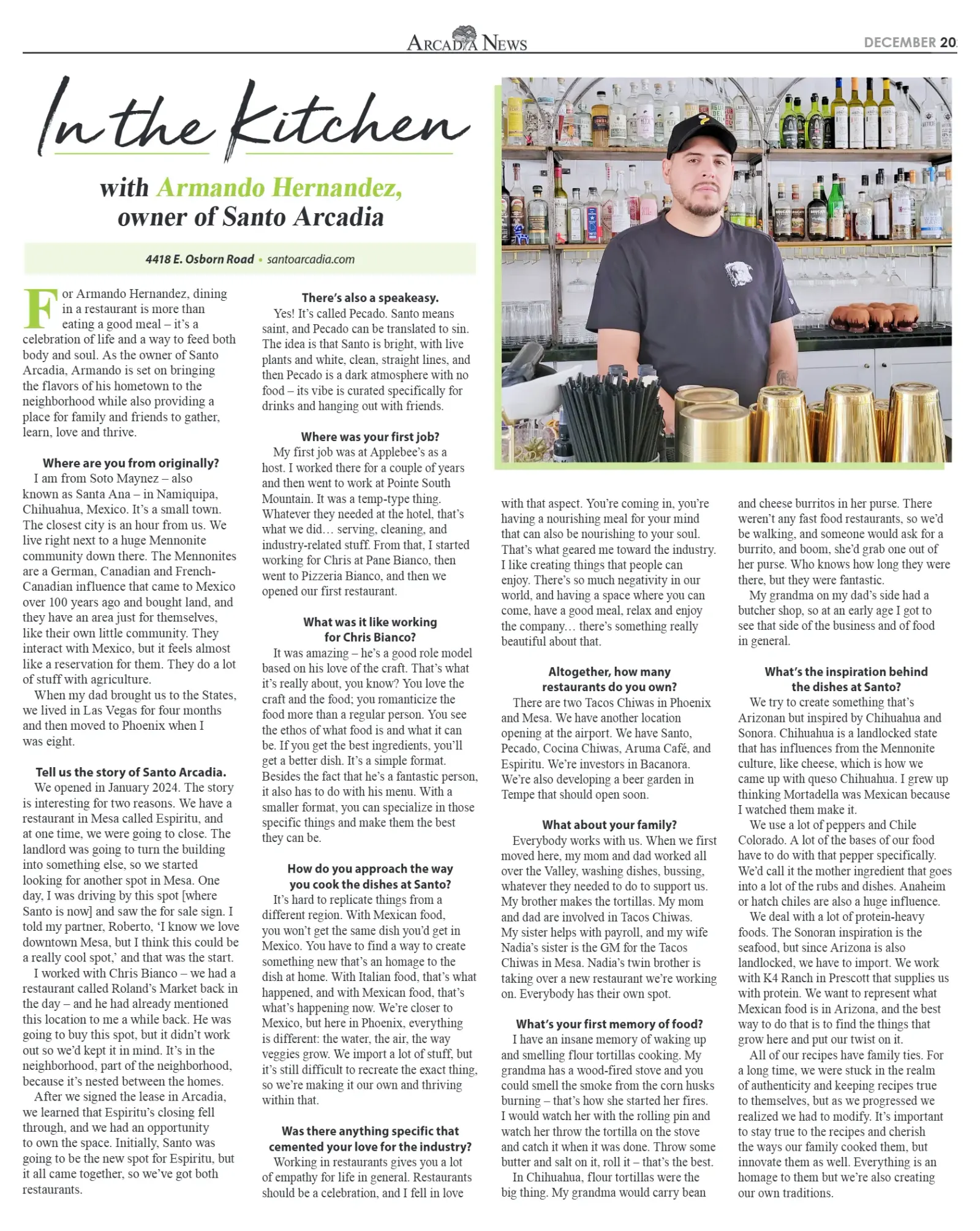
DECEMBER 202 with Armando Hernandez, owner of Santo Arcadia 4418 E. Osborn Road • santoarcadia.com In the Kitchen F or Armando Hernandez, dining in a restaurant is more than eating a good meal – it’s a celebration of life and a way to feed both body and soul. As the owner of Santo Arcadia, Armando is set on bringing the flavors of his hometown to the neighborhood while also providing a place for family and friends to gather, learn, love and thrive. Where are you from originally? I am from Soto Maynez – also known as Santa Ana – in Namiquipa, Chihuahua, Mexico. It’s a small town. The closest city is an hour from us. We live right next to a huge Mennonite community down there. The Mennonites are a German, Canadian and French- Canadian influence that came to Mexico over 100 years ago and bought land, and they have an area just for themselves, like their own little community. They interact with Mexico, but it feels almost like a reservation for them. They do a lot of stuff with agriculture. When my dad brought us to the States, we lived in Las Vegas for four months and then moved to Phoenix when I was eight. Tell us the story of Santo Arcadia. We opened in January 2024. The story is interesting for two reasons. We have a restaurant in Mesa called Espiritu, and at one time, we were going to close. The landlord was going to turn the building into something else, so we started looking for another spot in Mesa. One day, I was driving by this spot [where Santo is now] and saw the for sale sign. I told my partner, Roberto, ‘I know we love downtown Mesa, but I think this could be a really cool spot,’ and that was the start. I worked with Chris Bianco – we had a restaurant called Roland’s Market back in the day – and he had already mentioned this location to me a while back. He was going to buy this spot, but it didn’t work out so we’d kept it in mind. It’s in the neighborhood, part of the neighborhood, because it’s nested between the homes. After we signed the lease in Arcadia, we learned that Espiritu’s closing fell through, and we had an opportunity to own the space. Initially, Santo was going to be the new spot for Espiritu, but it all came together, so we’ve got both restaurants. There’s also a speakeasy. Yes! It’s called Pecado. Santo means saint, and Pecado can be translated to sin. The idea is that Santo is bright, with live plants and white, clean, straight lines, and then Pecado is a dark atmosphere with no food – its vibe is curated specifically for drinks and hanging out with friends. Where was your first job? My first job was at Applebee’s as a host. I worked there for a couple of years and then went to work at Pointe South Mountain. It was a temp-type thing. Whatever they needed at the hotel, that’s what we did… serving, cleaning, and industry-related stuff. From that, I started working for Chris at Pane Bianco, then went to Pizzeria Bianco, and then we opened our first restaurant. What was it like working for Chris Bianco? It was amazing – he’s a good role model based on his love of the craft. That’s what it’s really about, you know? You love the craft and the food; you romanticize the food more than a regular person. You see the ethos of what food is and what it can be. If you get the best ingredients, you’ll get a better dish. It’s a simple format. Besides the fact that he’s a fantastic person, it also has to do with his menu. With a smaller format, you can specialize in those specific things and make them the best they can be. How do you approach the way you cook the dishes at Santo? It’s hard to replicate things from a different region. With Mexican food, you won’t get the same dish you’d get in Mexico. You have to find a way to create something new that’s an homage to the dish at home. With Italian food, that’s what happened, and with Mexican food, that’s what’s happening now. We’re closer to Mexico, but here in Phoenix, everything is different: the water, the air, the way veggies grow. We import a lot of stuff, but it’s still difficult to recreate the exact thing, so we’re making it our own and thriving within that. Was there anything specific that cemented your love for the industry? Working in restaurants gives you a lot of empathy for life in general. Restaurants should be a celebration, and I fell in love with that aspect. You’re coming in, you’re having a nourishing meal for your mind that can also be nourishing to your soul. That’s what geared me toward the industry. I like creating things that people can enjoy. There’s so much negativity in our world, and having a space where you can come, have a good meal, relax and enjoy the company… there’s something really beautiful about that. Altogether, how many restaurants do you own? There are two Tacos Chiwas in Phoenix and Mesa. We have another location opening at the airport. We have Santo, Pecado, Cocina Chiwas, Aruma Café, and Espiritu. We’re investors in Bacanora. We’re also developing a beer garden in Tempe that should open soon. What about your family? Everybody works with us. When we first moved here, my mom and dad worked all over the Valley, washing dishes, bussing, whatever they needed to do to support us. My brother makes the tortillas. My mom and dad are involved in Tacos Chiwas. My sister helps with payroll, and my wife Nadia’s sister is the GM for the Tacos Chiwas in Mesa. Nadia’s twin brother is taking over a new restaurant we’re working on. Everybody has their own spot. What’s your first memory of food? I have an insane memory of waking up and smelling flour tortillas cooking. My grandma has a wood-fired stove and you could smell the smoke from the corn husks burning – that’s how she started her fires. I would watch her with the rolling pin and watch her throw the tortilla on the stove and catch it when it was done. Throw some butter and salt on it, roll it – that’s the best. In Chihuahua, flour tortillas were the big thing. My grandma would carry bean and cheese burritos in her purse. There weren’t any fast food restaurants, so we’d be walking, and someone would ask for a burrito, and boom, she’d grab one out of her purse. Who knows how long they were there, but they were fantastic. My grandma on my dad’s side had a butcher shop, so at an early age I got to see that side of the business and of food in general. What’s the inspiration behind the dishes at Santo? We try to create something that’s Arizonan but inspired by Chihuahua and Sonora. Chihuahua is a landlocked state that has influences from the Mennonite culture, like cheese, which is how we came up with queso Chihuahua. I grew up thinking Mortadella was Mexican because I watched them make it. We use a lot of peppers and Chile Colorado. A lot of the bases of our food have to do with that pepper specifically. We’d call it the mother ingredient that goes into a lot of the rubs and dishes. Anaheim or hatch chiles are also a huge influence. We deal with a lot of protein-heavy foods. The Sonoran inspiration is the seafood, but since Arizona is also landlocked, we have to import. We work with K4 Ranch in Prescott that supplies us with protein. We want to represent what Mexican food is in Arizona, and the best way to do that is to find the things that grow here and put our twist on it. All of our recipes have family ties. For a long time, we were stuck in the realm of authenticity and keeping recipes true to themselves, but as we progressed we realized we had to modify. It’s important to stay true to the recipes and cherish the ways our family cooked them, but innovate them as well. Everything is an homage to them but we’re also creating our own traditions.
CEMBER 2024 What about the drinks? You fall in love with the ideology of what liquor is to begin with, where it comes from, why it’s special. Our mixologists also have their sommelier certificate because – while all the stuff from Mexico is cool – we want to have a selection for everyone. It’s a lot of ‘one- offs,’ specialty tequilas and sotoles, things that are different. Our beverage program has worked out really well for us. There’s nothing wrong with Don Julio, but it feels nice to venture out and go with family businesses. We traveled to Oaxaca and met some of the families that are growing and creating the liquor and it feels special to have that bond with them. What’s the most challenging part of working in the restaurant industry? Consistent change. In the industry, the one constant is that it’s always changing. We’re navigating strange waters, from an employee’s perspective to interactions with customers. There’s this saying that the customer is always right, but I don’t believe that. That’s how you end up with nothing but chain restaurants. We put a lot of thought and time into the venue, the food and drinks, and it’s best to experience it for what it is instead of comparing it to something else. Trying to explain – especially with Mexican food – the difference in regions is an uphill battle. There’s a huge difference in cuisines from Oaxaca and Puebla to Chihuahua and Sonora. There are a lot of people who are ‘experts’ who want to do reviews, and it’s difficult because everyone has different tastes, and if it’s not for you, fine. We put on a show every night and hope for the best – we love what we do! On the flip side, what’s your favorite part? I’m optimistic by default. I see great things coming – and if I can do it, anyone can do it. My wife and I started with a little taqueria all bright-eyed and bushy-tailed, convinced it was going to be amazing. Then you get to the reality of the workload and everything that comes with it…but we’re on the fortunate side. We’ve opened 14 restaurants in nine years, and I take each one to heart. We want to earn people’s trust and be part of the community. That’s where we thrive. I could go on a tangent forever about how much I love doing this. Hearing from customers about what they love and helping remind others of home – those little moments make it worth it. Who is your biggest inspiration? My family. Leaving their hometown to give us an opportunity to have a better life is an enormous feat, and I’m forever indebted to them. At this point, I don’t think I could uproot my entire life and start over somewhere else. They inspire me to be a good person, be humble, and be thankful for my opportunities – that doesn’t go away. Because of them, I am incredibly lucky. And I’m thankful for every person that comes in here, spends their hard-earned money and helps me live this dream. It’s not lost on me the amount of privilege I have in loving my job. When you’re not working, what are you doing? I work a lot [ laughs ]. I work with my family and a lot of friends, so when we’re not here, we’re hanging out at home, cooking, and celebrating life every day. I know that sounds cheesy, but I really love that part of it. I have two kids and love hanging out with them; it’s more fulfilling than anything else. We love to travel, explore, and learn! Where’s a favorite spot you go for dinner? We go to Glai Baan a lot. She’s doing her thing – it’s an amazing little spot. For lunch, I go to Yoshi’s. I went to Camelback High and there’s a Yoshi’s right there, so eating there brings back a lot of memories. What’s next for Armando Hernandez? Future plans are to continue growing Santo, until it becomes a staple in the community. We are planning on doing a lunch menu – right now we do brunch on Sundays and we’d like to expand that as well. We’re hoping to do more events and dinners featuring other chefs and restaurants. The major thing is continuing to grow the dinner part and serving good food to our neighborhood. There’s so much negativity in our world, and having a space where you can come, have a good meal, relax and enjoy the company… there’s something really beautiful about that. THE ARCADIAN a r c a d i a n P H X . c o m STOP RENTING START OWNING Schedule a Tour! STARTING IN THE $600s PURCHASING A HOME IN ARCADIA IS EASIER THAN YOU MIGHT THINK!