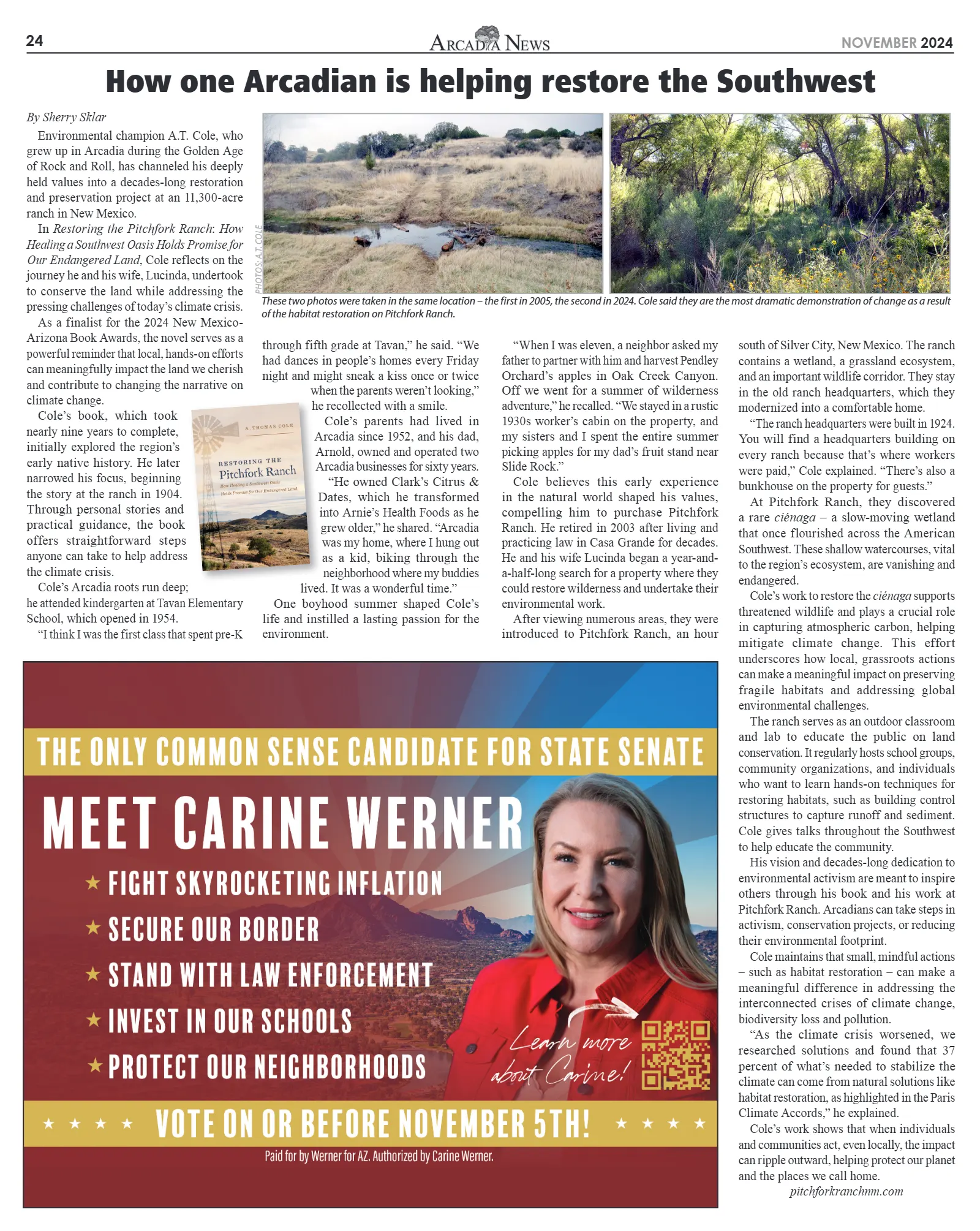

24 NOVEMBER 2024 By Sherry Sklar Environmental champion A.T. Cole, who grew up in Arcadia during the Golden Age of Rock and Roll, has channeled his deeply held values into a decades-long restoration and preservation project at an 11,300-acre ranch in New Mexico. In Restoring the Pitchfork Ranch : How Healing a Southwest Oasis Holds Promise for Our Endangered Land , Cole reflects on the journey he and his wife, Lucinda, undertook to conserve the land while addressing the pressing challenges of today’s climate crisis. As a finalist for the 2024 New Mexico- Arizona Book Awards, the novel serves as a powerful reminder that local, hands-on efforts can meaningfully impact the land we cherish and contribute to changing the narrative on climate change. Cole’s book, which took nearly nine years to complete, initially explored the region’s early native history. He later narrowed his focus, beginning the story at the ranch in 1904. Through personal stories and practical guidance, the book offers straightforward steps anyone can take to help address the climate crisis. Cole’s Arcadia roots run deep; he attended kindergarten at Tavan Elementary School, which opened in 1954. “I think I was the first class that spent pre-K through fifth grade at Tavan,” he said. “We had dances in people’s homes every Friday night and might sneak a kiss once or twice when the parents weren’t looking,” he recollected with a smile. Cole’s parents had lived in Arcadia since 1952, and his dad, Arnold, owned and operated two Arcadia businesses for sixty years. “He owned Clark’s Citrus & Dates, which he transformed into Arnie’s Health Foods as he grew older,” he shared. “Arcadia was my home, where I hung out as a kid, biking through the neighborhood where my buddies lived. It was a wonderful time.” One boyhood summer shaped Cole’s life and instilled a lasting passion for the environment. “When I was eleven, a neighbor asked my father to partner with him and harvest Pendley Orchard’s apples in Oak Creek Canyon. Off we went for a summer of wilderness adventure,” he recalled. “We stayed in a rustic 1930s worker’s cabin on the property, and my sisters and I spent the entire summer picking apples for my dad’s fruit stand near Slide Rock.” Cole believes this early experience in the natural world shaped his values, compelling him to purchase Pitchfork Ranch. He retired in 2003 after living and practicing law in Casa Grande for decades. He and his wife Lucinda began a year-and- a-half-long search for a property where they could restore wilderness and undertake their environmental work. After viewing numerous areas, they were introduced to Pitchfork Ranch, an hour south of Silver City, New Mexico. The ranch contains a wetland, a grassland ecosystem, and an important wildlife corridor. They stay in the old ranch headquarters, which they modernized into a comfortable home. “The ranch headquarters were built in 1924. You will find a headquarters building on every ranch because that’s where workers were paid,” Cole explained. “There’s also a bunkhouse on the property for guests.” At Pitchfork Ranch, they discovered a rare ciénaga – a slow-moving wetland that once flourished across the American Southwest. These shallow watercourses, vital to the region’s ecosystem, are vanishing and endangered. Cole’s work to restore the ciénaga supports threatened wildlife and plays a crucial role in capturing atmospheric carbon, helping mitigate climate change. This effort underscores how local, grassroots actions can make a meaningful impact on preserving fragile habitats and addressing global environmental challenges. The ranch serves as an outdoor classroom and lab to educate the public on land conservation. It regularly hosts school groups, community organizations, and individuals who want to learn hands-on techniques for restoring habitats, such as building control structures to capture runoff and sediment. Cole gives talks throughout the Southwest to help educate the community. His vision and decades-long dedication to environmental activism are meant to inspire others through his book and his work at Pitchfork Ranch. Arcadians can take steps in activism, conservation projects, or reducing their environmental footprint. Cole maintains that small, mindful actions – such as habitat restoration – can make a meaningful difference in addressing the interconnected crises of climate change, biodiversity loss and pollution. “As the climate crisis worsened, we researched solutions and found that 37 percent of what’s needed to stabilize the climate can come from natural solutions like habitat restoration, as highlighted in the Paris Climate Accords,” he explained. Cole’s work shows that when individuals and communities act, even locally, the impact can ripple outward, helping protect our planet and the places we call home. pitchforkranchnm.com How one Arcadian is helping restore the Southwest These two photos were taken in the same location – the first in 2005, the second in 2024. Cole said they are the most dramatic demonstration of change as a result of the habitat restoration on Pitchfork Ranch. PHOTOS: A.T. COLE