
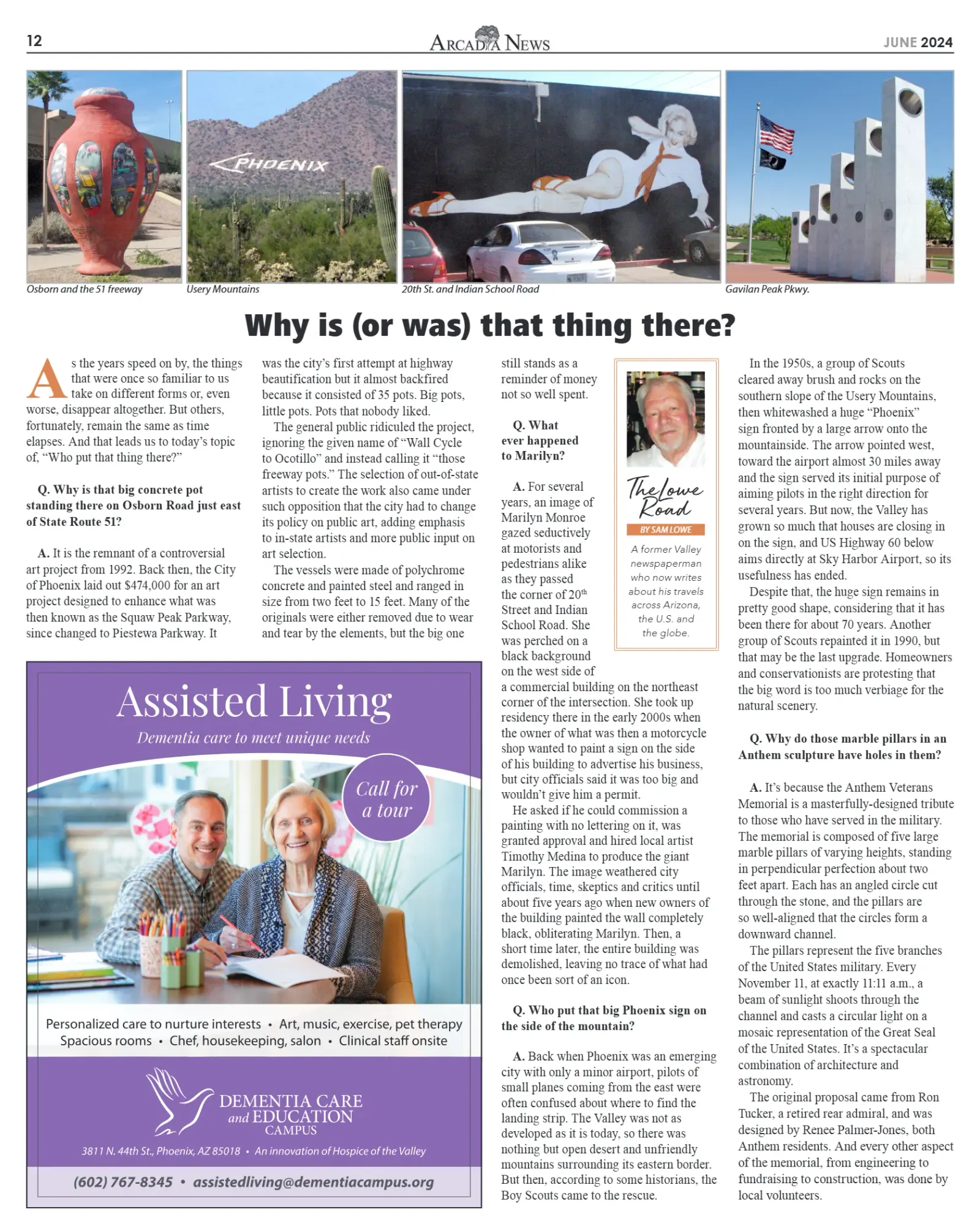

12 JUNE 2024 A s the years speed on by, the things that were once so familiar to us take on different forms or, even worse, disappear altogether. But others, fortunately, remain the same as time elapses. And that leads us to today’s topic of, “Who put that thing there?” Q. Why is that big concrete pot standing there on Osborn Road just east of State Route 51? A. It is the remnant of a controversial art project from 1992. Back then, the City of Phoenix laid out $474,000 for an art project designed to enhance what was then known as the Squaw Peak Parkway, since changed to Piestewa Parkway. It was the city’s first attempt at highway beautification but it almost backfired because it consisted of 35 pots. Big pots, little pots. Pots that nobody liked. The general public ridiculed the project, ignoring the given name of “Wall Cycle to Ocotillo” and instead calling it “those freeway pots.” The selection of out-of-state artists to create the work also came under such opposition that the city had to change its policy on public art, adding emphasis to in-state artists and more public input on art selection. The vessels were made of polychrome concrete and painted steel and ranged in size from two feet to 15 feet. Many of the originals were either removed due to wear and tear by the elements, but the big one still stands as a reminder of money not so well spent. Q. What ever happened to Marilyn? A. For several years, an image of Marilyn Monroe gazed seductively at motorists and pedestrians alike as they passed the corner of 20 th Street and Indian School Road. She was perched on a black background on the west side of a commercial building on the northeast corner of the intersection. She took up residency there in the early 2000s when the owner of what was then a motorcycle shop wanted to paint a sign on the side of his building to advertise his business, but city officials said it was too big and wouldn’t give him a permit. He asked if he could commission a painting with no lettering on it, was granted approval and hired local artist Timothy Medina to produce the giant Marilyn. The image weathered city officials, time, skeptics and critics until about five years ago when new owners of the building painted the wall completely black, obliterating Marilyn. Then, a short time later, the entire building was demolished, leaving no trace of what had once been sort of an icon. Q. Who put that big Phoenix sign on the side of the mountain? A. Back when Phoenix was an emerging city with only a minor airport, pilots of small planes coming from the east were often confused about where to find the landing strip. The Valley was not as developed as it is today, so there was nothing but open desert and unfriendly mountains surrounding its eastern border. But then, according to some historians, the Boy Scouts came to the rescue. In the 1950s, a group of Scouts cleared away brush and rocks on the southern slope of the Usery Mountains, then whitewashed a huge “Phoenix” sign fronted by a large arrow onto the mountainside. The arrow pointed west, toward the airport almost 30 miles away and the sign served its initial purpose of aiming pilots in the right direction for several years. But now, the Valley has grown so much that houses are closing in on the sign, and US Highway 60 below aims directly at Sky Harbor Airport, so its usefulness has ended. Despite that, the huge sign remains in pretty good shape, considering that it has been there for about 70 years. Another group of Scouts repainted it in 1990, but that may be the last upgrade. Homeowners and conservationists are protesting that the big word is too much verbiage for the natural scenery. Q. Why do those marble pillars in an Anthem sculpture have holes in them? A. It’s because the Anthem Veterans Memorial is a masterfully-designed tribute to those who have served in the military. The memorial is composed of five large marble pillars of varying heights, standing in perpendicular perfection about two feet apart. Each has an angled circle cut through the stone, and the pillars are so well-aligned that the circles form a downward channel. The pillars represent the five branches of the United States military. Every November 11, at exactly 11:11 a.m., a beam of sunlight shoots through the channel and casts a circular light on a mosaic representation of the Great Seal of the United States. It’s a spectacular combination of architecture and astronomy. The original proposal came from Ron Tucker, a retired rear admiral, and was designed by Renee Palmer-Jones, both Anthem residents. And every other aspect of the memorial, from engineering to fundraising to construction, was done by local volunteers. Why is (or was) that thing there? A former Valley newspaperman who now writes about his travels across Arizona, the U.S. and the globe. BY SAM LOWE Osborn and the 51 freeway Usery Mountains 20th St. and Indian School Road Gavilan Peak Pkwy.
Sean Andersen Founder & Owner MountainScapers.com Licensed, Bonded, Insured | ROC #303744 Call Today: Free Design Consultation 480-933-1740 DESIGN • INSTALLATION • SHADE STRUCTURES • HARDSCAPING • MASONRY FIRE/WATER FEATURES • IRRIGATION/LIGHTING • VERTICAL GARDENS • OUTDOOR KITCHENS Ask about our new louvered roof pergolas!