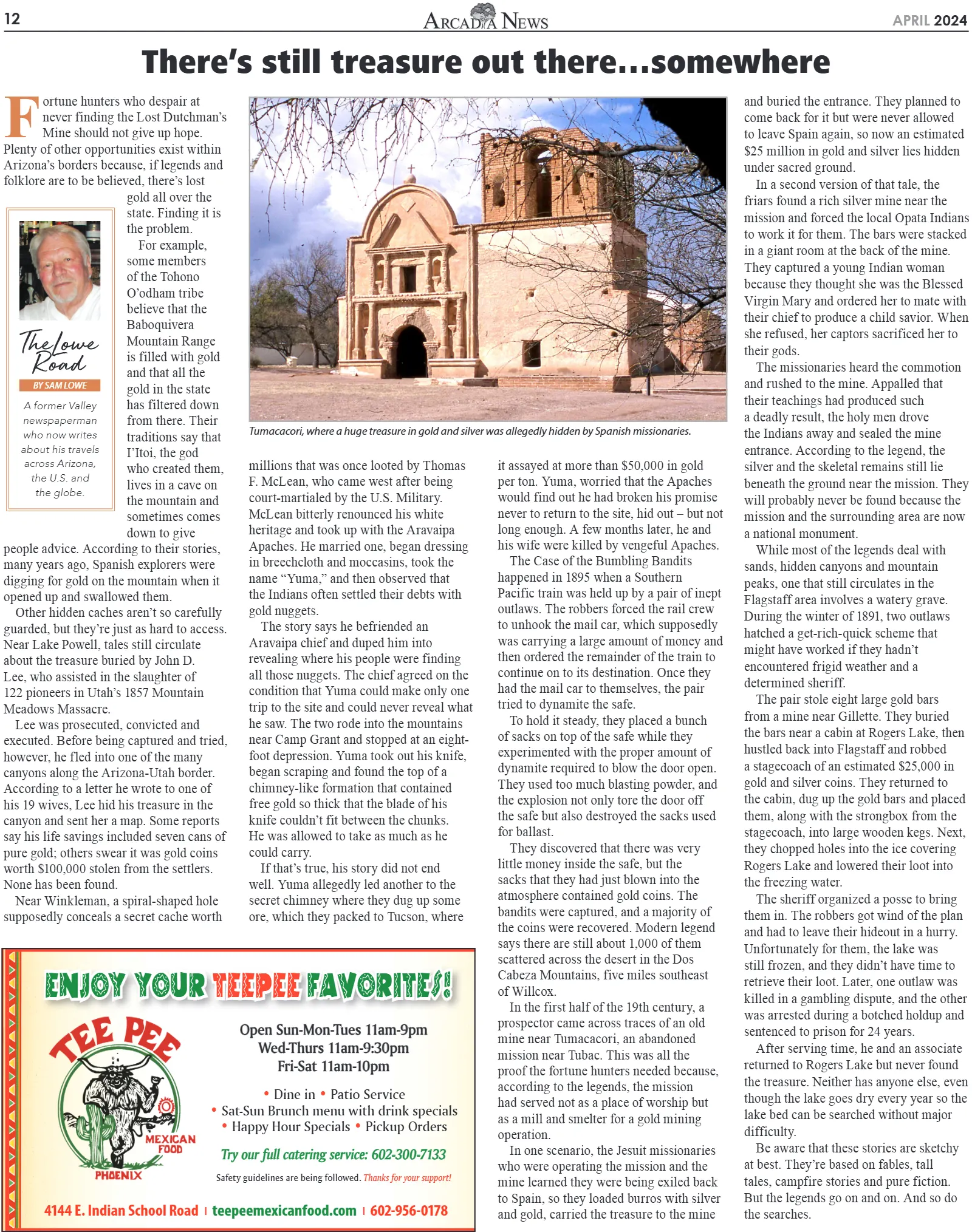

12 APRIL 2024 F ortune hunters who despair at never finding the Lost Dutchman’s Mine should not give up hope. Plenty of other opportunities exist within Arizona’s borders because, if legends and folklore are to be believed, there’s lost gold all over the state. Finding it is the problem. For example, some members of the Tohono O’odham tribe believe that the Baboquivera Mountain Range is filled with gold and that all the gold in the state has filtered down from there. Their traditions say that I’Itoi, the god who created them, lives in a cave on the mountain and sometimes comes down to give people advice. According to their stories, many years ago, Spanish explorers were digging for gold on the mountain when it opened up and swallowed them. Other hidden caches aren’t so carefully guarded, but they’re just as hard to access. Near Lake Powell, tales still circulate about the treasure buried by John D. Lee, who assisted in the slaughter of 122 pioneers in Utah’s 1857 Mountain Meadows Massacre. Lee was prosecuted, convicted and executed. Before being captured and tried, however, he fled into one of the many canyons along the Arizona-Utah border. According to a letter he wrote to one of his 19 wives, Lee hid his treasure in the canyon and sent her a map. Some reports say his life savings included seven cans of pure gold; others swear it was gold coins worth $100,000 stolen from the settlers. None has been found. Near Winkleman, a spiral-shaped hole supposedly conceals a secret cache worth millions that was once looted by Thomas F. McLean, who came west after being court-martialed by the U.S. Military. McLean bitterly renounced his white heritage and took up with the Aravaipa Apaches. He married one, began dressing in breechcloth and moccasins, took the name “Yuma,” and then observed that the Indians often settled their debts with gold nuggets. The story says he befriended an Aravaipa chief and duped him into revealing where his people were finding all those nuggets. The chief agreed on the condition that Yuma could make only one trip to the site and could never reveal what he saw. The two rode into the mountains near Camp Grant and stopped at an eight- foot depression. Yuma took out his knife, began scraping and found the top of a chimney-like formation that contained free gold so thick that the blade of his knife couldn’t fit between the chunks. He was allowed to take as much as he could carry. If that’s true, his story did not end well. Yuma allegedly led another to the secret chimney where they dug up some ore, which they packed to Tucson, where it assayed at more than $50,000 in gold per ton. Yuma, worried that the Apaches would find out he had broken his promise never to return to the site, hid out – but not long enough. A few months later, he and his wife were killed by vengeful Apaches. The Case of the Bumbling Bandits happened in 1895 when a Southern Pacific train was held up by a pair of inept outlaws. The robbers forced the rail crew to unhook the mail car, which supposedly was carrying a large amount of money and then ordered the remainder of the train to continue on to its destination. Once they had the mail car to themselves, the pair tried to dynamite the safe. To hold it steady, they placed a bunch of sacks on top of the safe while they experimented with the proper amount of dynamite required to blow the door open. They used too much blasting powder, and the explosion not only tore the door off the safe but also destroyed the sacks used for ballast. They discovered that there was very little money inside the safe, but the sacks that they had just blown into the atmosphere contained gold coins. The bandits were captured, and a majority of the coins were recovered. Modern legend says there are still about 1,000 of them scattered across the desert in the Dos Cabeza Mountains, five miles southeast of Willcox. In the first half of the 19th century, a prospector came across traces of an old mine near Tumacacori, an abandoned mission near Tubac. This was all the proof the fortune hunters needed because, according to the legends, the mission had served not as a place of worship but as a mill and smelter for a gold mining operation. In one scenario, the Jesuit missionaries who were operating the mission and the mine learned they were being exiled back to Spain, so they loaded burros with silver and gold, carried the treasure to the mine and buried the entrance. They planned to come back for it but were never allowed to leave Spain again, so now an estimated $25 million in gold and silver lies hidden under sacred ground. In a second version of that tale, the friars found a rich silver mine near the mission and forced the local Opata Indians to work it for them. The bars were stacked in a giant room at the back of the mine. They captured a young Indian woman because they thought she was the Blessed Virgin Mary and ordered her to mate with their chief to produce a child savior. When she refused, her captors sacrificed her to their gods. The missionaries heard the commotion and rushed to the mine. Appalled that their teachings had produced such a deadly result, the holy men drove the Indians away and sealed the mine entrance. According to the legend, the silver and the skeletal remains still lie beneath the ground near the mission. They will probably never be found because the mission and the surrounding area are now a national monument. While most of the legends deal with sands, hidden canyons and mountain peaks, one that still circulates in the Flagstaff area involves a watery grave. During the winter of 1891, two outlaws hatched a get-rich-quick scheme that might have worked if they hadn’t encountered frigid weather and a determined sheriff. The pair stole eight large gold bars from a mine near Gillette. They buried the bars near a cabin at Rogers Lake, then hustled back into Flagstaff and robbed a stagecoach of an estimated $25,000 in gold and silver coins. They returned to the cabin, dug up the gold bars and placed them, along with the strongbox from the stagecoach, into large wooden kegs. Next, they chopped holes into the ice covering Rogers Lake and lowered their loot into the freezing water. The sheriff organized a posse to bring them in. The robbers got wind of the plan and had to leave their hideout in a hurry. Unfortunately for them, the lake was still frozen, and they didn’t have time to retrieve their loot. Later, one outlaw was killed in a gambling dispute, and the other was arrested during a botched holdup and sentenced to prison for 24 years. After serving time, he and an associate returned to Rogers Lake but never found the treasure. Neither has anyone else, even though the lake goes dry every year so the lake bed can be searched without major difficulty. Be aware that these stories are sketchy at best. They’re based on fables, tall tales, campfire stories and pure fiction. But the legends go on and on. And so do the searches. There’s still treasure out there…somewhere A former Valley newspaperman who now writes about his travels across Arizona, the U.S. and the globe. BY SAM LOWE Tumacacori, where a huge treasure in gold and silver was allegedly hidden by Spanish missionaries. O Op pe en n S Su un n- -M Mo on n- -T Tu ue es s 1 11 1a am m- -9 9p pm m W We ed d- -T Th hu ur rs s 1 11 1a am m- -9 9: :3 30 0p pm m F Fr ri i- -S Sa at t 1 11 1a am m- -1 10 0p pm m • Dine in • Patio Service • Sat-Sun Brunch menu with drink specials • Happy Hour Specials • Pickup Orders T Tr ry y o ou ur r f fu ul ll l c ca at te er ri in ng g s se er rv vi ic ce e: : 6 60 02 2- -3 30 00 0- -7 71 13 33 3 Safety guidelines are being followed. Thanks for your support! 4144 E. Indian School Road | teepeemexicanfood.com teepeemexicanfood.com | 602-956-0178 602-956-0178 ENJOY YOUR ENJOY YOUR TEEPEE TEEPEE FAVORITES! FAVORITES!