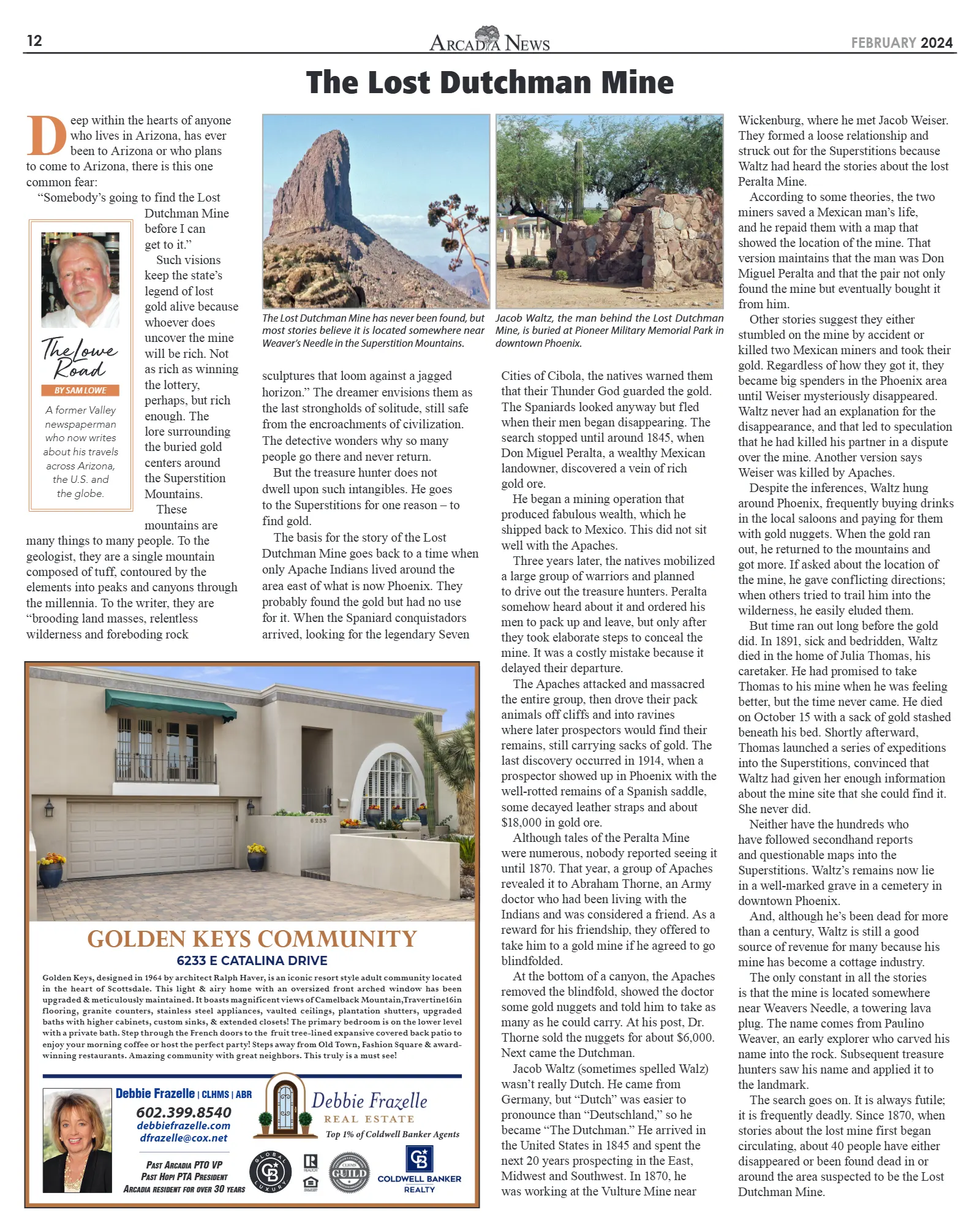
12 FEBRUARY 2024 D eep within the hearts of anyone who lives in Arizona, has ever been to Arizona or who plans to come to Arizona, there is this one common fear: “Somebody’s going to find the Lost Dutchman Mine before I can get to it.” Such visions keep the state’s legend of lost gold alive because whoever does uncover the mine will be rich. Not as rich as winning the lottery, perhaps, but rich enough. The lore surrounding the buried gold centers around the Superstition Mountains. These mountains are many things to many people. To the geologist, they are a single mountain composed of tuff, contoured by the elements into peaks and canyons through the millennia. To the writer, they are “brooding land masses, relentless wilderness and foreboding rock sculptures that loom against a jagged horizon.” The dreamer envisions them as the last strongholds of solitude, still safe from the encroachments of civilization. The detective wonders why so many people go there and never return. But the treasure hunter does not dwell upon such intangibles. He goes to the Superstitions for one reason – to find gold. The basis for the story of the Lost Dutchman Mine goes back to a time when only Apache Indians lived around the area east of what is now Phoenix. They probably found the gold but had no use for it. When the Spaniard conquistadors arrived, looking for the legendary Seven Cities of Cibola, the natives warned them that their Thunder God guarded the gold. The Spaniards looked anyway but fled when their men began disappearing. The search stopped until around 1845, when Don Miguel Peralta, a wealthy Mexican landowner, discovered a vein of rich gold ore. He began a mining operation that produced fabulous wealth, which he shipped back to Mexico. This did not sit well with the Apaches. Three years later, the natives mobilized a large group of warriors and planned to drive out the treasure hunters. Peralta somehow heard about it and ordered his men to pack up and leave, but only after they took elaborate steps to conceal the mine. It was a costly mistake because it delayed their departure. The Apaches attacked and massacred the entire group, then drove their pack animals off cliffs and into ravines where later prospectors would find their remains, still carrying sacks of gold. The last discovery occurred in 1914, when a prospector showed up in Phoenix with the well-rotted remains of a Spanish saddle, some decayed leather straps and about $18,000 in gold ore. Although tales of the Peralta Mine were numerous, nobody reported seeing it until 1870. That year, a group of Apaches revealed it to Abraham Thorne, an Army doctor who had been living with the Indians and was considered a friend. As a reward for his friendship, they offered to take him to a gold mine if he agreed to go blindfolded. At the bottom of a canyon, the Apaches removed the blindfold, showed the doctor some gold nuggets and told him to take as many as he could carry. At his post, Dr. Thorne sold the nuggets for about $6,000. Next came the Dutchman. Jacob Waltz (sometimes spelled Walz) wasn’t really Dutch. He came from Germany, but “Dutch” was easier to pronounce than “Deutschland,” so he became “The Dutchman.” He arrived in the United States in 1845 and spent the next 20 years prospecting in the East, Midwest and Southwest. In 1870, he was working at the Vulture Mine near Wickenburg, where he met Jacob Weiser. They formed a loose relationship and struck out for the Superstitions because Waltz had heard the stories about the lost Peralta Mine. According to some theories, the two miners saved a Mexican man’s life, and he repaid them with a map that showed the location of the mine. That version maintains that the man was Don Miguel Peralta and that the pair not only found the mine but eventually bought it from him. Other stories suggest they either stumbled on the mine by accident or killed two Mexican miners and took their gold. Regardless of how they got it, they became big spenders in the Phoenix area until Weiser mysteriously disappeared. Waltz never had an explanation for the disappearance, and that led to speculation that he had killed his partner in a dispute over the mine. Another version says Weiser was killed by Apaches. Despite the inferences, Waltz hung around Phoenix, frequently buying drinks in the local saloons and paying for them with gold nuggets. When the gold ran out, he returned to the mountains and got more. If asked about the location of the mine, he gave conflicting directions; when others tried to trail him into the wilderness, he easily eluded them. But time ran out long before the gold did. In 1891, sick and bedridden, Waltz died in the home of Julia Thomas, his caretaker. He had promised to take Thomas to his mine when he was feeling better, but the time never came. He died on October 15 with a sack of gold stashed beneath his bed. Shortly afterward, Thomas launched a series of expeditions into the Superstitions, convinced that Waltz had given her enough information about the mine site that she could find it. She never did. Neither have the hundreds who have followed secondhand reports and questionable maps into the Superstitions. Waltz’s remains now lie in a well-marked grave in a cemetery in downtown Phoenix. And, although he’s been dead for more than a century, Waltz is still a good source of revenue for many because his mine has become a cottage industry. The only constant in all the stories is that the mine is located somewhere near Weavers Needle, a towering lava plug. The name comes from Paulino Weaver, an early explorer who carved his name into the rock. Subsequent treasure hunters saw his name and applied it to the landmark. The search goes on. It is always futile; it is frequently deadly. Since 1870, when stories about the lost mine first began circulating, about 40 people have either disappeared or been found dead in or around the area suspected to be the Lost Dutchman Mine. The Lost Dutchman Mine A former Valley newspaperman who now writes about his travels across Arizona, the U.S. and the globe. BY SAM LOWE The Lost Dutchman Mine has never been found, but most stories believe it is located somewhere near Weaver’s Needle in the Superstition Mountains. Jacob Waltz, the man behind the Lost Dutchman Mine, is buried at Pioneer Military Memorial Park in downtown Phoenix. 602.399.8540 debbiefrazelle.com dfrazelle@cox.net PAST ARCADIA PTO VP PAST HOPI PTA PRESIDENT ARCADIA RESIDENT FOR OVER 30 YEARS Top 1% of Coldwell Banker Agents Debbie Frazelle | CLHMS | ABR Golden Keys, designed in 1964 by architect Ralph Haver, is an iconic resort style adult community located in the heart of Scottsdale. This light & airy home with an oversized front arched window has been upgraded & meticulously maintained. It boasts magnificent views of Camelback Mountain,Travertine16in flooring, granite counters, stainless steel appliances, vaulted ceilings, plantation shutters, upgraded baths with higher cabinets, custom sinks, & extended closets! The primary bedroom is on the lower level with a private bath. Step through the French doors to the fruit tree-lined expansive covered back patio to enjoy your morning coffee or host the perfect party! Steps away from Old Town, Fashion Square & award- winning restaurants. Amazing community with great neighbors. This truly is a must see! GOLDEN KEYS COMMUNITY 6233 E CATALINA DRIVE
13 FEBRUARY 2024 By Rachael Bouley A new app and QR code safety system designed by Valley dad Justin Behnke is giving greater peace of mind to families and caretakers of those who have autism, dementia, and Alzheimer’s. Behnke came up with the idea for Scan Me Home to keep his 12-year-old son safe. Jaxon has autism, is non-verbal, and has a tendency to wander off. “My son is the whole reason and purpose behind Scan Me Home. If Jaxon were to get lost, he has no way to tell anyone who he is or where he belongs,” Behnke said. “I needed something that works for him. Many kids and adults like Jaxon – with sensory issues – won’t wear bracelets or necklaces or keep anything in their pockets.” Needing something Jaxon couldn’t see, feel or touch, Behnke developed iron-on QR codes, which can be added to clothing and other personal items without bothering the wearer. It’s been a game-changer for Behnke and something he wants to share with other parents and caregivers in similar situations. After a positive community response, he rebuilt the app to make it easier to use and provide users with a simple way to reconnect with missing loved ones. Users create a Scan Me Home account and QR code, with the option to add contact details and medical info. They can buy iron-on tags to use on clothing, backpacks and jackets or check out the t-shirt line with QR codes already printed on them. “Once the code is scanned, the parent or caregiver profile comes up, and it’s a simple click to call the assigned person, thus lessening the time of separation,” Behnke explained. As a user of his own product, Behnke is reassured knowing his son has a better chance to get home if he ever slips out on his own. “I’ve come to realize if you live with or have a neuro-challenged person in your life, you get it immediately,” he added. “You don’t need it until you are desperate. I hope Scan Me Home can get ahead of any families’ desperate need.” Behnke looks forward to partnering with local schools and businesses to drive community support and awareness. While competitors charge up to $50 a month for a more generic lost-and- found solution, he’s proud to offer free accounts and codes to use immediately or an upgraded version with extra features and merchandise for $9.95 a month. Affordability and accessibility remain very important to Behnke, who wants Scan Me Home to support the most vulnerable populations. So far, the feedback has been very supportive. “The calls, messages, families and users have all been incredible. Everybody wants to help in some way, and that’s special,” Behnke said. “Whether someone is a nonverbal autistic human or a person who has dementia, we want to help as many people as we can to be a little safer when leaving their homes.” scanmehome.com Dad creates app to get children home Justin Behnke ANTHROPOLOGIE ARHAUS CORNELIA PARK EVEREVE GORJANA J.CREW LULULEMON POTTERY BARN RYE 51 WILLIAMS-SONOMA +MORE GET READY for fashion envy SCAN TO UNLOCK FASHION BIL-24104 A1 February Print Ads.indd 1 BIL-24104 A1 February Print Ads.indd 1 1/10/24 9:31 AM 1/10/24 9:31 AM