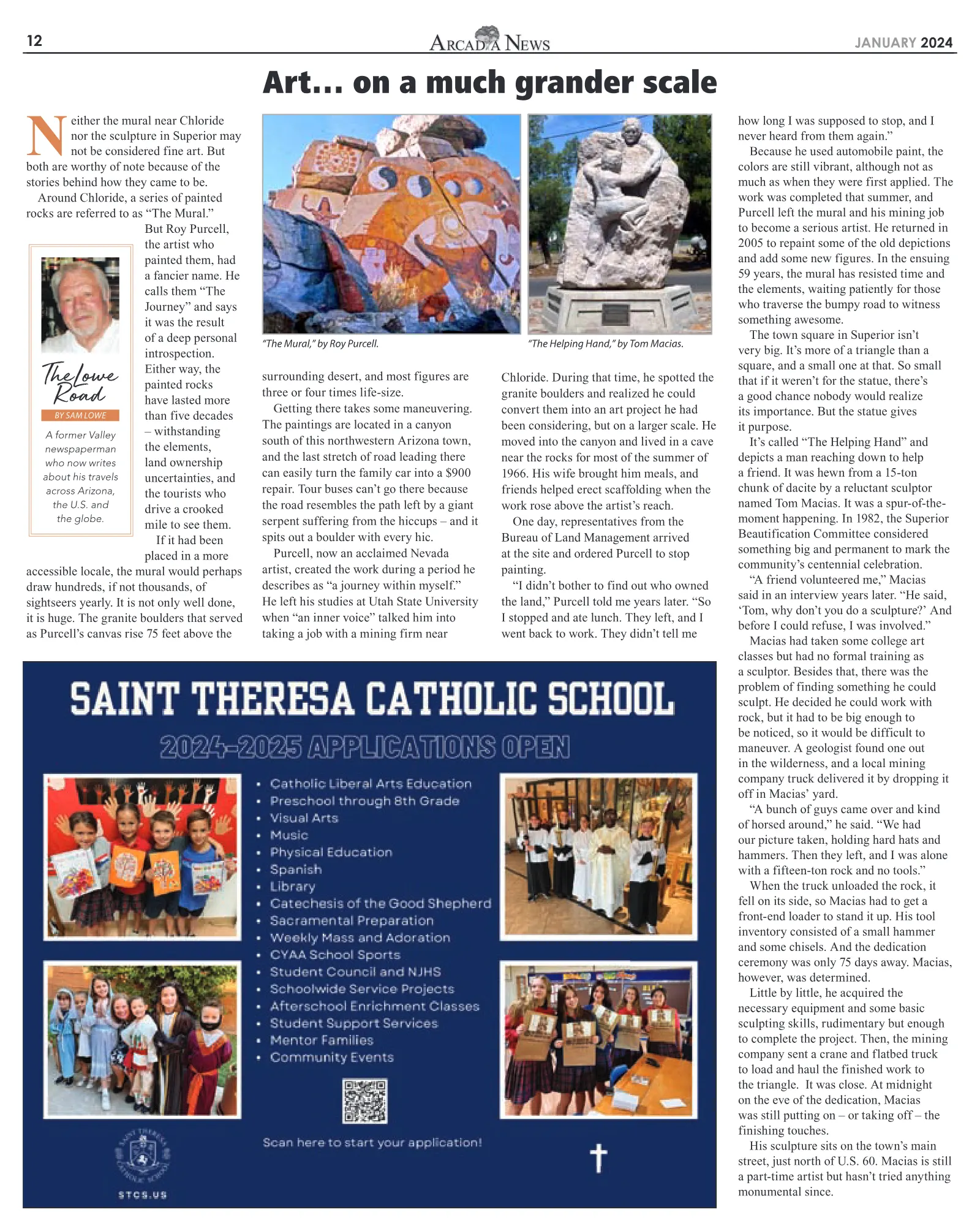

12 JANUARY 2024 N either the mural near Chloride nor the sculpture in Superior may not be considered fine art. But both are worthy of note because of the stories behind how they came to be. Around Chloride, a series of painted rocks are referred to as “The Mural.” But Roy Purcell, the artist who painted them, had a fancier name. He calls them “The Journey” and says it was the result of a deep personal introspection. Either way, the painted rocks have lasted more than five decades – withstanding the elements, land ownership uncertainties, and the tourists who drive a crooked mile to see them. If it had been placed in a more accessible locale, the mural would perhaps draw hundreds, if not thousands, of sightseers yearly. It is not only well done, it is huge. The granite boulders that served as Purcell’s canvas rise 75 feet above the surrounding desert, and most figures are three or four times life-size. Getting there takes some maneuvering. The paintings are located in a canyon south of this northwestern Arizona town, and the last stretch of road leading there can easily turn the family car into a $900 repair. Tour buses can’t go there because the road resembles the path left by a giant serpent suffering from the hiccups – and it spits out a boulder with every hic. Purcell, now an acclaimed Nevada artist, created the work during a period he describes as “a journey within myself.” He left his studies at Utah State University when “an inner voice” talked him into taking a job with a mining firm near Chloride. During that time, he spotted the granite boulders and realized he could convert them into an art project he had been considering, but on a larger scale. He moved into the canyon and lived in a cave near the rocks for most of the summer of 1966. His wife brought him meals, and friends helped erect scaffolding when the work rose above the artist’s reach. One day, representatives from the Bureau of Land Management arrived at the site and ordered Purcell to stop painting. “I didn’t bother to find out who owned the land,” Purcell told me years later. “So I stopped and ate lunch. They left, and I went back to work. They didn’t tell me how long I was supposed to stop, and I never heard from them again.” Because he used automobile paint, the colors are still vibrant, although not as much as when they were first applied. The work was completed that summer, and Purcell left the mural and his mining job to become a serious artist. He returned in 2005 to repaint some of the old depictions and add some new figures. In the ensuing 59 years, the mural has resisted time and the elements, waiting patiently for those who traverse the bumpy road to witness something awesome. The town square in Superior isn’t very big. It’s more of a triangle than a square, and a small one at that. So small that if it weren’t for the statue, there’s a good chance nobody would realize its importance. But the statue gives it purpose. It’s called “The Helping Hand” and depicts a man reaching down to help a friend. It was hewn from a 15-ton chunk of dacite by a reluctant sculptor named Tom Macias. It was a spur-of-the- moment happening. In 1982, the Superior Beautification Committee considered something big and permanent to mark the community’s centennial celebration. “A friend volunteered me,” Macias said in an interview years later. “He said, ‘Tom, why don’t you do a sculpture?’ And before I could refuse, I was involved.” Macias had taken some college art classes but had no formal training as a sculptor. Besides that, there was the problem of finding something he could sculpt. He decided he could work with rock, but it had to be big enough to be noticed, so it would be difficult to maneuver. A geologist found one out in the wilderness, and a local mining company truck delivered it by dropping it off in Macias’ yard. “A bunch of guys came over and kind of horsed around,” he said. “We had our picture taken, holding hard hats and hammers. Then they left, and I was alone with a fifteen-ton rock and no tools.” When the truck unloaded the rock, it fell on its side, so Macias had to get a front-end loader to stand it up. His tool inventory consisted of a small hammer and some chisels. And the dedication ceremony was only 75 days away. Macias, however, was determined. Little by little, he acquired the necessary equipment and some basic sculpting skills, rudimentary but enough to complete the project. Then, the mining company sent a crane and flatbed truck to load and haul the finished work to the triangle. It was close. At midnight on the eve of the dedication, Macias was still putting on – or taking off – the finishing touches. His sculpture sits on the town’s main street, just north of U.S. 60. Macias is still a part-time artist but hasn’t tried anything monumental since. Art… on a much grander scale The Lowe Road A former Valley newspaperman who now writes about his travels across Arizona, the U.S. and the globe. BY SAM LOWE “The Helping Hand,” by Tom Macias. “The Mural,” by Roy Purcell.
13 JANUARY 2024 By Mallory Gleich After installing a Level 2 EV car charger at his house, Aaron Lieberman realized he only needed to use the charger one night a week. Other than that, the station was completely unused. This was Lieberman’s moment of inspiration – and the impetus behind his new business. Buzze is a neighborhood EV (electric vehicle) charging app with over 150 “fast Level 2 EV chargers” located at people’s homes across the Valley. Like Airbnb for EV charging, Buzze lets anyone with a home charger list it on the app – and get paid. “These Buzze hosts can generate extra income, up to $400 a month, by offering charging at home,” Marketing Exec Candace Youde said. “At the same time, any driver who needs a charge has access to hundreds of chargers, many of which are located in the neighborhood.” All level 2 EV chargers are unused 95 percent of the time, according to Youde. Buzze’s mission is to create a network to help those who are ‘charging challenged’ get one million new EVs to the road, which would remove 4.6 million metric tons of carbon dioxide from the air annually. Those interested can download the app, which shows drivers a map of nearby Level 2 charging hosts to select from. Then, they can schedule a charging appointment. The driver arrives at the host’s home to charge their vehicle. The app then meters the charge through the car’s telematics to determine the payment. Buzze charges the driver and compensates the host for the energy used, allowing them to earn additional income – even if they’re not home. Buzze is an Arizona startup with national ambitions to encourage individuals to switch to electric vehicles and promote sustainable transportation options. Lieberman’s name may sound familiar to some. He is a former Arizona State Representative who served for three years before running for governor in 2022. He’s also an Arcadia resident who hopes to expand Buzze to new markets in the near future. “The company’s initial geographic focus is the greater Phoenix area,” she said. “Just through word of mouth, Buzze currently has almost 100 hosts in 30 states outside of Arizona, and 160+ hosts in our state.” The ultimate goal of this company is to build a community of “drivers helping drivers.” “Buzze hopes to encourage the adoption of electric vehicles and contribute to a cleaner and more sustainable future. For the 40 percent of Americans who rent their home, the high install costs of level 2 home chargers mean they will not be able to access fast home charging,” Youde said. Earn extra money, help out a neighbor, and lower the carbon footprint simultaneously – this is Buzze’s ultimate goal. buzze.biz New company making a ‘buzze’ around town Aaron Lieberman ANTHROPOLOGIE ARHAUS CORNELIA PARK EVEREVE GORJANA J.CREW LULULEMON POTTERY BARN RYE 51 WILLIAMS-SONOMA +MORE GET READY for fashion envy SCAN TO UNLOCK FASHION BIL-23138 A4 January print Ads.indd 1 12/18/23 2:40 PM