
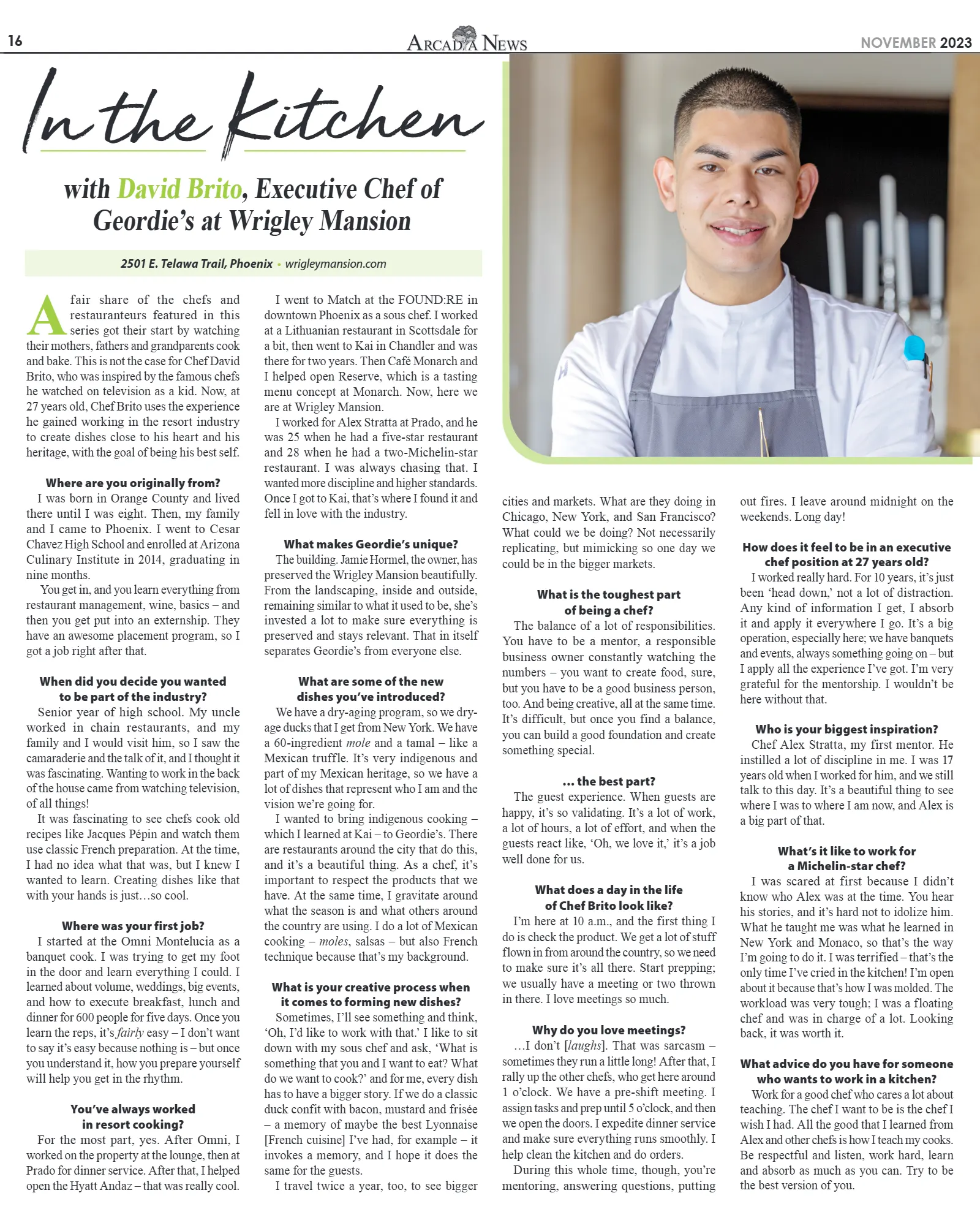
NOVEMBER 2023 16 with David Brito, Executive Chef of Geordie’s at Wrigley Mansion A fair share of the chefs and restauranteurs featured in this series got their start by watching their mothers, fathers and grandparents cook and bake. This is not the case for Chef David Brito, who was inspired by the famous chefs he watched on television as a kid. Now, at 27 years old, Chef Brito uses the experience he gained working in the resort industry to create dishes close to his heart and his heritage, with the goal of being his best self. Where are you originally from? I was born in Orange County and lived there until I was eight. Then, my family and I came to Phoenix. I went to Cesar Chavez High School and enrolled at Arizona Culinary Institute in 2014, graduating in nine months. You get in, and you learn everything from restaurant management, wine, basics – and then you get put into an externship. They have an awesome placement program, so I got a job right after that. When did you decide you wanted to be part of the industry? Senior year of high school. My uncle worked in chain restaurants, and my family and I would visit him, so I saw the camaraderie and the talk of it, and I thought it was fascinating. Wanting to work in the back of the house came from watching television, of all things! It was fascinating to see chefs cook old recipes like Jacques Pépin and watch them use classic French preparation. At the time, I had no idea what that was, but I knew I wanted to learn. Creating dishes like that with your hands is just…so cool. Where was your first job? I started at the Omni Montelucia as a banquet cook. I was trying to get my foot in the door and learn everything I could. I learned about volume, weddings, big events, and how to execute breakfast, lunch and dinner for 600 people for five days. Once you learn the reps, it’s fairly easy – I don’t want to say it’s easy because nothing is – but once you understand it, how you prepare yourself will help you get in the rhythm. You’ve always worked in resort cooking? For the most part, yes. After Omni, I worked on the property at the lounge, then at Prado for dinner service. After that, I helped open the Hyatt Andaz – that was really cool. I went to Match at the FOUND:RE in downtown Phoenix as a sous chef. I worked at a Lithuanian restaurant in Scottsdale for a bit, then went to Kai in Chandler and was there for two years. Then Café Monarch and I helped open Reserve, which is a tasting menu concept at Monarch. Now, here we are at Wrigley Mansion. I worked for Alex Stratta at Prado, and he was 25 when he had a five-star restaurant and 28 when he had a two-Michelin-star restaurant. I was always chasing that. I wanted more discipline and higher standards. Once I got to Kai, that’s where I found it and fell in love with the industry. What makes Geordie’s unique? The building. Jamie Hormel, the owner, has preserved the Wrigley Mansion beautifully. From the landscaping, inside and outside, remaining similar to what it used to be, she’s invested a lot to make sure everything is preserved and stays relevant. That in itself separates Geordie’s from everyone else. What are some of the new dishes you’ve introduced? We have a dry-aging program, so we dry- age ducks that I get from New York. We have a 60-ingredient mole and a tamal – like a Mexican truffle. It’s very indigenous and part of my Mexican heritage, so we have a lot of dishes that represent who I am and the vision we’re going for. I wanted to bring indigenous cooking – which I learned at Kai – to Geordie’s. There are restaurants around the city that do this, and it’s a beautiful thing. As a chef, it’s important to respect the products that we have. At the same time, I gravitate around what the season is and what others around the country are using. I do a lot of Mexican cooking – moles , salsas – but also French technique because that’s my background. What is your creative process when it comes to forming new dishes? Sometimes, I’ll see something and think, ‘Oh, I’d like to work with that.’ I like to sit down with my sous chef and ask, ‘What is something that you and I want to eat? What do we want to cook?’ and for me, every dish has to have a bigger story. If we do a classic duck confit with bacon, mustard and frisée – a memory of maybe the best Lyonnaise [French cuisine] I’ve had, for example – it invokes a memory, and I hope it does the same for the guests. I travel twice a year, too, to see bigger cities and markets. What are they doing in Chicago, New York, and San Francisco? What could we be doing? Not necessarily replicating, but mimicking so one day we could be in the bigger markets. What is the toughest part of being a chef? The balance of a lot of responsibilities. You have to be a mentor, a responsible business owner constantly watching the numbers – you want to create food, sure, but you have to be a good business person, too. And being creative, all at the same time. It’s difficult, but once you find a balance, you can build a good foundation and create something special. … the best part? The guest experience. When guests are happy, it’s so validating. It’s a lot of work, a lot of hours, a lot of effort, and when the guests react like, ‘Oh, we love it,’ it’s a job well done for us. What does a day in the life of Chef Brito look like? I’m here at 10 a.m., and the first thing I do is check the product. We get a lot of stuff flown in from around the country, so we need to make sure it’s all there. Start prepping; we usually have a meeting or two thrown in there. I love meetings so much. Why do you love meetings? …I don’t [ laughs ]. That was sarcasm – sometimes they run a little long! After that, I rally up the other chefs, who get here around 1 o’clock. We have a pre-shift meeting. I assign tasks and prep until 5 o’clock, and then we open the doors. I expedite dinner service and make sure everything runs smoothly. I help clean the kitchen and do orders. During this whole time, though, you’re mentoring, answering questions, putting out fires. I leave around midnight on the weekends. Long day! How does it feel to be in an executive chef position at 27 years old? I worked really hard. For 10 years, it’s just been ‘head down,’ not a lot of distraction. Any kind of information I get, I absorb it and apply it everywhere I go. It’s a big operation, especially here; we have banquets and events, always something going on – but I apply all the experience I’ve got. I’m very grateful for the mentorship. I wouldn’t be here without that. Who is your biggest inspiration? Chef Alex Stratta, my first mentor. He instilled a lot of discipline in me. I was 17 years old when I worked for him, and we still talk to this day. It’s a beautiful thing to see where I was to where I am now, and Alex is a big part of that. What’s it like to work for a Michelin-star chef? I was scared at first because I didn’t know who Alex was at the time. You hear his stories, and it’s hard not to idolize him. What he taught me was what he learned in New York and Monaco, so that’s the way I’m going to do it. I was terrified – that’s the only time I’ve cried in the kitchen! I’m open about it because that’s how I was molded. The workload was very tough; I was a floating chef and was in charge of a lot. Looking back, it was worth it. What advice do you have for someone who wants to work in a kitchen? Work for a good chef who cares a lot about teaching. The chef I want to be is the chef I wish I had. All the good that I learned from Alex and other chefs is how I teach my cooks. Be respectful and listen, work hard, learn and absorb as much as you can. Try to be the best version of you. 2501 E. Telawa Trail, Phoenix • wrigleymansion.com In the Kitchen
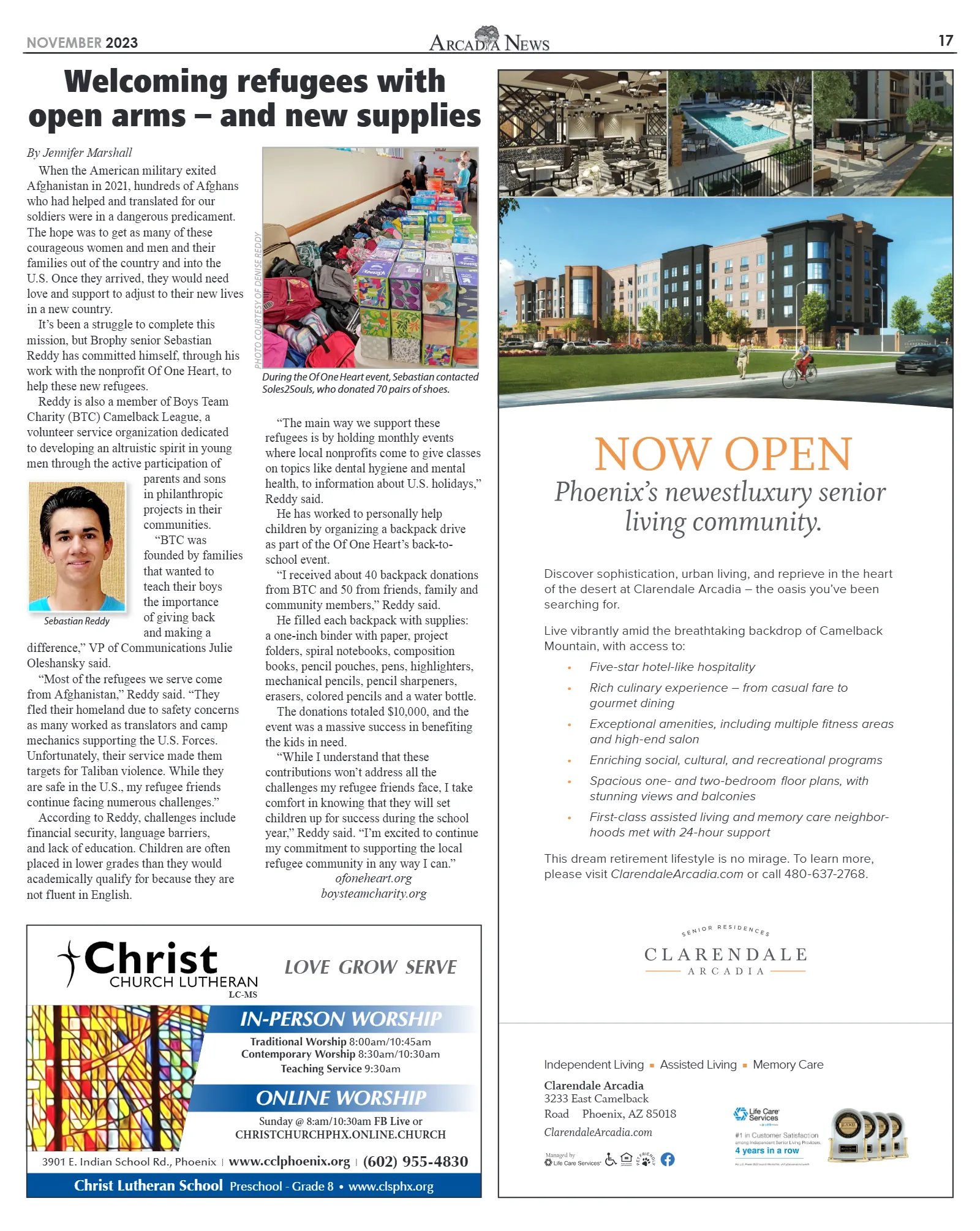
17 NOVEMBER 2023 By Jennifer Marshall When the American military exited Afghanistan in 2021, hundreds of Afghans who had helped and translated for our soldiers were in a dangerous predicament. The hope was to get as many of these courageous women and men and their families out of the country and into the U.S. Once they arrived, they would need love and support to adjust to their new lives in a new country. It’s been a struggle to complete this mission, but Brophy senior Sebastian Reddy has committed himself, through his work with the nonprofit Of One Heart, to help these new refugees. Reddy is also a member of Boys Team Charity (BTC) Camelback League, a volunteer service organization dedicated to developing an altruistic spirit in young men through the active participation of parents and sons in philanthropic projects in their communities. “BTC was founded by families that wanted to teach their boys the importance of giving back and making a difference,” VP of Communications Julie Oleshansky said. “Most of the refugees we serve come from Afghanistan,” Reddy said. “They fled their homeland due to safety concerns as many worked as translators and camp mechanics supporting the U.S. Forces. Unfortunately, their service made them targets for Taliban violence. While they are safe in the U.S., my refugee friends continue facing numerous challenges.” According to Reddy, challenges include financial security, language barriers, and lack of education. Children are often placed in lower grades than they would academically qualify for because they are not fluent in English. “The main way we support these refugees is by holding monthly events where local nonprofits come to give classes on topics like dental hygiene and mental health, to information about U.S. holidays,” Reddy said. He has worked to personally help children by organizing a backpack drive as part of the Of One Heart’s back-to- school event. “I received about 40 backpack donations from BTC and 50 from friends, family and community members,” Reddy said. He filled each backpack with supplies: a one-inch binder with paper, project folders, spiral notebooks, composition books, pencil pouches, pens, highlighters, mechanical pencils, pencil sharpeners, erasers, colored pencils and a water bottle. The donations totaled $10,000, and the event was a massive success in benefiting the kids in need. “While I understand that these contributions won’t address all the challenges my refugee friends face, I take comfort in knowing that they will set children up for success during the school year,” Reddy said. “I’m excited to continue my commitment to supporting the local refugee community in any way I can.” ofoneheart.org boysteamcharity.org Welcoming refugees with open arms – and new supplies Sebastian Reddy During the Of One Heart event, Sebastian contacted Soles2Souls, who donated 70 pairs of shoes. PHOTO COURTESY OF DENISE REDDY Christ Lutheran School Preschool - Grade 8 • www.clsphx.org LC-MS 3901 E. Indian School Rd., Phoenix | www.cclphoenix.org | (602) 955-4830 LOVE GROW SERVE IN-PERSON WORSHIP Traditional Worship 8:00am/10:45am Contemporary Worship 8:30am/10:30am Teaching Service 9:30am ONLINE WORSHIP Sunday @ 8:am/10:30am FB Live or CHRISTCHURCHPHX.ONLINE.CHURCH Discover sophistication, urban living, and reprieve in the heart of the desert at Clarendale Arcadia – the oasis you’ve been searching for. Live vibrantly amid the breathtaking backdrop of Camelback Mountain, with access to: • Five-star hotel-like hospitality • Rich culinary experience – from casual fare to gourmet dining • Exceptional amenities, including multiple fitness areas and high-end salon • Enriching social, cultural, and recreational programs • Spacious one- and two-bedroom stunning views and balconies • First-class assisted living and floor plans, with memory care neighbor- hoods met with 24-hour support This dream retirement lifestyle is no mirage. To learn more, please visit ClarendaleArcadia.com or call 480-637-2768. NOW OPEN Phoenix’s newestluxury senior living community. Independent Living ■ Assisted Living ■ Memory Care Clarendale Arcadia 3233 East Camelback Road Phoenix, AZ 85018 ClarendaleArcadia.com