
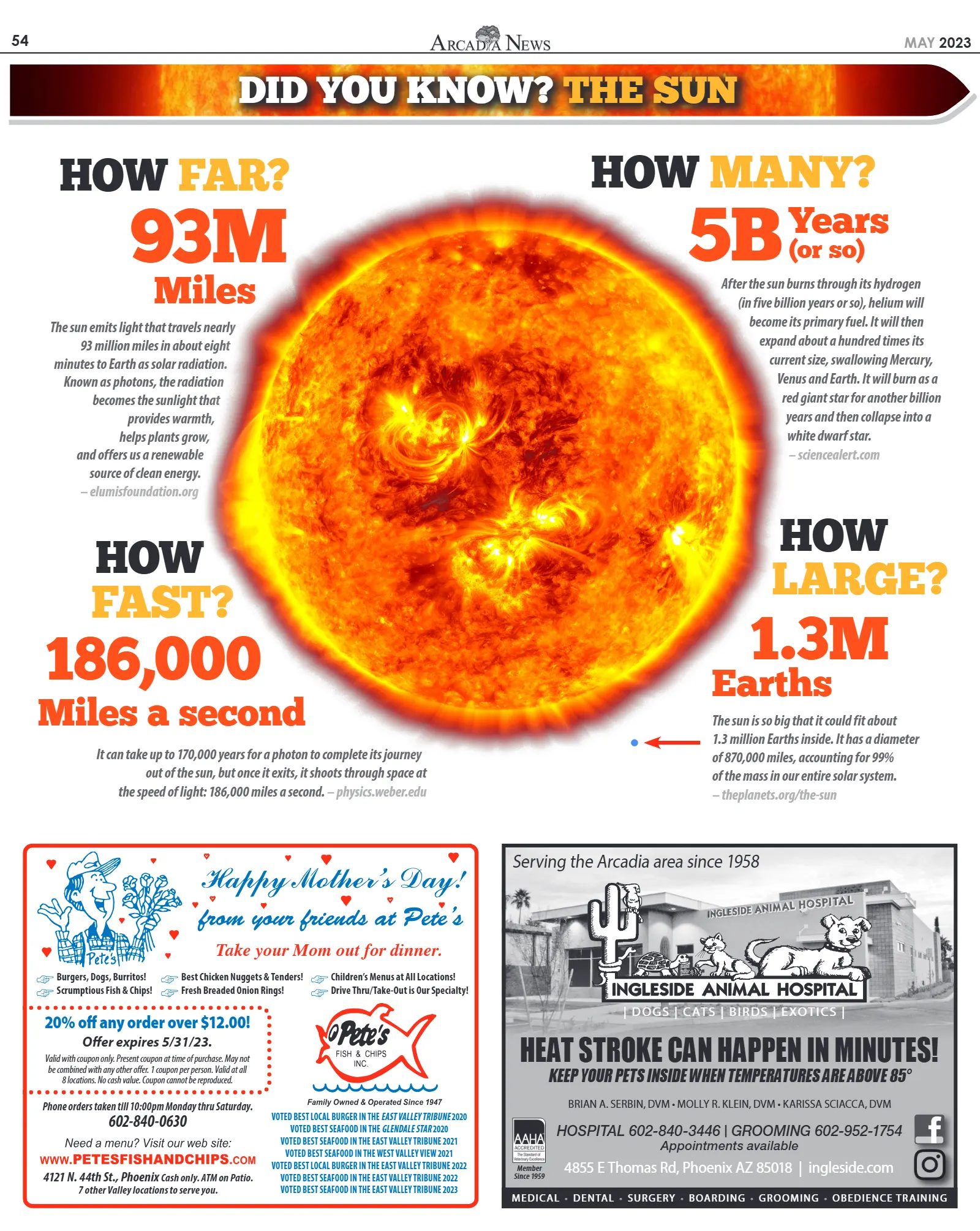
MAY 2023 54 HOW LARGE? 93M 93M Miles Miles After the sun burns through its hydrogen (in five billion years or so), helium will become its primary fuel. It will then expand about a hundred times its current size, swallowing Mercury, Venus and Earth. It will burn as a red giant star for another billion years and then collapse into a white dwarf star. – sciencealert.com HOW MANY? HOW FAST? 5B 5B 1.3M 1.3M Earths Earths DID YOU KNOW? THE SUN The sun is so big that it could fit about 1.3 million Earths inside. It has a diameter of 870,000 miles, accounting for 99% of the mass in our entire solar system. – theplanets.org/the-sun It can take up to 170,000 years for a photon to complete its journey out of the sun, but once it exits, it shoots through space at the speed of light: 186,000 miles a second. – physics.weber.edu 186,000 186,000 Miles a second Miles a second HOW HOW FAR? FAR? The sun emits light that travels nearly 93 million miles in about eight minutes to Earth as solar radiation. Known as photons, the radiation becomes the sunlight that provides warmth, helps plants grow, and offers us a renewable source of clean energy. – elumisfoundation.org Years Years (or so) (or so) VOTED BEST LOCAL BURGER IN THE EAST VALLEY TRIBUNE 2020 VOTED BEST SEAFOOD IN THE GLENDALE STAR 2020 VOTED BEST SEAFOOD IN THE EAST VALLEY TRIBUNE 2021 VOTED BEST SEAFOOD IN THE WEST VALLEY VIEW 2021 VOTED BEST LOCAL BURGER IN THE EAST VALLEY TRIBUNE 2022 VOTED BEST SEAFOOD IN THE EAST VALLEY TRIBUNE 2022 VOTED BEST SEAFOOD IN THE EAST VALLEY TRIBUNE 2023 20% off any order over $12.00! Offer expires 5/31/23. Valid with coupon only. Present coupon at time of purchase. May not be combined with any other offer. 1 coupon per person. Valid at all 8 locations. No cash value. Coupon cannot be reproduced. Phone orders taken till 10:00pm Monday thru Saturday. 602-840-0630 4121 N. 44th St., Phoenix Cash only. ATM on Patio. 7 other Valley locations to serve you. Burgers, Dogs, Burritos! Scrumptious Fish & Chips! Best Chicken Nuggets & Tenders! Fresh Breaded Onion Rings! Children’s Menus at All Locations! Drive Thru/Take-Out is Our Specialty! Take your Mom out for dinner. Serving the Arcadia area since 1958 | D O GS | C AT S | B I R DS | E XOT I C S | M ED I C A L • D EN TA L • SU R G ERY • B OA R D I N G • G R O O M I N G • O B ED I EN CE T R A I N I N G HEAT STROKE CAN HAPPEN IN MINUTES! KEEP YOUR PETS INSIDE WHEN TEMPERATURES ARE ABOVE 85° Member Since 1959 4855 E Thomas Rd, Phoenix AZ 85018 | ingleside.com HOSPITAL 602-840-3446 | GROOMING 602-952-1754 Appointments available BRIAN A. SERBIN, DVM • MOLLY R. KLEIN, DVM • KARISSA SCIACCA, DVM
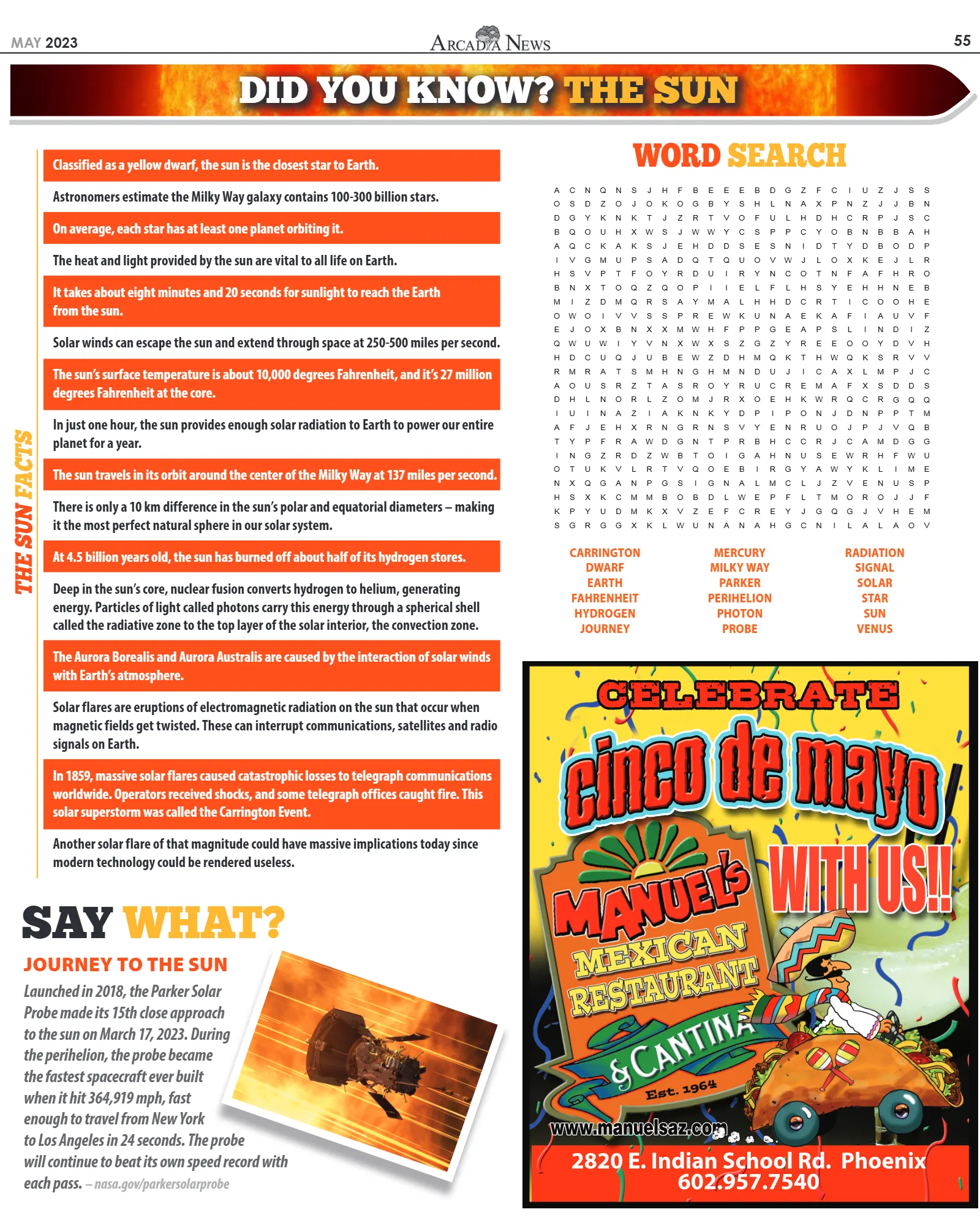
55 MAY 2023 WORD SEARCH CARRINGTON DWARF EARTH FAHRENHEIT HYDROGEN JOURNEY MERCURY MILKY WAY PARKER PERIHELION PHOTON PROBE RADIATION SIGNAL SOLAR STAR SUN VENUS THE SUN FACTS A C N Q N S J H F B E E E B D G Z F C I U Z J S S O S D Z O J O K O G B Y S H L N A X P N Z J J B N D G Y K N K T J Z R T V O F U L H D H C R P J S C B Q O U H X W S J W W Y C S P P C Y O B N B B A H A Q C K A K S J E H D D S E S N I D T Y D B O D P I V G M U P S A D Q T Q U O V W J L O X K E J L R H S V P T F O Y R D U I R Y N C O T N F A F H R O B N X T O Q Z Q O P I I E L F L H S Y E H H N E B M I Z D M Q R S A Y M A L H H D C R T I C O O H E O W O I V V S S P R E W K U N A E K A F I A U V F E J O X B N X X M W H F P P G E A P S L I N D I Z Q W U W I Y V N X W X S Z G Z Y R E E O O Y D V H H D C U Q J U B E W Z D H M Q K T H W Q K S R V V R M R A T S M H N G H M N D U J I C A X L M P J C A O U S R Z T A S R O Y R U C R E M A F X S D D S D H L N O R L Z O M J R X O E H K W R Q C R G Q Q I U I N A Z I A K N K Y D P I P O N J D N P P T M A F J E H X R N G R N S V Y E N R U O J P J V Q B T Y P F R A W D G N T P R B H C C R J C A M D G G I N G Z R D Z W B T O I G A H N U S E W R H F W U O T U K V L R T V Q O E B I R G Y A W Y K L I M E N X Q G A N P G S I G N A L M C L J Z V E N U S P H S X K C M M B O B D L W E P F L T M O R O J J F K P Y U D M K X V Z E F C R E Y J G Q G J V H E M S G R G G X K L W U N A N A H G C N I L A L A O V SAY WHAT? DID YOU KNOW? THE SUN JOURNEY TO THE SUN Launched in 2018, the Parker Solar Probe made its 15th close approach to the sun on March 17, 2023. During the perihelion, the probe became the fastest spacecraft ever built when it hit 364,919 mph, fast enough to travel from New York to Los Angeles in 24 seconds. The probe will continue to beat its own speed record with each pass. – nasa.gov/parkersolarprobe Classified as a yellow dwarf, the sun is the closest star to Earth. Astronomers estimate the Milky Way galaxy contains 100-300 billion stars. On average, each star has at least one planet orbiting it. The heat and light provided by the sun are vital to all life on Earth. It takes about eight minutes and 20 seconds for sunlight to reach the Earth from the sun. Solar winds can escape the sun and extend through space at 250-500 miles per second. The sun’s surface temperature is about 10,000 degrees Fahrenheit, and it’s 27 million degrees Fahrenheit at the core. In just one hour, the sun provides enough solar radiation to Earth to power our entire planet for a year. The sun travels in its orbit around the center of the Milky Way at 137 miles per second. There is only a 10 km difference in the sun’s polar and equatorial diameters – making it the most perfect natural sphere in our solar system. At 4.5 billion years old, the sun has burned off about half of its hydrogen stores. Deep in the sun’s core, nuclear fusion converts hydrogen to helium, generating energy. Particles of light called photons carry this energy through a spherical shell called the radiative zone to the top layer of the solar interior, the convection zone. The Aurora Borealis and Aurora Australis are caused by the interaction of solar winds with Earth’s atmosphere. Solar flares are eruptions of electromagnetic radiation on the sun that occur when magnetic fields get twisted. These can interrupt communications, satellites and radio signals on Earth. In 1859, massive solar flares caused catastrophic losses to telegraph communications worldwide. Operators received shocks, and some telegraph offices caught fire. This solar superstorm was called the Carrington Event. Another solar flare of that magnitude could have massive implications today since modern technology could be rendered useless.