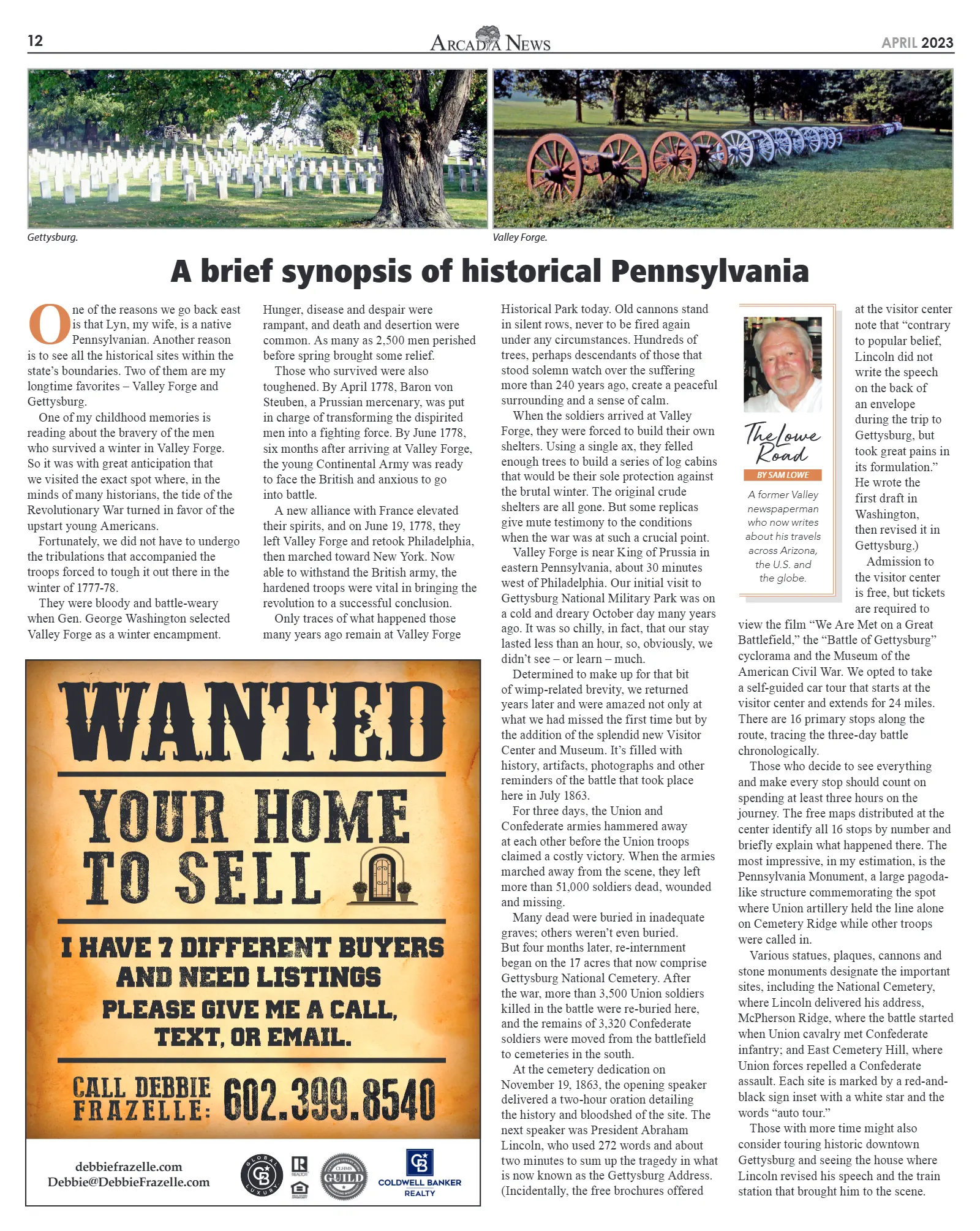

12 APRIL 2023 O ne of the reasons we go back east is that Lyn, my wife, is a native Pennsylvanian. Another reason is to see all the historical sites within the state’s boundaries. Two of them are my longtime favorites – Valley Forge and Gettysburg. One of my childhood memories is reading about the bravery of the men who survived a winter in Valley Forge. So it was with great anticipation that we visited the exact spot where, in the minds of many historians, the tide of the Revolutionary War turned in favor of the upstart young Americans. Fortunately, we did not have to undergo the tribulations that accompanied the troops forced to tough it out there in the winter of 1777-78. They were bloody and battle-weary when Gen. George Washington selected Valley Forge as a winter encampment. Hunger, disease and despair were rampant, and death and desertion were common. As many as 2,500 men perished before spring brought some relief. Those who survived were also toughened. By April 1778, Baron von Steuben, a Prussian mercenary, was put in charge of transforming the dispirited men into a fighting force. By June 1778, six months after arriving at Valley Forge, the young Continental Army was ready to face the British and anxious to go into battle. A new alliance with France elevated their spirits, and on June 19, 1778, they left Valley Forge and retook Philadelphia, then marched toward New York. Now able to withstand the British army, the hardened troops were vital in bringing the revolution to a successful conclusion. Only traces of what happened those many years ago remain at Valley Forge Historical Park today. Old cannons stand in silent rows, never to be fired again under any circumstances. Hundreds of trees, perhaps descendants of those that stood solemn watch over the suffering more than 240 years ago, create a peaceful surrounding and a sense of calm. When the soldiers arrived at Valley Forge, they were forced to build their own shelters. Using a single ax, they felled enough trees to build a series of log cabins that would be their sole protection against the brutal winter. The original crude shelters are all gone. But some replicas give mute testimony to the conditions when the war was at such a crucial point. Valley Forge is near King of Prussia in eastern Pennsylvania, about 30 minutes west of Philadelphia. Our initial visit to Gettysburg National Military Park was on a cold and dreary October day many years ago. It was so chilly, in fact, that our stay lasted less than an hour, so, obviously, we didn’t see – or learn – much. Determined to make up for that bit of wimp-related brevity, we returned years later and were amazed not only at what we had missed the first time but by the addition of the splendid new Visitor Center and Museum. It’s filled with history, artifacts, photographs and other reminders of the battle that took place here in July 1863. For three days, the Union and Confederate armies hammered away at each other before the Union troops claimed a costly victory. When the armies marched away from the scene, they left more than 51,000 soldiers dead, wounded and missing. Many dead were buried in inadequate graves; others weren’t even buried. But four months later, re-internment began on the 17 acres that now comprise Gettysburg National Cemetery. After the war, more than 3,500 Union soldiers killed in the battle were re-buried here, and the remains of 3,320 Confederate soldiers were moved from the battlefield to cemeteries in the south. At the cemetery dedication on November 19, 1863, the opening speaker delivered a two-hour oration detailing the history and bloodshed of the site. The next speaker was President Abraham Lincoln, who used 272 words and about two minutes to sum up the tragedy in what is now known as the Gettysburg Address. (Incidentally, the free brochures offered at the visitor center note that “contrary to popular belief, Lincoln did not write the speech on the back of an envelope during the trip to Gettysburg, but took great pains in its formulation.” He wrote the first draft in Washington, then revised it in Gettysburg.) Admission to the visitor center is free, but tickets are required to view the film “We Are Met on a Great Battlefield,” the “Battle of Gettysburg” cyclorama and the Museum of the American Civil War. We opted to take a self-guided car tour that starts at the visitor center and extends for 24 miles. There are 16 primary stops along the route, tracing the three-day battle chronologically. Those who decide to see everything and make every stop should count on spending at least three hours on the journey. The free maps distributed at the center identify all 16 stops by number and briefly explain what happened there. The most impressive, in my estimation, is the Pennsylvania Monument, a large pagoda- like structure commemorating the spot where Union artillery held the line alone on Cemetery Ridge while other troops were called in. Various statues, plaques, cannons and stone monuments designate the important sites, including the National Cemetery, where Lincoln delivered his address, McPherson Ridge, where the battle started when Union cavalry met Confederate infantry; and East Cemetery Hill, where Union forces repelled a Confederate assault. Each site is marked by a red-and- black sign inset with a white star and the words “auto tour.” Those with more time might also consider touring historic downtown Gettysburg and seeing the house where Lincoln revised his speech and the train station that brought him to the scene. A brief synopsis of historical Pennsylvania The Lowe Road A former Valley newspaperman who now writes about his travels across Arizona, the U.S. and the globe. BY SAM LOWE Gettysburg. Valley Forge. debbiefrazelle.com Debbie@DebbieFrazelle.com