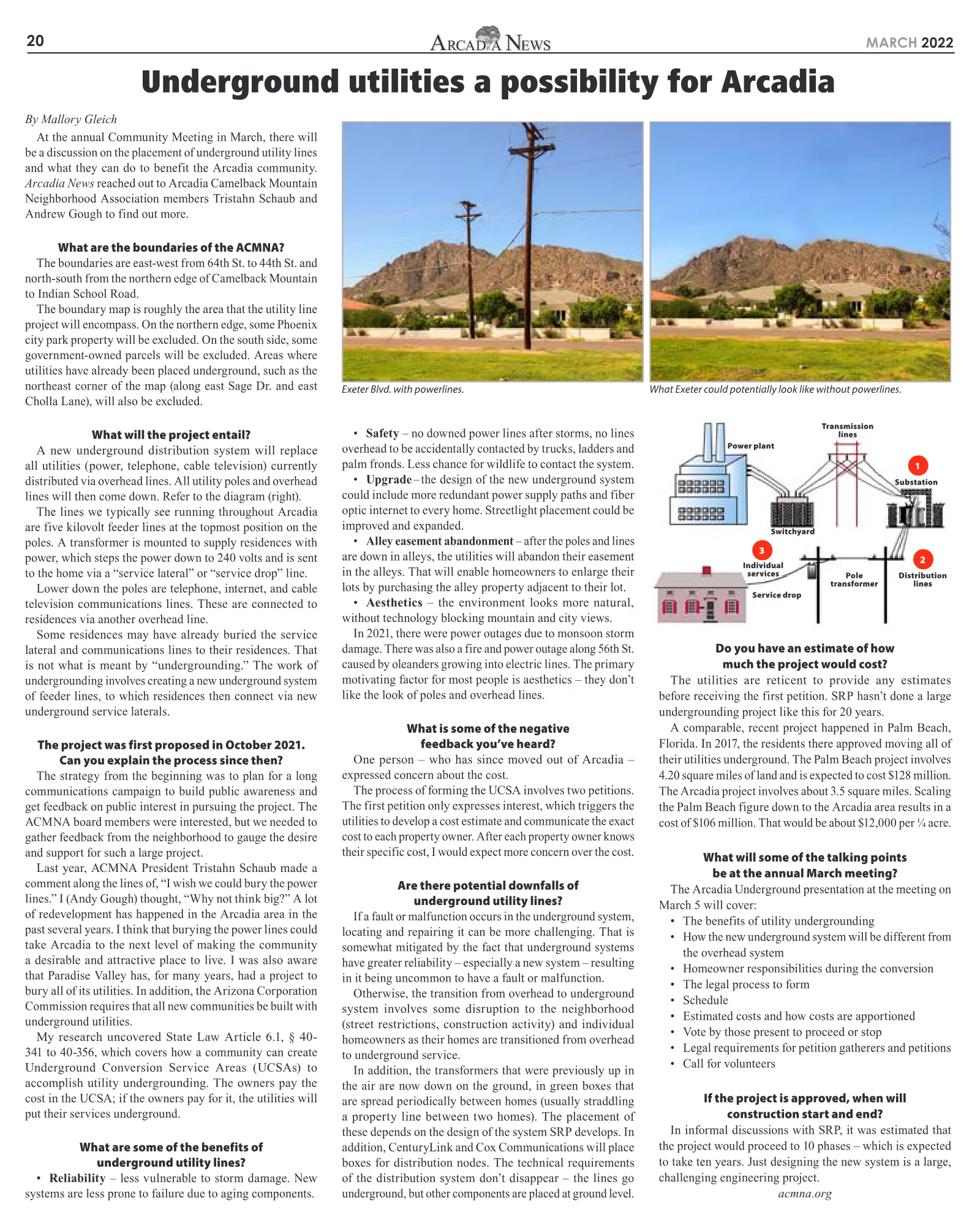
20 MARCH 2022 By Mallory Gleich At the annual Community Meeting in March, there will be a discussion on the placement of underground utility lines and what they can do to benefit the Arcadia community. Arcadia News reached out to Arcadia Camelback Mountain Neighborhood Association members Tristahn Schaub and Andrew Gough to find out more. What are the boundaries of the ACMNA? The boundaries are east-west from 64th St. to 44th St. and north-south from the northern edge of Camelback Mountain to Indian School Road. The boundary map is roughly the area that the utility line project will encompass. On the northern edge, some Phoenix city park property will be excluded. On the south side, some government-owned parcels will be excluded. Areas where utilities have already been placed underground, such as the northeast corner of the map (along east Sage Dr. and east Cholla Lane), will also be excluded. What will the project entail? A new underground distribution system will replace all utilities (power, telephone, cable television) currently distributed via overhead lines. All utility poles and overhead lines will then come down. Refer to the diagram (right). The lines we typically see running throughout Arcadia are five kilovolt feeder lines at the topmost position on the poles. A transformer is mounted to supply residences with power, which steps the power down to 240 volts and is sent to the home via a “service lateral” or “service drop” line. Lower down the poles are telephone, internet, and cable television communications lines. These are connected to residences via another overhead line. Some residences may have already buried the service lateral and communications lines to their residences. That is not what is meant by “undergrounding.” The work of undergrounding involves creating a new underground system of feeder lines, to which residences then connect via new underground service laterals. The project was first proposed in October 2021. Can you explain the process since then? The strategy from the beginning was to plan for a long communications campaign to build public awareness and get feedback on public interest in pursuing the project. The ACMNA board members were interested, but we needed to gather feedback from the neighborhood to gauge the desire and support for such a large project. Last year, ACMNA President Tristahn Schaub made a comment along the lines of, “I wish we could bury the power lines.” I (Andy Gough) thought, “Why not think big?” A lot of redevelopment has happened in the Arcadia area in the past several years. I think that burying the power lines could take Arcadia to the next level of making the community a desirable and attractive place to live. I was also aware that Paradise Valley has, for many years, had a project to bury all of its utilities. In addition, the Arizona Corporation Commission requires that all new communities be built with underground utilities. My research uncovered State Law Article 6.1, § 40- 341 to 40-356, which covers how a community can create Underground Conversion Service Areas (UCSAs) to accomplish utility undergrounding. The owners pay the cost in the UCSA; if the owners pay for it, the utilities will put their services underground. What are some of the benefits of underground utility lines? • Reliability – less vulnerable to storm damage. New systems are less prone to failure due to aging components. • Safety – no downed power lines after storms, no lines overhead to be accidentally contacted by trucks, ladders and palm fronds. Less chance for wildlife to contact the system. • Upgrade – the design of the new underground system could include more redundant power supply paths and fiber optic internet to every home. Streetlight placement could be improved and expanded. • Alley easement abandonment – after the poles and lines are down in alleys, the utilities will abandon their easement in the alleys. That will enable homeowners to enlarge their lots by purchasing the alley property adjacent to their lot. • Aesthetics – the environment looks more natural, without technology blocking mountain and city views. In 2021, there were power outages due to monsoon storm damage. There was also a fire and power outage along 56th St. caused by oleanders growing into electric lines. The primary motivating factor for most people is aesthetics – they don’t like the look of poles and overhead lines. What is some of the negative feedback you’ve heard? One person – who has since moved out of Arcadia – expressed concern about the cost. The process of forming the UCSA involves two petitions. The first petition only expresses interest, which triggers the utilities to develop a cost estimate and communicate the exact cost to each property owner. After each property owner knows their specific cost, I would expect more concern over the cost. Are there potential downfalls of underground utility lines? If a fault or malfunction occurs in the underground system, locating and repairing it can be more challenging. That is somewhat mitigated by the fact that underground systems have greater reliability – especially a new system – resulting in it being uncommon to have a fault or malfunction. Otherwise, the transition from overhead to underground system involves some disruption to the neighborhood (street restrictions, construction activity) and individual homeowners as their homes are transitioned from overhead to underground service. In addition, the transformers that were previously up in the air are now down on the ground, in green boxes that are spread periodically between homes (usually straddling a property line between two homes). The placement of these depends on the design of the system SRP develops. In addition, CenturyLink and Cox Communications will place boxes for distribution nodes. The technical requirements of the distribution system don’t disappear – the lines go underground, but other components are placed at ground level. Do you have an estimate of how much the project would cost? The utilities are reticent to provide any estimates before receiving the first petition. SRP hasn’t done a large undergrounding project like this for 20 years. A comparable, recent project happened in Palm Beach, Florida. In 2017, the residents there approved moving all of their utilities underground. The Palm Beach project involves 4.20 square miles of land and is expected to cost $128 million. The Arcadia project involves about 3.5 square miles. Scaling the Palm Beach figure down to the Arcadia area results in a cost of $106 million. That would be about $12,000 per ¼ acre. What will some of the talking points be at the annual March meeting? The Arcadia Underground presentation at the meeting on March 5 will cover: • The benefits of utility undergrounding • How the new underground system will be different from the overhead system • Homeowner responsibilities during the conversion • The legal process to form • Schedule • Estimated costs and how costs are apportioned • Vote by those present to proceed or stop • Legal requirements for petition gatherers and petitions • Call for volunteers If the project is approved, when will construction start and end? In informal discussions with SRP, it was estimated that the project would proceed to 10 phases – which is expected to take ten years. Just designing the new system is a large, challenging engineering project. acmna.org Underground utilities a possibility for Arcadia 1 2 3 Power plant Substation Distribution lines Pole transformer Individual services Service drop Switchyard Transmission lines Exeter Blvd. with powerlines. What Exeter could potentially look like without powerlines.
Debbie is a true professional in every sense of the word, all the while making us feel as though we were family. Her passion for what she does shines through with her impeccable organization, prompt follow-through, and transparent communication. While the decision to move is not always an easy one; Debbie made us feel confident in our decision every step along the way. Thank you, Debbie! You truly have a servant’s heart, and we could not be any happier with how the sale of our home was handled.” -Jim D. and Bill H. Debbie Pontikas recently assisted us in the sale of our home in Arcadia, and we couldn’t have been any happier with how smoothly the entire transaction went. Debbie Pontikas, Associate Broker d e b b i e @ t h e b r o k e r y . c o m / / 4 8 0 . 3 3 5 . 8 6 0 4 w w w . d e b b i e p o n t i k a s . c o m If you are considering selling your home and would like the same level of service, give me a call!