
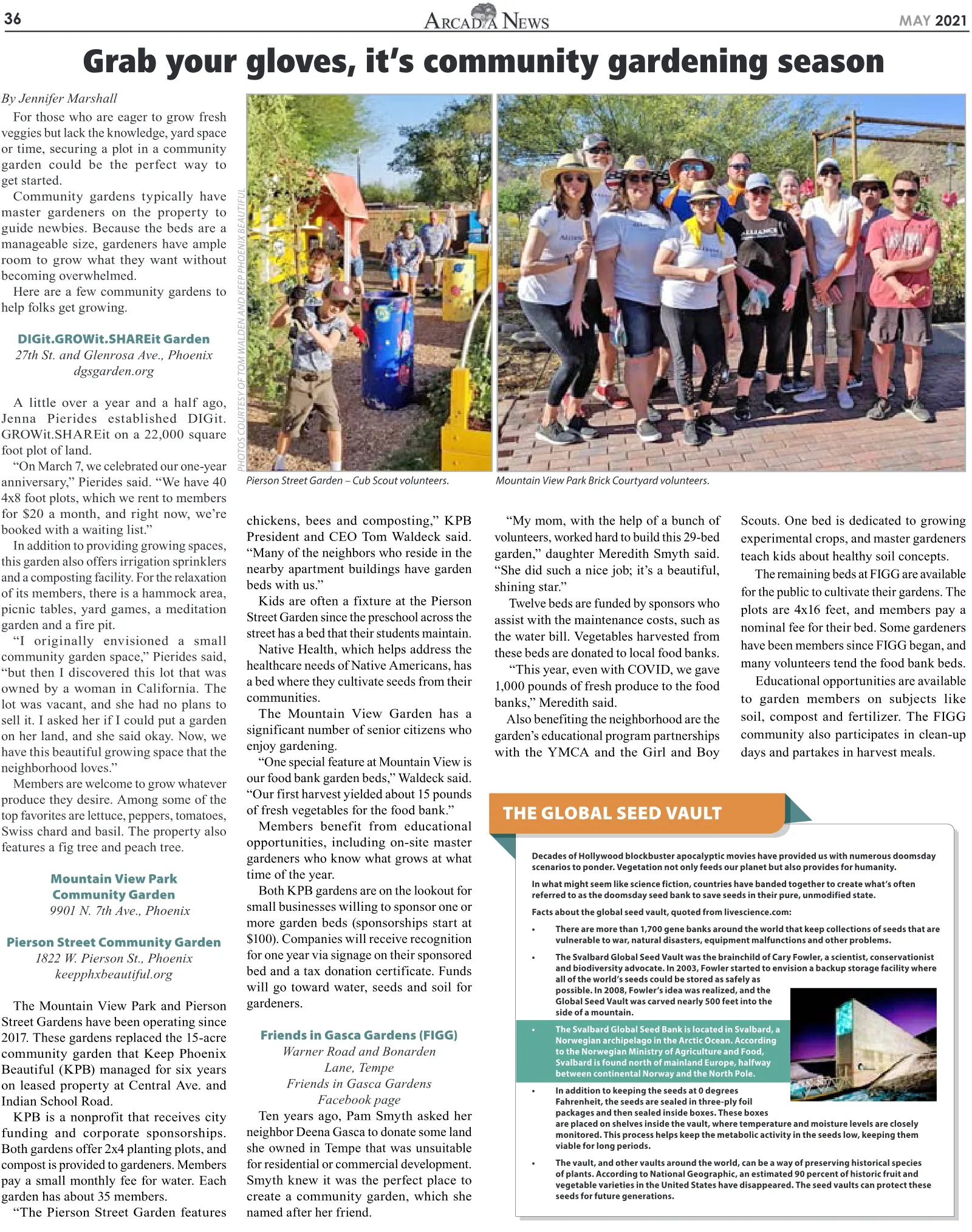

36 MAY 2021 By Jennifer Marshall For those who are eager to grow fresh veggies but lack the knowledge, yard space or time, securing a plot in a community garden could be the perfect way to get started. Community gardens typically have master gardeners on the property to guide newbies. Because the beds are a manageable size, gardeners have ample room to grow what they want without becoming overwhelmed. Here are a few community gardens to help folks get growing. DIGit.GROWit.SHAREit Garden 27th St. and Glenrosa Ave., Phoenix dgsgarden.org A little over a year and a half ago, Jenna Pierides established DIGit. GROWit.SHAREit on a 22,000 square foot plot of land. “On March 7, we celebrated our one-year anniversary,” Pierides said. “We have 40 4x8 foot plots, which we rent to members for $20 a month, and right now, we’re booked with a waiting list.” In addition to providing growing spaces, this garden also offers irrigation sprinklers and a composting facility. For the relaxation of its members, there is a hammock area, picnic tables, yard games, a meditation garden and a fire pit. “I originally envisioned a small community garden space,” Pierides said, “but then I discovered this lot that was owned by a woman in California. The lot was vacant, and she had no plans to sell it. I asked her if I could put a garden on her land, and she said okay. Now, we have this beautiful growing space that the neighborhood loves.” Members are welcome to grow whatever produce they desire. Among some of the top favorites are lettuce, peppers, tomatoes, Swiss chard and basil. The property also features a fig tree and peach tree. Mountain View Park Community Garden 9901 N. 7th Ave., Phoenix Pierson Street Community Garden 1822 W. Pierson St., Phoenix keepphxbeautiful.org The Mountain View Park and Pierson Street Gardens have been operating since 2017. These gardens replaced the 15-acre community garden that Keep Phoenix Beautiful (KPB) managed for six years on leased property at Central Ave. and Indian School Road. KPB is a nonprofit that receives city funding and corporate sponsorships. Both gardens offer 2x4 planting plots, and compost is provided to gardeners. Members pay a small monthly fee for water. Each garden has about 35 members. “The Pierson Street Garden features chickens, bees and composting,” KPB President and CEO Tom Waldeck said. “Many of the neighbors who reside in the nearby apartment buildings have garden beds with us.” Kids are often a fixture at the Pierson Street Garden since the preschool across the street has a bed that their students maintain. Native Health, which helps address the healthcare needs of Native Americans, has a bed where they cultivate seeds from their communities. The Mountain View Garden has a significant number of senior citizens who enjoy gardening. “One special feature at Mountain View is our food bank garden beds,” Waldeck said. “Our first harvest yielded about 15 pounds of fresh vegetables for the food bank.” Members benefit from educational opportunities, including on-site master gardeners who know what grows at what time of the year. Both KPB gardens are on the lookout for small businesses willing to sponsor one or more garden beds (sponsorships start at $100). Companies will receive recognition for one year via signage on their sponsored bed and a tax donation certificate. Funds will go toward water, seeds and soil for gardeners. Friends in Gasca Gardens (FIGG) Warner Road and Bonarden Lane, Tempe Friends in Gasca Gardens Facebook page Ten years ago, Pam Smyth asked her neighbor Deena Gasca to donate some land she owned in Tempe that was unsuitable for residential or commercial development. Smyth knew it was the perfect place to create a community garden, which she named after her friend. Grab your gloves, it’s community gardening season Mountain View Park Brick Courtyard volunteers. Pierson Street Garden – Cub Scout volunteers. PHOTOS COURTESY OF TOM WALDEN AND KEEP PHOENIX BEAUTIFUL “My mom, with the help of a bunch of volunteers, worked hard to build this 29-bed garden,” daughter Meredith Smyth said. “She did such a nice job; it’s a beautiful, shining star.” Twelve beds are funded by sponsors who assist with the maintenance costs, such as the water bill. Vegetables harvested from these beds are donated to local food banks. “This year, even with COVID, we gave 1,000 pounds of fresh produce to the food banks,” Meredith said. Also benefiting the neighborhood are the garden’s educational program partnerships with the YMCA and the Girl and Boy Scouts. One bed is dedicated to growing experimental crops, and master gardeners teach kids about healthy soil concepts. The remaining beds at FIGG are available for the public to cultivate their gardens. The plots are 4x16 feet, and members pay a nominal fee for their bed. Some gardeners have been members since FIGG began, and many volunteers tend the food bank beds. Educational opportunities are available to garden members on subjects like soil, compost and fertilizer. The FIGG community also participates in clean-up days and partakes in harvest meals. Decades of Hollywood blockbuster apocalyptic movies have provided us with numerous doomsday scenarios to ponder. Vegetation not only feeds our planet but also provides for humanity. In what might seem like science fiction, countries have banded together to create what’s often referred to as the doomsday seed bank to save seeds in their pure, unmodified state. Facts about the global seed vault, quoted from livescience.com: • There are more than 1,700 gene banks around the world that keep collections of seeds that are vulnerable to war, natural disasters, equipment malfunctions and other problems. • The Svalbard Global Seed Vault was the brainchild of Cary Fowler, a scientist, conservationist and biodiversity advocate. In 2003, Fowler started to envision a backup storage facility where all of the world’s seeds could be stored as safely as possible. In 2008, Fowler’s idea was realized, and the Global Seed Vault was carved nearly 500 feet into the side of a mountain. • The Svalbard Global Seed Bank is located in Svalbard, a Norwegian archipelago in the Arctic Ocean. According to the Norwegian Ministry of Agriculture and Food, Svalbard is found north of mainland Europe, halfway between continental Norway and the North Pole. • In addition to keeping the seeds at 0 degrees Fahrenheit, the seeds are sealed in three-ply foil packages and then sealed inside boxes. These boxes are placed on shelves inside the vault, where temperature and moisture levels are closely monitored. This process helps keep the metabolic activity in the seeds low, keeping them viable for long periods. • The vault, and other vaults around the world, can be a way of preserving historical species of plants. According to National Geographic, an estimated 90 percent of historic fruit and vegetable varieties in the United States have disappeared. The seed vaults can protect these seeds for future generations. THE GLOBAL SEED VAULT
Milgard® offers beautiful, comfortable, energy efficient vinyl windows and doors for your home. Whether you’re building a new home or renovating your existing one, your choices are wide open when it comes to selecting beautifully designed Milgard windows and patio doors. Strong, beautiful, long lasting and durable. Milgard windows and patio doors are designed with stunning architectural style and superior performance. Plus, you’ll feel secure in your investment with an industry leading, Full Lifetime Warranty that includes parts and labor. Available from Lasting Impressions: 4454 E. Thomas Road, Phoenix, AZ 85018 Call 602.508.0800 or vist liwindow.com for more information. ROC# 179513