
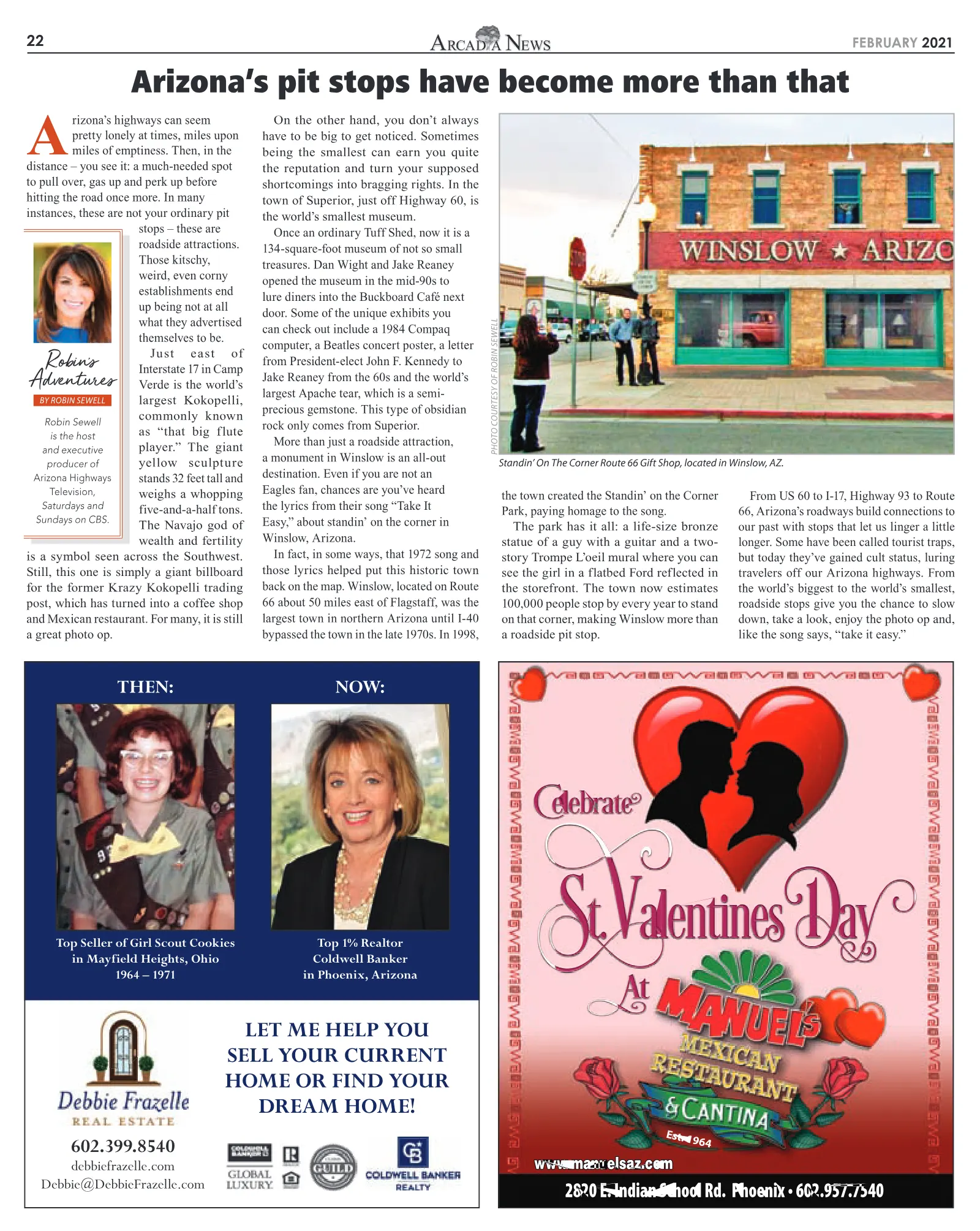
22 FEBRUARY 2021 A rizona’s highways can seem pretty lonely at times, miles upon miles of emptiness. Then, in the distance – you see it: a much-needed spot to pull over, gas up and perk up before hitting the road once more. In many instances, these are not your ordinary pit stops – these are roadside attractions. Those kitschy, weird, even corny establishments end up being not at all what they advertised themselves to be. Just east of Interstate 17 in Camp Verde is the world’s largest Kokopelli, commonly known as “that big flute player.” The giant yellow sculpture stands 32 feet tall and weighs a whopping five-and-a-half tons. The Navajo god of wealth and fertility is a symbol seen across the Southwest. Still, this one is simply a giant billboard for the former Krazy Kokopelli trading post, which has turned into a coffee shop and Mexican restaurant. For many, it is still a great photo op. On the other hand, you don’t always have to be big to get noticed. Sometimes being the smallest can earn you quite the reputation and turn your supposed shortcomings into bragging rights. In the town of Superior, just off Highway 60, is the world’s smallest museum. Once an ordinary Tuff Shed, now it is a 134-square-foot museum of not so small treasures. Dan Wight and Jake Reaney opened the museum in the mid-90s to lure diners into the Buckboard Café next door. Some of the unique exhibits you can check out include a 1984 Compaq computer, a Beatles concert poster, a letter from President-elect John F. Kennedy to Jake Reaney from the 60s and the world’s largest Apache tear, which is a semi- precious gemstone. This type of obsidian rock only comes from Superior. More than just a roadside attraction, a monument in Winslow is an all-out destination. Even if you are not an Eagles fan, chances are you’ve heard the lyrics from their song “Take It Easy,” about standin’ on the corner in Winslow, Arizona. In fact, in some ways, that 1972 song and those lyrics helped put this historic town back on the map. Winslow, located on Route 66 about 50 miles east of Flagstaff, was the largest town in northern Arizona until I-40 bypassed the town in the late 1970s. In 1998, the town created the Standin’ on the Corner Park, paying homage to the song. The park has it all: a life-size bronze statue of a guy with a guitar and a two- story Trompe L’oeil mural where you can see the girl in a flatbed Ford reflected in the storefront. The town now estimates 100,000 people stop by every year to stand on that corner, making Winslow more than a roadside pit stop. From US 60 to I-17, Highway 93 to Route 66, Arizona’s roadways build connections to our past with stops that let us linger a little longer. Some have been called tourist traps, but today they’ve gained cult status, luring travelers off our Arizona highways. From the world’s biggest to the world’s smallest, roadside stops give you the chance to slow down, take a look, enjoy the photo op and, like the song says, “take it easy.” Arizona’s pit stops have become more than that Robin Sewell is the host and executive producer of Arizona Highways Television , Saturdays and Sundays on CBS. BY ROBIN SEWELL Robins Adventures Standin’ On The Corner Route 66 Gift Shop, located in Winslow, AZ. PHOTO COURTESY OF ROBIN SEWELL Est. 1964 S t . V alentine s D a y C elebrat e a t 2820 E. Indian School Rd. Phoenix • 602.957.7540 www.manuelsaz.com Top Seller of Girl Scout Cookies in Mayfield Heights, Ohio 1964 – 1971 THEN: NOW: Top 1% Realtor Coldwell Banker in Phoenix, Arizona LET ME HELP YOU SELL YOUR CURRENT HOME OR FIND YOUR DREAM HOME! 602.399.8540 debbiefrazelle.com Debbie@DebbieFrazelle.com
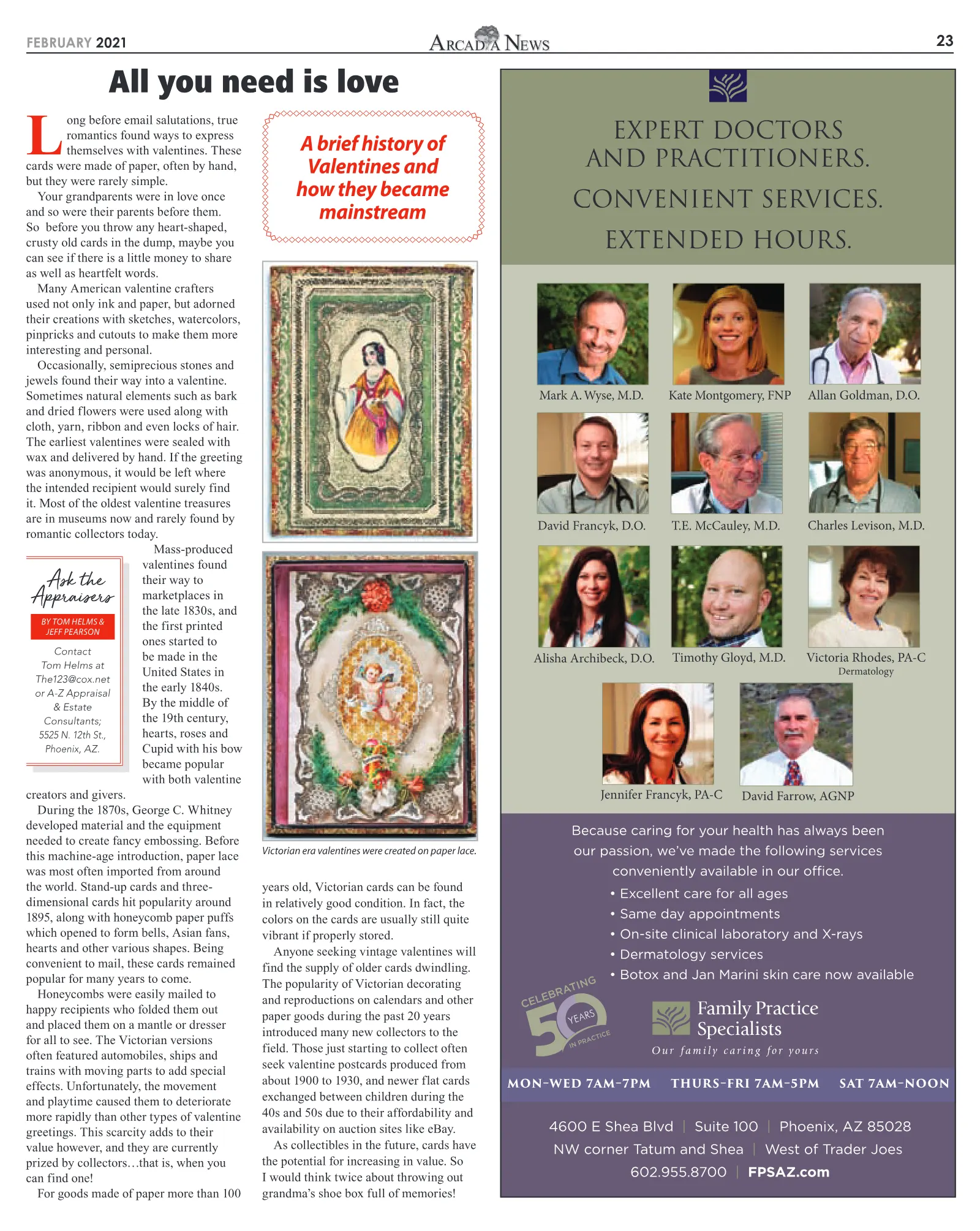
23 FEBRUARY 2021 L ong before email salutations, true romantics found ways to express themselves with valentines. These cards were made of paper, often by hand, but they were rarely simple. Your grandparents were in love once and so were their parents before them. So before you throw any heart-shaped, crusty old cards in the dump, maybe you can see if there is a little money to share as well as heartfelt words. Many American valentine crafters used not only ink and paper, but adorned their creations with sketches, watercolors, pinpricks and cutouts to make them more interesting and personal. Occasionally, semiprecious stones and jewels found their way into a valentine. Sometimes natural elements such as bark and dried flowers were used along with cloth, yarn, ribbon and even locks of hair. The earliest valentines were sealed with wax and delivered by hand. If the greeting was anonymous, it would be left where the intended recipient would surely find it. Most of the oldest valentine treasures are in museums now and rarely found by romantic collectors today. Mass-produced valentines found their way to marketplaces in the late 1830s, and the first printed ones started to be made in the United States in the early 1840s. By the middle of the 19th century, hearts, roses and Cupid with his bow became popular with both valentine creators and givers. During the 1870s, George C. Whitney developed material and the equipment needed to create fancy embossing. Before this machine-age introduction, paper lace was most often imported from around the world. Stand-up cards and three- dimensional cards hit popularity around 1895, along with honeycomb paper puffs which opened to form bells, Asian fans, hearts and other various shapes. Being convenient to mail, these cards remained popular for many years to come. Honeycombs were easily mailed to happy recipients who folded them out and placed them on a mantle or dresser for all to see. The Victorian versions often featured automobiles, ships and trains with moving parts to add special effects. Unfortunately, the movement and playtime caused them to deteriorate more rapidly than other types of valentine greetings. This scarcity adds to their value however, and they are currently prized by collectors…that is, when you can find one! For goods made of paper more than 100 years old, Victorian cards can be found in relatively good condition. In fact, the colors on the cards are usually still quite vibrant if properly stored. Anyone seeking vintage valentines will find the supply of older cards dwindling. The popularity of Victorian decorating and reproductions on calendars and other paper goods during the past 20 years introduced many new collectors to the field. Those just starting to collect often seek valentine postcards produced from about 1900 to 1930, and newer flat cards exchanged between children during the 40s and 50s due to their affordability and availability on auction sites like eBay. As collectibles in the future, cards have the potential for increasing in value. So I would think twice about throwing out grandma’s shoe box full of memories! All you need is love A brief history of Valentines and how they became mainstream Victorian era valentines were created on paper lace. Ask the Appraisers Contact Tom Helms at The123@cox.net or A-Z Appraisal & Estate Consultants; 5525 N. 12th St., Phoenix, AZ. BY TOM HELMS & JEFF PEARSON Mark A. Wyse, M.D. Kate Montgomery, FNP Allan Goldman, D.O. David Francyk, D.O. T.E. McCauley, M.D. Alisha Archibeck, D.O. Jennifer Francyk, PA-C Timothy Gloyd, M.D. Victoria Rhodes, PA-C Dermatology Charles Levison, M.D. Because caring for your health has always been our passion, we’ve made the following services conveniently available in our office. • Excellent care for all ages • Same day appointments • On-site clinical laboratory and X-rays • Dermatology services • Botox and Jan Marini skin care now available MON–WED 7AM–7PM THUR S–FRI 7AM–5PM SAT 7AM–NOON EXPERT DOCTORS AND PRACTITIONERS. CONVENIENT SERVICES. EXTENDED HOURS. David Farrow, AGNP IN PRACTICE CELEBRATING 4600 E Shea Blvd | Suite 100 | Phoenix, AZ 85028 NW corner Tatum and Shea | West of Trader Joes 602.955.8700 | FPSAZ.com