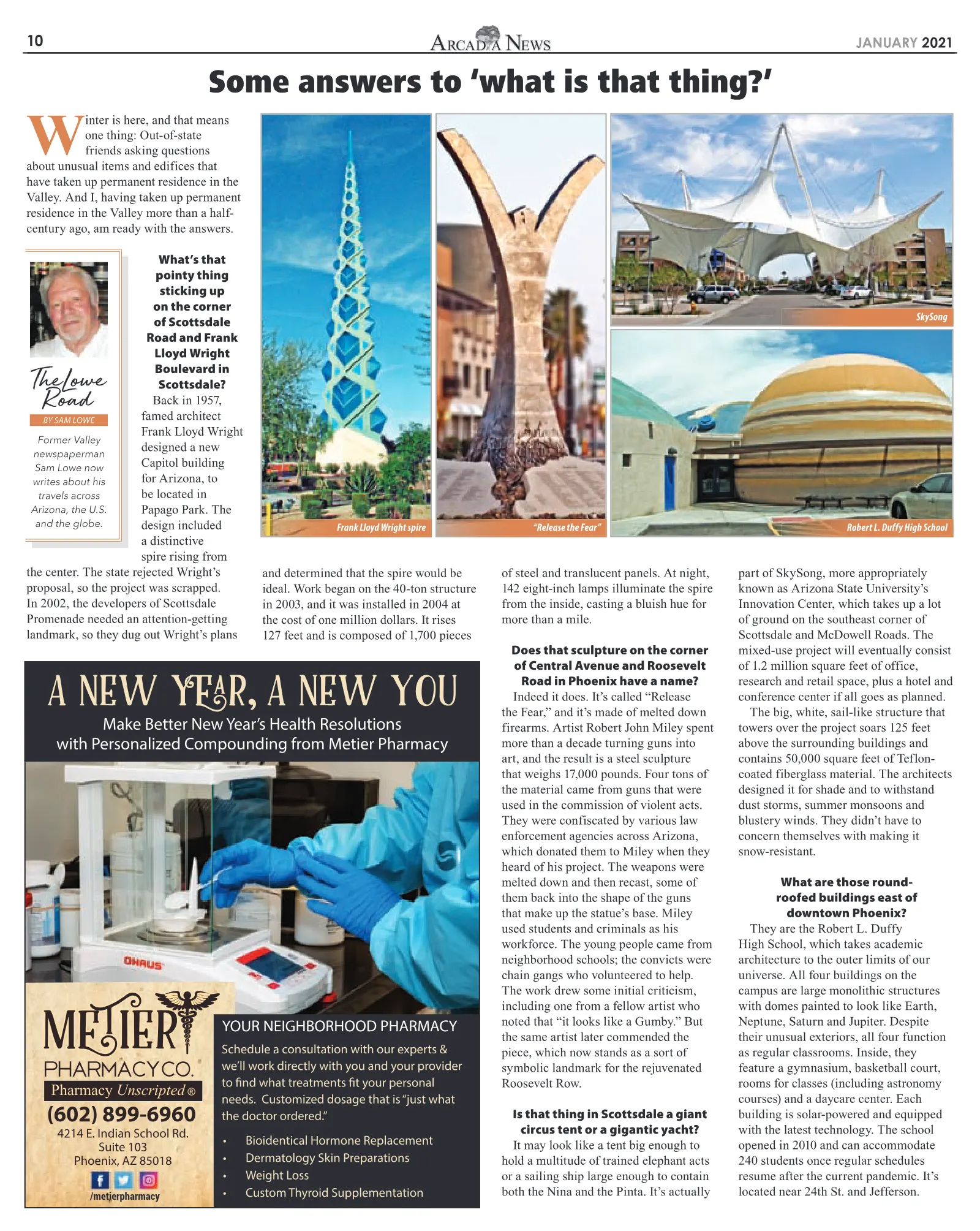
10 JANUARY 2021 W inter is here, and that means one thing: Out-of-state friends asking questions about unusual items and edifices that have taken up permanent residence in the Valley. And I, having taken up permanent residence in the Valley more than a half- century ago, am ready with the answers. What’s that pointy thing sticking up on the corner of Scottsdale Road and Frank Lloyd Wright Boulevard in Scottsdale? Back in 1957, famed architect Frank Lloyd Wright designed a new Capitol building for Arizona, to be located in Papago Park. The design included a distinctive spire rising from the center. The state rejected Wright’s proposal, so the project was scrapped. In 2002, the developers of Scottsdale Promenade needed an attention-getting landmark, so they dug out Wright’s plans and determined that the spire would be ideal. Work began on the 40-ton structure in 2003, and it was installed in 2004 at the cost of one million dollars. It rises 127 feet and is composed of 1,700 pieces of steel and translucent panels. At night, 142 eight-inch lamps illuminate the spire from the inside, casting a bluish hue for more than a mile. Does that sculpture on the corner of Central Avenue and Roosevelt Road in Phoenix have a name? Indeed it does. It’s called “Release the Fear,” and it’s made of melted down firearms. Artist Robert John Miley spent more than a decade turning guns into art, and the result is a steel sculpture that weighs 17,000 pounds. Four tons of the material came from guns that were used in the commission of violent acts. They were confiscated by various law enforcement agencies across Arizona, which donated them to Miley when they heard of his project. The weapons were melted down and then recast, some of them back into the shape of the guns that make up the statue’s base. Miley used students and criminals as his workforce. The young people came from neighborhood schools; the convicts were chain gangs who volunteered to help. The work drew some initial criticism, including one from a fellow artist who noted that “it looks like a Gumby.” But the same artist later commended the piece, which now stands as a sort of symbolic landmark for the rejuvenated Roosevelt Row. Is that thing in Scottsdale a giant circus tent or a gigantic yacht? It may look like a tent big enough to hold a multitude of trained elephant acts or a sailing ship large enough to contain both the Nina and the Pinta. It’s actually part of SkySong, more appropriately known as Arizona State University’s Innovation Center, which takes up a lot of ground on the southeast corner of Scottsdale and McDowell Roads. The mixed-use project will eventually consist of 1.2 million square feet of office, research and retail space, plus a hotel and conference center if all goes as planned. The big, white, sail-like structure that towers over the project soars 125 feet above the surrounding buildings and contains 50,000 square feet of Teflon- coated fiberglass material. The architects designed it for shade and to withstand dust storms, summer monsoons and blustery winds. They didn’t have to concern themselves with making it snow-resistant. What are those round- roofed buildings east of downtown Phoenix? They are the Robert L. Duffy High School, which takes academic architecture to the outer limits of our universe. All four buildings on the campus are large monolithic structures with domes painted to look like Earth, Neptune, Saturn and Jupiter. Despite their unusual exteriors, all four function as regular classrooms. Inside, they feature a gymnasium, basketball court, rooms for classes (including astronomy courses) and a daycare center. Each building is solar-powered and equipped with the latest technology. The school opened in 2010 and can accommodate 240 students once regular schedules resume after the current pandemic. It’s located near 24th St. and Jefferson. The Lowe Road Former Valley newspaperman Sam Lowe now writes about his travels across Arizona, the U.S. and the globe. BY SAM LOWE “Release the Fear” Frank Lloyd Wright spire Robert L. Duffy High School SkySong Some answers to ‘what is that thing?’
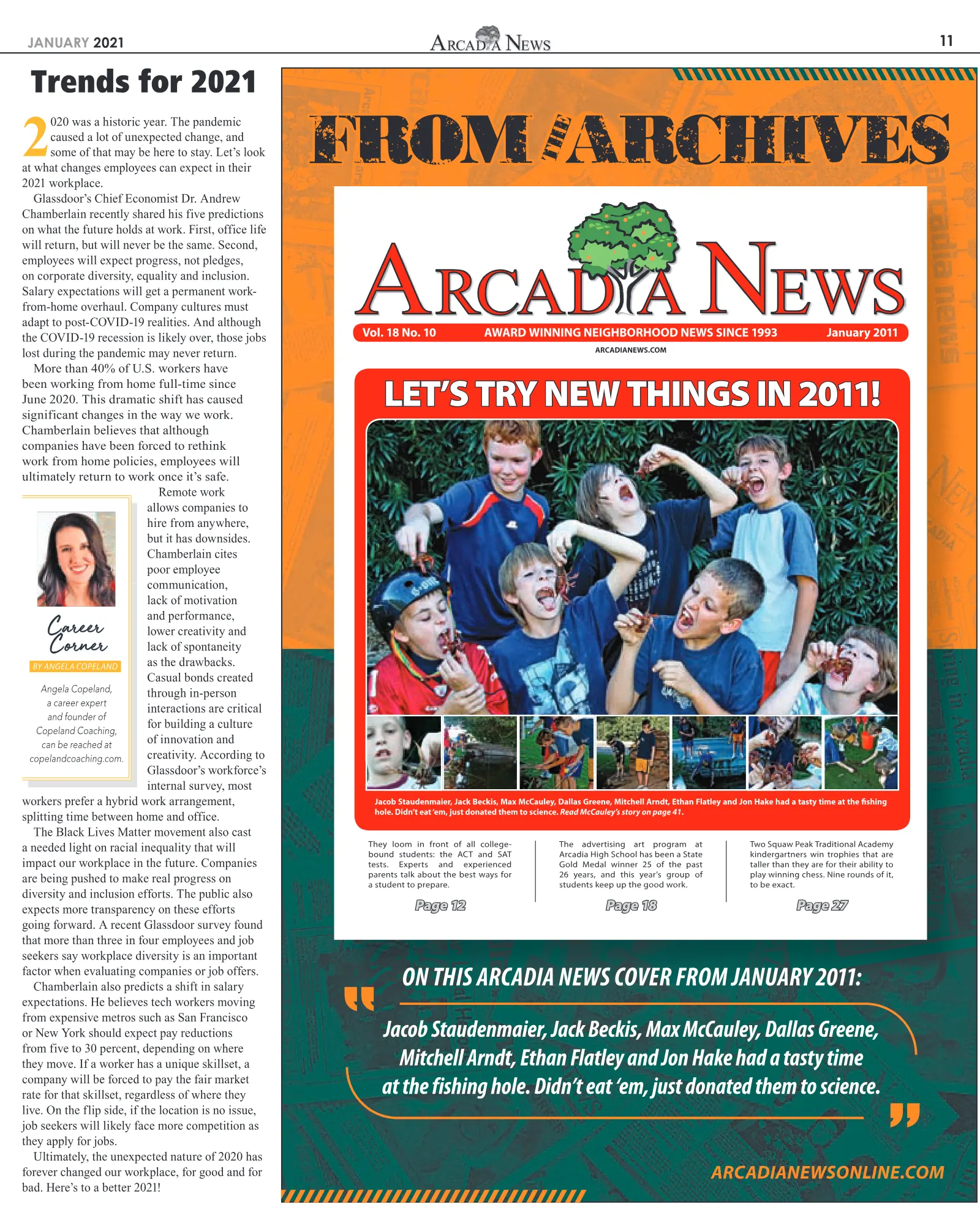
11 JANUARY 2021 LET’S TRY NEW THINGS IN 2011! ARCADIANEWS.COM January 2011 Vol. 18 No. 10 AWARD WINNING NEIGHBORHOOD NEWS SINCE 1993 Page 18 The advertising art program at Arcadia High School has been a State Gold Medal winner 25 of the past 26 years, and this year’s group of students keep up the good work. Page 12 They loom in front of all college- bound students: the ACT and SAT tests. Experts and experienced parents talk about the best ways for a student to prepare. Page 27 Two Squaw Peak Traditional Academy kindergartners win trophies that are taller than they are for their ability to play winning chess. Nine rounds of it, to be exact. Jacob Staudenmaier, Jack Beckis, Max McCauley, Dallas Greene, Mitchell Arndt, Ethan Flatley and Jon Hake had a tasty time at the fishing hole. Didn’t eat ‘em, just donated them to science. Read McCauley’s story on page 41 . the ON THIS ARCADIA NEWS COVER FROM JANUARY 2011: Jacob Staudenmaier, Jack Beckis, Max McCauley, Dallas Greene, Mitchell Arndt, Ethan Flatley and Jon Hake had a tasty time at the fishing hole. Didn’t eat ‘em, just donated them to science. ARCADIANEWSONLINE.COM 2 020 was a historic year. The pandemic caused a lot of unexpected change, and some of that may be here to stay. Let’s look at what changes employees can expect in their 2021 workplace. Glassdoor’s Chief Economist Dr. Andrew Chamberlain recently shared his five predictions on what the future holds at work. First, office life will return, but will never be the same. Second, employees will expect progress, not pledges, on corporate diversity, equality and inclusion. Salary expectations will get a permanent work- from-home overhaul. Company cultures must adapt to post-COVID-19 realities. And although the COVID-19 recession is likely over, those jobs lost during the pandemic may never return. More than 40% of U.S. workers have been working from home full-time since June 2020. This dramatic shift has caused significant changes in the way we work. Chamberlain believes that although companies have been forced to rethink work from home policies, employees will ultimately return to work once it’s safe. Remote work allows companies to hire from anywhere, but it has downsides. Chamberlain cites poor employee communication, lack of motivation and performance, lower creativity and lack of spontaneity as the drawbacks. Casual bonds created through in-person interactions are critical for building a culture of innovation and creativity. According to Glassdoor’s workforce’s internal survey, most workers prefer a hybrid work arrangement, splitting time between home and office. The Black Lives Matter movement also cast a needed light on racial inequality that will impact our workplace in the future. Companies are being pushed to make real progress on diversity and inclusion efforts. The public also expects more transparency on these efforts going forward. A recent Glassdoor survey found that more than three in four employees and job seekers say workplace diversity is an important factor when evaluating companies or job offers. Chamberlain also predicts a shift in salary expectations. He believes tech workers moving from expensive metros such as San Francisco or New York should expect pay reductions from five to 30 percent, depending on where they move. If a worker has a unique skillset, a company will be forced to pay the fair market rate for that skillset, regardless of where they live. On the flip side, if the location is no issue, job seekers will likely face more competition as they apply for jobs. Ultimately, the unexpected nature of 2020 has forever changed our workplace, for good and for bad. Here’s to a better 2021! Trends for 2021 Career Corner Angela Copeland, a career expert and founder of Copeland Coaching, can be reached at copelandcoaching.com. BY ANGELA COPELAND