
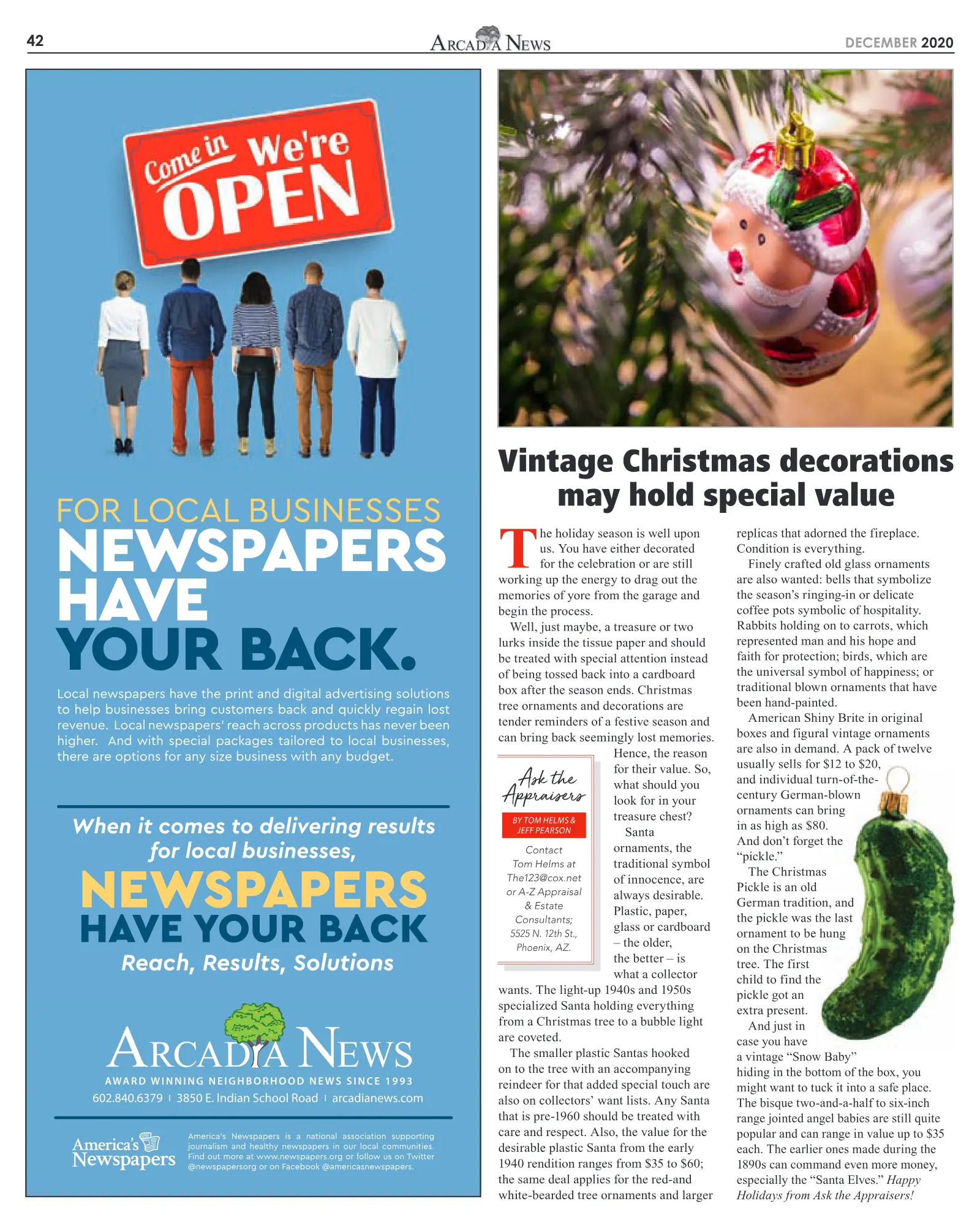
42 DECEMBER 2020 T he holiday season is well upon us. You have either decorated for the celebration or are still working up the energy to drag out the memories of yore from the garage and begin the process. Well, just maybe, a treasure or two lurks inside the tissue paper and should be treated with special attention instead of being tossed back into a cardboard box after the season ends. Christmas tree ornaments and decorations are tender reminders of a festive season and can bring back seemingly lost memories. Hence, the reason for their value. So, what should you look for in your treasure chest? Santa ornaments, the traditional symbol of innocence, are always desirable. Plastic, paper, glass or cardboard – the older, the better – is what a collector wants. The light-up 1940s and 1950s specialized Santa holding everything from a Christmas tree to a bubble light are coveted. The smaller plastic Santas hooked on to the tree with an accompanying reindeer for that added special touch are also on collectors’ want lists. Any Santa that is pre-1960 should be treated with care and respect. Also, the value for the desirable plastic Santa from the early 1940 rendition ranges from $35 to $60; the same deal applies for the red-and white-bearded tree ornaments and larger replicas that adorned the fireplace. Condition is everything. Finely crafted old glass ornaments are also wanted: bells that symbolize the season’s ringing-in or delicate coffee pots symbolic of hospitality. Rabbits holding on to carrots, which represented man and his hope and faith for protection; birds, which are the universal symbol of happiness; or traditional blown ornaments that have been hand-painted. American Shiny Brite in original boxes and figural vintage ornaments are also in demand. A pack of twelve usually sells for $12 to $20, and individual turn-of-the- century German-blown ornaments can bring in as high as $80. And don’t forget the “pickle.” The Christmas Pickle is an old German tradition, and the pickle was the last ornament to be hung on the Christmas tree. The first child to find the pickle got an extra present. And just in case you have a vintage “Snow Baby” hiding in the bottom of the box, you might want to tuck it into a safe place. The bisque two-and-a-half to six-inch range jointed angel babies are still quite popular and can range in value up to $35 each. The earlier ones made during the 1890s can command even more money, especially the “Santa Elves.” Happy Holidays from Ask the Appraisers! Vintage Christmas decorations may hold special value Ask the Appraisers Contact Tom Helms at The123@cox.net or A-Z Appraisal & Estate Consultants; 5525 N. 12th St., Phoenix, AZ. BY TOM HELMS & JEFF PEARSON usually sells for $12 to $20, and individual turn-of-the- century German-blown ornaments can bring in as high as $80. And don’t forget the The Christmas Pickle is an old German tradition, and the pickle was the last ornament to be hung on the Christmas child to find the a vintage “Snow Baby” Local newspapers have the print and digital advertising solutions to help businesses bring customers back and quickly regain lost revenue. Local newspapers’ reach across products has never been higher. And with special packages tailored to local businesses, there are options for any size business with any budget. FOR LOCAL BUSINESSES NEWSPAPERS HAVE YOUR BACK. When it comes to delivering results for local businesses, NEWSPAPERS HAVE YOUR BACK Reach, Results, Solutions America’s Newspapers is a national association supporting journalism and healthy newspapers in our local communities. Find out more at www.newspapers.org or follow us on Twitter @newspapersorg or on Facebook @americasnewspapers. Reach, Results, Solutions Local newspapers have the print and digital advertising solutions to help businesses bring customers back and quickly regain lost revenue. Local newspapers’ reach across products has never been higher. And with special packages tailored to local businesses, there are options for any size business with any budget. FOR LOCAL BUSINESSES NEWSPAPERS HAVE YOUR BACK. When it comes to delivering results for local businesses, NEWSPAPERS HAVE YOUR BACK Reach, Results, Solutions America’s Newspapers is a national association supporting journalism and healthy newspapers in our local communities. Find out more at www.newspapers.org or follow us on Twitter @newspapersorg or on Facebook @americasnewspapers. AWA R D W I N N I N G N E I G H B O R H O O D N E W S S I N C E 1 9 9 3 AWA R D W I N N I N G N E I G H B O R H O O D N E W S S I N C E 1 9 9 3 Local newspapers have the print and digital advertising solutions to help businesses bring customers back and quickly regain lost revenue. Local newspapers’ reach across products has never been higher. And with special packages tailored to local businesses, there are options for any size business with any budget. FOR LOCAL BUSINESSES NEWSPAPERS HAVE YOUR BACK. When it comes to delivering results for local businesses, NEWSPAPERS HAVE YOUR BACK Reach, Results, Solutions America’s Newspapers is a national association supporting journalism and healthy newspapers in our local communities. Find out more at www.newspapers.org or follow us on Twitter @newspapersorg or on Facebook @americasnewspapers. Local newspapers have the print and digital advertising solutions to help businesses bring customers back and quickly regain lost revenue. Local newspapers’ reach across products has never been higher. And with special packages tailored to local businesses, there are options for any size business with any budget. FOR LOCAL BUSINESSES NEWSPAPERS HAVE YOUR BACK. When it comes to delivering results for local businesses, NEWSPAPERS HAVE YOUR BACK Reach, Results, Solutions America’s Newspapers is a national association supporting journalism and healthy newspapers in our local communities. Find out more at www.newspapers.org or follow us on Twitter @newspapersorg or on Facebook @americasnewspapers. 602.840.6379 | 3850 E. Indian School Road | arcadianews.com
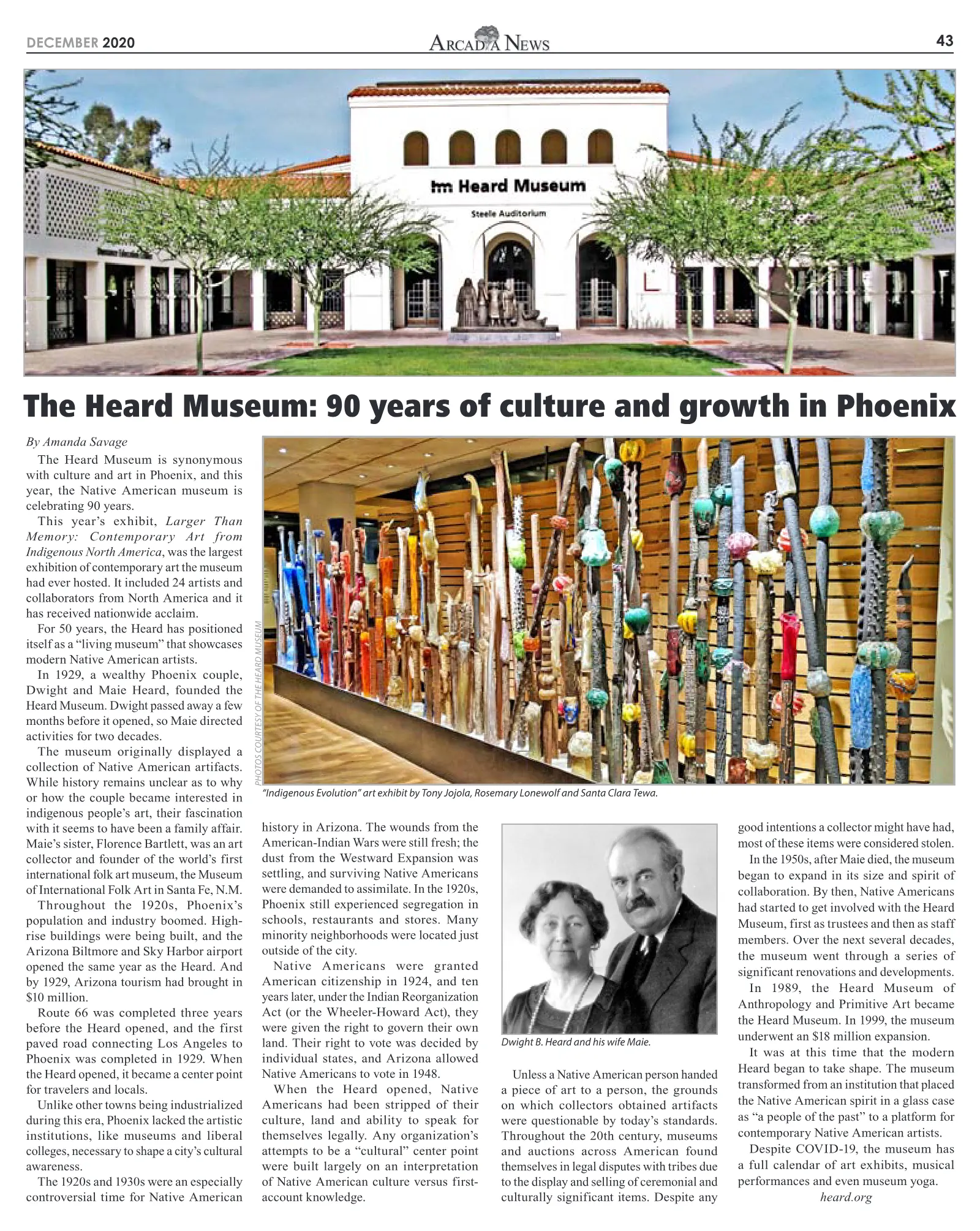
43 DECEMBER 2020 By Amanda Savage The Heard Museum is synonymous with culture and art in Phoenix, and this year, the Native American museum is celebrating 90 years. This year’s exhibit, Larger Than Memory: Contemporary Art from Indigenous North America , was the largest exhibition of contemporary art the museum had ever hosted. It included 24 artists and collaborators from North America and it has received nationwide acclaim. For 50 years, the Heard has positioned itself as a “living museum” that showcases modern Native American artists. In 1929, a wealthy Phoenix couple, Dwight and Maie Heard, founded the Heard Museum. Dwight passed away a few months before it opened, so Maie directed activities for two decades. The museum originally displayed a collection of Native American artifacts. While history remains unclear as to why or how the couple became interested in indigenous people’s art, their fascination with it seems to have been a family affair. Maie’s sister, Florence Bartlett, was an art collector and founder of the world’s first international folk art museum, the Museum of International Folk Art in Santa Fe, N.M. Throughout the 1920s, Phoenix’s population and industry boomed. High- rise buildings were being built, and the Arizona Biltmore and Sky Harbor airport opened the same year as the Heard. And by 1929, Arizona tourism had brought in $10 million. Route 66 was completed three years before the Heard opened, and the first paved road connecting Los Angeles to Phoenix was completed in 1929. When the Heard opened, it became a center point for travelers and locals. Unlike other towns being industrialized during this era, Phoenix lacked the artistic institutions, like museums and liberal colleges, necessary to shape a city’s cultural awareness. The 1920s and 1930s were an especially controversial time for Native American history in Arizona. The wounds from the American-Indian Wars were still fresh; the dust from the Westward Expansion was settling, and surviving Native Americans were demanded to assimilate. In the 1920s, Phoenix still experienced segregation in schools, restaurants and stores. Many minority neighborhoods were located just outside of the city. Native Americans were granted American citizenship in 1924, and ten years later, under the Indian Reorganization Act (or the Wheeler-Howard Act), they were given the right to govern their own land. Their right to vote was decided by individual states, and Arizona allowed Native Americans to vote in 1948. When the Heard opened, Native Americans had been stripped of their culture, land and ability to speak for themselves legally. Any organization’s attempts to be a “cultural” center point were built largely on an interpretation of Native American culture versus first- account knowledge. Unless a Native American person handed a piece of art to a person, the grounds on which collectors obtained artifacts were questionable by today’s standards. Throughout the 20th century, museums and auctions across American found themselves in legal disputes with tribes due to the display and selling of ceremonial and culturally significant items. Despite any good intentions a collector might have had, most of these items were considered stolen. In the 1950s, after Maie died, the museum began to expand in its size and spirit of collaboration. By then, Native Americans had started to get involved with the Heard Museum, first as trustees and then as staff members. Over the next several decades, the museum went through a series of significant renovations and developments. In 1989, the Heard Museum of Anthropology and Primitive Art became the Heard Museum. In 1999, the museum underwent an $18 million expansion. It was at this time that the modern Heard began to take shape. The museum transformed from an institution that placed the Native American spirit in a glass case as “a people of the past” to a platform for contemporary Native American artists. Despite COVID-19, the museum has a full calendar of art exhibits, musical performances and even museum yoga. heard.org The Heard Museum: 90 years of culture and growth in Phoenix “Indigenous Evolution” art exhibit by Tony Jojola, Rosemary Lonewolf and Santa Clara Tewa. Dwight B. Heard and his wife Maie. PHOTOS COURTESY OF THE HEARD MUSEUM