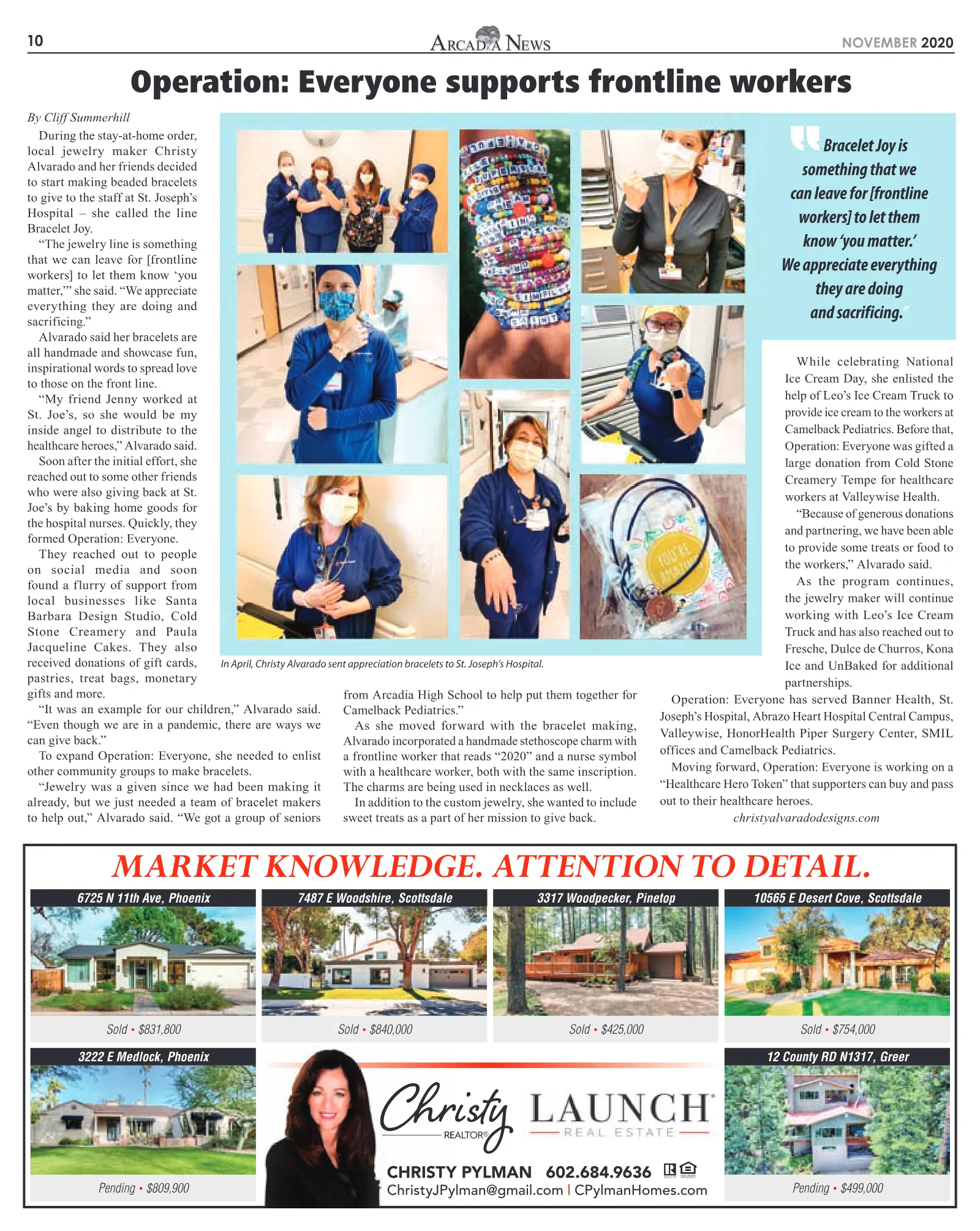
10 NOVEMBER 2020 By Cliff Summerhill During the stay-at-home order, local jewelry maker Christy Alvarado and her friends decided to start making beaded bracelets to give to the staff at St. Joseph’s Hospital – she called the line Bracelet Joy. “The jewelry line is something that we can leave for [frontline workers] to let them know ‘you matter,’” she said. “We appreciate everything they are doing and sacrificing.” Alvarado said her bracelets are all handmade and showcase fun, inspirational words to spread love to those on the front line. “My friend Jenny worked at St. Joe’s, so she would be my inside angel to distribute to the healthcare heroes,” Alvarado said. Soon after the initial effort, she reached out to some other friends who were also giving back at St. Joe’s by baking home goods for the hospital nurses. Quickly, they formed Operation: Everyone. They reached out to people on social media and soon found a flurry of support from local businesses like Santa Barbara Design Studio, Cold Stone Creamery and Paula Jacqueline Cakes. They also received donations of gift cards, pastries, treat bags, monetary gifts and more. “It was an example for our children,” Alvarado said. “Even though we are in a pandemic, there are ways we can give back.” To expand Operation: Everyone, she needed to enlist other community groups to make bracelets. “Jewelry was a given since we had been making it already, but we just needed a team of bracelet makers to help out,” Alvarado said. “We got a group of seniors from Arcadia High School to help put them together for Camelback Pediatrics.” As she moved forward with the bracelet making, Alvarado incorporated a handmade stethoscope charm with a frontline worker that reads “2020” and a nurse symbol with a healthcare worker, both with the same inscription. The charms are being used in necklaces as well. In addition to the custom jewelry, she wanted to include sweet treats as a part of her mission to give back. While celebrating National Ice Cream Day, she enlisted the help of Leo’s Ice Cream Truck to provide ice cream to the workers at Camelback Pediatrics. Before that, Operation: Everyone was gifted a large donation from Cold Stone Creamery Tempe for healthcare workers at Valleywise Health. “Because of generous donations and partnering, we have been able to provide some treats or food to the workers,” Alvarado said. As the program continues, the jewelry maker will continue working with Leo’s Ice Cream Truck and has also reached out to Fresche, Dulce de Churros, Kona Ice and UnBaked for additional partnerships. Operation: Everyone has served Banner Health, St. Joseph’s Hospital, Abrazo Heart Hospital Central Campus, Valleywise, HonorHealth Piper Surgery Center, SMIL offices and Camelback Pediatrics. Moving forward, Operation: Everyone is working on a “Healthcare Hero Token” that supporters can buy and pass out to their healthcare heroes. christyalvaradodesigns.com In April, Christy Alvarado sent appreciation bracelets to St. Joseph’s Hospital. Bracelet Joy is something that we can leave for [frontline workers] to let them know ‘you matter.’ We appreciate everything they are doing and sacrificing.” Operation: Everyone supports frontline workers Sold • $831,800 Sold • $840,000 Sold • $425,000 Sold • $754,000 MARKET KNOWLEDGE. ATTENTION TO DETAIL. 6725 N 11th Ave, Phoenix Pending • $499,000 12 County RD N1317, Greer 7487 E Woodshire, Scottsdale 3317 Woodpecker, Pinetop 10565 E Desert Cove, Scottsdale CHRISTY PYLMAN 602.684.9636 ChristyJPylman@gmail.com | CPylmanHomes.com Pending • $809,900 3222 E Medlock, Phoenix
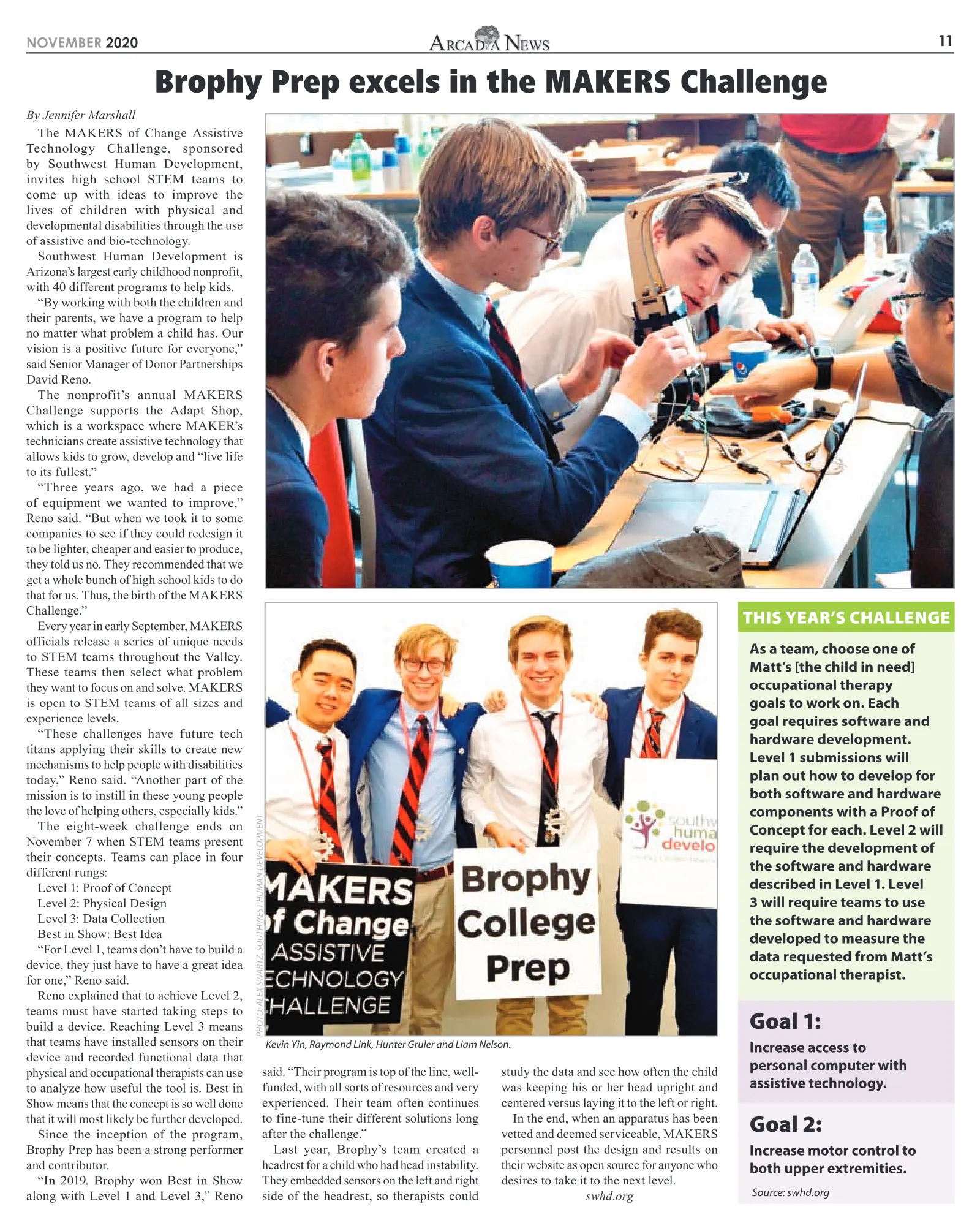
11 NOVEMBER 2020 Brophy Prep excels in the MAKERS Challenge Kevin Yin, Raymond Link, Hunter Gruler and Liam Nelson. PHOTO: ALEX SWARTZ, SOUTHWEST HUMAN DEVELOPMENT By Jennifer Marshall The MAKERS of Change Assistive Technology Challenge, sponsored by Southwest Human Development, invites high school STEM teams to come up with ideas to improve the lives of children with physical and developmental disabilities through the use of assistive and bio-technology. Southwest Human Development is Arizona’s largest early childhood nonprofit, with 40 different programs to help kids. “By working with both the children and their parents, we have a program to help no matter what problem a child has. Our vision is a positive future for everyone,” said Senior Manager of Donor Partnerships David Reno. The nonprofit’s annual MAKERS Challenge supports the Adapt Shop, which is a workspace where MAKER’s technicians create assistive technology that allows kids to grow, develop and “live life to its fullest.” “Three years ago, we had a piece of equipment we wanted to improve,” Reno said. “But when we took it to some companies to see if they could redesign it to be lighter, cheaper and easier to produce, they told us no. They recommended that we get a whole bunch of high school kids to do that for us. Thus, the birth of the MAKERS Challenge.” Every year in early September, MAKERS officials release a series of unique needs to STEM teams throughout the Valley. These teams then select what problem they want to focus on and solve. MAKERS is open to STEM teams of all sizes and experience levels. “These challenges have future tech titans applying their skills to create new mechanisms to help people with disabilities today,” Reno said. “Another part of the mission is to instill in these young people the love of helping others, especially kids.” The eight-week challenge ends on November 7 when STEM teams present their concepts. Teams can place in four different rungs: Level 1: Proof of Concept Level 2: Physical Design Level 3: Data Collection Best in Show: Best Idea “For Level 1, teams don’t have to build a device, they just have to have a great idea for one,” Reno said. Reno explained that to achieve Level 2, teams must have started taking steps to build a device. Reaching Level 3 means that teams have installed sensors on their device and recorded functional data that physical and occupational therapists can use to analyze how useful the tool is. Best in Show means that the concept is so well done that it will most likely be further developed. Since the inception of the program, Brophy Prep has been a strong performer and contributor. “In 2019, Brophy won Best in Show along with Level 1 and Level 3,” Reno said. “Their program is top of the line, well- funded, with all sorts of resources and very experienced. Their team often continues to fine-tune their different solutions long after the challenge.” Last year, Brophy’s team created a headrest for a child who had head instability. They embedded sensors on the left and right side of the headrest, so therapists could study the data and see how often the child was keeping his or her head upright and centered versus laying it to the left or right. In the end, when an apparatus has been vetted and deemed serviceable, MAKERS personnel post the design and results on their website as open source for anyone who desires to take it to the next level. swhd.org E As a team, choose one of Matt’s [the child in need] occupational therapy goals to work on. Each goal requires software and hardware development. Level 1 submissions will plan out how to develop for both software and hardware components with a Proof of Concept for each. Level 2 will require the development of the software and hardware described in Level 1. Level 3 will require teams to use the software and hardware developed to measure the data requested from Matt’s occupational therapist. Goal 1: Increase access to personal computer with assistive technology. Goal 2: Increase motor control to both upper extremities. THIS YEAR’S CHALLENGE Source: swhd.org