
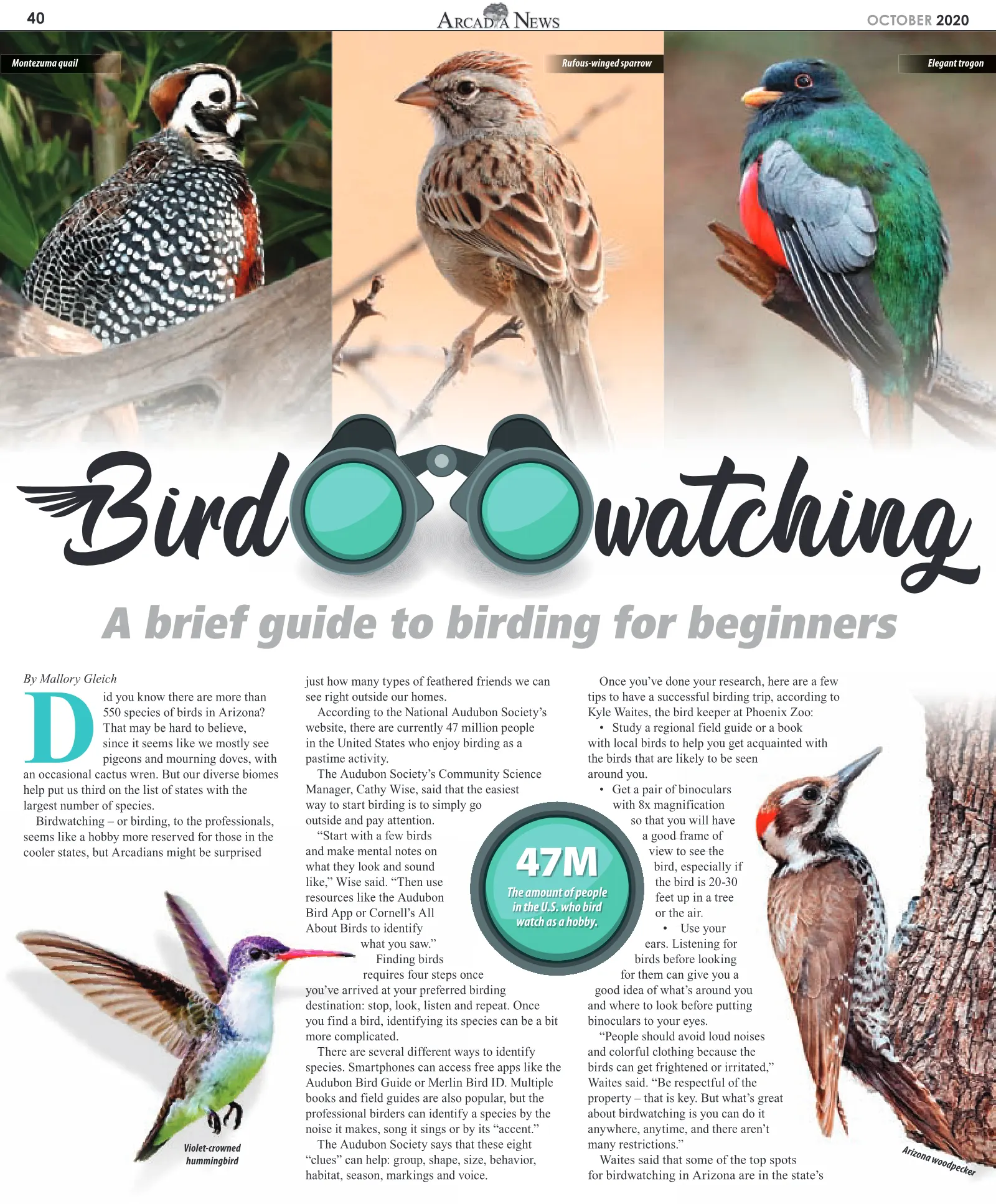
40 OCTOBER 2020 By Mallory Gleich D id you know there are more than 550 species of birds in Arizona? That may be hard to believe, since it seems like we mostly see pigeons and mourning doves, with an occasional cactus wren. But our diverse biomes help put us third on the list of states with the largest number of species. Birdwatching – or birding, to the professionals, seems like a hobby more reserved for those in the cooler states, but Arcadians might be surprised just how many types of feathered friends we can see right outside our homes. According to the National Audubon Society’s website, there are currently 47 million people in the United States who enjoy birding as a pastime activity. The Audubon Society’s Community Science Manager, Cathy Wise, said that the easiest way to start birding is to simply go outside and pay attention. “Start with a few birds and make mental notes on what they look and sound like,” Wise said. “Then use resources like the Audubon Bird App or Cornell’s All About Birds to identify what you saw.” Finding birds requires four steps once you’ve arrived at your preferred birding destination: stop, look, listen and repeat. Once you find a bird, identifying its species can be a bit more complicated. There are several different ways to identify species. Smartphones can access free apps like the Audubon Bird Guide or Merlin Bird ID. Multiple books and field guides are also popular, but the professional birders can identify a species by the noise it makes, song it sings or by its “accent.” The Audubon Society says that these eight “clues” can help: group, shape, size, behavior, habitat, season, markings and voice. Once you’ve done your research, here are a few tips to have a successful birding trip, according to Kyle Waites, the bird keeper at Phoenix Zoo: • Study a regional field guide or a book with local birds to help you get acquainted with the birds that are likely to be seen around you. • Get a pair of binoculars with 8x magnification so that you will have a good frame of view to see the bird, especially if the bird is 20-30 feet up in a tree or the air. • Use your ears. Listening for birds before looking for them can give you a good idea of what’s around you and where to look before putting binoculars to your eyes. “People should avoid loud noises and colorful clothing because the birds can get frightened or irritated,” Waites said. “Be respectful of the property – that is key. But what’s great about birdwatching is you can do it anywhere, anytime, and there aren’t many restrictions.” Waites said that some of the top spots for birdwatching in Arizona are in the state’s Once you’ve done your research, here are a few tips to have a successful birding trip, according to Kyle Waites, the bird keeper at Phoenix Zoo: • Study a regional field guide or a book with local birds to help you get acquainted with the birds that are likely to be seen • Get a pair of binoculars with 8x magnification so that you will have a good frame of view to see the bird, especially if the bird is 20-30 feet up in a tree or the air. • Use your ears. Listening for birds before looking for them can give you a good idea of what’s around you and where to look before putting binoculars to your eyes. “People should avoid loud noises and colorful clothing because the birds can get frightened or irritated,” Waites said. “Be respectful of the property – that is key. But what’s great about birdwatching is you can do it anywhere, anytime, and there aren’t many restrictions.” Waites said that some of the top spots for birdwatching in Arizona are in the state’s Elegant trogon Rufous-winged sparrow Montezuma quail largest number of species. Birdwatching – or birding, to the professionals, seems like a hobby more reserved for those in the cooler states, but Arcadians might be surprised “Start with a few birds and make mental notes on what they look and sound like,” Wise said. “Then use resources like the Audubon Bird App or Cornell’s All About Birds to identify what you saw.” Finding birds requires four steps once you’ve arrived at your preferred birding destination: stop, look, listen and repeat. Once you find a bird, identifying its species can be a bit more complicated. There are several different ways to identify species. Smartphones can access free apps like the Audubon Bird Guide or Merlin Bird ID. Multiple books and field guides are also popular, but the professional birders can identify a species by the noise it makes, song it sings or by its “accent.” The Audubon Society says that these eight “clues” can help: group, shape, size, behavior, habitat, season, markings and voice. About Birds to identify you’ve arrived at your preferred birding destination: stop, look, listen and repeat. Once you find a bird, identifying its species can be a bit more complicated. There are several different ways to identify species. Smartphones can access free apps like the Audubon Bird Guide or Merlin Bird ID. Multiple books and field guides are also popular, but the professional birders can identify a species by the noise it makes, song it sings or by its “accent.” The Audubon Society says that these eight “clues” can help: group, shape, size, behavior, habitat, season, markings and voice. A brief guide to birding for beginners Arizona woodpecker Arizona woodpecker The amount of people in the U.S. who bird watch as a hobby. 47M Violet-crowned hummingbird
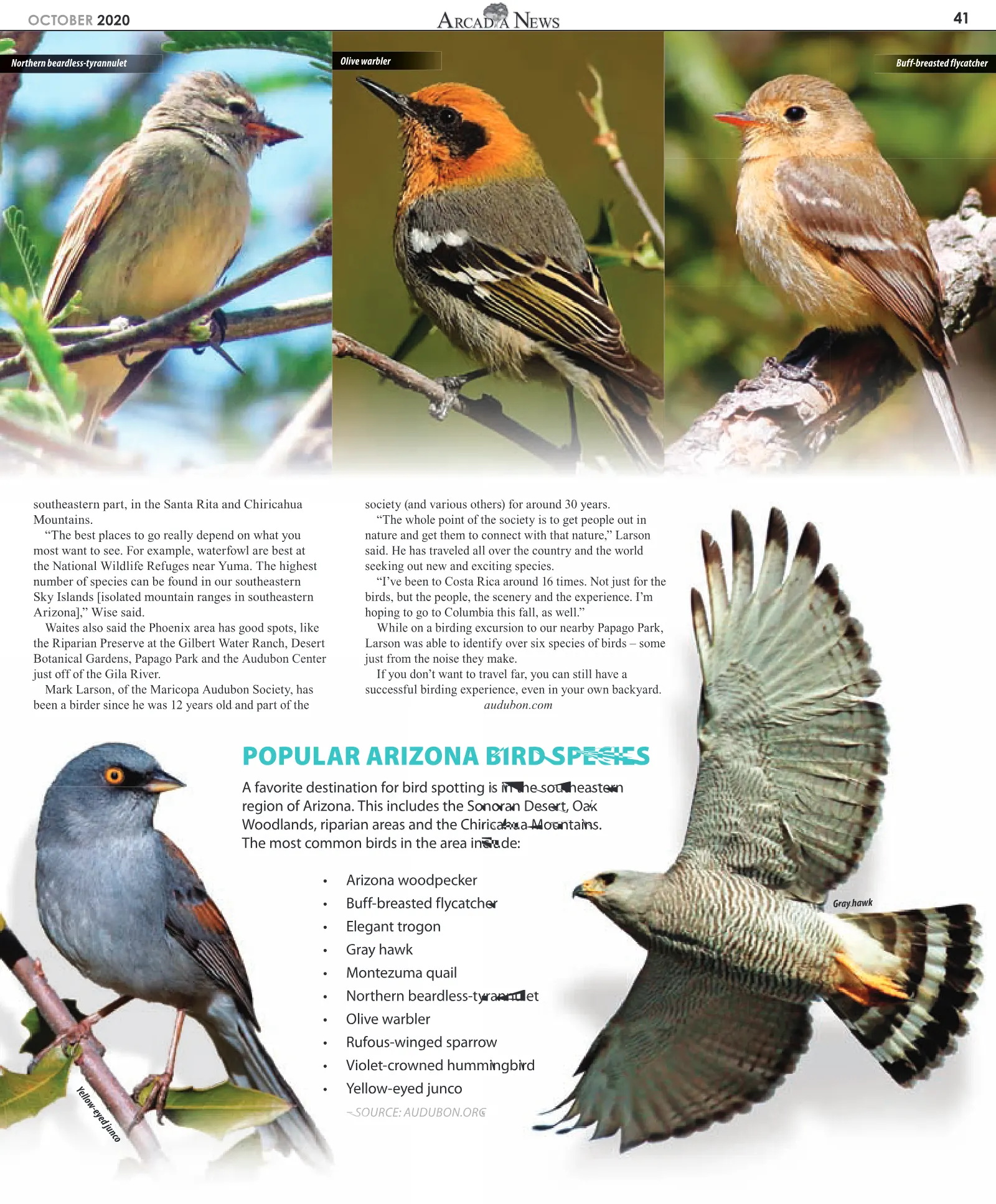
41 OCTOBER 2020 southeastern part, in the Santa Rita and Chiricahua Mountains. “The best places to go really depend on what you most want to see. For example, waterfowl are best at the National Wildlife Refuges near Yuma. The highest number of species can be found in our southeastern Sky Islands [isolated mountain ranges in southeastern Arizona],” Wise said. Waites also said the Phoenix area has good spots, like the Riparian Preserve at the Gilbert Water Ranch, Desert Botanical Gardens, Papago Park and the Audubon Center just off of the Gila River. Mark Larson, of the Maricopa Audubon Society, has been a birder since he was 12 years old and part of the society (and various others) for around 30 years. “The whole point of the society is to get people out in nature and get them to connect with that nature,” Larson said. He has traveled all over the country and the world seeking out new and exciting species. “I’ve been to Costa Rica around 16 times. Not just for the birds, but the people, the scenery and the experience. I’m hoping to go to Columbia this fall, as well.” While on a birding excursion to our nearby Papago Park, Larson was able to identify over six species of birds – some just from the noise they make. If you don’t want to travel far, you can still have a successful birding experience, even in your own backyard. audubon.com Buff-breasted flycatcher Northern beardless-tyrannulet Olive warbler Gray hawk Botanical Gardens, Papago Park and the Audubon Center just off of the Gila River. Mark Larson, of the Maricopa Audubon Society, has been a birder since he was 12 years old and part of the just from the noise they make. If you don’t want to travel far, you can still have a successful birding experience, even in your own backyard. POPULAR ARIZONA BIRD SPECIES A favorite destination for bird spotting is in the southeastern region of Arizona. This includes the Sonoran Desert, Oak Woodlands, riparian areas and the Chiricahua Mountains. The most common birds in the area include: • Arizona woodpecker • Buff-breasted flycatcher • Elegant trogon • Gray hawk • Montezuma quail • Northern beardless-tyrannulet • Olive warbler • Rufous-winged sparrow • Violet-crowned hummingbird • Yellow-eyed junco SOURCE: AUDUBON.ORG society (and various others) for around 30 years. society (and various others) for around 30 years. “The whole point of the society is to get people out in nature and get them to connect with that nature,” Larson said. He has traveled all over the country and the world seeking out new and exciting species. “I’ve been to Costa Rica around 16 times. Not just for the birds, but the people, the scenery and the experience. I’m hoping to go to Columbia this fall, as well.” While on a birding excursion to our nearby Papago Park, Larson was able to identify over six species of birds – some just from the noise they make. If you don’t want to travel far, you can still have a successful birding experience, even in your own backyard. audubon.com Gray hawk POPULAR ARIZONA BIRD SPECIES A favorite destination for bird spotting is in the southeastern region of Arizona. This includes the Sonoran Desert, Oak Woodlands, riparian areas and the Chiricahua Mountains. The most common birds in the area include: Buff-breasted flycatcher Northern beardless-tyrannulet Rufous-winged sparrow Violet-crowned hummingbird SOURCE: AUDUBON.ORG SOURCE: AUDUBON.ORG Yellow-eyed junco