
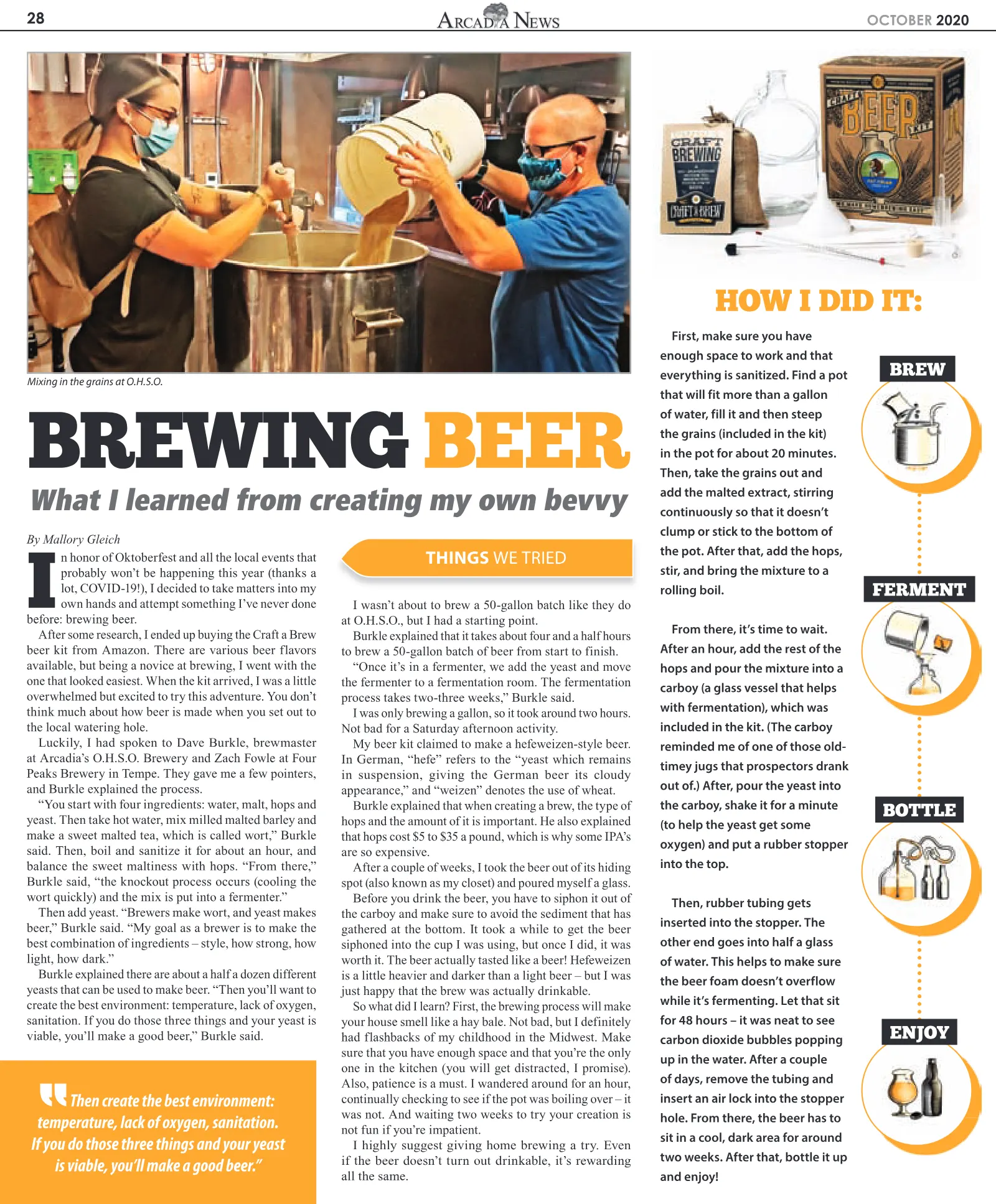

28 OCTOBER 2020 By Mallory Gleich I n honor of Oktoberfest and all the local events that probably won’t be happening this year (thanks a lot, COVID-19!), I decided to take matters into my own hands and attempt something I’ve never done before: brewing beer. After some research, I ended up buying the Craft a Brew beer kit from Amazon. There are various beer flavors available, but being a novice at brewing, I went with the one that looked easiest. When the kit arrived, I was a little overwhelmed but excited to try this adventure. You don’t think much about how beer is made when you set out to the local watering hole. Luckily, I had spoken to Dave Burkle, brewmaster at Arcadia’s O.H.S.O. Brewery and Zach Fowle at Four Peaks Brewery in Tempe. They gave me a few pointers, and Burkle explained the process. “You start with four ingredients: water, malt, hops and yeast. Then take hot water, mix milled malted barley and make a sweet malted tea, which is called wort,” Burkle said. Then, boil and sanitize it for about an hour, and balance the sweet maltiness with hops. “From there,” Burkle said, “the knockout process occurs (cooling the wort quickly) and the mix is put into a fermenter.” Then add yeast. “Brewers make wort, and yeast makes beer,” Burkle said. “My goal as a brewer is to make the best combination of ingredients – style, how strong, how light, how dark.” Burkle explained there are about a half a dozen different yeasts that can be used to make beer. “Then you’ll want to create the best environment: temperature, lack of oxygen, sanitation. If you do those three things and your yeast is viable, you’ll make a good beer,” Burkle said. I wasn’t about to brew a 50-gallon batch like they do at O.H.S.O., but I had a starting point. Burkle explained that it takes about four and a half hours to brew a 50-gallon batch of beer from start to finish. “Once it’s in a fermenter, we add the yeast and move the fermenter to a fermentation room. The fermentation process takes two-three weeks,” Burkle said. I was only brewing a gallon, so it took around two hours. Not bad for a Saturday afternoon activity. My beer kit claimed to make a hefeweizen-style beer. In German, “hefe” refers to the “yeast which remains in suspension, giving the German beer its cloudy appearance,” and “weizen” denotes the use of wheat. Burkle explained that when creating a brew, the type of hops and the amount of it is important. He also explained that hops cost $5 to $35 a pound, which is why some IPA’s are so expensive. After a couple of weeks, I took the beer out of its hiding spot (also known as my closet) and poured myself a glass. Before you drink the beer, you have to siphon it out of the carboy and make sure to avoid the sediment that has gathered at the bottom. It took a while to get the beer siphoned into the cup I was using, but once I did, it was worth it. The beer actually tasted like a beer! Hefeweizen is a little heavier and darker than a light beer – but I was just happy that the brew was actually drinkable. So what did I learn? First, the brewing process will make your house smell like a hay bale. Not bad, but I definitely had flashbacks of my childhood in the Midwest. Make sure that you have enough space and that you’re the only one in the kitchen (you will get distracted, I promise). Also, patience is a must. I wandered around for an hour, continually checking to see if the pot was boiling over – it was not. And waiting two weeks to try your creation is not fun if you’re impatient. I highly suggest giving home brewing a try. Even if the beer doesn’t turn out drinkable, it’s rewarding all the same. What I learned from creating my own bevvy First, make sure you have enough space to work and that everything is sanitized. Find a pot that will fit more than a gallon of water, fill it and then steep the grains (included in the kit) in the pot for about 20 minutes. Then, take the grains out and add the malted extract, stirring continuously so that it doesn’t clump or stick to the bottom of the pot. After that, add the hops, stir, and bring the mixture to a rolling boil. From there, it’s time to wait. After an hour, add the rest of the hops and pour the mixture into a carboy (a glass vessel that helps with fermentation), which was included in the kit. (The carboy reminded me of one of those old- timey jugs that prospectors drank out of.) After, pour the yeast into the carboy, shake it for a minute (to help the yeast get some oxygen) and put a rubber stopper into the top. Then, rubber tubing gets inserted into the stopper. The other end goes into half a glass of water. This helps to make sure the beer foam doesn’t overflow while it’s fermenting. Let that sit for 48 hours – it was neat to see carbon dioxide bubbles popping up in the water. After a couple of days, remove the tubing and insert an air lock into the stopper hole. From there, the beer has to sit in a cool, dark area for around two weeks. After that, bottle it up and enjoy! Then create the best environment: temperature, lack of oxygen, sanitation. If you do those three things and your yeast is viable, you’ll make a good beer.” BREW FERMENT BOTTLE ENJOY HOW I DID IT: BREWING BEER Mixing in the grains at O.H.S.O. THINGS WE TRIED
Christ Lutheran School Preschool - Grade 8 • www.clsphx.org LC-MS 3901 E. Indian School Rd., Phoenix | www.cclphoenix.org | (602) 955-4830 LOVE GROW SERVE IN-PERSON WORSHIP Visit our website for times and to reserve your seat. ONLINE WORSHIP Sunday @ 9:30am FB Live or CHRISTCHURCHPHX.ONLINE.CHURCH 29 OCTOBER 2020 How did you come to work for O.H.S.O.? I grew up in Oregon and was a home brewer there. I hadn’t done it for a long time and when the sign for O.H.S.O. went up I said “time for a change.” I came in and met the owner, Jon Lane. It took about a year to start the nanoBrewery. Most of the brewers are devout home brewers without much experience – we have nine brewers and only the last couple have come from other breweries so it’s been cool to work with Jon and start from the ground up. How is O.H.S.O.’s beer connected to Arcadia? Some of the ingredients – we get a lot of the citrus from our neighbors. This location was always a restaurant, but when we added the patio, it became Arcadia’s. Before all the other brunch and brewery places opened around here, we kind of started an awesome neighborhood spot. Our name is Outrageous Homebrewer’s Social Outpost and part of the concept was to have the neighbors come in and brew with us. Up until COVID, we had groups come in and brew 50 gallon batches. We go through the mash, boil, hopping… they brew the beer and we help them out and show them the ropes. Our owners live within a mile of here, so that helps. Is working at a brewery different than what you thought it would be? It’s not lucrative; it’s not the highest paying job around. But for me, I get a lot of satisfaction – there’s a lot of engineering, there’s the cooking aspect, getting creative with recipes, and I enjoy the finished product. And when other people enjoy it, that’s the best. What is unique about O.H.S.O.’s beer? We have three different locations. The nanoBrewery makes 50 gallon batches so What is your position at Four Peaks? I’m the communications manager. I take care of all of our social media, messaging, events. I also hold the title of advanced cicerone, which is like a level three sommelier, but for beer. I do a lot of trainings and teach people about beer. How is Four Peaks beer connected to Arizona? We’re one of the oldest continuous breweries in Arizona. Most are five/six years old – we opened in 1996 so we’re kind of the “old card” of Arizona beer. I think in a lot of ways we were the first craft beer that people tried in Arizona, and we introduced them to a lot of flavors they hadn’t been exposed to before. Is working in a brewery different than you thought it’d be? One thing to know about brewing beer – it’s not nearly as glamorous as people think it is. People think brewers spend all day tasting beer and the truth is, most of the time you’re cleaning up after yourself. You’re more a janitor than anything else. You set up the ingredients in the right way and make sure everything’s proportioned, but in the end it’s much more about how clean you are. A lot of the day is spent cleaning out the tanks, sweeping and everything. You’re a yeast wrangler, you’re a janitor, but the yeast is what makes the beer. Short and sweet – how is beer made? You are creating a sugary liquid by combining water with some kind of grain. You boil that liquid with hops to give it some bitterness and flavor and then you combine that hoppy liquid with yeast. The yeast eats the sugars, converting what you try here you may never try again, and there’s always something new and different. The Paradise Valley location has our regular beers – we make those in large containers and those are always available. The Gilbert location is our barrel house and lager tanks, where we get to make light lagers and pilsners and barrel-aged beers with strong 10, 12, 14% alcohol by volume (ABV) – and we can use different barrels and wines. We have such a different selection at all of our locations. What is the hardest part about being a brewmaster? What’s your favorite part? There’s nothing fun about cleaning. Brewing is only about 25 percent. There’s a lot of cleaning involved – and preparation. You can’t assume things are clean. Being patient is another thing. Taking notes. One of my brewers once said, “The difference between messing around and science is taking notes.” You can just mess around, but as soon as you start plotting it, it’s real. I think seeing people’s satisfaction is my favorite part. What new brews are you currently working on? We’re always trying different hop combinations and different pale ales. Hazy pale ales are one of the most popular these days. Gilbert’s mixing it up – they recently had a jasmine rice lager. Here, we’re able to use a lot of local fruits and stuff like that. What’s the most important thing to know about brewing from home? You need to keep on trying. The first batch might not turn out well. Pay attention and you’ll learn something new every time you brew. Don’t start with something strong. Get serious, but don’t take yourself too seriously! them into alcohol and carbon dioxide. You have four main ingredients: water, malt, hops and yeast – that’s all you really need to make the beer. How many beers do you guys have? We probably have more year- round beers than any brewery should have – more than a dozen at any given time, and we have at least one seasonal that comes out each season. In total, it’s probably between 30-50 beers every year. What’s the hardest part of brewing beer? The waiting. Once you’ve brewed everything you have to sit back and let the yeast do its job. So if you’re making an ale, that can take seven to ten days, if you’re making a lager, that could take months. You have to be patient and let time take its course. And you have to be okay with pouring something down the drain if it doesn’t turn out the way that you want. The most fun part is getting to drink your beer. When you come to the end result and see what you’ve created and see other people enjoy it too – there’s not a lot of industries where you have a connection to the end product. It’s very cool. What is the most important thing to know when brewing at home? Cleanliness and temperature. Those two are the most important. I’ve judged a lot of home-brewing competitions and most often, you see things that haven’t been cleaned properly. Because we live in Arizona it’s hard to keep temperatures cold enough for beer to ferment. For a home brewer it’s hard to maintain that unless you have a refrigerator set up. When you ferment too hot, yeast doesn’t like that and it’ll create some weird flavors. Dave Burkle, O.H.S.O. Brewery Zach Fowle, Four Peaks Brewery Dave Burkle Zach Fowle THE PROFESSIONALS