
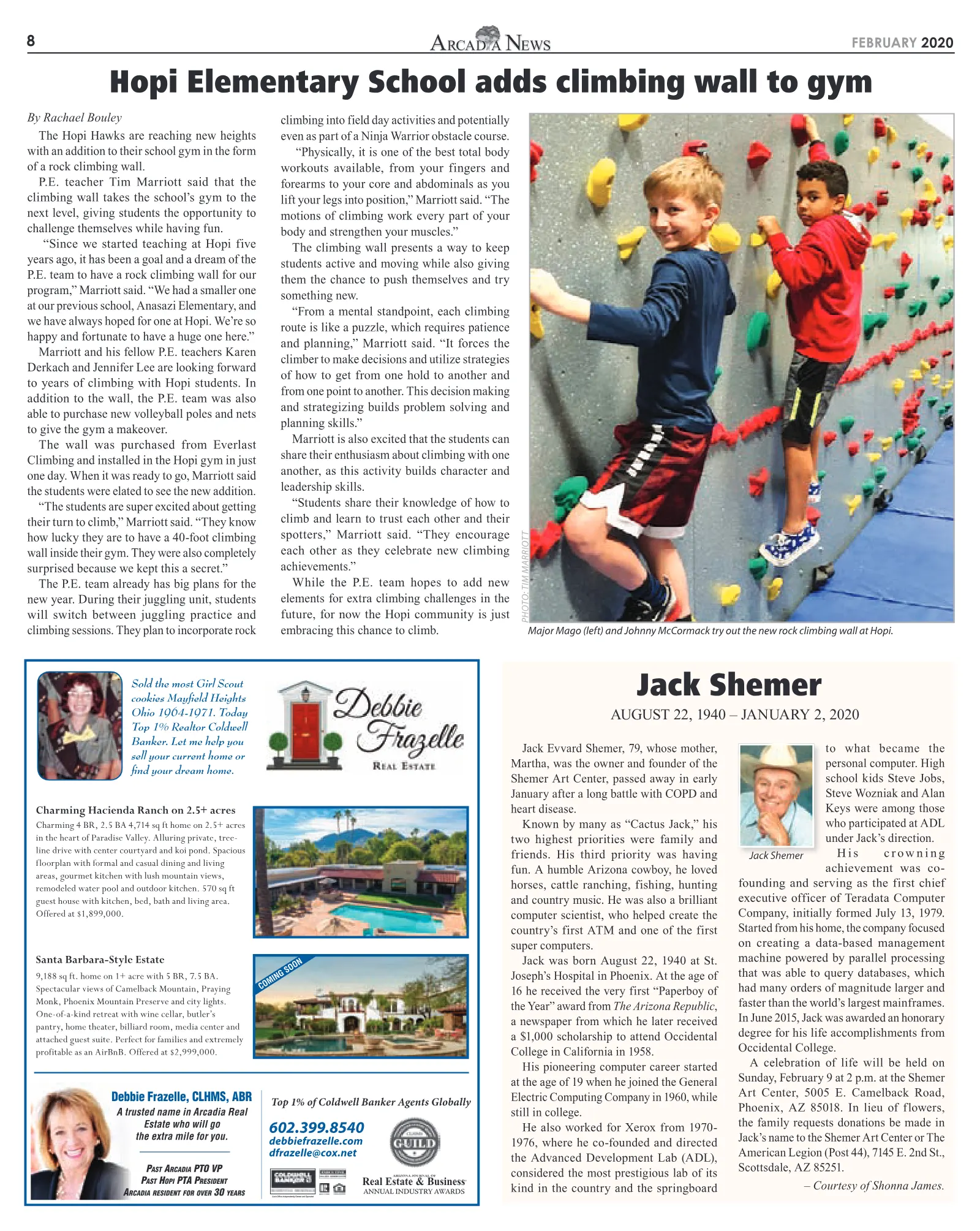
8 FEBRUARY 2020 By Rachael Bouley The Hopi Hawks are reaching new heights with an addition to their school gym in the form of a rock climbing wall. P.E. teacher Tim Marriott said that the climbing wall takes the school’s gym to the next level, giving students the opportunity to challenge themselves while having fun. “Since we started teaching at Hopi five years ago, it has been a goal and a dream of the P.E. team to have a rock climbing wall for our program,” Marriott said. “We had a smaller one at our previous school, Anasazi Elementary, and we have always hoped for one at Hopi. We’re so happy and fortunate to have a huge one here.” Marriott and his fellow P.E. teachers Karen Derkach and Jennifer Lee are looking forward to years of climbing with Hopi students. In addition to the wall, the P.E. team was also able to purchase new volleyball poles and nets to give the gym a makeover. The wall was purchased from Everlast Climbing and installed in the Hopi gym in just one day. When it was ready to go, Marriott said the students were elated to see the new addition. “The students are super excited about getting their turn to climb,” Marriott said. “They know how lucky they are to have a 40-foot climbing wall inside their gym. They were also completely surprised because we kept this a secret.” The P.E. team already has big plans for the new year. During their juggling unit, students will switch between juggling practice and climbing sessions. They plan to incorporate rock climbing into field day activities and potentially even as part of a Ninja Warrior obstacle course. “Physically, it is one of the best total body workouts available, from your fingers and forearms to your core and abdominals as you lift your legs into position,” Marriott said. “The motions of climbing work every part of your body and strengthen your muscles.” The climbing wall presents a way to keep students active and moving while also giving them the chance to push themselves and try something new. “From a mental standpoint, each climbing route is like a puzzle, which requires patience and planning,” Marriott said. “It forces the climber to make decisions and utilize strategies of how to get from one hold to another and from one point to another. This decision making and strategizing builds problem solving and planning skills.” Marriott is also excited that the students can share their enthusiasm about climbing with one another, as this activity builds character and leadership skills. “Students share their knowledge of how to climb and learn to trust each other and their spotters,” Marriott said. “They encourage each other as they celebrate new climbing achievements.” While the P.E. team hopes to add new elements for extra climbing challenges in the future, for now the Hopi community is just embracing this chance to climb. Hopi Elementary School adds climbing wall to gym PHOTO: TIM MARRIOTT Major Mago (left) and Johnny McCormack try out the new rock climbing wall at Hopi. Jack Evvard Shemer, 79, whose mother, Martha, was the owner and founder of the Shemer Art Center, passed away in early January after a long battle with COPD and heart disease. Known by many as “Cactus Jack,” his two highest priorities were family and friends. His third priority was having fun. A humble Arizona cowboy, he loved horses, cattle ranching, fishing, hunting and country music. He was also a brilliant computer scientist, who helped create the country’s first ATM and one of the first super computers. Jack was born August 22, 1940 at St. Joseph’s Hospital in Phoenix. At the age of 16 he received the very first “Paperboy of the Year” award from The Arizona Republic , a newspaper from which he later received a $1,000 scholarship to attend Occidental College in California in 1958. His pioneering computer career started at the age of 19 when he joined the General Electric Computing Company in 1960, while still in college. He also worked for Xerox from 1970- 1976, where he co-founded and directed the Advanced Development Lab (ADL), considered the most prestigious lab of its kind in the country and the springboard to what became the personal computer. High school kids Steve Jobs, Steve Wozniak and Alan Keys were among those who participated at ADL under Jack’s direction. H i s c r o w n i n g achievement was co- founding and serving as the first chief executive officer of Teradata Computer Company, initially formed July 13, 1979. Started from his home, the company focused on creating a data-based management machine powered by parallel processing that was able to query databases, which had many orders of magnitude larger and faster than the world’s largest mainframes. In June 2015, Jack was awarded an honorary degree for his life accomplishments from Occidental College. A celebration of life will be held on Sunday, February 9 at 2 p.m. at the Shemer Art Center, 5005 E. Camelback Road, Phoenix, AZ 85018. In lieu of flowers, the family requests donations be made in Jack’s name to the Shemer Art Center or The American Legion (Post 44), 7145 E. 2nd St., Scottsdale, AZ 85251. – Courtesy of Shonna James. Jack Shemer AUGUST 22, 1940 – JANUARY 2, 2020 Jack Shemer 602.399.8540 debbiefrazelle.com dfrazelle@cox.net Each Office Independently Owned and Operated A R I Z O N A J O U R N A L O F R E A L E S T A T E & E S S leading az industry information since 1985 ARIZONA JOURNAL OF Real Estate & Business ® ANNUAL INDUSTRY AWARDS REAL ESTATE AGENT OF THE YEAR NOMINEE 2015 Debbie Frazelle, CLHMS, ABR A trusted name in Arcadia Real Estate who will go the extra mile for you. PAST ARCADIA PTO VP PAST HOPI PTA PRESIDENT ARCADIA RESIDENT FOR OVER 30 YEARS Charming 4 BR, 2.5 BA 4,714 sq ft home on 2.5+ acres in the heart of Paradise Valley. Alluring private, tree- line drive with center courtyard and koi pond. Spacious floorplan with formal and casual dining and living areas, gourmet kitchen with lush mountain views, remodeled water pool and outdoor kitchen. 570 sq ft guest house with kitchen, bed, bath and living area. Offered at $1,899,000. Charming Hacienda Ranch on 2.5+ acres Santa Barbara-Style Estate 9,188 sq ft. home on 1+ acre with 5 BR, 7.5 BA. Spectacular views of Camelback Mountain, Praying Monk, Phoenix Mountain Preserve and city lights. One-of-a-kind retreat with wine cellar, butler’s pantry, home theater, billiard room, media center and attached guest suite. Perfect for families and extremely profitable as an AirBnB. Offered at $2,999,000. Top 1% of Coldwell Banker Agents Globally Sold the most Girl Scout cookies Mayfield Heights Ohio 1964-1971. Today Top 1% Realtor Coldwell Banker. Let me help you sell your current home or find your dream home. COMING SOON
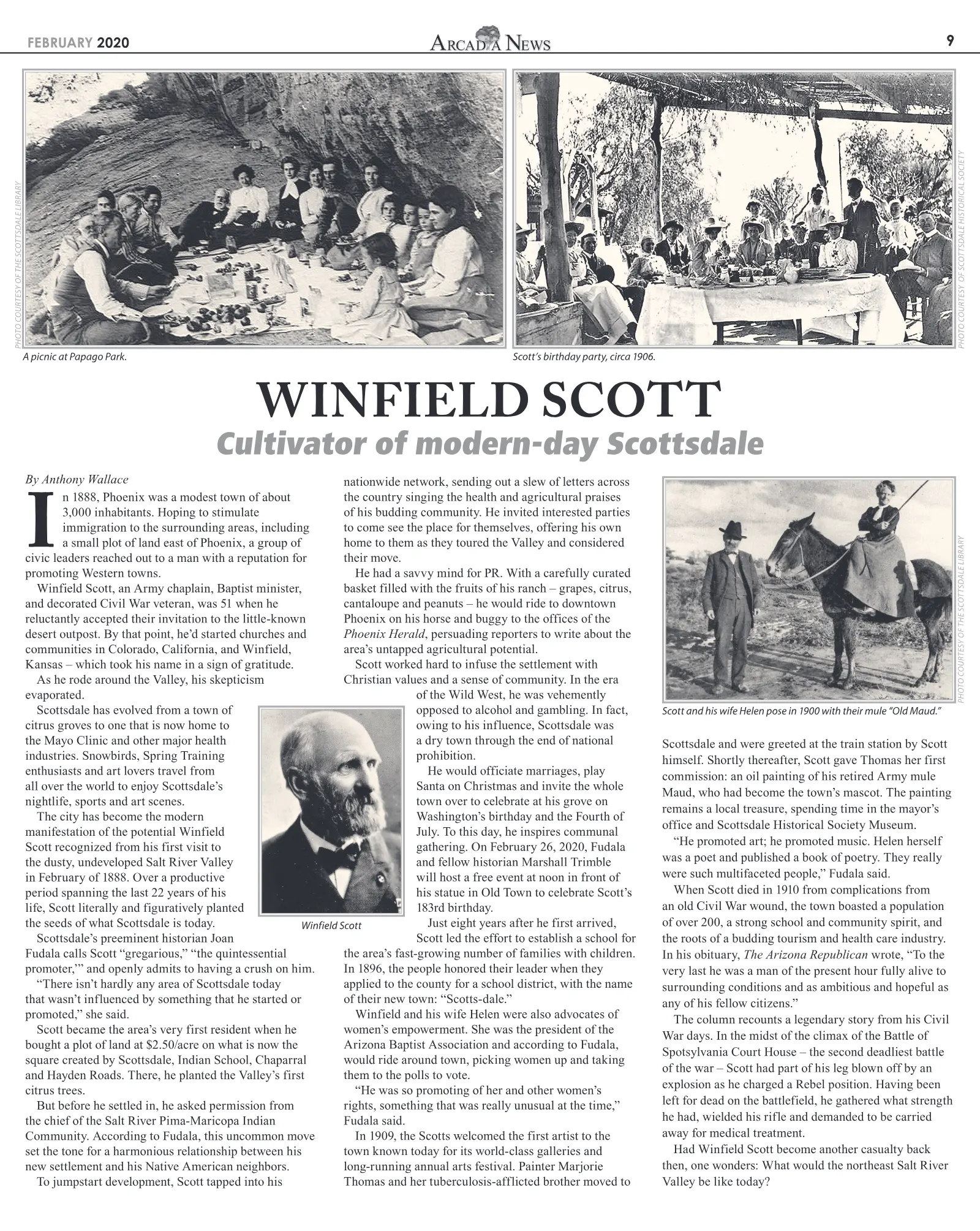
9 FEBRUARY 2020 PHOTO COURTESY OF THE SCOTTSDALE LIBRARY By Anthony Wallace I n 1888, Phoenix was a modest town of about 3,000 inhabitants. Hoping to stimulate immigration to the surrounding areas, including a small plot of land east of Phoenix, a group of civic leaders reached out to a man with a reputation for promoting Western towns. Winfield Scott, an Army chaplain, Baptist minister, and decorated Civil War veteran, was 51 when he reluctantly accepted their invitation to the little-known desert outpost. By that point, he’d started churches and communities in Colorado, California, and Winfield, Kansas – which took his name in a sign of gratitude. As he rode around the Valley, his skepticism evaporated. Scottsdale has evolved from a town of citrus groves to one that is now home to the Mayo Clinic and other major health industries. Snowbirds, Spring Training enthusiasts and art lovers travel from all over the world to enjoy Scottsdale’s nightlife, sports and art scenes. The city has become the modern manifestation of the potential Winfield Scott recognized from his first visit to the dusty, undeveloped Salt River Valley in February of 1888. Over a productive period spanning the last 22 years of his life, Scott literally and figuratively planted the seeds of what Scottsdale is today. Scottsdale’s preeminent historian Joan Fudala calls Scott “gregarious,” “the quintessential promoter,’” and openly admits to having a crush on him. “There isn’t hardly any area of Scottsdale today that wasn’t influenced by something that he started or promoted,” she said. Scott became the area’s very first resident when he bought a plot of land at $2.50/acre on what is now the square created by Scottsdale, Indian School, Chaparral and Hayden Roads. There, he planted the Valley’s first citrus trees. But before he settled in, he asked permission from the chief of the Salt River Pima-Maricopa Indian Community. According to Fudala, this uncommon move set the tone for a harmonious relationship between his new settlement and his Native American neighbors. To jumpstart development, Scott tapped into his nationwide network, sending out a slew of letters across the country singing the health and agricultural praises of his budding community. He invited interested parties to come see the place for themselves, offering his own home to them as they toured the Valley and considered their move. He had a savvy mind for PR. With a carefully curated basket filled with the fruits of his ranch – grapes, citrus, cantaloupe and peanuts – he would ride to downtown Phoenix on his horse and buggy to the offices of the Phoenix Herald , persuading reporters to write about the area’s untapped agricultural potential. Scott worked hard to infuse the settlement with Christian values and a sense of community. In the era of the Wild West, he was vehemently opposed to alcohol and gambling. In fact, owing to his influence, Scottsdale was a dry town through the end of national prohibition. He would officiate marriages, play Santa on Christmas and invite the whole town over to celebrate at his grove on Washington’s birthday and the Fourth of July. To this day, he inspires communal gathering. On February 26, 2020, Fudala and fellow historian Marshall Trimble will host a free event at noon in front of his statue in Old Town to celebrate Scott’s 183rd birthday. Just eight years after he first arrived, Scott led the effort to establish a school for the area’s fast-growing number of families with children. In 1896, the people honored their leader when they applied to the county for a school district, with the name of their new town: “Scotts-dale.” Winfield and his wife Helen were also advocates of women’s empowerment. She was the president of the Arizona Baptist Association and according to Fudala, would ride around town, picking women up and taking them to the polls to vote. “He was so promoting of her and other women’s rights, something that was really unusual at the time,” Fudala said. In 1909, the Scotts welcomed the first artist to the town known today for its world-class galleries and long-running annual arts festival. Painter Marjorie Thomas and her tuberculosis-afflicted brother moved to Scottsdale and were greeted at the train station by Scott himself. Shortly thereafter, Scott gave Thomas her first commission: an oil painting of his retired Army mule Maud, who had become the town’s mascot. The painting remains a local treasure, spending time in the mayor’s office and Scottsdale Historical Society Museum. “He promoted art; he promoted music. Helen herself was a poet and published a book of poetry. They really were such multifaceted people,” Fudala said. When Scott died in 1910 from complications from an old Civil War wound, the town boasted a population of over 200, a strong school and community spirit, and the roots of a budding tourism and health care industry. In his obituary, The Arizona Republican wrote, “To the very last he was a man of the present hour fully alive to surrounding conditions and as ambitious and hopeful as any of his fellow citizens.” The column recounts a legendary story from his Civil War days. In the midst of the climax of the Battle of Spotsylvania Court House – the second deadliest battle of the war – Scott had part of his leg blown off by an explosion as he charged a Rebel position. Having been left for dead on the battlefield, he gathered what strength he had, wielded his rifle and demanded to be carried away for medical treatment. Had Winfield Scott become another casualty back then, one wonders: What would the northeast Salt River Valley be like today? WINFIELD SCOTT Cultivator of modern-day Scottsdale PHOTO COURTESY OF SCOTTSDALE HISTORICAL SOCIETY A picnic at Papago Park. Scott’s birthday party, circa 1906. Scott and his wife Helen pose in 1900 with their mule “Old Maud.” PHOTO COURTESY OF THE SCOTTSDALE LIBRARY Winfield Scott