
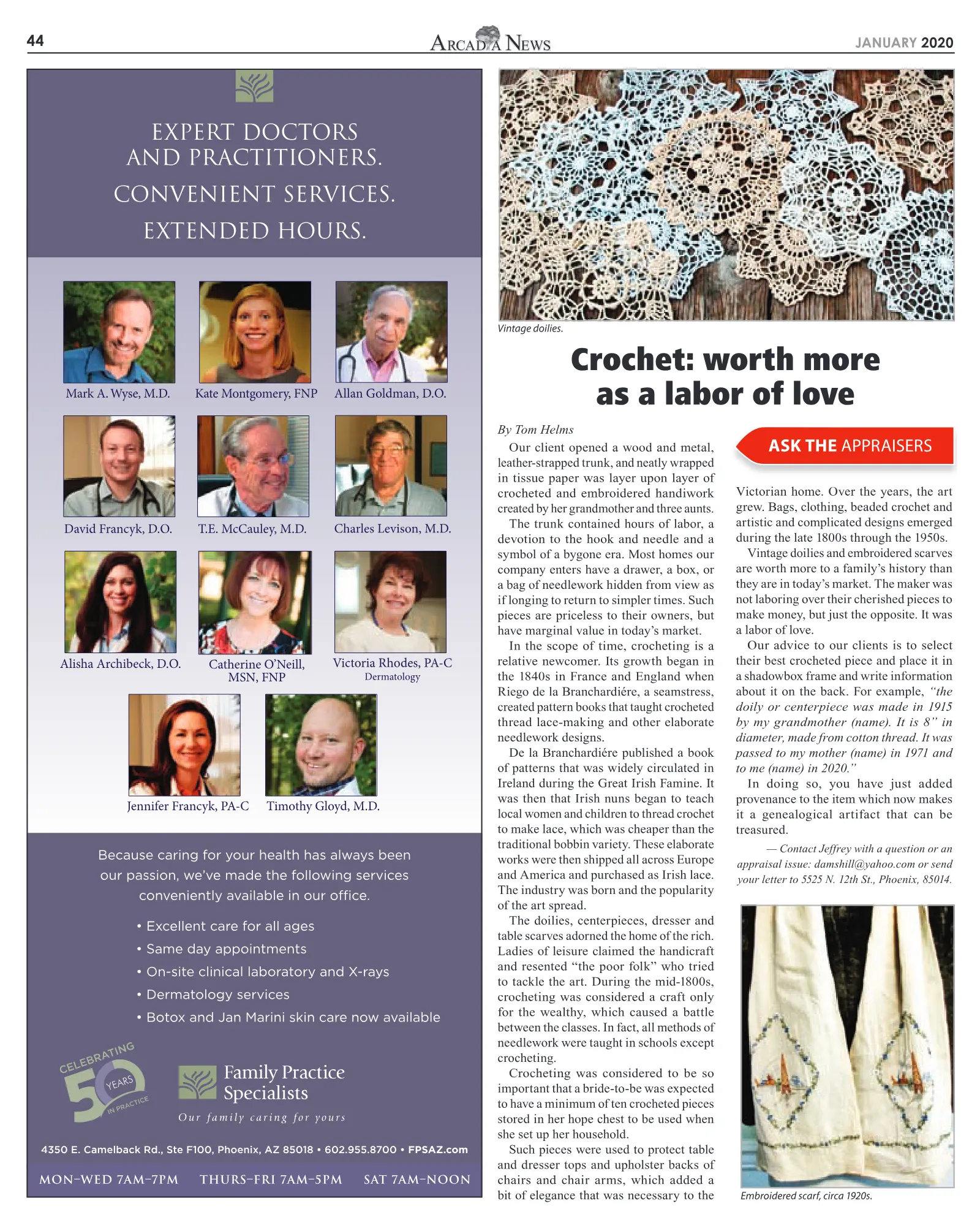
44 JANUARY 2020 By Tom Helms Our client opened a wood and metal, leather-strapped trunk, and neatly wrapped in tissue paper was layer upon layer of crocheted and embroidered handiwork created by her grandmother and three aunts. The trunk contained hours of labor, a devotion to the hook and needle and a symbol of a bygone era. Most homes our company enters have a drawer, a box, or a bag of needlework hidden from view as if longing to return to simpler times. Such pieces are priceless to their owners, but have marginal value in today’s market. In the scope of time, crocheting is a relative newcomer. Its growth began in the 1840s in France and England when Riego de la Branchardiére, a seamstress, created pattern books that taught crocheted thread lace-making and other elaborate needlework designs. De la Branchardiére published a book of patterns that was widely circulated in Ireland during the Great Irish Famine. It was then that Irish nuns began to teach local women and children to thread crochet to make lace, which was cheaper than the traditional bobbin variety. These elaborate works were then shipped all across Europe and America and purchased as Irish lace. The industry was born and the popularity of the art spread. The doilies, centerpieces, dresser and table scarves adorned the home of the rich. Ladies of leisure claimed the handicraft and resented “the poor folk” who tried to tackle the art. During the mid-1800s, crocheting was considered a craft only for the wealthy, which caused a battle between the classes. In fact, all methods of needlework were taught in schools except crocheting. Crocheting was considered to be so important that a bride-to-be was expected to have a minimum of ten crocheted pieces stored in her hope chest to be used when she set up her household. Such pieces were used to protect table and dresser tops and upholster backs of chairs and chair arms, which added a bit of elegance that was necessary to the Victorian home. Over the years, the art grew. Bags, clothing, beaded crochet and artistic and complicated designs emerged during the late 1800s through the 1950s. Vintage doilies and embroidered scarves are worth more to a family’s history than they are in today’s market. The maker was not laboring over their cherished pieces to make money, but just the opposite. It was a labor of love. Our advice to our clients is to select their best crocheted piece and place it in a shadowbox frame and write information about it on the back. For example, “the doily or centerpiece was made in 1915 by my grandmother (name). It is 8” in diameter, made from cotton thread. It was passed to my mother (name) in 1971 and to me (name) in 2020.” In doing so, you have just added provenance to the item which now makes it a genealogical artifact that can be treasured. — Contact Jeffrey with a question or an appraisal issue: damshill@yahoo.com or send your letter to 5525 N. 12th St., Phoenix, 85014. Crochet: worth more as a labor of love ASK THE APPRAISERS Vintage doilies. Embroidered scarf, circa 1920s. Mark A. Wyse, M.D. Kate Montgomery, FNP Allan Goldman, D.O. David Francyk, D.O. T.E. McCauley, M.D. Alisha Archibeck, D.O. Jennifer Francyk, PA-C Timothy Gloyd, M.D. Victoria Rhodes, PA-C Dermatology Charles Levison, M.D. Because caring for your health has always been our passion, we’ve made the following services conveniently available in our office. • Excellent care for all ages • Same day appointments • On-site clinical laboratory and X-rays • Dermatology services • Botox and Jan Marini skin care now available MON–WED 7AM–7PM THURS–FRI 7AM–5PM SAT 7AM–NOON EXPERT DOCTORS AND PRACTITIONERS. CONVENIENT SERVICES. EXTENDED HOURS. Catherine O’Neill, MSN, FNP 4350 E. Camelback Rd., Ste F100, Phoenix, AZ 85018 • 602.955.8700 • FPSAZ.com IN PRACTICE CELEBRATING
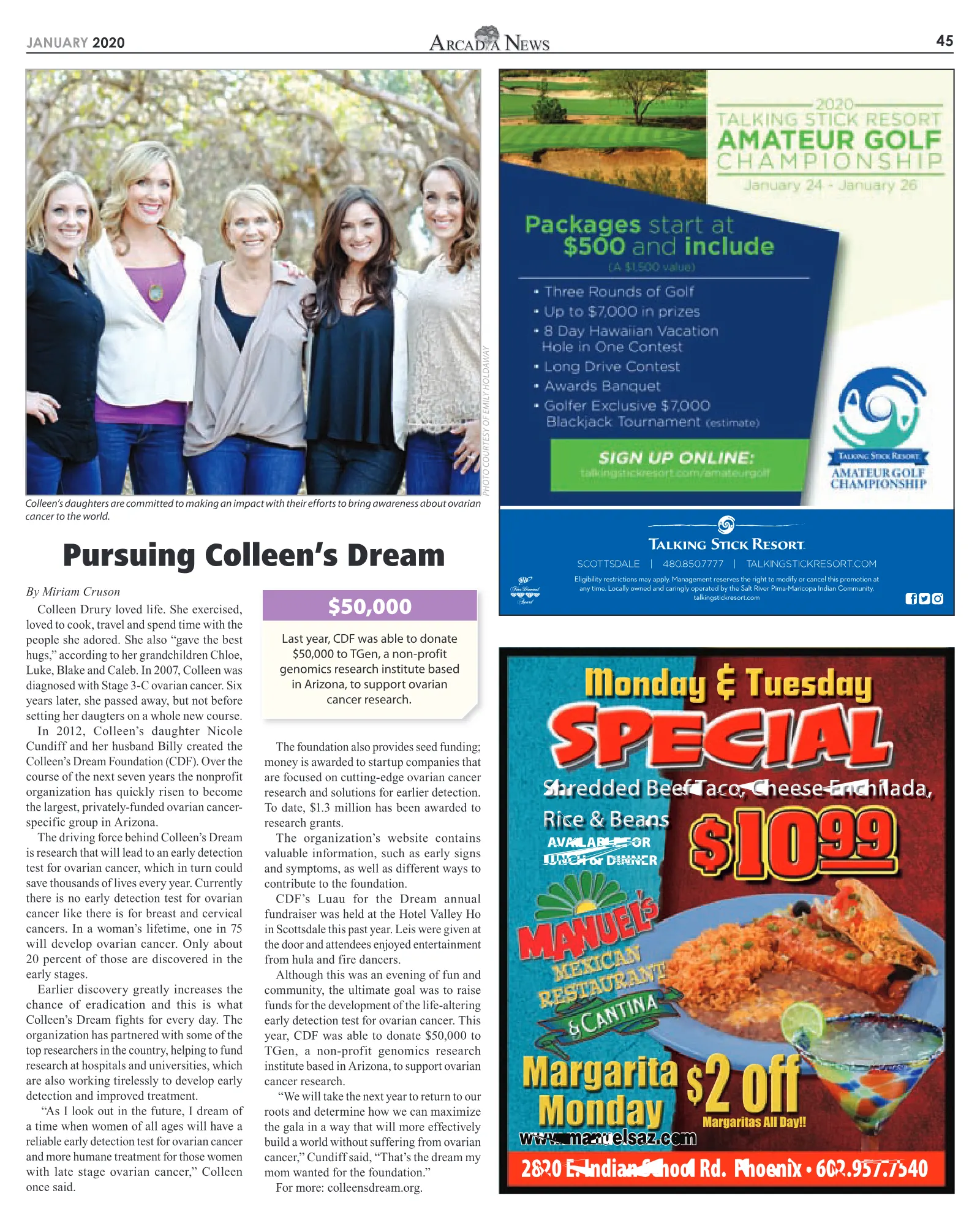
45 JANUARY 2020 Colleen’s daughters are committed to making an impact with their efforts to bring awareness about ovarian cancer to the world. PHOTO COURTESY OF EMILY HOLDAWAY By Miriam Cruson Colleen Drury loved life. She exercised, loved to cook, travel and spend time with the people she adored. She also “gave the best hugs,” according to her grandchildren Chloe, Luke, Blake and Caleb. In 2007, Colleen was diagnosed with Stage 3-C ovarian cancer. Six years later, she passed away, but not before setting her daugters on a whole new course. In 2012, Colleen’s daughter Nicole Cundiff and her husband Billy created the Colleen’s Dream Foundation (CDF). Over the course of the next seven years the nonprofit organization has quickly risen to become the largest, privately-funded ovarian cancer- specific group in Arizona. The driving force behind Colleen’s Dream is research that will lead to an early detection test for ovarian cancer, which in turn could save thousands of lives every year. Currently there is no early detection test for ovarian cancer like there is for breast and cervical cancers. In a woman’s lifetime, one in 75 will develop ovarian cancer. Only about 20 percent of those are discovered in the early stages. Earlier discovery greatly increases the chance of eradication and this is what Colleen’s Dream fights for every day. The organization has partnered with some of the top researchers in the country, helping to fund research at hospitals and universities, which are also working tirelessly to develop early detection and improved treatment. “As I look out in the future, I dream of a time when women of all ages will have a reliable early detection test for ovarian cancer and more humane treatment for those women with late stage ovarian cancer,” Colleen once said. The foundation also provides seed funding; money is awarded to startup companies that are focused on cutting-edge ovarian cancer research and solutions for earlier detection. To date, $1.3 million has been awarded to research grants. The organization’s website contains valuable information, such as early signs and symptoms, as well as different ways to contribute to the foundation. CDF’s Luau for the Dream annual fundraiser was held at the Hotel Valley Ho in Scottsdale this past year. Leis were given at the door and attendees enjoyed entertainment from hula and fire dancers. Although this was an evening of fun and community, the ultimate goal was to raise funds for the development of the life-altering early detection test for ovarian cancer. This year, CDF was able to donate $50,000 to TGen, a non-profit genomics research institute based in Arizona, to support ovarian cancer research. “We will take the next year to return to our roots and determine how we can maximize the gala in a way that will more effectively build a world without suffering from ovarian cancer,” Cundiff said, “That’s the dream my mom wanted for the foundation.” For more: colleensdream.org. Pursuing Colleen’s Dream Last year, CDF was able to donate $50,000 to TGen, a non-profit genomics research institute based in Arizona, to support ovarian cancer research. $50,000 Shredded Beef Taco, Cheese Enchilada, Rice & Beans AVAILABLE FOR LUNCH or DINNER Monday & Tuesday Margarita Monday $2 off Margaritas All Day!! 2820 E. Indian School Rd. Phoenix • 602.957.7540 www.manuelsaz.com Eligibility restrictions may apply. Management reserves the right to modify or cancel this promotion at any time. Locally owned and caringly operated by the Salt River Pima-Maricopa Indian Community. talkingstickresort.com TSRAmateurGolfChampionship_AN.indd 1 11/15/19 11:03 AM