
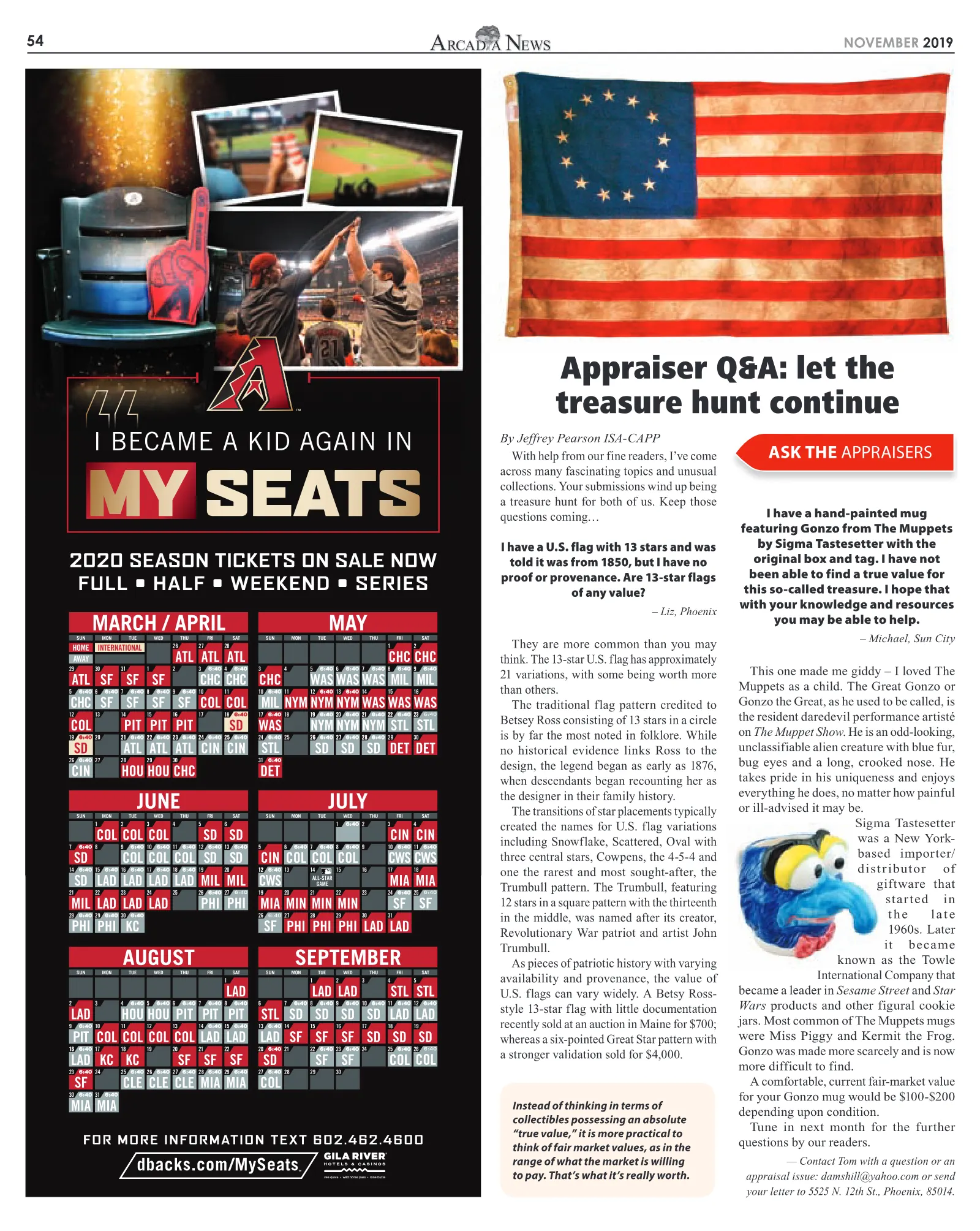
54 NOVEMBER 2019 By Jeffrey Pearson ISA-CAPP With help from our fine readers, I’ve come across many fascinating topics and unusual collections. Your submissions wind up being a treasure hunt for both of us. Keep those questions coming… I have a U.S. flag with 13 stars and was told it was from 1850, but I have no proof or provenance. Are 13-star flags of any value? – Liz, Phoenix They are more common than you may think. The 13-star U.S. flag has approximately 21 variations, with some being worth more than others. The traditional flag pattern credited to Betsey Ross consisting of 13 stars in a circle is by far the most noted in folklore. While no historical evidence links Ross to the design, the legend began as early as 1876, when descendants began recounting her as the designer in their family history. The transitions of star placements typically created the names for U.S. flag variations including Snowflake, Scattered, Oval with three central stars, Cowpens, the 4-5-4 and one the rarest and most sought-after, the Trumbull pattern. The Trumbull, featuring 12 stars in a square pattern with the thirteenth in the middle, was named after its creator, Revolutionary War patriot and artist John Trumbull. As pieces of patriotic history with varying availability and provenance, the value of U.S. flags can vary widely. A Betsy Ross- style 13-star flag with little documentation recently sold at an auction in Maine for $700; whereas a six-pointed Great Star pattern with a stronger validation sold for $4,000. I have a hand-painted mug featuring Gonzo from The Muppets by Sigma Tastesetter with the original box and tag. I have not been able to find a true value for this so-called treasure. I hope that with your knowledge and resources you may be able to help. – Michael, Sun City This one made me giddy – I loved The Muppets as a child. The Great Gonzo or Gonzo the Great, as he used to be called, is the resident daredevil performance artisté on The Muppet Show . He is an odd-looking, unclassifiable alien creature with blue fur, bug eyes and a long, crooked nose. He takes pride in his uniqueness and enjoys everything he does, no matter how painful or ill-advised it may be. Sigma Tastesetter was a New York- based importer/ dist r ibutor of giftware that star ted in t h e l a t e 1960s. Later it became known as the Towle International Company that became a leader in Sesame Street and Star Wars products and other figural cookie jars. Most common of The Muppets mugs were Miss Piggy and Kermit the Frog. Gonzo was made more scarcely and is now more difficult to find. A comfortable, current fair-market value for your Gonzo mug would be $100-$200 depending upon condition. Tune in next month for the further questions by our readers. — Contact Tom with a question or an appraisal issue: damshill@yahoo.com or send your letter to 5525 N. 12th St., Phoenix, 85014. ASK THE APPRAISERS Instead of thinking in terms of collectibles possessing an absolute “true value,” it is more practical to think of fair market values, as in the range of what the market is willing to pay. That’s what it’s really worth. Appraiser Q&A: let the treasure hunt continue Sigma Tastesetter was a New York- based importer/ dist r ibutor of giftware that star ted in t h e l a t e it became known as the Towle ATL ATL ATL MARCH / APRIL SF SF SF COL COL ATL PIT PIT PIT COL CHC HOU HOU HOME SUN MON TUE WED THU FRI SAT CHC SF SF SF CHC SD CIN CIN ATL ATL ATL SD CIN CHC SF AWAY INTERNATIONAL 28 27 26 4 3 2 1 31 30 29 11 10 9 8 7 6 5 18 17 16 15 14 13 12 25 24 23 22 19 20 21 30 29 26 27 28 25 24 23 22 21 6:40 6:40 6:40 6:40 6:40 6:40 6:40 6:40 6:40 6:40 6:40 6:40 6:40 6:40 6:40 CHC CHC MAY WAS WAS NYM WAS NYM CHC WAS DET DET DET SUN MON TUE WED THU FRI SAT NYM MIL WAS WAS WAS MIL STL NYM STL NYM NYM SD SD SD STL MIL 2 1 9 8 7 6 5 4 3 16 15 14 13 12 11 10 23 22 21 20 19 18 17 30 29 28 27 24 25 26 31 23 22 21 20 19 28 27 26 6:40 6:40 6:40 6:40 6:40 6:40 6:40 6:40 6:40 6:40 6:40 6:40 6:40 6:40 6:40 6:40 6:40 6:40 6:40 SD SD COL COL COL JUNE MIL MIL SD LAD LAD LAD MIL SUN MON TUE WED THU FRI SAT SD COL COL COL LAD LAD LAD SD PHI PHI KC PHI PHI SD LAD 6 5 4 3 2 1 13 12 11 10 9 8 7 20 19 18 17 16 15 14 27 26 25 24 23 22 21 28 29 30 6:40 6:40 6:40 6:40 6:40 6:40 6:40 6:40 6:40 6:40 6:40 6:40 6:40 6:40 6:40 6:40 CIN CIN JULY MIA MIA CIN MIN MIN MIN MIA PHI PHI LAD LAD PHI SUN MON TUE WED THU FRI SAT ALL-STAR GAME CWS COL COL COL CWS SF SF SF CWS 4 3 2 1 11 10 9 8 7 6 5 18 17 16 15 14 13 12 25 24 23 22 21 20 19 26 27 28 29 30 31 12 6:40 6:40 6:40 6:40 6:40 6:40 6:40 6:40 6:40 6:40 LAD AUGUST COL COL COL LAD SF SF SF KC KC SF SUN MON TUE WED THU FRI SAT COL PIT HOU PIT HOU LAD LAD PIT LAD MIA MIA CLE CLE CLE MIA MIA PIT 1 8 7 6 5 4 3 2 15 14 13 12 11 10 9 22 21 20 19 18 17 16 29 28 27 26 23 24 25 30 31 16 6:40 6:40 6:40 6:40 6:40 6:40 6:40 6:40 6:40 6:40 6:40 6:40 6:40 6:40 6:40 6:40 6:40 STL LAD LAD STL SEPTEMBER SD SD SF SD SF STL SD SUN MON TUE WED THU FRI SAT SF LAD SD SD SD SD LAD COL SF COL SF COL LAD 5 1 2 3 4 12 11 10 9 8 7 6 19 18 17 16 15 14 13 26 25 24 23 22 21 20 30 27 28 29 6:40 6:40 6:40 6:40 6:40 6:40 6:40 6:40 6:40 6:40 6:40 6:40 6:40
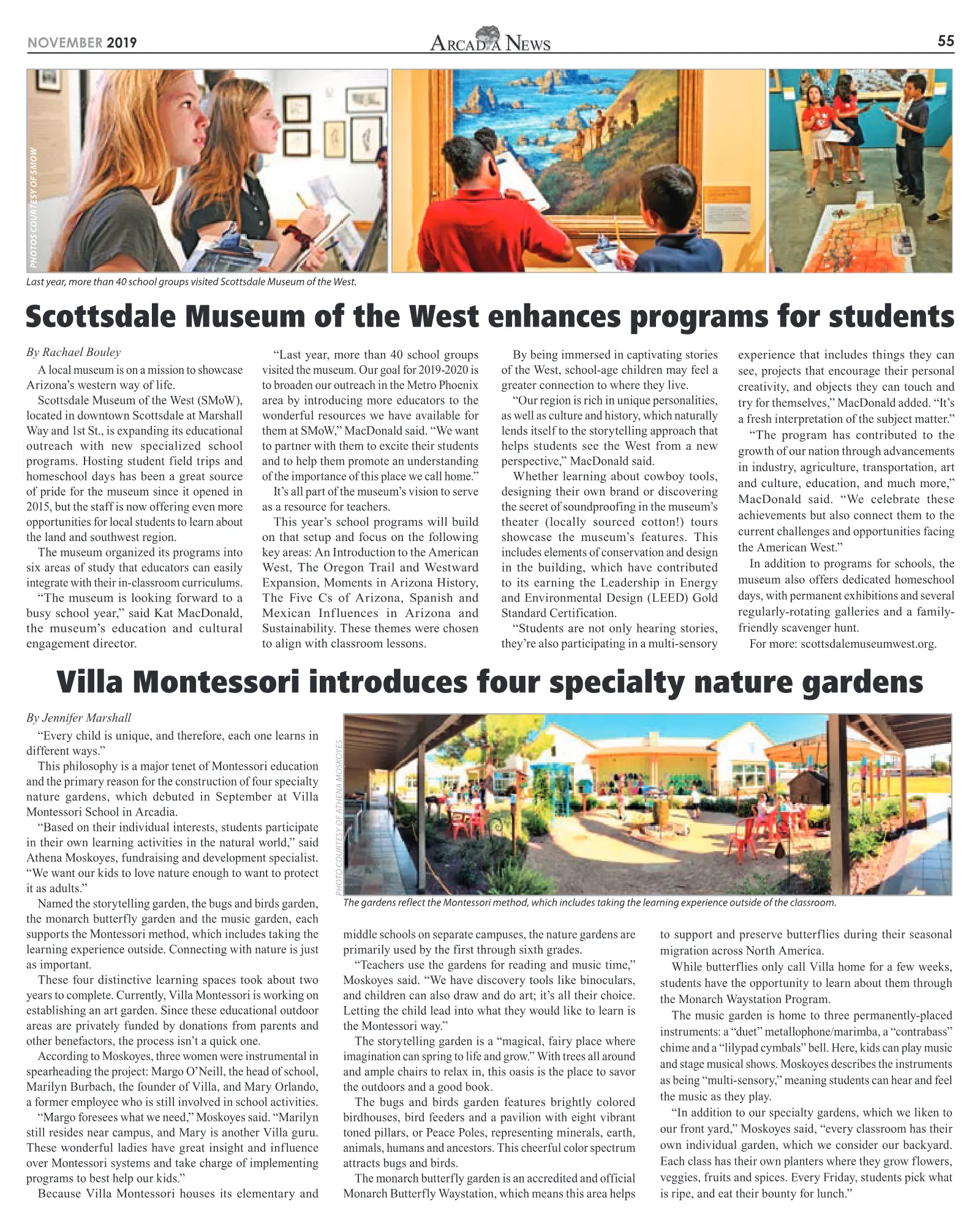
55 NOVEMBER 2019 By Rachael Bouley A local museum is on a mission to showcase Arizona’s western way of life. Scottsdale Museum of the West (SMoW), located in downtown Scottsdale at Marshall Way and 1st St., is expanding its educational outreach with new specialized school programs. Hosting student field trips and homeschool days has been a great source of pride for the museum since it opened in 2015, but the staff is now offering even more opportunities for local students to learn about the land and southwest region. The museum organized its programs into six areas of study that educators can easily integrate with their in-classroom curriculums. “The museum is looking forward to a busy school year,” said Kat MacDonald, the museum’s education and cultural engagement director. “Last year, more than 40 school groups visited the museum. Our goal for 2019-2020 is to broaden our outreach in the Metro Phoenix area by introducing more educators to the wonderful resources we have available for them at SMoW,” MacDonald said. “We want to partner with them to excite their students and to help them promote an understanding of the importance of this place we call home.” It’s all part of the museum’s vision to serve as a resource for teachers. This year’s school programs will build on that setup and focus on the following key areas: An Introduction to the American West, The Oregon Trail and Westward Expansion, Moments in Arizona History, The Five Cs of Arizona, Spanish and Mexican Influences in Arizona and Sustainability. These themes were chosen to align with classroom lessons. By being immersed in captivating stories of the West, school-age children may feel a greater connection to where they live. “Our region is rich in unique personalities, as well as culture and history, which naturally lends itself to the storytelling approach that helps students see the West from a new perspective,” MacDonald said. Whether learning about cowboy tools, designing their own brand or discovering the secret of soundproofing in the museum’s theater (locally sourced cotton!) tours showcase the museum’s features. This includes elements of conservation and design in the building, which have contributed to its earning the Leadership in Energy and Environmental Design (LEED) Gold Standard Certification. “Students are not only hearing stories, they’re also participating in a multi-sensory experience that includes things they can see, projects that encourage their personal creativity, and objects they can touch and try for themselves,” MacDonald added. “It’s a fresh interpretation of the subject matter.” “The program has contributed to the growth of our nation through advancements in industry, agriculture, transportation, art and culture, education, and much more,” MacDonald said. “We celebrate these achievements but also connect them to the current challenges and opportunities facing the American West.” In addition to programs for schools, the museum also offers dedicated homeschool days, with permanent exhibitions and several regularly-rotating galleries and a family- friendly scavenger hunt. For more: scottsdalemuseumwest.org. Scottsdale Museum of the West enhances programs for students Last year, more than 40 school groups visited Scottsdale Museum of the West. By Jennifer Marshall “Every child is unique, and therefore, each one learns in different ways.” This philosophy is a major tenet of Montessori education and the primary reason for the construction of four specialty nature gardens, which debuted in September at Villa Montessori School in Arcadia. “Based on their individual interests, students participate in their own learning activities in the natural world,” said Athena Moskoyes, fundraising and development specialist. “We want our kids to love nature enough to want to protect it as adults.” Named the storytelling garden, the bugs and birds garden, the monarch butterfly garden and the music garden, each supports the Montessori method, which includes taking the learning experience outside. Connecting with nature is just as important. These four distinctive learning spaces took about two years to complete. Currently, Villa Montessori is working on establishing an art garden. Since these educational outdoor areas are privately funded by donations from parents and other benefactors, the process isn’t a quick one. According to Moskoyes, three women were instrumental in spearheading the project: Margo O’Neill, the head of school, Marilyn Burbach, the founder of Villa, and Mary Orlando, a former employee who is still involved in school activities. “Margo foresees what we need,” Moskoyes said. “Marilyn still resides near campus, and Mary is another Villa guru. These wonderful ladies have great insight and influence over Montessori systems and take charge of implementing programs to best help our kids.” Because Villa Montessori houses its elementary and middle schools on separate campuses, the nature gardens are primarily used by the first through sixth grades. “Teachers use the gardens for reading and music time,” Moskoyes said. “We have discovery tools like binoculars, and children can also draw and do art; it’s all their choice. Letting the child lead into what they would like to learn is the Montessori way.” The storytelling garden is a “magical, fairy place where imagination can spring to life and grow.” With trees all around and ample chairs to relax in, this oasis is the place to savor the outdoors and a good book. The bugs and birds garden features brightly colored birdhouses, bird feeders and a pavilion with eight vibrant toned pillars, or Peace Poles, representing minerals, earth, animals, humans and ancestors. This cheerful color spectrum attracts bugs and birds. The monarch butterfly garden is an accredited and official Monarch Butterfly Waystation, which means this area helps to support and preserve butterflies during their seasonal migration across North America. While butterflies only call Villa home for a few weeks, students have the opportunity to learn about them through the Monarch Waystation Program. The music garden is home to three permanently-placed instruments: a “duet” metallophone/marimba, a “contrabass” chime and a “lilypad cymbals” bell. Here, kids can play music and stage musical shows. Moskoyes describes the instruments as being “multi-sensory,” meaning students can hear and feel the music as they play. “In addition to our specialty gardens, which we liken to our front yard,” Moskoyes said, “every classroom has their own individual garden, which we consider our backyard. Each class has their own planters where they grow flowers, veggies, fruits and spices. Every Friday, students pick what is ripe, and eat their bounty for lunch.” Villa Montessori introduces four specialty nature gardens The gardens reflect the Montessori method, which includes taking the learning experience outside of the classroom. PHOTOS COURTESY OF SMOW PHOTO COURTESY OF ATHENA MOSKOYES