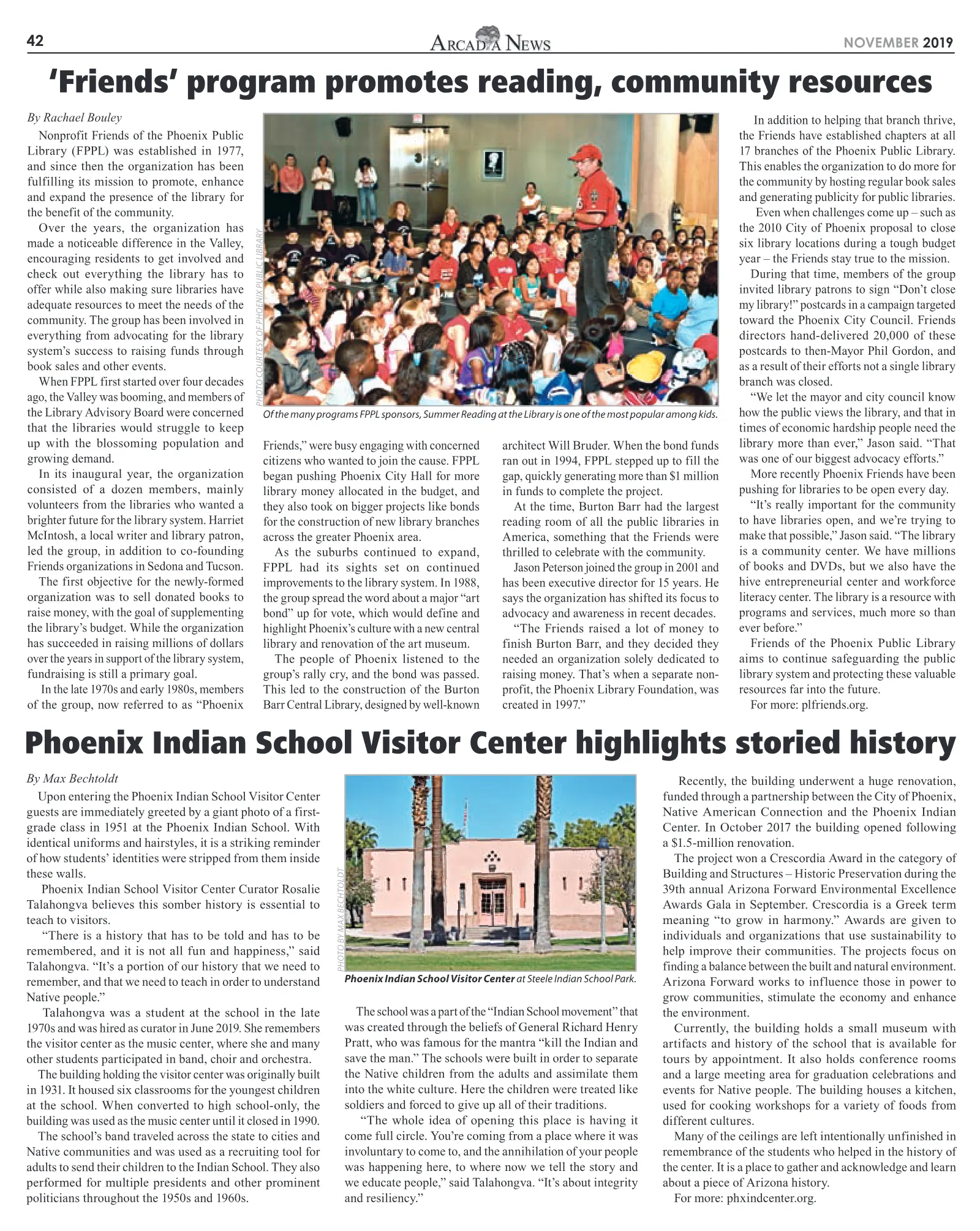
42 NOVEMBER 2019 By Rachael Bouley Nonprofit Friends of the Phoenix Public Library (FPPL) was established in 1977, and since then the organization has been fulfilling its mission to promote, enhance and expand the presence of the library for the benefit of the community. Over the years, the organization has made a noticeable difference in the Valley, encouraging residents to get involved and check out everything the library has to offer while also making sure libraries have adequate resources to meet the needs of the community. The group has been involved in everything from advocating for the library system’s success to raising funds through book sales and other events. When FPPL first started over four decades ago, the Valley was booming, and members of the Library Advisory Board were concerned that the libraries would struggle to keep up with the blossoming population and growing demand. In its inaugural year, the organization consisted of a dozen members, mainly volunteers from the libraries who wanted a brighter future for the library system. Harriet McIntosh, a local writer and library patron, led the group, in addition to co-founding Friends organizations in Sedona and Tucson. The first objective for the newly-formed organization was to sell donated books to raise money, with the goal of supplementing the library’s budget. While the organization has succeeded in raising millions of dollars over the years in support of the library system, fundraising is still a primary goal. In the late 1970s and early 1980s, members of the group, now referred to as “Phoenix Friends,” were busy engaging with concerned citizens who wanted to join the cause. FPPL began pushing Phoenix City Hall for more library money allocated in the budget, and they also took on bigger projects like bonds for the construction of new library branches across the greater Phoenix area. As the suburbs continued to expand, FPPL had its sights set on continued improvements to the library system. In 1988, the group spread the word about a major “art bond” up for vote, which would define and highlight Phoenix’s culture with a new central library and renovation of the art museum. The people of Phoenix listened to the group’s rally cry, and the bond was passed. This led to the construction of the Burton Barr Central Library, designed by well-known architect Will Bruder. When the bond funds ran out in 1994, FPPL stepped up to fill the gap, quickly generating more than $1 million in funds to complete the project. At the time, Burton Barr had the largest reading room of all the public libraries in America, something that the Friends were thrilled to celebrate with the community. Jason Peterson joined the group in 2001 and has been executive director for 15 years. He says the organization has shifted its focus to advocacy and awareness in recent decades. “The Friends raised a lot of money to finish Burton Barr, and they decided they needed an organization solely dedicated to raising money. That’s when a separate non- profit, the Phoenix Library Foundation, was created in 1997.” In addition to helping that branch thrive, the Friends have established chapters at all 17 branches of the Phoenix Public Library. This enables the organization to do more for the community by hosting regular book sales and generating publicity for public libraries. Even when challenges come up – such as the 2010 City of Phoenix proposal to close six library locations during a tough budget year – the Friends stay true to the mission. During that time, members of the group invited library patrons to sign “Don’t close my library!” postcards in a campaign targeted toward the Phoenix City Council. Friends directors hand-delivered 20,000 of these postcards to then-Mayor Phil Gordon, and as a result of their efforts not a single library branch was closed. “We let the mayor and city council know how the public views the library, and that in times of economic hardship people need the library more than ever,” Jason said. “That was one of our biggest advocacy efforts.” More recently Phoenix Friends have been pushing for libraries to be open every day. “It’s really important for the community to have libraries open, and we’re trying to make that possible,” Jason said. “The library is a community center. We have millions of books and DVDs, but we also have the hive entrepreneurial center and workforce literacy center. The library is a resource with programs and services, much more so than ever before.” Friends of the Phoenix Public Library aims to continue safeguarding the public library system and protecting these valuable resources far into the future. For more: plfriends.org. ‘Friends’ program promotes reading, community resources Of the many programs FPPL sponsors, Summer Reading at the Library is one of the most popular among kids. PHOTO COURTESY OF PHOENIX PUBLIC LIBRARY By Max Bechtoldt Upon entering the Phoenix Indian School Visitor Center guests are immediately greeted by a giant photo of a first- grade class in 1951 at the Phoenix Indian School. With identical uniforms and hairstyles, it is a striking reminder of how students’ identities were stripped from them inside these walls. Phoenix Indian School Visitor Center Curator Rosalie Talahongva believes this somber history is essential to teach to visitors. “There is a history that has to be told and has to be remembered, and it is not all fun and happiness,” said Talahongva. “It’s a portion of our history that we need to remember, and that we need to teach in order to understand Native people.” Talahongva was a student at the school in the late 1970s and was hired as curator in June 2019. She remembers the visitor center as the music center, where she and many other students participated in band, choir and orchestra. The building holding the visitor center was originally built in 1931. It housed six classrooms for the youngest children at the school. When converted to high school-only, the building was used as the music center until it closed in 1990. The school’s band traveled across the state to cities and Native communities and was used as a recruiting tool for adults to send their children to the Indian School. They also performed for multiple presidents and other prominent politicians throughout the 1950s and 1960s. The school was a part of the “Indian School movement” that was created through the beliefs of General Richard Henry Pratt, who was famous for the mantra “kill the Indian and save the man.” The schools were built in order to separate the Native children from the adults and assimilate them into the white culture. Here the children were treated like soldiers and forced to give up all of their traditions. “The whole idea of opening this place is having it come full circle. You’re coming from a place where it was involuntary to come to, and the annihilation of your people was happening here, to where now we tell the story and we educate people,” said Talahongva. “It’s about integrity and resiliency.” Recently, the building underwent a huge renovation, funded through a partnership between the City of Phoenix, Native American Connection and the Phoenix Indian Center. In October 2017 the building opened following a $1.5-million renovation. The project won a Crescordia Award in the category of Building and Structures – Historic Preservation during the 39th annual Arizona Forward Environmental Excellence Awards Gala in September. Crescordia is a Greek term meaning “to grow in harmony.” Awards are given to individuals and organizations that use sustainability to help improve their communities. The projects focus on finding a balance between the built and natural environment. Arizona Forward works to influence those in power to grow communities, stimulate the economy and enhance the environment. Currently, the building holds a small museum with artifacts and history of the school that is available for tours by appointment. It also holds conference rooms and a large meeting area for graduation celebrations and events for Native people. The building houses a kitchen, used for cooking workshops for a variety of foods from different cultures. Many of the ceilings are left intentionally unfinished in remembrance of the students who helped in the history of the center. It is a place to gather and acknowledge and learn about a piece of Arizona history. For more: phxindcenter.org. Phoenix Indian School Visitor Center highlights storied history Phoenix Indian School Visitor Center at Steele Indian School Park. PHOTO BY MAX BECHTOLDT
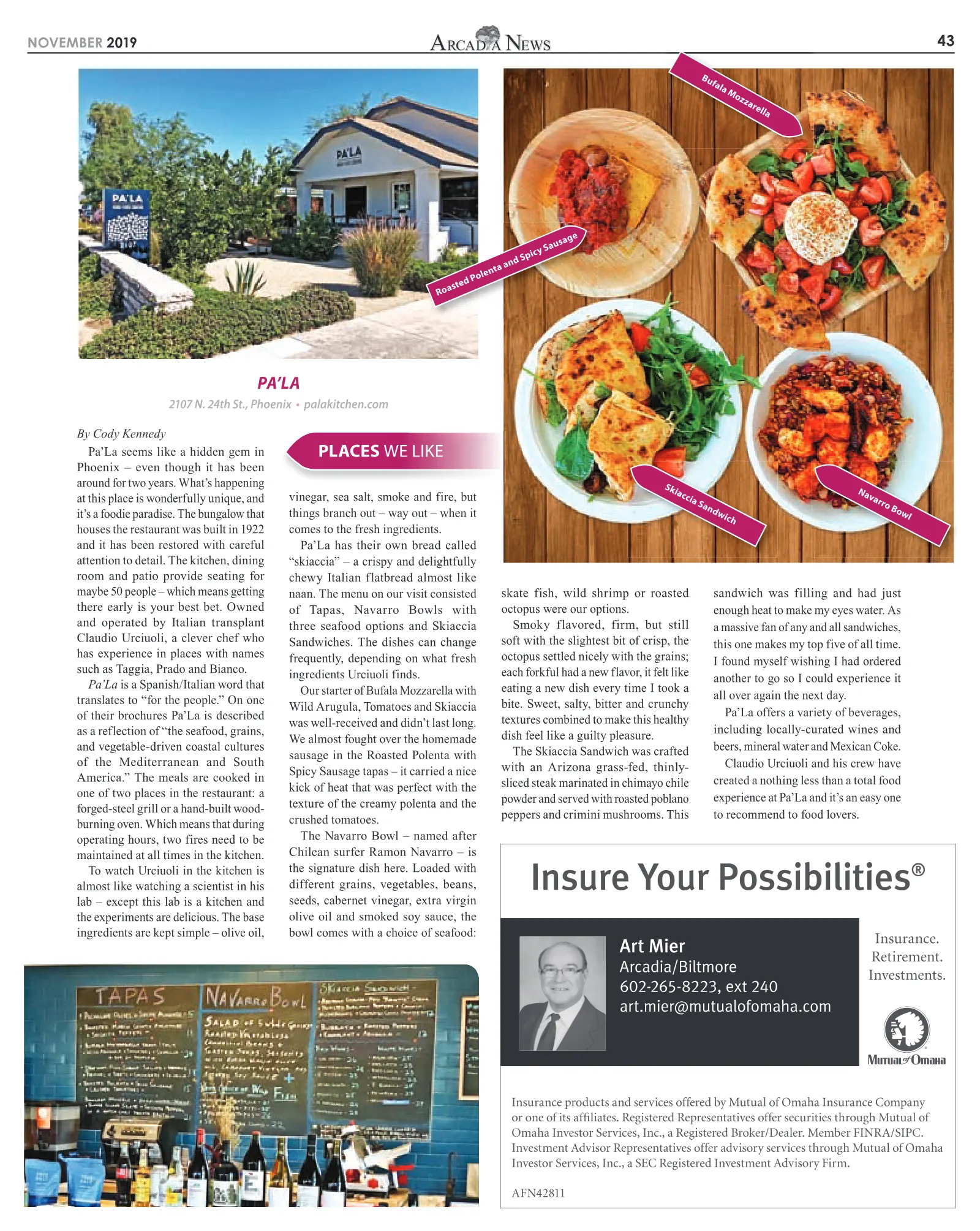
43 NOVEMBER 2019 By Cody Kennedy Pa’La seems like a hidden gem in Phoenix – even though it has been around for two years. What’s happening at this place is wonderfully unique, and it’s a foodie paradise. The bungalow that houses the restaurant was built in 1922 and it has been restored with careful attention to detail. The kitchen, dining room and patio provide seating for maybe 50 people – which means getting there early is your best bet. Owned and operated by Italian transplant Claudio Urciuoli, a clever chef who has experience in places with names such as Taggia, Prado and Bianco. Pa’La is a Spanish/Italian word that translates to “for the people.” On one of their brochures Pa’La is described as a reflection of “the seafood, grains, and vegetable-driven coastal cultures of the Mediterranean and South America.” The meals are cooked in one of two places in the restaurant: a forged-steel grill or a hand-built wood- burning oven. Which means that during operating hours, two fires need to be maintained at all times in the kitchen. To watch Urciuoli in the kitchen is almost like watching a scientist in his lab – except this lab is a kitchen and the experiments are delicious. The base ingredients are kept simple – olive oil, vinegar, sea salt, smoke and fire, but things branch out – way out – when it comes to the fresh ingredients. Pa’La has their own bread called “skiaccia” – a crispy and delightfully chewy Italian flatbread almost like naan. The menu on our visit consisted of Tapas, Navarro Bowls with three seafood options and Skiaccia Sandwiches. The dishes can change frequently, depending on what fresh ingredients Urciuoli finds. Our starter of Bufala Mozzarella with Wild Arugula, Tomatoes and Skiaccia was well-received and didn’t last long. We almost fought over the homemade sausage in the Roasted Polenta with Spicy Sausage tapas – it carried a nice kick of heat that was perfect with the texture of the creamy polenta and the crushed tomatoes. The Navarro Bowl – named after Chilean surfer Ramon Navarro – is the signature dish here. Loaded with different grains, vegetables, beans, seeds, cabernet vinegar, extra virgin olive oil and smoked soy sauce, the bowl comes with a choice of seafood: skate fish, wild shrimp or roasted octopus were our options. Smoky flavored, firm, but still soft with the slightest bit of crisp, the octopus settled nicely with the grains; each forkful had a new flavor, it felt like eating a new dish every time I took a bite. Sweet, salty, bitter and crunchy textures combined to make this healthy dish feel like a guilty pleasure. The Skiaccia Sandwich was crafted with an Arizona grass-fed, thinly- sliced steak marinated in chimayo chile powder and served with roasted poblano peppers and crimini mushrooms. This sandwich was filling and had just enough heat to make my eyes water. As a massive fan of any and all sandwiches, this one makes my top five of all time. I found myself wishing I had ordered another to go so I could experience it all over again the next day. Pa’La offers a variety of beverages, including locally-curated wines and beers, mineral water and Mexican Coke. Claudio Urciuoli and his crew have created a nothing less than a total food experience at Pa’La and it’s an easy one to recommend to food lovers. PA’LA 2107 N. 24th St., Phoenix • palakitchen.com Roasted Polenta and Spicy Sausage Bufala Mozzarella Navarro Bowl Skiaccia Sandwich PLACES WE LIKE Insurance products and services offered by Mutual of Omaha Insurance Company or one of its affiliates. Registered Representatives offer securities through Mutual of Omaha Investor Services, Inc., a Registered Broker/Dealer. Member FINRA/SIPC. Investment Advisor Representatives offer advisory services through Mutual of Omaha Investor Services, Inc., a SEC Registered Investment Advisory Firm. AFN42811 Art Mier Arcadia/Biltmore 602-265-8223, ext 240 art.mier@mutualofomaha.com Insurance. Retirement. Investments. Insure Your Possibilities ®