
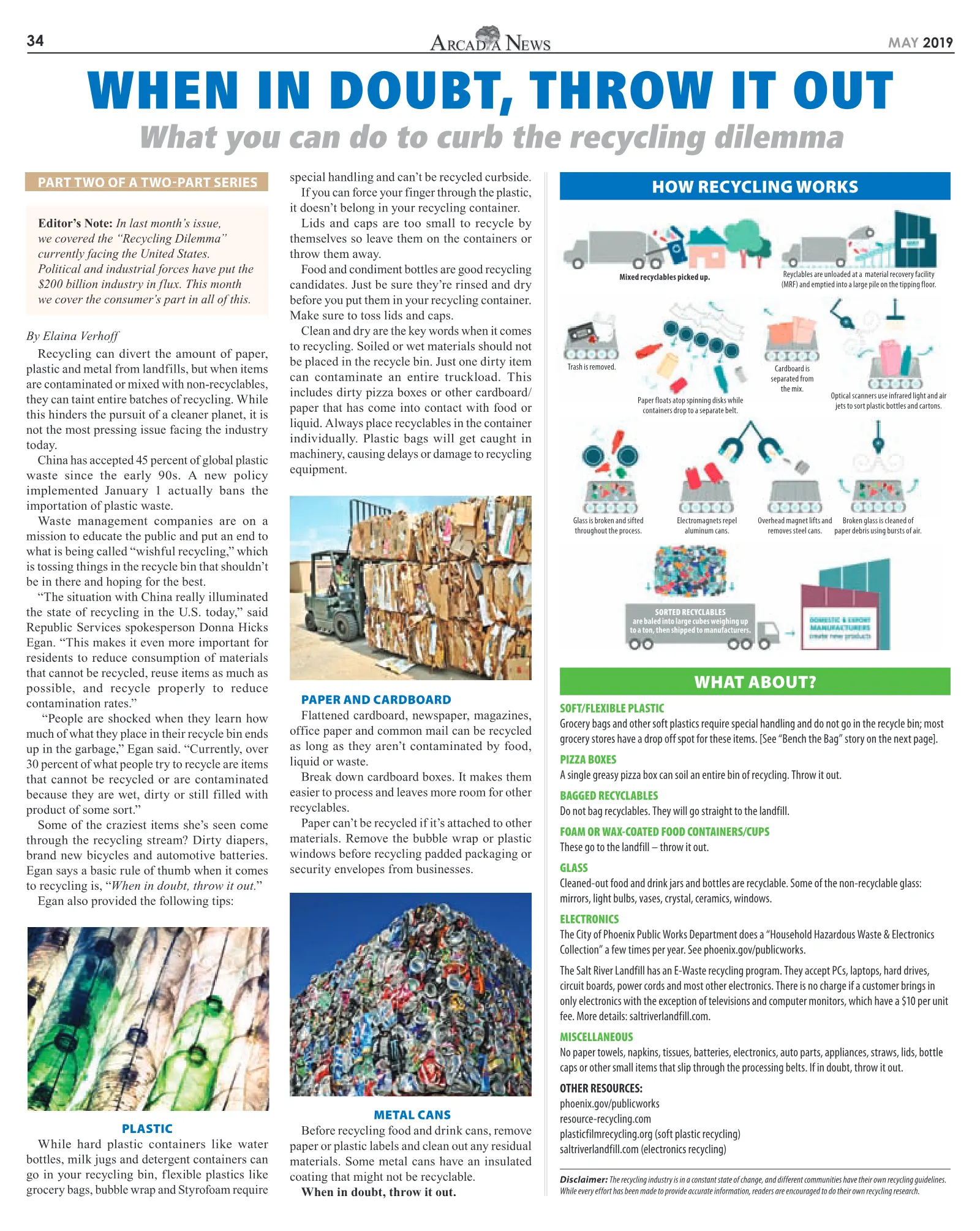
34 MAY 2019 By Elaina Verhoff Recycling can divert the amount of paper, plastic and metal from landfills, but when items are contaminated or mixed with non-recyclables, they can taint entire batches of recycling. While this hinders the pursuit of a cleaner planet, it is not the most pressing issue facing the industry today. China has accepted 45 percent of global plastic waste since the early 90s. A new policy implemented January 1 actually bans the importation of plastic waste. Waste management companies are on a mission to educate the public and put an end to what is being called “wishful recycling,” which is tossing things in the recycle bin that shouldn’t be in there and hoping for the best. “The situation with China really illuminated the state of recycling in the U.S. today,” said Republic Services spokesperson Donna Hicks Egan. “This makes it even more important for residents to reduce consumption of materials that cannot be recycled, reuse items as much as possible, and recycle properly to reduce contamination rates.” “People are shocked when they learn how much of what they place in their recycle bin ends up in the garbage,” Egan said. “Currently, over 30 percent of what people try to recycle are items that cannot be recycled or are contaminated because they are wet, dirty or still filled with product of some sort.” Some of the craziest items she’s seen come through the recycling stream? Dirty diapers, brand new bicycles and automotive batteries. Egan says a basic rule of thumb when it comes to recycling is, “ When in doubt, throw it out. ” Egan also provided the following tips: PLASTIC While hard plastic containers like water bottles, milk jugs and detergent containers can go in your recycling bin, flexible plastics like grocery bags, bubble wrap and Styrofoam require special handling and can’t be recycled curbside. If you can force your finger through the plastic, it doesn’t belong in your recycling container. Lids and caps are too small to recycle by themselves so leave them on the containers or throw them away. Food and condiment bottles are good recycling candidates. Just be sure they’re rinsed and dry before you put them in your recycling container. Make sure to toss lids and caps. Clean and dry are the key words when it comes to recycling. Soiled or wet materials should not be placed in the recycle bin. Just one dirty item can contaminate an entire truckload. This includes dirty pizza boxes or other cardboard/ paper that has come into contact with food or liquid. Always place recyclables in the container individually. Plastic bags will get caught in machinery, causing delays or damage to recycling equipment. PAPER AND CARDBOARD Flattened cardboard, newspaper, magazines, office paper and common mail can be recycled as long as they aren’t contaminated by food, liquid or waste. Break down cardboard boxes. It makes them easier to process and leaves more room for other recyclables. Paper can’t be recycled if it’s attached to other materials. Remove the bubble wrap or plastic windows before recycling padded packaging or security envelopes from businesses. METAL CANS Before recycling food and drink cans, remove paper or plastic labels and clean out any residual materials. Some metal cans have an insulated coating that might not be recyclable. When in doubt, throw it out. What you can do to curb the recycling dilemma WHEN IN DOUBT, THROW IT OUT SOFT/FLEXIBLE PLASTIC Grocery bags and other soft plastics require special handling and do not go in the recycle bin; most grocery stores have a drop off spot for these items. [See “Bench the Bag” story on the next page]. PIZZA BOXES A single greasy pizza box can soil an entire bin of recycling. Throw it out. BAGGED RECYCLABLES Do not bag recyclables. They will go straight to the landfill. FOAM OR WAX-COATED FOOD CONTAINERS/CUPS These go to the landfill – throw it out. GLASS Cleaned-out food and drink jars and bottles are recyclable. Some of the non-recyclable glass: mirrors, light bulbs, vases, crystal, ceramics, windows. ELECTRONICS The City of Phoenix Public Works Department does a “Household Hazardous Waste & Electronics Collection” a few times per year. See phoenix.gov/publicworks. The Salt River Landfill has an E-Waste recycling program. They accept PCs, laptops, hard drives, circuit boards, power cords and most other electronics. There is no charge if a customer brings in only electronics with the exception of televisions and computer monitors, which have a $10 per unit fee. More details: saltriverlandfill.com. MISCELLANEOUS No paper towels, napkins, tissues, batteries, electronics, auto parts, appliances, straws, lids, bottle caps or other small items that slip through the processing belts. If in doubt, throw it out. OTHER RESOURCES: phoenix.gov/publicworks resource-recycling.com plasticfilmrecycling.org (soft plastic recycling) saltriverlandfill.com (electronics recycling) PART TWO OF A TWO PART SERIES Editor’s Note: In last month’s issue, we covered the “Recycling Dilemma” currently facing the United States. Political and industrial forces have put the $200 billion industry in flux. This month we cover the consumer’s part in all of this. Disclaimer: The recycling industry is in a constant state of change, and different communities have their own recycling guidelines. While every effort has been made to provide accurate information, readers are encouraged to do their own recycling research. Mixed recyclables picked up. Reyclables are unloaded at a material recovery facility (MRF) and emptied into a large pile on the tipping floor. Paper floats atop spinning disks while containers drop to a separate belt. Glass is broken and sifted throughout the process. Electromagnets repel aluminum cans. Overhead magnet lifts and removes steel cans. Broken glass is cleaned of paper debris using bursts of air. Cardboard is separated from the mix. Optical scanners use infrared light and air jets to sort plastic bottles and cartons. Trash is removed. SORTED RECYCLABLES are baled into large cubes weighing up to a ton, then shipped to manufacturers. WHAT ABOUT? HOW RECYCLING WORKS
35 MAY 2019 Three days worth of bags collected by Hopi Elementary, ready to be recycled by Trex. By Mallory Gleich This year marked the 12th annual plastic recycling competition that took place at elementary and middle schools around the nation. This is the 6th year that Scottsdale schools have participated in the Trex recycling competition. Sponsored nationally by Virginia-based Trex Company and locally by the Scottsdale Solid Waste Company, this competition challenged students to collect as much plastic film as they could between February and March. The school that collected the most will receive a composite bench (made from recycled plastic) donated by Trex. Each year the winner is announced on Earth Day (April 22). Trex started their recycling program in 2006 as a way to educate the public about the damage that plastic can do and to encourage people to properly recycle. The company, which uses recycled plastic to make decking boards, recently celebrated its 25th anniversary. Thin film plastic is one of the biggest contaminants in recycling. It can damage the automated equipment at the facility where recyclables are sorted. Students were asked to collect plastic items such as grocery bags, Saran wrap, cereal bags, Ziploc bags, newspaper sleeves and bubble wrap and bring it to their school. This year, both Hopi Elementary and Echo Canyon participated. Each week, a City of Scottsdale representative visited each school to weigh and pick up collected materials and took them to be recycled. “All of our students participated and came together and helped make a difference in our world,” said Blanca Ruiz-Moreno, the community specialist at Echo Canyon. At the end of the competition, they had collected just over 300 lbs. of plastic. Teachers Jacqueline Comerford, Kelsey Wolf and Whitney Keeler run an after- school club called the Hopi Environmental Leaders and one of the group’s focuses is the “Bench the Bag” competition. The group continues to promote awareness about how long it takes for plastic materials to decompose, and how much of it can end up in the ocean. “At Hopi we have not treated it like a competition. It is more about being part of the solution to a problem. And our community really gets behind it. We collected so much plastic. Hopi plans to continue the collection of plastic this year, so we can continue being part of the solution,” said Keeler. Hopi Elementary collected over 330 lbs. of plastic. The Trex Company utilizes donated plastic film to create composite lumber, keeping this material out of landfills. Trex provided each school with a poster, magnets for each student and an award made from Trex decking boards. All ten participating SUSD schools collected over 5,800 lbs. of plastic material. The schools received a collected plastics flower planter from Trex. Nationwide, the school that collected the most will receive a composite bench, made from 10,000 pieces of plastic film. Bench the Bag competition Composite material bench Mark A. Wyse, M.D. Kate Montgomery, FNP Allan Goldman, D.O. David Francyk, D.O. T.E. McCauley, M.D. Tyler Southwell, M.D. Alisha Archibeck, D.O. Jennifer Francyk, PA-C Victoria Rhodes, PA-C Dermatology Charles Levison, M.D. Because caring for your health has always been our passion, we’ve made the following services conveniently available in our office. • Excellent care for all ages • Same day appointments • On-site clinical laboratory and X-rays • Dermatology services • Botox and Jan Marini skin care now available MON–WED 7AM–7PM THURS–FRI 7AM–5PM SAT 7AM–NOON EXPERT DOCTORS AND PRACTITIONERS. CONVENIENT SERVICES. EXTENDED HOURS. 4350 E. Camelback Rd., Ste F100, Phoenix, AZ 85018 • 602.955.8700 • FPSAZ.com Catherine O’Neill, MSN, FNP IN PRACTICE CELEBRATING