
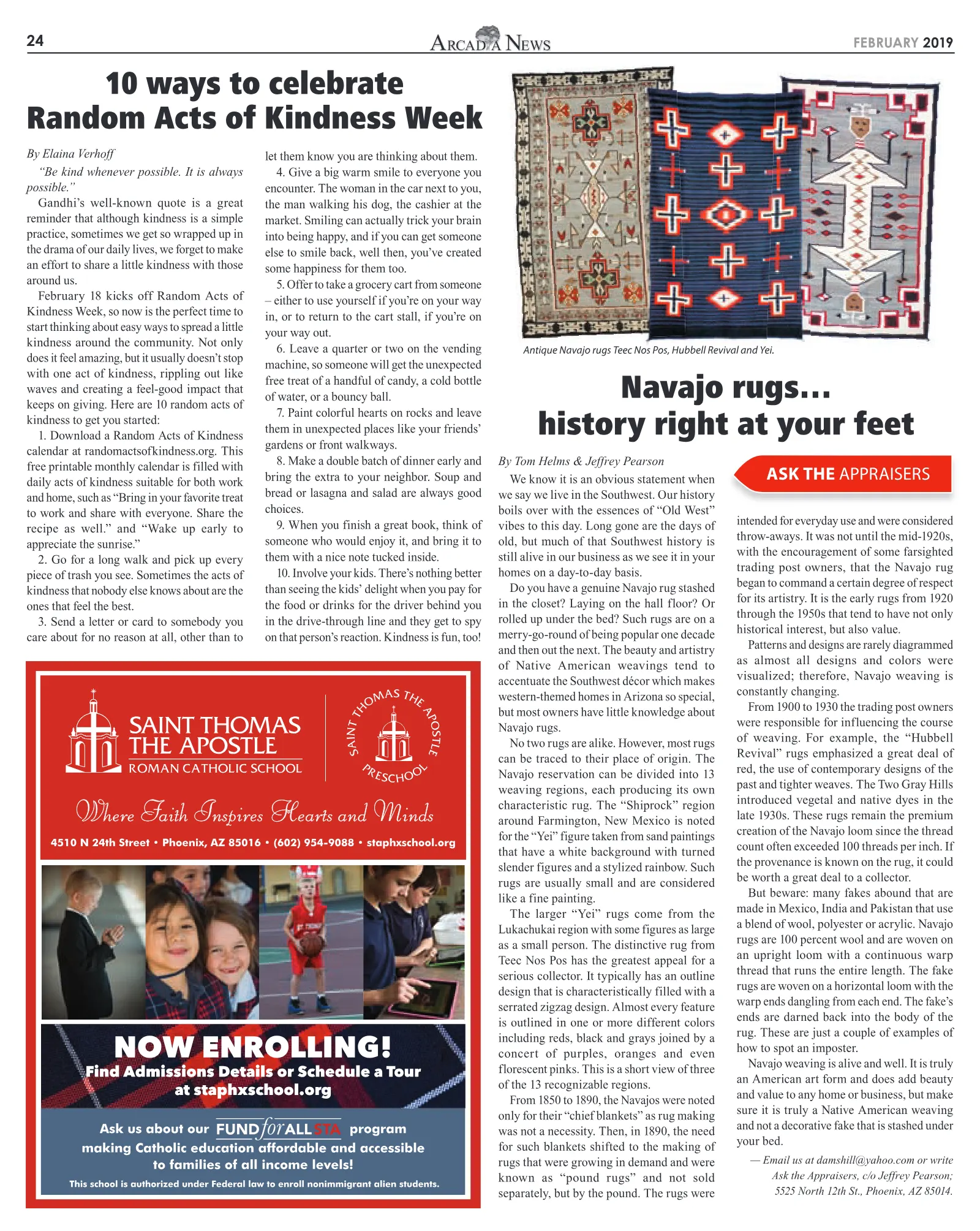
24 FEBRUARY 2019 By Elaina Verhoff “Be kind whenever possible. It is always possible.” Gandhi’s well-known quote is a great reminder that although kindness is a simple practice, sometimes we get so wrapped up in the drama of our daily lives, we forget to make an effort to share a little kindness with those around us. February 18 kicks off Random Acts of Kindness Week, so now is the perfect time to start thinking about easy ways to spread a little kindness around the community. Not only does it feel amazing, but it usually doesn’t stop with one act of kindness, rippling out like waves and creating a feel-good impact that keeps on giving. Here are 10 random acts of kindness to get you started: 1. Download a Random Acts of Kindness calendar at randomactsofkindness.org. This free printable monthly calendar is filled with daily acts of kindness suitable for both work and home, such as “Bring in your favorite treat to work and share with everyone. Share the recipe as well.” and “Wake up early to appreciate the sunrise.” 2. Go for a long walk and pick up every piece of trash you see. Sometimes the acts of kindness that nobody else knows about are the ones that feel the best. 3. Send a letter or card to somebody you care about for no reason at all, other than to let them know you are thinking about them. 4. Give a big warm smile to everyone you encounter. The woman in the car next to you, the man walking his dog, the cashier at the market. Smiling can actually trick your brain into being happy, and if you can get someone else to smile back, well then, you’ve created some happiness for them too. 5. Offer to take a grocery cart from someone – either to use yourself if you’re on your way in, or to return to the cart stall, if you’re on your way out. 6. Leave a quarter or two on the vending machine, so someone will get the unexpected free treat of a handful of candy, a cold bottle of water, or a bouncy ball. 7. Paint colorful hearts on rocks and leave them in unexpected places like your friends’ gardens or front walkways. 8. Make a double batch of dinner early and bring the extra to your neighbor. Soup and bread or lasagna and salad are always good choices. 9. When you finish a great book, think of someone who would enjoy it, and bring it to them with a nice note tucked inside. 10. Involve your kids. There’s nothing better than seeing the kids’ delight when you pay for the food or drinks for the driver behind you in the drive-through line and they get to spy on that person’s reaction. Kindness is fun, too! 10 ways to celebrate Random Acts of Kindness Week By Tom Helms & Jeffrey Pearson We know it is an obvious statement when we say we live in the Southwest. Our history boils over with the essences of “Old West” vibes to this day. Long gone are the days of old, but much of that Southwest history is still alive in our business as we see it in your homes on a day-to-day basis. Do you have a genuine Navajo rug stashed in the closet? Laying on the hall floor? Or rolled up under the bed? Such rugs are on a merry-go-round of being popular one decade and then out the next. The beauty and artistry of Native American weavings tend to accentuate the Southwest décor which makes western-themed homes in Arizona so special, but most owners have little knowledge about Navajo rugs. No two rugs are alike. However, most rugs can be traced to their place of origin. The Navajo reservation can be divided into 13 weaving regions, each producing its own characteristic rug. The “Shiprock” region around Farmington, New Mexico is noted for the “Yei” figure taken from sand paintings that have a white background with turned slender figures and a stylized rainbow. Such rugs are usually small and are considered like a fine painting. The larger “Yei” rugs come from the Lukachukai region with some figures as large as a small person. The distinctive rug from Teec Nos Pos has the greatest appeal for a serious collector. It typically has an outline design that is characteristically filled with a serrated zigzag design. Almost every feature is outlined in one or more different colors including reds, black and grays joined by a concert of purples, oranges and even florescent pinks. This is a short view of three of the 13 recognizable regions. From 1850 to 1890, the Navajos were noted only for their “chief blankets” as rug making was not a necessity. Then, in 1890, the need for such blankets shifted to the making of rugs that were growing in demand and were known as “pound rugs” and not sold separately, but by the pound. The rugs were intended for everyday use and were considered throw-aways. It was not until the mid-1920s, with the encouragement of some farsighted trading post owners, that the Navajo rug began to command a certain degree of respect for its artistry. It is the early rugs from 1920 through the 1950s that tend to have not only historical interest, but also value. Patterns and designs are rarely diagrammed as almost all designs and colors were visualized; therefore, Navajo weaving is constantly changing. From 1900 to 1930 the trading post owners were responsible for influencing the course of weaving. For example, the “Hubbell Revival” rugs emphasized a great deal of red, the use of contemporary designs of the past and tighter weaves. The Two Gray Hills introduced vegetal and native dyes in the late 1930s. These rugs remain the premium creation of the Navajo loom since the thread count often exceeded 100 threads per inch. If the provenance is known on the rug, it could be worth a great deal to a collector. But beware: many fakes abound that are made in Mexico, India and Pakistan that use a blend of wool, polyester or acrylic. Navajo rugs are 100 percent wool and are woven on an upright loom with a continuous warp thread that runs the entire length. The fake rugs are woven on a horizontal loom with the warp ends dangling from each end. The fake’s ends are darned back into the body of the rug. These are just a couple of examples of how to spot an imposter. Navajo weaving is alive and well. It is truly an American art form and does add beauty and value to any home or business, but make sure it is truly a Native American weaving and not a decorative fake that is stashed under your bed. — Email us at damshill@yahoo.com or write Ask the Appraisers, c/o Jeffrey Pearson; 5525 North 12th St., Phoenix, AZ 85014. Navajo rugs… history right at your feet Antique Navajo rugs Teec Nos Pos, Hubbell Revival and Yei. ASK THE APPRAISERS 4510 N 24th Street • Phoenix, AZ 85016 • (602) 954-9088 • staphxschool.org NOW ENROLLING! Find Admissions Details or Schedule a Tour at staphxschool.org This school is authorized under Federal law to enroll nonimmigrant alien students.
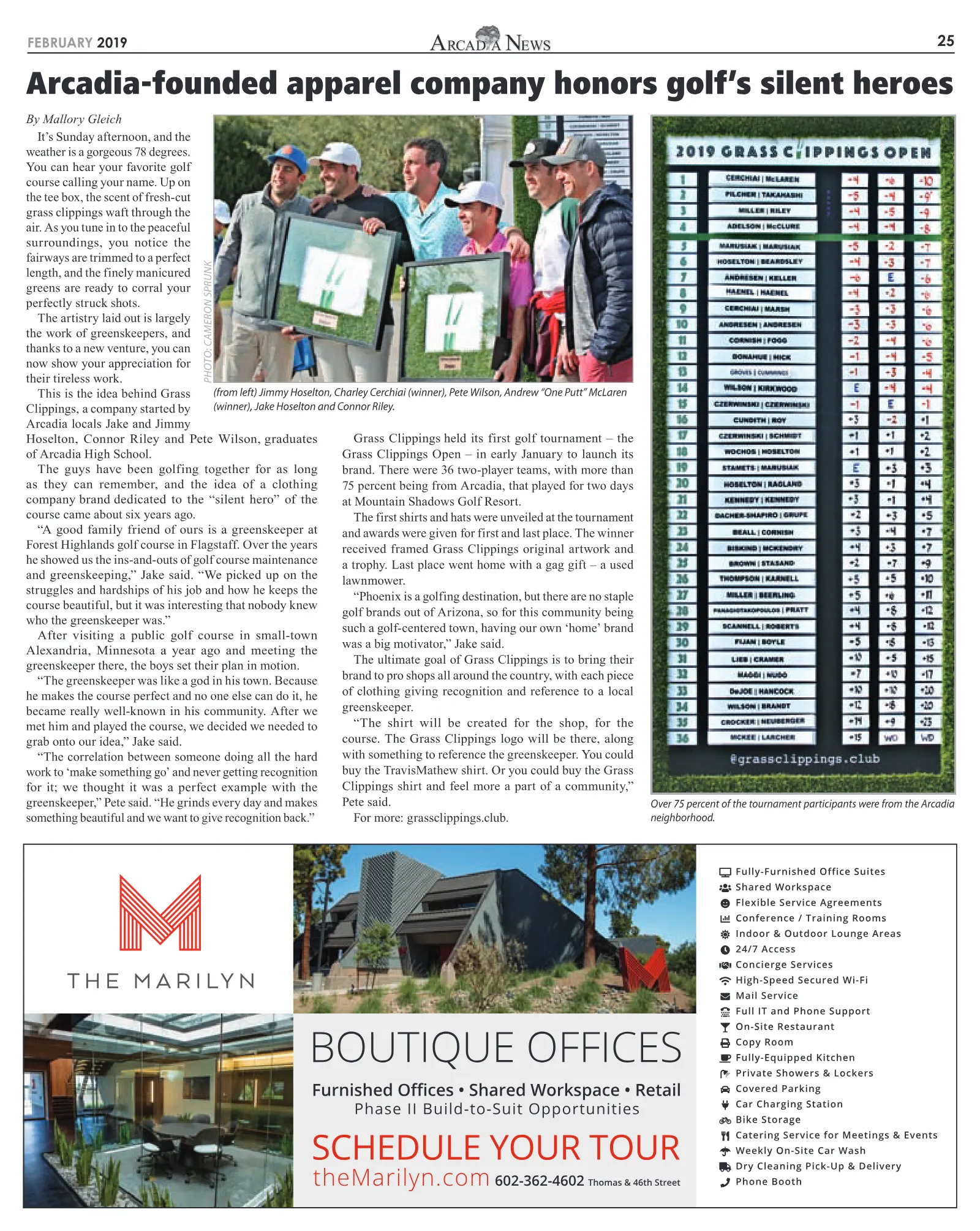
25 FEBRUARY 2019 By Mallory Gleich It’s Sunday afternoon, and the weather is a gorgeous 78 degrees. You can hear your favorite golf course calling your name. Up on the tee box, the scent of fresh-cut grass clippings waft through the air. As you tune in to the peaceful surroundings, you notice the fairways are trimmed to a perfect length, and the finely manicured greens are ready to corral your perfectly struck shots. The artistry laid out is largely the work of greenskeepers, and thanks to a new venture, you can now show your appreciation for their tireless work. This is the idea behind Grass Clippings, a company started by Arcadia locals Jake and Jimmy Hoselton, Connor Riley and Pete Wilson, graduates of Arcadia High School. The guys have been golfing together for as long as they can remember, and the idea of a clothing company brand dedicated to the “silent hero” of the course came about six years ago. “A good family friend of ours is a greenskeeper at Forest Highlands golf course in Flagstaff. Over the years he showed us the ins-and-outs of golf course maintenance and greenskeeping,” Jake said. “We picked up on the struggles and hardships of his job and how he keeps the course beautiful, but it was interesting that nobody knew who the greenskeeper was.” After visiting a public golf course in small-town Alexandria, Minnesota a year ago and meeting the greenskeeper there, the boys set their plan in motion. “The greenskeeper was like a god in his town. Because he makes the course perfect and no one else can do it, he became really well-known in his community. After we met him and played the course, we decided we needed to grab onto our idea,” Jake said. “The correlation between someone doing all the hard work to ‘make something go’ and never getting recognition for it; we thought it was a perfect example with the greenskeeper,” Pete said. “He grinds every day and makes something beautiful and we want to give recognition back.” Grass Clippings held its first golf tournament – the Grass Clippings Open – in early January to launch its brand. There were 36 two-player teams, with more than 75 percent being from Arcadia, that played for two days at Mountain Shadows Golf Resort. The first shirts and hats were unveiled at the tournament and awards were given for first and last place. The winner received framed Grass Clippings original artwork and a trophy. Last place went home with a gag gift – a used lawnmower. “Phoenix is a golfing destination, but there are no staple golf brands out of Arizona, so for this community being such a golf-centered town, having our own ‘home’ brand was a big motivator,” Jake said. The ultimate goal of Grass Clippings is to bring their brand to pro shops all around the country, with each piece of clothing giving recognition and reference to a local greenskeeper. “The shirt will be created for the shop, for the course. The Grass Clippings logo will be there, along with something to reference the greenskeeper. You could buy the TravisMathew shirt. Or you could buy the Grass Clippings shirt and feel more a part of a community,” Pete said. For more: grassclippings.club. Arcadia-founded apparel company honors golf’s silent heroes Over 75 percent of the tournament participants were from the Arcadia neighborhood. (from left) Jimmy Hoselton, Charley Cerchiai (winner), Pete Wilson, Andrew “One Putt” McLaren (winner), Jake Hoselton and Connor Riley. PHOTO: CAMERON SPRUNK T H E M A R I LY N