
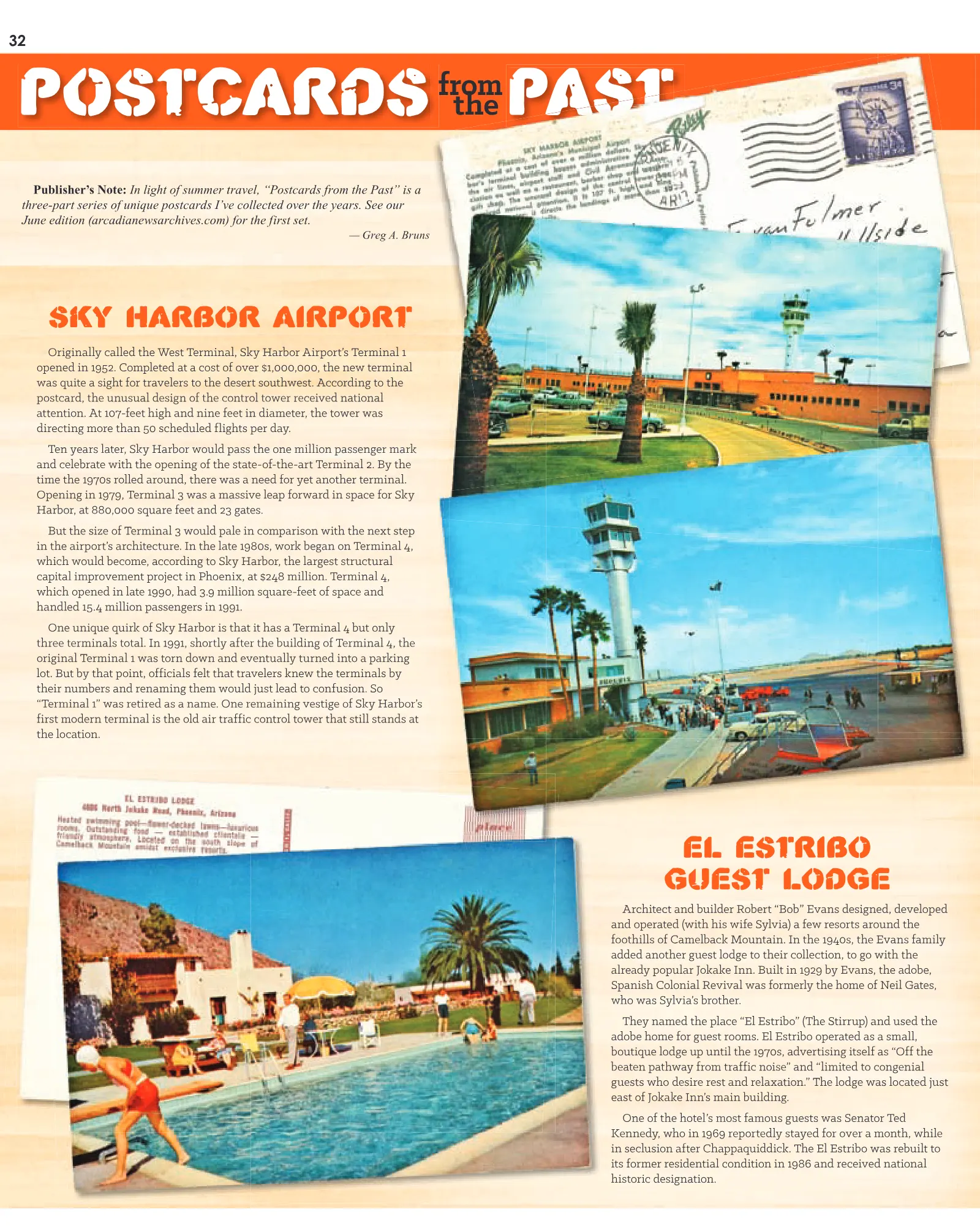
32 past past past Originally called the West Terminal, Sky Harbor Airport’s Terminal 1 opened in 1952. Completed at a cost of over $1,000,000, the new terminal was quite a sight for travelers to the desert southwest. According to the postcard, the unusual design of the control tower received national attention. At 107-feet high and nine feet in diameter, the tower was directing more than 50 scheduled flights per day. Ten years later, Sky Harbor would pass the one million passenger mark and celebrate with the opening of the state-of-the-art Terminal 2. By the time the 1970s rolled around, there was a need for yet another terminal. Opening in 1979, Terminal 3 was a massive leap forward in space for Sky Harbor, at 880,000 square feet and 23 gates. But the size of Terminal 3 would pale in comparison with the next step in the airport’s architecture. In the late 1980s, work began on Terminal 4, which would become, according to Sky Harbor, the largest structural capital improvement project in Phoenix, at $248 million. Terminal 4, which opened in late 1990, had 3.9 million square-feet of space and handled 15.4 million passengers in 1991. One unique quirk of Sky Harbor is that it has a Terminal 4 but only three terminals total. In 1991, shortly after the building of Terminal 4, the original Terminal 1 was torn down and eventually turned into a parking lot. But by that point, officials felt that travelers knew the terminals by their numbers and renaming them would just lead to confusion. So “Terminal 1” was retired as a name. One remaining vestige of Sky Harbor’s first modern terminal is the old air traffic control tower that still stands at the location. Publisher’s Note: In light of summer travel, “Postcards from the Past” is a three-part series of unique postcards I’ve collected over the years. See our June edition (arcadianewsarchives.com) for the first set. — Greg A. Bruns Architect and builder Robert “Bob” Evans designed, developed and operated (with his wife Sylvia) a few resorts around the foothills of Camelback Mountain. In the 1940s, the Evans family added another guest lodge to their collection, to go with the already popular Jokake Inn. Built in 1929 by Evans, the adobe, Spanish Colonial Revival was formerly the home of Neil Gates, who was Sylvia’s brother. They named the place “El Estribo” (The Stirrup) and used the adobe home for guest rooms. El Estribo operated as a small, boutique lodge up until the 1970s, advertising itself as “Off the beaten pathway from traffic noise” and “limited to congenial guests who desire rest and relaxation.” The lodge was located just east of Jokake Inn’s main building. One of the hotel’s most famous guests was Senator Ted Kennedy, who in 1969 reportedly stayed for over a month, while in seclusion after Chappaquiddick. The El Estribo was rebuilt to its former residential condition in 1986 and received national historic designation. SKY HARBOR AIRPORT El estribo guest lodge postcards the from
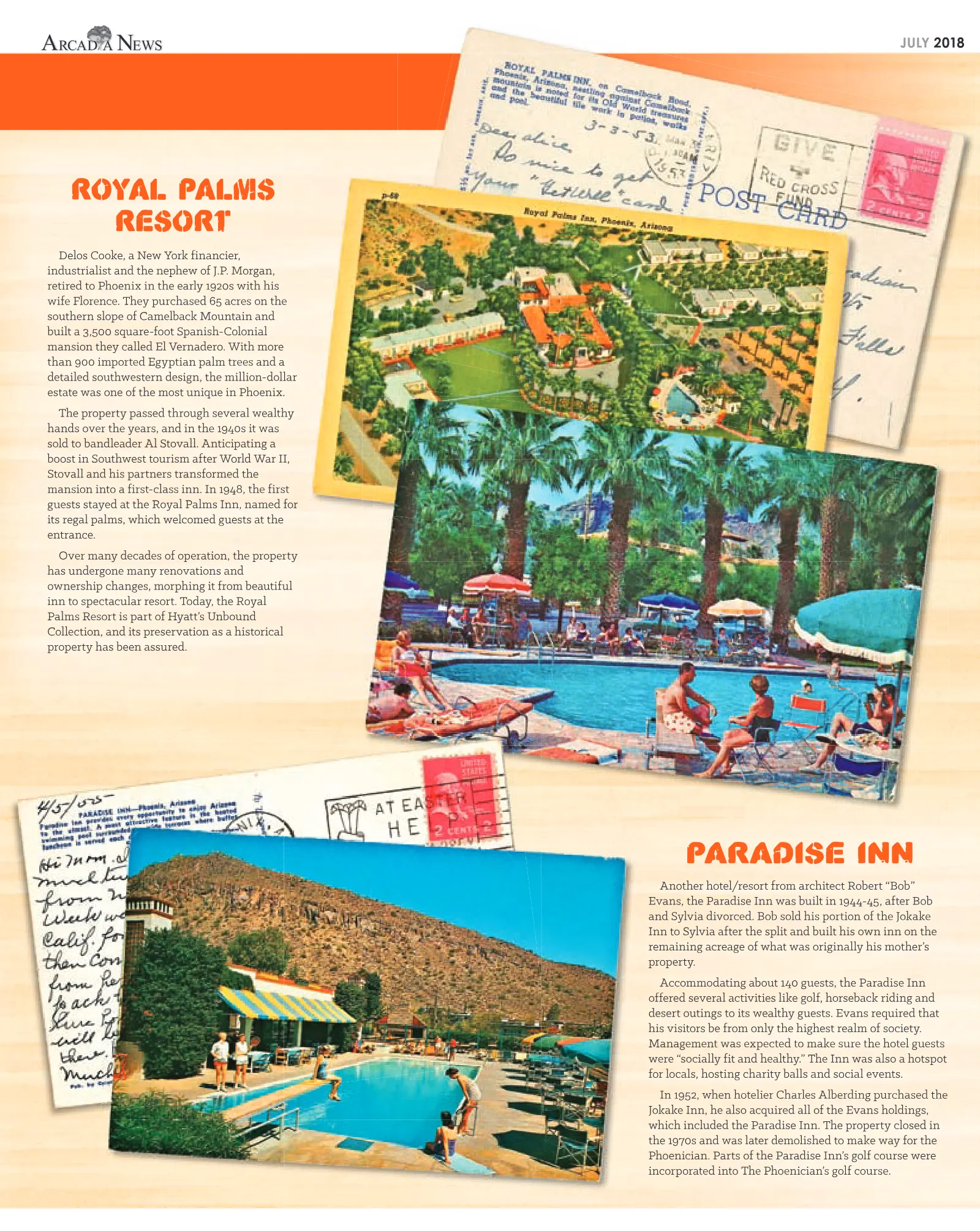
JULY 2018 Another hotel/resort from architect Robert “Bob” Evans, the Paradise Inn was built in 1944-45, after Bob and Sylvia divorced. Bob sold his portion of the Jokake Inn to Sylvia after the split and built his own inn on the remaining acreage of what was originally his mother’s property. Accommodating about 140 guests, the Paradise Inn offered several activities like golf, horseback riding and desert outings to its wealthy guests. Evans required that his visitors be from only the highest realm of society. Management was expected to make sure the hotel guests were “socially fit and healthy.” The Inn was also a hotspot for locals, hosting charity balls and social events. In 1952, when hotelier Charles Alberding purchased the Jokake Inn, he also acquired all of the Evans holdings, which included the Paradise Inn. The property closed in the 1970s and was later demolished to make way for the Phoenician. Parts of the Paradise Inn’s golf course were incorporated into The Phoenician’s golf course. JULY 2018 Royal Palms resort Delos Cooke, a New York financier, industrialist and the nephew of J.P. Morgan, retired to Phoenix in the early 1920s with his wife Florence. They purchased 65 acres on the southern slope of Camelback Mountain and built a 3,500 square-foot Spanish-Colonial mansion they called El Vernadero. With more than 900 imported Egyptian palm trees and a detailed southwestern design, the million-dollar estate was one of the most unique in Phoenix. The property passed through several wealthy hands over the years, and in the 1940s it was sold to bandleader Al Stovall. Anticipating a boost in Southwest tourism after World War II, Stovall and his partners transformed the mansion into a first-class inn. In 1948, the first guests stayed at the Royal Palms Inn, named for its regal palms, which welcomed guests at the entrance. Over many decades of operation, the property has undergone many renovations and ownership changes, morphing it from beautiful inn to spectacular resort. Today, the Royal Palms Resort is part of Hyatt’s Unbound Collection, and its preservation as a historical property has been assured. Paradise inn