
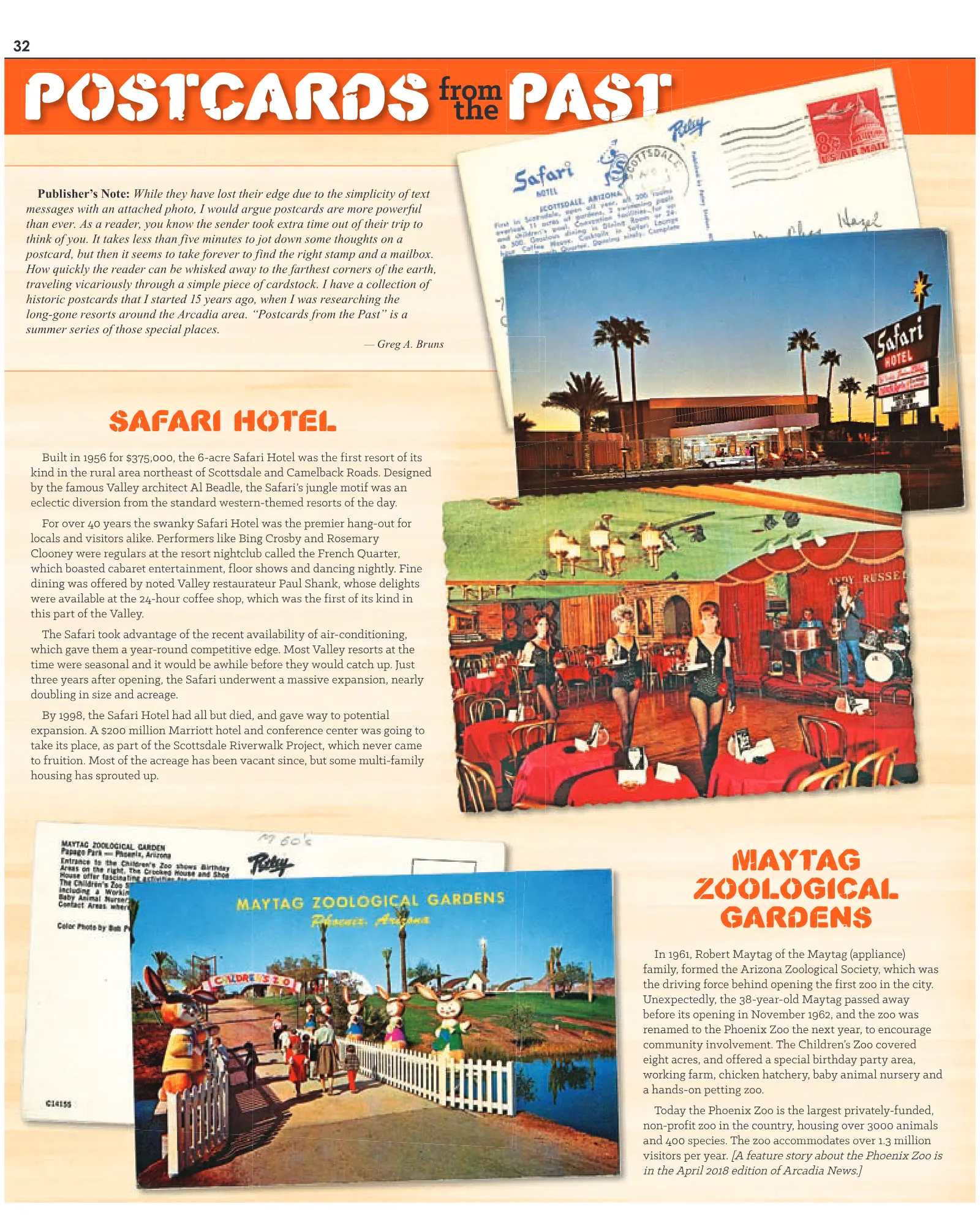
32 past past past Built in 1956 for $375,000, the 6-acre Safari Hotel was the first resort of its kind in the rural area northeast of Scottsdale and Camelback Roads. Designed by the famous Valley architect Al Beadle, the Safari’s jungle motif was an eclectic diversion from the standard western-themed resorts of the day. For over 40 years the swanky Safari Hotel was the premier hang-out for locals and visitors alike. Performers like Bing Crosby and Rosemary Clooney were regulars at the resort nightclub called the French Quarter, which boasted cabaret entertainment, floor shows and dancing nightly. Fine dining was offered by noted Valley restaurateur Paul Shank, whose delights were available at the 24-hour coffee shop, which was the first of its kind in this part of the Valley. The Safari took advantage of the recent availability of air-conditioning, which gave them a year-round competitive edge. Most Valley resorts at the time were seasonal and it would be awhile before they would catch up. Just three years after opening, the Safari underwent a massive expansion, nearly doubling in size and acreage. By 1998, the Safari Hotel had all but died, and gave way to potential expansion. A $200 million Marriott hotel and conference center was going to take its place, as part of the Scottsdale Riverwalk Project, which never came to fruition. Most of the acreage has been vacant since, but some multi-family housing has sprouted up. Publisher’s Note: While they have lost their edge due to the simplicity of text messages with an attached photo, I would argue postcards are more powerful than ever. As a reader, you know the sender took extra time out of their trip to think of you. It takes less than five minutes to jot down some thoughts on a postcard, but then it seems to take forever to find the right stamp and a mailbox. How quickly the reader can be whisked away to the farthest corners of the earth, traveling vicariously through a simple piece of cardstock. I have a collection of historic postcards that I started 15 years ago, when I was researching the long-gone resorts around the Arcadia area. “Postcards from the Past” is a summer series of those special places. — Greg A. Bruns In 1961, Robert Maytag of the Maytag (appliance) family, formed the Arizona Zoological Society, which was the driving force behind opening the first zoo in the city. Unexpectedly, the 38-year-old Maytag passed away before its opening in November 1962, and the zoo was renamed to the Phoenix Zoo the next year, to encourage community involvement. The Children’s Zoo covered eight acres, and offered a special birthday party area, working farm, chicken hatchery, baby animal nursery and a hands-on petting zoo. Today the Phoenix Zoo is the largest privately-funded, non-profit zoo in the country, housing over 3000 animals and 400 species. The zoo accommodates over 1.3 million visitors per year. [A feature story about the Phoenix Zoo is in the April 2018 edition of Arcadia News.] SAFARI HOTEL Maytag Zoological Gardens postcards the from
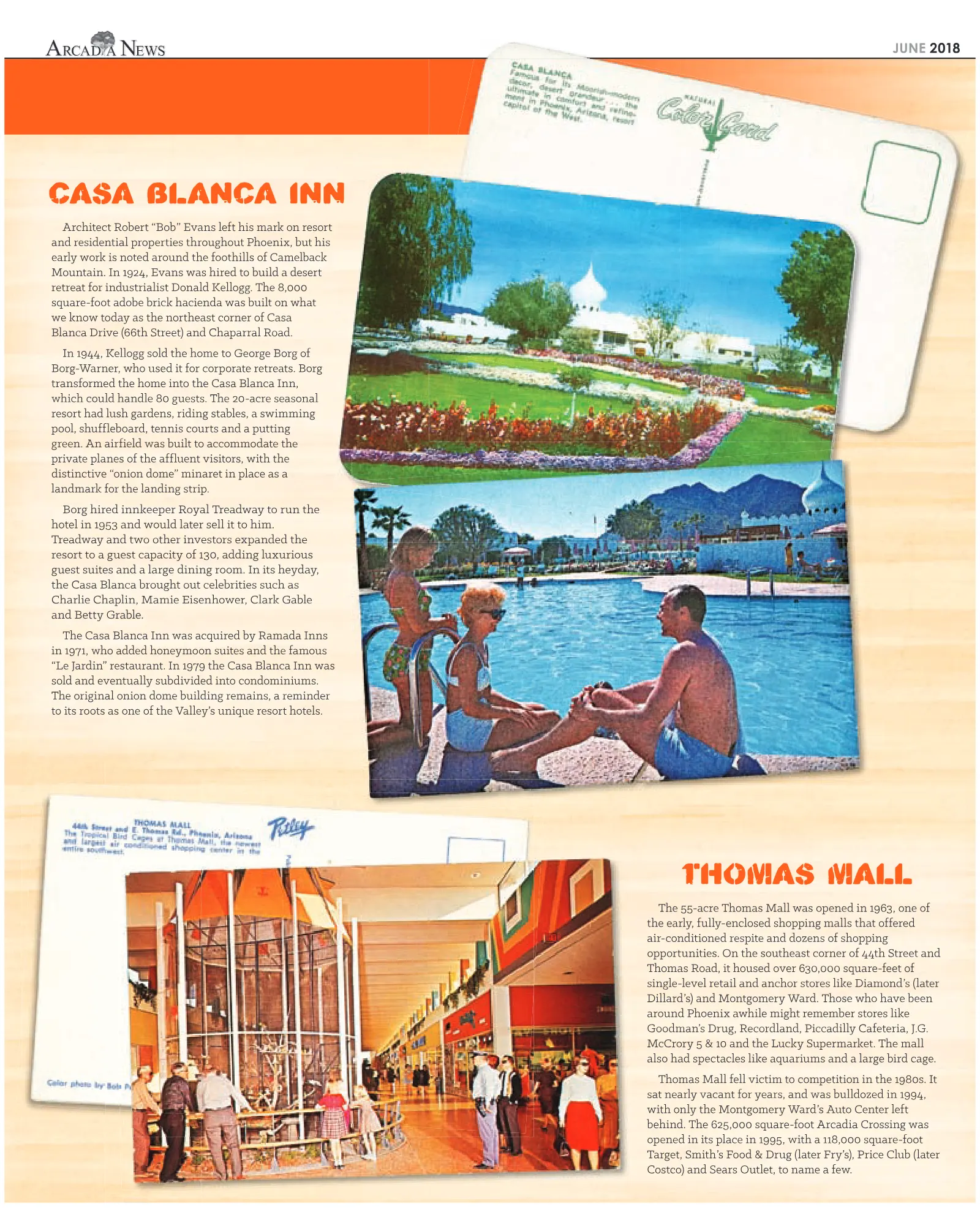
JUNE 2018 The 55-acre Thomas Mall was opened in 1963, one of the early, fully-enclosed shopping malls that offered air-conditioned respite and dozens of shopping opportunities. On the southeast corner of 44th Street and Thomas Road, it housed over 630,000 square-feet of single-level retail and anchor stores like Diamond’s (later Dillard’s) and Montgomery Ward. Those who have been around Phoenix awhile might remember stores like Goodman’s Drug, Recordland, Piccadilly Cafeteria, J.G. McCrory 5 & 10 and the Lucky Supermarket. The mall also had spectacles like aquariums and a large bird cage. Thomas Mall fell victim to competition in the 1980s. It sat nearly vacant for years, and was bulldozed in 1994, with only the Montgomery Ward’s Auto Center left behind. The 625,000 square-foot Arcadia Crossing was opened in its place in 1995, with a 118,000 square-foot Target, Smith’s Food & Drug (later Fry’s), Price Club (later Costco) and Sears Outlet, to name a few. JUNE 2018 Casa Blanca inn Architect Robert “Bob” Evans left his mark on resort and residential properties throughout Phoenix, but his early work is noted around the foothills of Camelback Mountain. In 1924, Evans was hired to build a desert retreat for industrialist Donald Kellogg. The 8,000 square-foot adobe brick hacienda was built on what we know today as the northeast corner of Casa Blanca Drive (66th Street) and Chaparral Road. In 1944, Kellogg sold the home to George Borg of Borg-Warner, who used it for corporate retreats. Borg transformed the home into the Casa Blanca Inn, which could handle 80 guests. The 20-acre seasonal resort had lush gardens, riding stables, a swimming pool, shuffleboard, tennis courts and a putting green. An airfield was built to accommodate the private planes of the affluent visitors, with the distinctive “onion dome” minaret in place as a landmark for the landing strip. Borg hired innkeeper Royal Treadway to run the hotel in 1953 and would later sell it to him. Treadway and two other investors expanded the resort to a guest capacity of 130, adding luxurious guest suites and a large dining room. In its heyday, the Casa Blanca brought out celebrities such as Charlie Chaplin, Mamie Eisenhower, Clark Gable and Betty Grable. The Casa Blanca Inn was acquired by Ramada Inns in 1971, who added honeymoon suites and the famous “Le Jardin” restaurant. In 1979 the Casa Blanca Inn was sold and eventually subdivided into condominiums. The original onion dome building remains, a reminder to its roots as one of the Valley’s unique resort hotels. Thomas Mall