
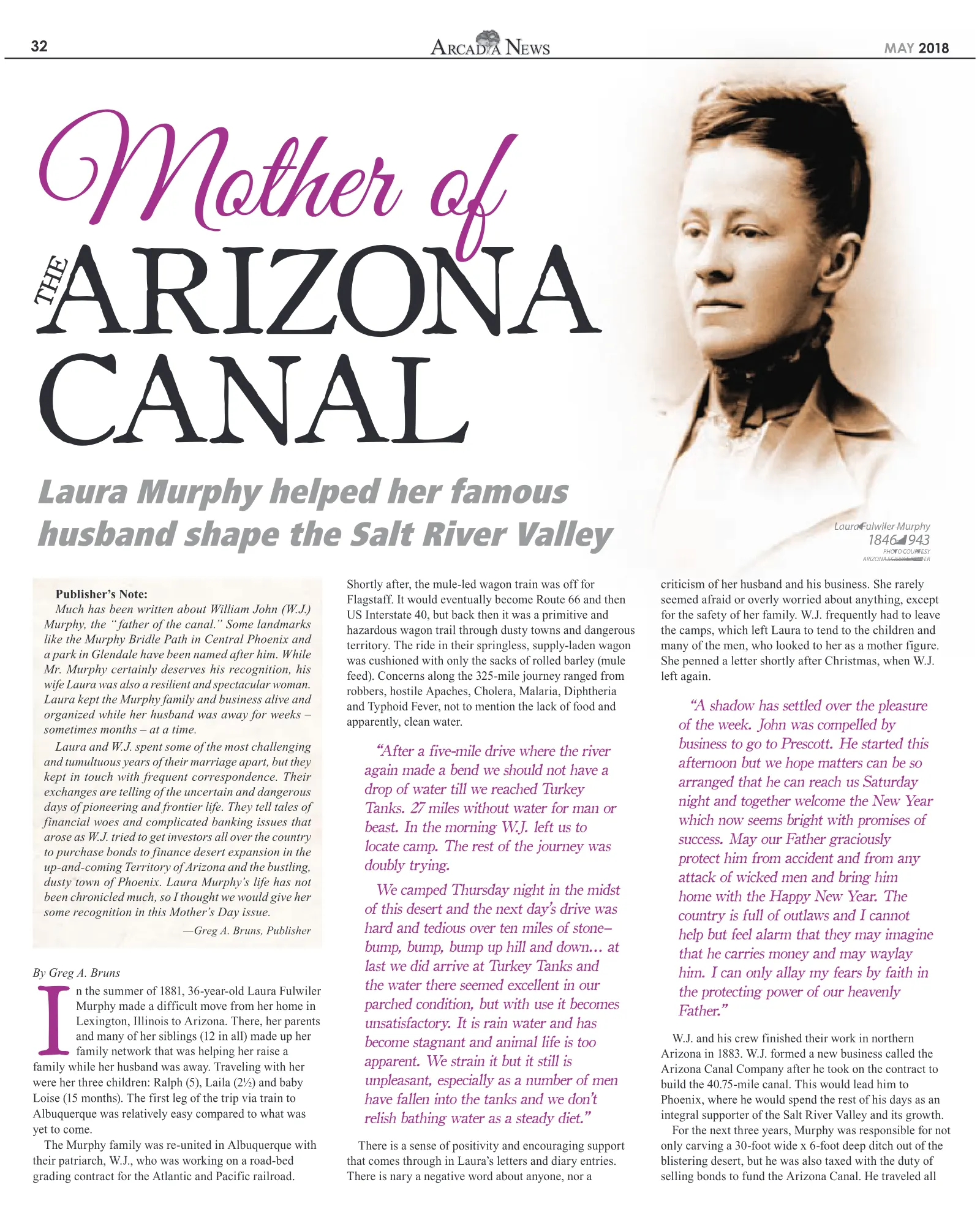
Publisher’s Note: Much has been written about William John (W.J.) Murphy, the “ father of the canal.” Some landmarks like the Murphy Bridle Path in Central Phoenix and a park in Glendale have been named after him. While Mr. Murphy certainly deserves his recognition, his wife Laura was also a resilient and spectacular woman. Laura kept the Murphy family and business alive and organized while her husband was away for weeks – sometimes months – at a time. Laura and W.J. spent some of the most challenging and tumultuous years of their marriage apart, but they kept in touch with frequent correspondence. Their exchanges are telling of the uncertain and dangerous days of pioneering and frontier life. They tell tales of financial woes and complicated banking issues that arose as W.J. tried to get investors all over the country to purchase bonds to finance desert expansion in the up-and-coming Territory of Arizona and the bustling, dusty town of Phoenix. Laura Murphy’s life has not been chronicled much, so I thought we would give her some recognition in this Mother’s Day issue. —Greg A. Bruns, Publisher 32 MAY 2018 By Greg A. Bruns I n the summer of 1881, 36-year-old Laura Fulwiler Murphy made a difficult move from her home in Lexington, Illinois to Arizona. There, her parents and many of her siblings (12 in all) made up her family network that was helping her raise a family while her husband was away. Traveling with her were her three children: Ralph (5), Laila (2½) and baby Loise (15 months). The first leg of the trip via train to Albuquerque was relatively easy compared to what was yet to come. The Murphy family was re-united in Albuquerque with their patriarch, W.J., who was working on a road-bed grading contract for the Atlantic and Pacific railroad. Shortly after, the mule-led wagon train was off for Flagstaff. It would eventually become Route 66 and then US Interstate 40, but back then it was a primitive and hazardous wagon trail through dusty towns and dangerous territory. The ride in their springless, supply-laden wagon was cushioned with only the sacks of rolled barley (mule feed). Concerns along the 325-mile journey ranged from robbers, hostile Apaches, Cholera, Malaria, Diphtheria and Typhoid Fever, not to mention the lack of food and apparently, clean water. “After a five-mile drive where the river again made a bend we should not have a drop of water till we reached Turkey Tanks. 27 miles without water for man or beast. In the morning W.J. left us to locate camp. The rest of the journey was doubly trying. We camped Thursday night in the midst of this desert and the next day’s drive was hard and tedious over ten miles of stone– bump, bump, bump up hill and down … at last we did arrive at Turkey Tanks and the water there seemed excellent in our parched condition, but with use it becomes unsatisfactory. It is rain water and has become stagnant and animal life is too apparent. We strain it but it still is unpleasant, especially as a number of men have fallen into the tanks and we don’t relish bathing water as a steady diet.” There is a sense of positivity and encouraging support that comes through in Laura’s letters and diary entries. There is nary a negative word about anyone, nor a criticism of her husband and his business. She rarely seemed afraid or overly worried about anything, except for the safety of her family. W.J. frequently had to leave the camps, which left Laura to tend to the children and many of the men, who looked to her as a mother figure. She penned a letter shortly after Christmas, when W.J. left again. “A shadow has settled over the pleasure of the week. John was compelled by business to go to Prescott. He started this afternoon but we hope matters can be so arranged that he can reach us Saturday night and together welcome the New Year which now seems bright with promises of success. May our Father graciously protect him from accident and from any attack of wicked men and bring him home with the Happy New Year. The country is full of outlaws and I cannot help but feel alarm that they may imagine that he carries money and may waylay him. I can only allay my fears by faith in the protecting power of our heavenly Father.” W.J. and his crew finished their work in northern Arizona in 1883. W.J. formed a new business called the Arizona Canal Company after he took on the contract to build the 40.75-mile canal. This would lead him to Phoenix, where he would spend the rest of his days as an integral supporter of the Salt River Valley and its growth. For the next three years, Murphy was responsible for not only carving a 30-foot wide x 6-foot deep ditch out of the blistering desert, but he was also taxed with the duty of selling bonds to fund the Arizona Canal. He traveled all Laura Murphy helped her famous husband shape the Salt River Valley Mother of ARIZONA CANAL Laura Fulwiler Murphy 1846-1943 PHOTO COURTESY ARIZONA SCIENCE CENTER THE
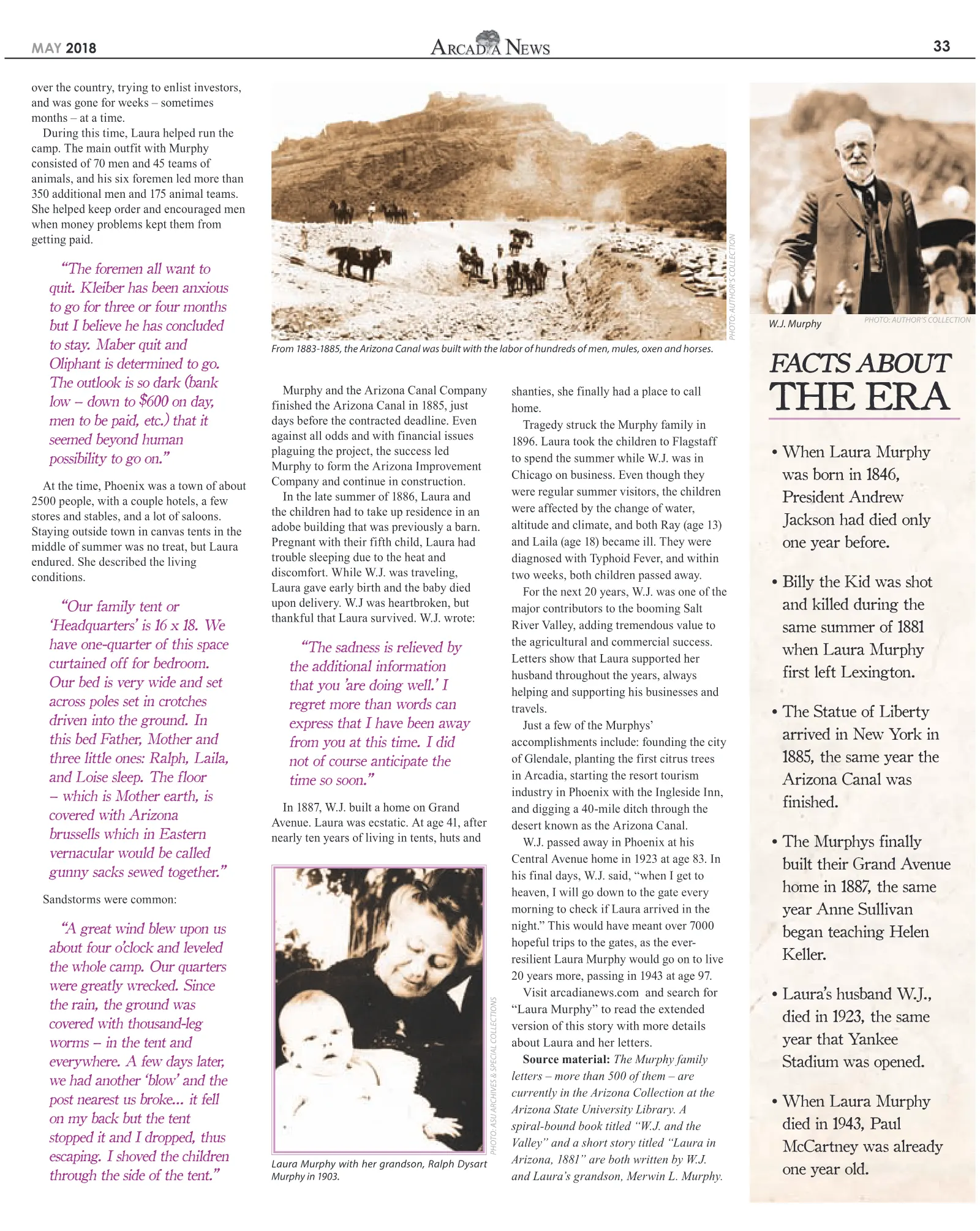
MAY 2018 over the country, trying to enlist investors, and was gone for weeks – sometimes months – at a time. During this time, Laura helped run the camp. The main outfit with Murphy consisted of 70 men and 45 teams of animals, and his six foremen led more than 350 additional men and 175 animal teams. She helped keep order and encouraged men when money problems kept them from getting paid. “The foremen all want to quit. Kleiber has been anxious to go for three or four months but I believe he has concluded to stay. Maber quit and Oliphant is determined to go. The outlook is so dark (bank low – down to $600 on day, men to be paid, etc.) that it seemed beyond human possibility to go on.” At the time, Phoenix was a town of about 2500 people, with a couple hotels, a few stores and stables, and a lot of saloons. Staying outside town in canvas tents in the middle of summer was no treat, but Laura endured. She described the living conditions. “Our family tent or ‘Headquarters’ is 16 x 18. We have one-quarter of this space curtained off for bedroom. Our bed is very wide and set across poles set in crotches driven into the ground. In this bed Father, Mother and three little ones: Ralph, Laila, and Loise sleep. The floor – which is Mother earth, is covered with Arizona brussells which in Eastern vernacular would be called gunny sacks sewed together.” Sandstorms were common: “A great wind blew upon us about four o’clock and leveled the whole camp. Our quarters were greatly wrecked. Since the rain, the ground was covered with thousand-leg worms – in the tent and everywhere. A few days later, we had another ‘blow’ and the post nearest us broke... it fell on my back but the tent stopped it and I dropped, thus escaping. I shoved the children through the side of the tent.” Murphy and the Arizona Canal Company finished the Arizona Canal in 1885, just days before the contracted deadline. Even against all odds and with financial issues plaguing the project, the success led Murphy to form the Arizona Improvement Company and continue in construction. In the late summer of 1886, Laura and the children had to take up residence in an adobe building that was previously a barn. Pregnant with their fifth child, Laura had trouble sleeping due to the heat and discomfort. While W.J. was traveling, Laura gave early birth and the baby died upon delivery. W.J was heartbroken, but thankful that Laura survived. W.J. wrote: “The sadness is relieved by the additional information that you ’are doing well.’ I regret more than words can express that I have been away from you at this time. I did not of course anticipate the time so soon.” In 1887, W.J. built a home on Grand Avenue. Laura was ecstatic. At age 41, after nearly ten years of living in tents, huts and shanties, she finally had a place to call home. Tragedy struck the Murphy family in 1896. Laura took the children to Flagstaff to spend the summer while W.J. was in Chicago on business. Even though they were regular summer visitors, the children were affected by the change of water, altitude and climate, and both Ray (age 13) and Laila (age 18) became ill. They were diagnosed with Typhoid Fever, and within two weeks, both children passed away. For the next 20 years, W.J. was one of the major contributors to the booming Salt River Valley, adding tremendous value to the agricultural and commercial success. Letters show that Laura supported her husband throughout the years, always helping and supporting his businesses and travels. Just a few of the Murphys’ accomplishments include: founding the city of Glendale, planting the first citrus trees in Arcadia, starting the resort tourism industry in Phoenix with the Ingleside Inn, and digging a 40-mile ditch through the desert known as the Arizona Canal. W.J. passed away in Phoenix at his Central Avenue home in 1923 at age 83. In his final days, W.J. said, “when I get to heaven, I will go down to the gate every morning to check if Laura arrived in the night.” This would have meant over 7000 hopeful trips to the gates, as the ever- resilient Laura Murphy would go on to live 20 years more, passing in 1943 at age 97. Visit arcadianews.com and search for “Laura Murphy” to read the extended version of this story with more details about Laura and her letters. Source material: The Murphy family letters – more than 500 of them – are currently in the Arizona Collection at the Arizona State University Library. A spiral-bound book titled “W.J. and the Valley” and a short story titled “Laura in Arizona, 1881” are both written by W.J. and Laura’s grandson, Merwin L. Murphy. From 1883-1885, the Arizona Canal was built with the labor of hundreds of men, mules, oxen and horses. Laura Murphy with her grandson, Ralph Dysart Murphy in 1903. W.J. Murphy • When Laura Murphy was born in 1846, President Andrew Jackson had died only one year before. • Billy the Kid was shot and killed during the same summer of 1881 when Laura Murphy first left Lexington. • The Statue of Liberty arrived in New York in 1885, the same year the Arizona Canal was finished. • The Murphys finally built their Grand Avenue home in 1887, the same year Anne Sullivan began teaching Helen Keller. • Laura’s husband W.J., died in 1923, the same year that Yankee Stadium was opened. • When Laura Murphy died in 1943, Paul McCartney was already one year old. FACTS ABOUT THE ERA 33 PHOTO: ASU ARCHIVES & SPECIAL COLLECTIONS PHOTO: AUTHOR’S COLLECTION PHOTO: AUTHOR’S COLLECTION