
30 FEBRUARY 2018 ArcAd A News
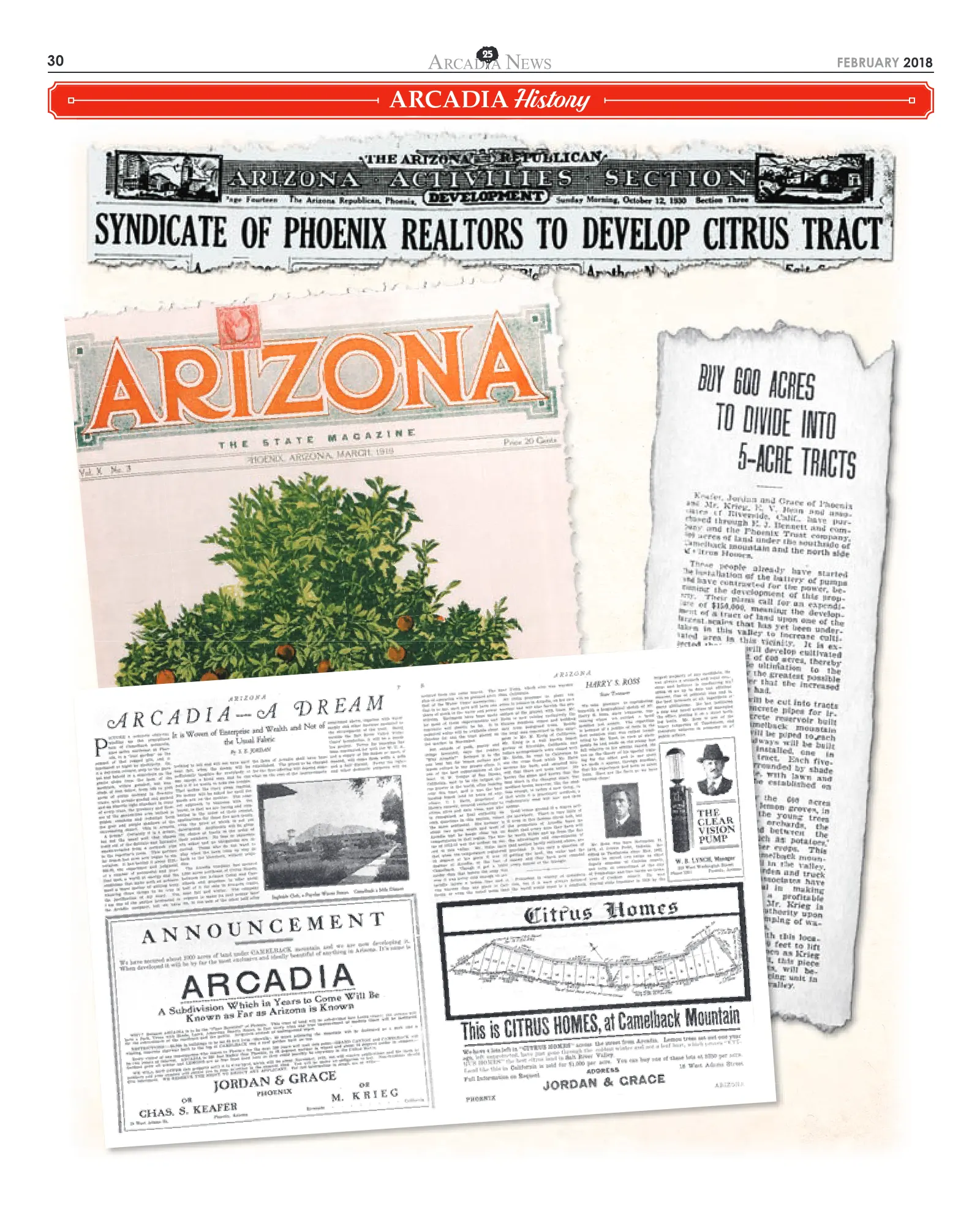
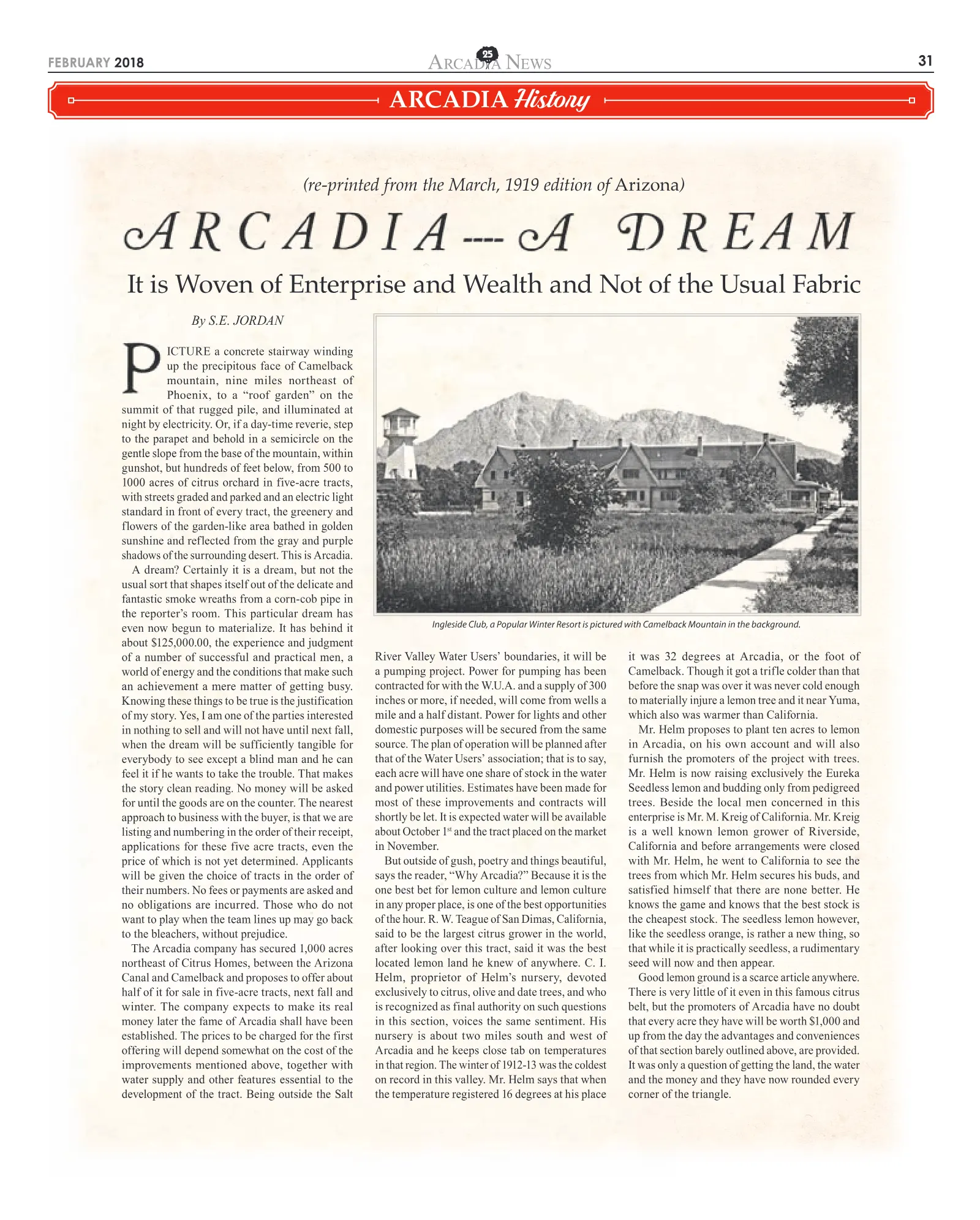
31 FEBRUARY 2018 ARCAD A NEWS By S.E. JORDAN ICTURE a concrete stairway winding up the precipitous face of Camelback mountain, nine miles northeast of Phoenix, to a “roof garden” on the summit of that rugged pile, and illuminated at night by electricity. Or, if a day-time reverie, step to the parapet and behold in a semicircle on the gentle slope from the base of the mountain, within gunshot, but hundreds of feet below, from 500 to 1000 acres of citrus orchard in five-acre tracts, with streets graded and parked and an electric light standard in front of every tract, the greenery and flowers of the garden-like area bathed in golden sunshine and reflected from the gray and purple shadows of the surrounding desert. This is Arcadia. A dream? Certainly it is a dream, but not the usual sort that shapes itself out of the delicate and fantastic smoke wreaths from a corn-cob pipe in the reporter’s room. This particular dream has even now begun to materialize. It has behind it about $125,000.00, the experience and judgment of a number of successful and practical men, a world of energy and the conditions that make such an achievement a mere matter of getting busy. Knowing these things to be true is the justification of my story. Yes, I am one of the parties interested in nothing to sell and will not have until next fall, when the dream will be sufficiently tangible for everybody to see except a blind man and he can feel it if he wants to take the trouble. That makes the story clean reading. No money will be asked for until the goods are on the counter. The nearest approach to business with the buyer, is that we are listing and numbering in the order of their receipt, applications for these five acre tracts, even the price of which is not yet determined. Applicants will be given the choice of tracts in the order of their numbers. No fees or payments are asked and no obligations are incurred. Those who do not want to play when the team lines up may go back to the bleachers, without prejudice. The Arcadia company has secured 1,000 acres northeast of Citrus Homes, between the Arizona Canal and Camelback and proposes to offer about half of it for sale in five-acre tracts, next fall and winter. The company expects to make its real money later the fame of Arcadia shall have been established. The prices to be charged for the first offering will depend somewhat on the cost of the improvements mentioned above, together with water supply and other features essential to the development of the tract. Being outside the Salt River Valley Water Users’ boundaries, it will be a pumping project. Power for pumping has been contracted for with the W.U.A. and a supply of 300 inches or more, if needed, will come from wells a mile and a half distant. Power for lights and other domestic purposes will be secured from the same source. The plan of operation will be planned after that of the Water Users’ association; that is to say, each acre will have one share of stock in the water and power utilities. Estimates have been made for most of these improvements and contracts will shortly be let. It is expected water will be available about October 1 st and the tract placed on the market in November. But outside of gush, poetry and things beautiful, says the reader, “Why Arcadia?” Because it is the one best bet for lemon culture and lemon culture in any proper place, is one of the best opportunities of the hour. R. W. Teague of San Dimas, California, said to be the largest citrus grower in the world, after looking over this tract, said it was the best located lemon land he knew of anywhere. C. I. Helm, proprietor of Helm’s nursery, devoted exclusively to citrus, olive and date trees, and who is recognized as final authority on such questions in this section, voices the same sentiment. His nursery is about two miles south and west of Arcadia and he keeps close tab on temperatures in that region. The winter of 1912-13 was the coldest on record in this valley. Mr. Helm says that when the temperature registered 16 degrees at his place it was 32 degrees at Arcadia, or the foot of Camelback. Though it got a trifle colder than that before the snap was over it was never cold enough to materially injure a lemon tree and it near Yuma, which also was warmer than California. Mr. Helm proposes to plant ten acres to lemon in Arcadia, on his own account and will also furnish the promoters of the project with trees. Mr. Helm is now raising exclusively the Eureka Seedless lemon and budding only from pedigreed trees. Beside the local men concerned in this enterprise is Mr. M. Kreig of California. Mr. Kreig is a well known lemon grower of Riverside, California and before arrangements were closed with Mr. Helm, he went to California to see the trees from which Mr. Helm secures his buds, and satisfied himself that there are none better. He knows the game and knows that the best stock is the cheapest stock. The seedless lemon however, like the seedless orange, is rather a new thing, so that while it is practically seedless, a rudimentary seed will now and then appear. Good lemon ground is a scarce article anywhere. There is very little of it even in this famous citrus belt, but the promoters of Arcadia have no doubt that every acre they have will be worth $1,000 and up from the day the advantages and conveniences of that section barely outlined above, are provided. It was only a question of getting the land, the water and the money and they have now rounded every corner of the triangle. It is Woven of Enterprise and Wealth and Not of the Usual Fabric (re-printed from the March, 1919 edition of Arizona ) Ingleside Club, a Popular Winter Resort is pictured with Camelback Mountain in the background.