
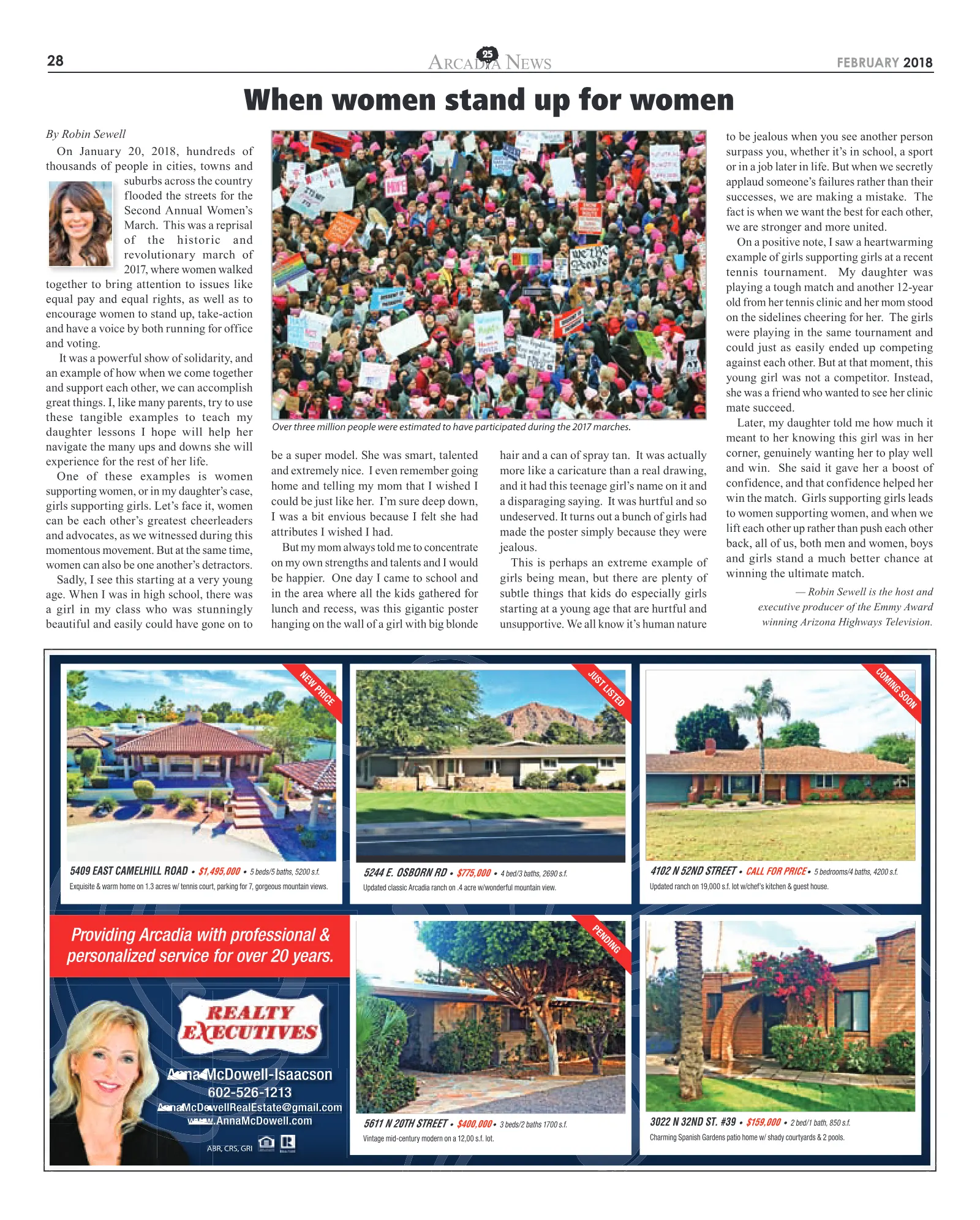
28 FEBRUARY 2018 ARCAD A NEWS By Robin Sewell On January 20, 2018, hundreds of thousands of people in cities, towns and suburbs across the country flooded the streets for the Second Annual Women’s March. This was a reprisal of the historic and revolutionary march of 2017, where women walked together to bring attention to issues like equal pay and equal rights, as well as to encourage women to stand up, take-action and have a voice by both running for office and voting. It was a powerful show of solidarity, and an example of how when we come together and support each other, we can accomplish great things. I, like many parents, try to use these tangible examples to teach my daughter lessons I hope will help her navigate the many ups and downs she will experience for the rest of her life. One of these examples is women supporting women, or in my daughter’s case, girls supporting girls. Let’s face it, women can be each other’s greatest cheerleaders and advocates, as we witnessed during this momentous movement. But at the same time, women can also be one another’s detractors. Sadly, I see this starting at a very young age. When I was in high school, there was a girl in my class who was stunningly beautiful and easily could have gone on to be a super model. She was smart, talented and extremely nice. I even remember going home and telling my mom that I wished I could be just like her. I’m sure deep down, I was a bit envious because I felt she had attributes I wished I had. But my mom always told me to concentrate on my own strengths and talents and I would be happier. One day I came to school and in the area where all the kids gathered for lunch and recess, was this gigantic poster hanging on the wall of a girl with big blonde hair and a can of spray tan. It was actually more like a caricature than a real drawing, and it had this teenage girl’s name on it and a disparaging saying. It was hurtful and so undeserved. It turns out a bunch of girls had made the poster simply because they were jealous. This is perhaps an extreme example of girls being mean, but there are plenty of subtle things that kids do especially girls starting at a young age that are hurtful and unsupportive. We all know it’s human nature to be jealous when you see another person surpass you, whether it’s in school, a sport or in a job later in life. But when we secretly applaud someone’s failures rather than their successes, we are making a mistake. The fact is when we want the best for each other, we are stronger and more united. On a positive note, I saw a heartwarming example of girls supporting girls at a recent tennis tournament. My daughter was playing a tough match and another 12-year old from her tennis clinic and her mom stood on the sidelines cheering for her. The girls were playing in the same tournament and could just as easily ended up competing against each other. But at that moment, this young girl was not a competitor. Instead, she was a friend who wanted to see her clinic mate succeed. Later, my daughter told me how much it meant to her knowing this girl was in her corner, genuinely wanting her to play well and win. She said it gave her a boost of confidence, and that confidence helped her win the match. Girls supporting girls leads to women supporting women, and when we lift each other up rather than push each other back, all of us, both men and women, boys and girls stand a much better chance at winning the ultimate match. — Robin Sewell is the host and executive producer of the Emmy Award winning Arizona Highways Television. When women stand up for women Over three million people were estimated to have participated during the 2017 marches. Anna McDowell-Isaacson 602-526-1213 AnnaMcDowellRealEstate@gmail.com www.AnnaMcDowell.com ABR, CRS, GRI Anna McDowell-Isaacson Anna McDowell-Isaacson 602-526-1213 602-526-1213 AnnaMcDowellRealEstate@gmail.com www.AnnaMcDowell.com www.AnnaMcDowell.com ABR, CRS, GRI Anna McDowell-Isaacson Anna McDowell-Isaacson AnnaMcDowellRealEstate@gmail.com AnnaMcDowellRealEstate@gmail.com www.AnnaMcDowell.com www.AnnaMcDowell.com Exquisite & warm home on 1.3 acres w/ tennis court, parking for 7, gorgeous mountain views. 5409 EAST CAMELHILL ROAD • $1,495,000 • 5 beds/5 baths, 5200 s.f. NEW PRICE Charming Spanish Gardens patio home w/ shady courtyards & 2 pools. 3022 N 32ND ST. #39 • $159,000 • 2 bed/1 bath, 850 s.f. Updated ranch on 19,000 s.f. lot w/chef’s kitchen & guest house. 4102 N 52ND STREET • CALL FOR PRICE • 5 bedrooms/4 baths, 4200 s.f. COMING SOON Providing Arcadia with professional & personalized service for over 20 years. Vintage mid-century modern on a 12,00 s.f. lot. 5611 N 20TH STREET • $400,000 • 3 beds/2 baths 1700 s.f. PENDING Updated classic Arcadia ranch on .4 acre w/wonderful mountain view. 5244 E. OSBORN RD • $775,000 • 4 bed/3 baths, 2690 s.f. JUST LISTED
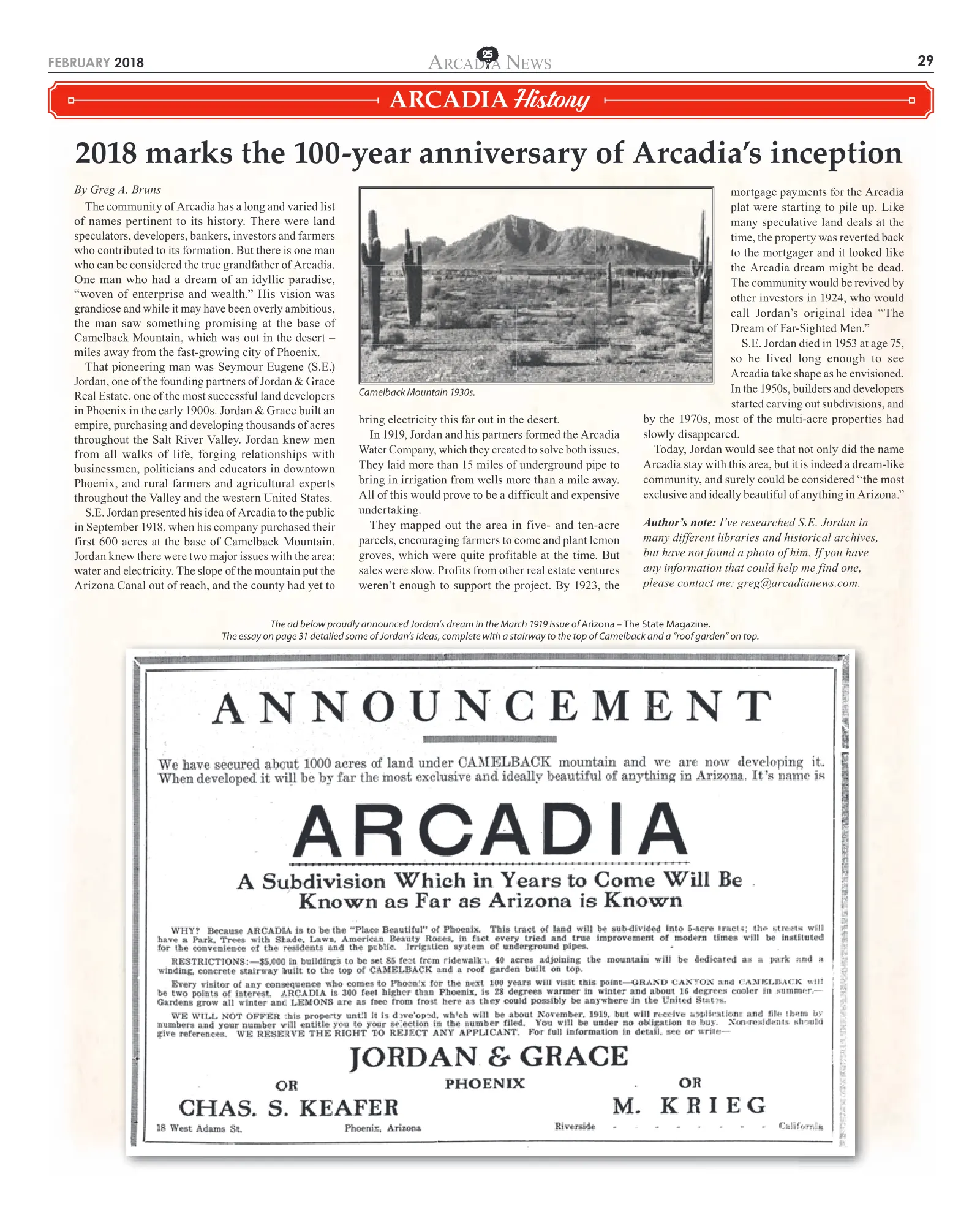
29 FEBRUARY 2018 ARCAD A NEWS By Greg A. Bruns The community of Arcadia has a long and varied list of names pertinent to its history. There were land speculators, developers, bankers, investors and farmers who contributed to its formation. But there is one man who can be considered the true grandfather of Arcadia. One man who had a dream of an idyllic paradise, “woven of enterprise and wealth.” His vision was grandiose and while it may have been overly ambitious, the man saw something promising at the base of Camelback Mountain, which was out in the desert – miles away from the fast-growing city of Phoenix. That pioneering man was Seymour Eugene (S.E.) Jordan, one of the founding partners of Jordan & Grace Real Estate, one of the most successful land developers in Phoenix in the early 1900s. Jordan & Grace built an empire, purchasing and developing thousands of acres throughout the Salt River Valley. Jordan knew men from all walks of life, forging relationships with businessmen, politicians and educators in downtown Phoenix, and rural farmers and agricultural experts throughout the Valley and the western United States. S.E. Jordan presented his idea of Arcadia to the public in September 1918, when his company purchased their first 600 acres at the base of Camelback Mountain. Jordan knew there were two major issues with the area: water and electricity. The slope of the mountain put the Arizona Canal out of reach, and the county had yet to bring electricity this far out in the desert. In 1919, Jordan and his partners formed the Arcadia Water Company, which they created to solve both issues. They laid more than 15 miles of underground pipe to bring in irrigation from wells more than a mile away. All of this would prove to be a difficult and expensive undertaking. They mapped out the area in five- and ten-acre parcels, encouraging farmers to come and plant lemon groves, which were quite profitable at the time. But sales were slow. Profits from other real estate ventures weren’t enough to support the project. By 1923, the mortgage payments for the Arcadia plat were starting to pile up. Like many speculative land deals at the time, the property was reverted back to the mortgager and it looked like the Arcadia dream might be dead. The community would be revived by other investors in 1924, who would call Jordan’s original idea “The Dream of Far-Sighted Men.” S.E. Jordan died in 1953 at age 75, so he lived long enough to see Arcadia take shape as he envisioned. In the 1950s, builders and developers started carving out subdivisions, and by the 1970s, most of the multi-acre properties had slowly disappeared. Today, Jordan would see that not only did the name Arcadia stay with this area, but it is indeed a dream-like community, and surely could be considered “the most exclusive and ideally beautiful of anything in Arizona.” Author’s note: I’ve researched S.E. Jordan in many different libraries and historical archives, but have not found a photo of him. If you have any information that could help me find one, please contact me: greg@arcadianews.com. 2018 marks the 100-year anniversary of Arcadia’s inception The ad below proudly announced Jordan’s dream in the March 1919 issue of Arizona – The State Magazine . The essay on page 31 detailed some of Jordan’s ideas, complete with a stairway to the top of Camelback and a “roof garden” on top. Camelback Mountain 1930s.