
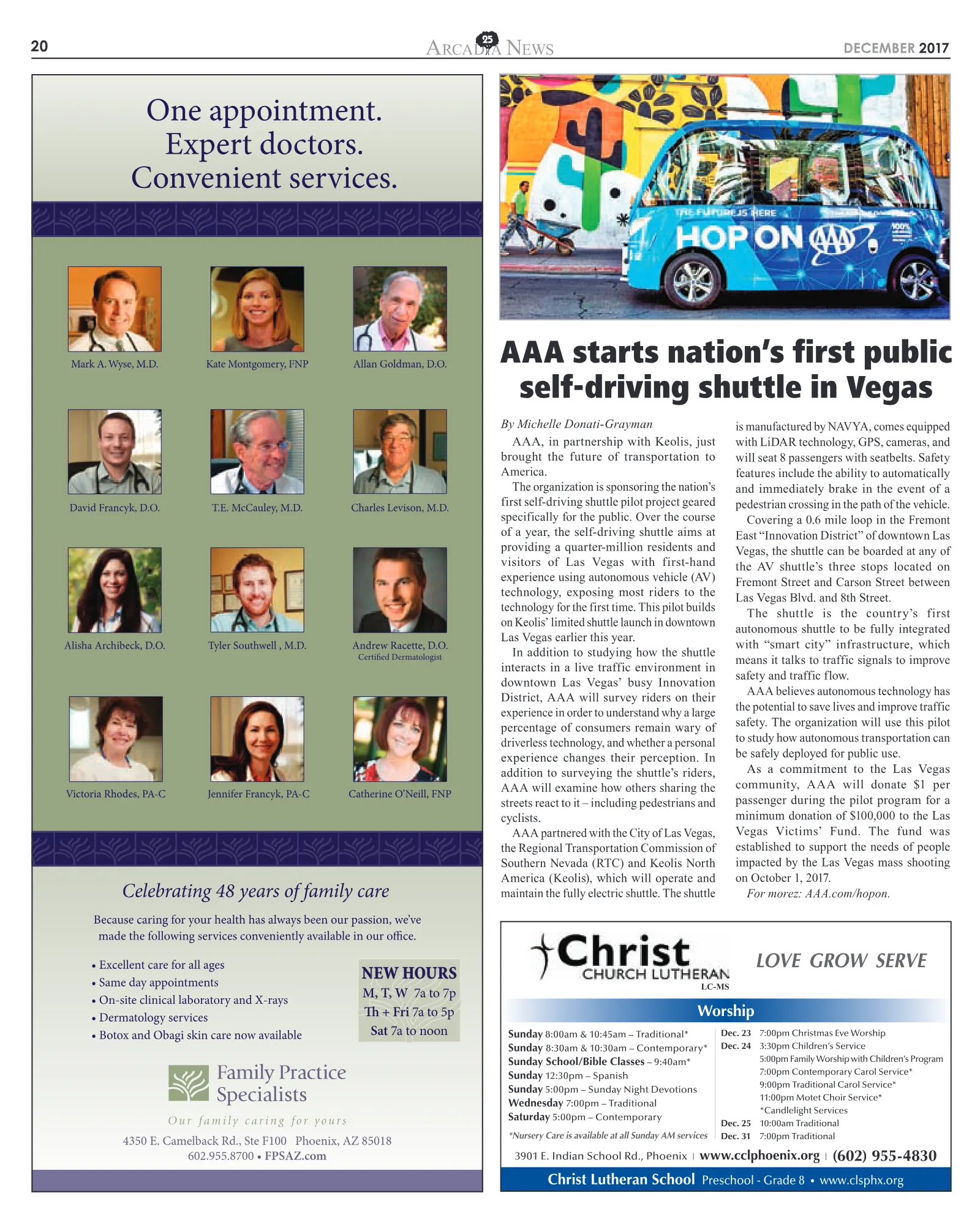

20 DECEMBER 2017 ARCAD A NEWS By Michelle Donati-Grayman AAA, in partnership with Keolis, just brought the future of transportation to America. The organization is sponsoring the nation’s first self-driving shuttle pilot project geared specifically for the public. Over the course of a year, the self-driving shuttle aims at providing a quarter-million residents and visitors of Las Vegas with first-hand experience using autonomous vehicle (AV) technology, exposing most riders to the technology for the first time. This pilot builds on Keolis’ limited shuttle launch in downtown Las Vegas earlier this year. In addition to studying how the shuttle interacts in a live traffic environment in downtown Las Vegas’ busy Innovation District, AAA will survey riders on their experience in order to understand why a large percentage of consumers remain wary of driverless technology, and whether a personal experience changes their perception. In addition to surveying the shuttle’s riders, AAA will examine how others sharing the streets react to it – including pedestrians and cyclists. AAA partnered with the City of Las Vegas, the Regional Transportation Commission of Southern Nevada (RTC) and Keolis North America (Keolis), which will operate and maintain the fully electric shuttle. The shuttle is manufactured by NAVYA, comes equipped with LiDAR technology, GPS, cameras, and will seat 8 passengers with seatbelts. Safety features include the ability to automatically and immediately brake in the event of a pedestrian crossing in the path of the vehicle. Covering a 0.6 mile loop in the Fremont East “Innovation District” of downtown Las Vegas, the shuttle can be boarded at any of the AV shuttle’s three stops located on Fremont Street and Carson Street between Las Vegas Blvd. and 8th Street. The shuttle is the country’s first autonomous shuttle to be fully integrated with “smart city” infrastructure, which means it talks to traffic signals to improve safety and traffic flow. AAA believes autonomous technology has the potential to save lives and improve traffic safety. The organization will use this pilot to study how autonomous transportation can be safely deployed for public use. As a commitment to the Las Vegas community, AAA will donate $1 per passenger during the pilot program for a minimum donation of $100,000 to the Las Vegas Victims’ Fund. The fund was established to support the needs of people impacted by the Las Vegas mass shooting on October 1, 2017. For morez: AAA.com/hopon. AAA starts nation’s first public self-driving shuttle in Vegas Christ Lutheran School Preschool - Grade 8 • www.clsphx.org LC-MS Worship Sunday 8:00am & 10:45am – Traditional* Sunday 8:30am & 10:30am – Contemporary* Sunday School/Bible Classes – 9:40am* Sunday 12:30pm – Spanish Sunday 5:00pm – Sunday Night Devotions Wednesday 7:00pm – Traditional Saturday 5:00pm – Contemporary *Nursery Care is available at all Sunday AM services 3901 E. Indian School Rd., Phoenix | www.cclphoenix.org | (602) 955-4830 LOVE GROW SERVE Dec. 23 7:00pm Christmas Eve Worship Dec. 24 3:30pm Children’s Service 5:00pm Family Worship with Children’s Program 7:00pm Contemporary Carol Service* 9:00pm Traditional Carol Service* 11:00pm Motet Choir Service* *Candlelight Services Dec. 25 10:00am Traditional Dec. 31 7:00pm Traditional One appointment. Expert doctors. Convenient services. 4350 E. Camelback Rd., Ste F100 Phoenix, AZ 85018 602.955.8700 • FPSAZ.com Because caring for your health has always been our passion, we’ve made the following services conveniently available in our office. • Excellent care for all ages • Same day appointments • On-site clinical laboratory and X-rays • Dermatology services • Botox and Obagi skin care now available Celebrating 48 years of family care Mark A. Wyse, M.D. Kate Montgomery, FNP Allan Goldman, D.O. Tyler Southwell , M.D. Andrew Racette, D.O. Certified Dermatologist Alisha Archibeck, D.O. David Francyk, D.O. T.E. McCauley, M.D. Charles Levison, M.D. NEW HOURS M, T, W 7a to 7p Th + Fri 7a to 5p Sat 7a to noon Victoria Rhodes, PA-C Jennifer Francyk, PA-C Catherine O’Neill, FNP
21 DECEMBER 2017 ArcAd A News By Jonell Sloekers Ho, ho, ho! If you are ready for the holidays, then you have probably already made the annual journey to the garage or attic to retrieve and unpack your boxes of décor. Other than sentimental, do you have anything of value in those boxes? With today’s focus on Midcentury Modern décor, numerous Christmas items from yesteryear are experiencing resurgence in secondary market value. Aluminum Christmas trees from the 1960s are highly collectible. Introduced to the market in 1959 by the Aluminum Specialty Company of Manitowoc, Wisc., their modern look appealed to consumers during the Space Age. Other companies joined in, and aluminum trees soon became a staple of Christmas décor. Silver tone aluminum trees were the most popular and plentiful, though the trees were also found in red, blue, gold and green, which are now rare. Pink is the rarest variety, and thus the most expensive, with recent eBay sales in excess of $1,000. The silver trees are worth significantly less, with six- foot trees found under “sold listings” on eBay for $100 - $150. Glass Christmas tree ornaments were first produced in Lauscha, Germany by artisans who would blow glass into clay molds, usually in the shape of fruits and nuts. Later artisans would then swirl a silver nitrate solution into the interior, a technique called “silvering”, which was developed in the 1840s. Silvered ornaments were then hand painted and topped with a hooked cap. Popularity of the ornaments grew and artisans expanded their craft to include a wide range of designs. A picture of Queen Victoria’s Christmas tree decorated with lights and ornaments led to the demand for Lauscha’s beautiful ornaments throughout Europe. Beginning in 1880, F.W. Woolworth made a fortune exporting them to the United States and selling them in his stores. Originally, mercury was used instead of silver nitrate. Thus, silvered ornaments are still often called “mercury glass” ornaments, although they are NOT the same thing. In order to truly be mercury glass, the ornament must have two walls of glass with the silvering appearing between the layers. Mercury glass ornaments are much heavier than everyday ornaments, and are not that easy to come by. Most exhibit moderate to heavy oxidation (spots) because of age. Many that purport to be mercury glass on eBay are in fact just silvered glass. So, how do you tell if you have real silvered glass? Check the bottom. Silvered glass pieces have an opening in the bottom that was used for pouring the silver nitrate solution into and out of the vessel. The holes are often closed by a glass plug cemented in place, or by a wooden cork covered with paper and wax. The glass plug was often embossed with the name of the company that produced the object. Are they valuable? In glass ornaments, the greatest values are found in figurals, which are shaped like a person or a thing. These were popular around 1900-1920, so it is rare to find them without some wear. Watch out for reproductions! The most popular figurals are in the shape of animals, personalities from long ago, and objects such as airplanes and automobiles. A recent eBay sale of an antique silvered German figure of Christ sold for more than $1,000; however, most “sold listings” of silvered glass ornaments are less than $30. Ceramic tabletop Christmas trees have been around since the 1940s. They usually range from 17” to 24” tall, sometimes with a musical base. They consist of a molded ceramic tree that fits over a single lightbulb inserted into the base. The “lights” on the tree are hollow plastic pegs that fit into holes in the tree, and light up when turned on. It wasn’t until 1958 that Atlantic Molds copyrighted one of the first ceramic Christmas tree designs. Thousands of copies were made of the A-64. Other companies followed with their own designs. Most of the trees currently on the market were produced in the 1970s and 1980s, making them not vintage, but close. The embossed date on the bottom of the tree may indicate the year the mold was copyrighted, rather than the date that particular tree was produced from the mold. So, how do you tell if you have a truly vintage tree? Look for another number on the tree. A truly vintage tree should be individually numbered. Recent eBay sales for vintage ceramic Christmas trees have ranged from $50-$150, with extra-large, flocked and/or musical versions fetching up to $250. Thank you for sending your questions and comments to our column! We at A-Z Appraisal and Estate Consultants wish our readers the most joyous of holiday seasons. Do you have an appraisal question? Send it to editor@arcadianews.com. We look forward to hearing from you. It’s beginning to look a lot like… collectibles! ASK THE APPRAISERS