
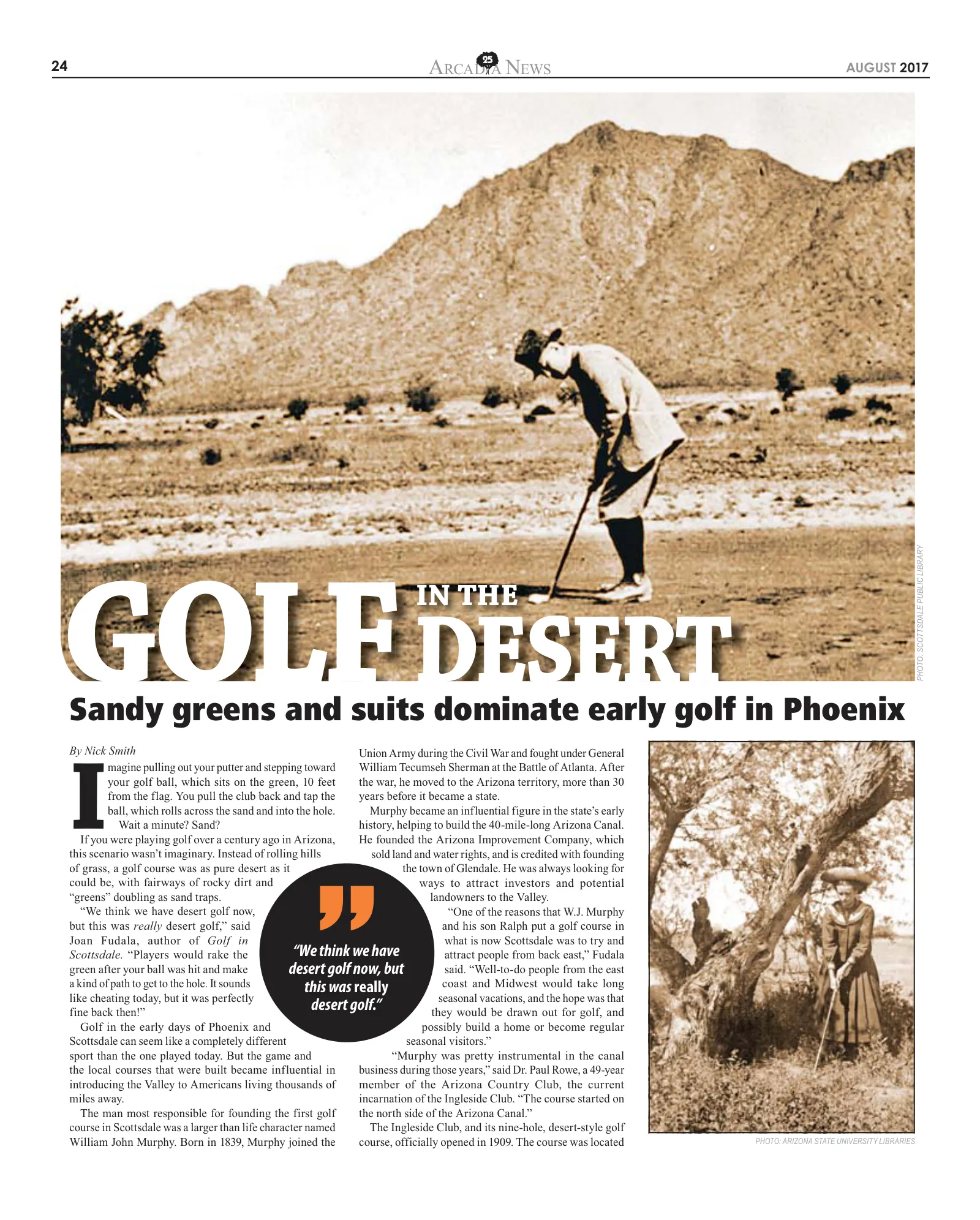
24 AUGUST 2017 ARCAD A NEWS By Nick Smith I magine pulling out your putter and stepping toward your golf ball, which sits on the green, 10 feet from the flag. You pull the club back and tap the ball, which rolls across the sand and into the hole. Wait a minute? Sand? If you were playing golf over a century ago in Arizona, this scenario wasn’t imaginary. Instead of rolling hills of grass, a golf course was as pure desert as it could be, with fairways of rocky dirt and “greens” doubling as sand traps. “We think we have desert golf now, but this was really desert golf,” said Joan Fudala, author of Golf in Scottsdale. “Players would rake the green after your ball was hit and make a kind of path to get to the hole. It sounds like cheating today, but it was perfectly fine back then!” Golf in the early days of Phoenix and Scottsdale can seem like a completely different sport than the one played today. But the game and the local courses that were built became influential in introducing the Valley to Americans living thousands of miles away. The man most responsible for founding the first golf course in Scottsdale was a larger than life character named William John Murphy. Born in 1839, Murphy joined the Union Army during the Civil War and fought under General William Tecumseh Sherman at the Battle of Atlanta. After the war, he moved to the Arizona territory, more than 30 years before it became a state. Murphy became an influential figure in the state’s early history, helping to build the 40-mile-long Arizona Canal. He founded the Arizona Improvement Company, which sold land and water rights, and is credited with founding the town of Glendale. He was always looking for ways to attract investors and potential landowners to the Valley. “One of the reasons that W.J. Murphy and his son Ralph put a golf course in what is now Scottsdale was to try and attract people from back east,” Fudala said. “Well-to-do people from the east coast and Midwest would take long seasonal vacations, and the hope was that they would be drawn out for golf, and possibly build a home or become regular seasonal visitors.” “Murphy was pretty instrumental in the canal business during those years,” said Dr. Paul Rowe, a 49-year member of the Arizona Country Club, the current incarnation of the Ingleside Club. “The course started on the north side of the Arizona Canal.” The Ingleside Club, and its nine-hole, desert-style golf course, officially opened in 1909. The course was located GOLF DESERT IN THE Sandy greens and suits dominate early golf in Phoenix “We think we have desert golf now, but this was really desert golf.” PHOTO: ARIZONA STATE UNIVERSITY LIBRARIES PHOTO: SCOTTSDALE PUBLIC LIBRARY
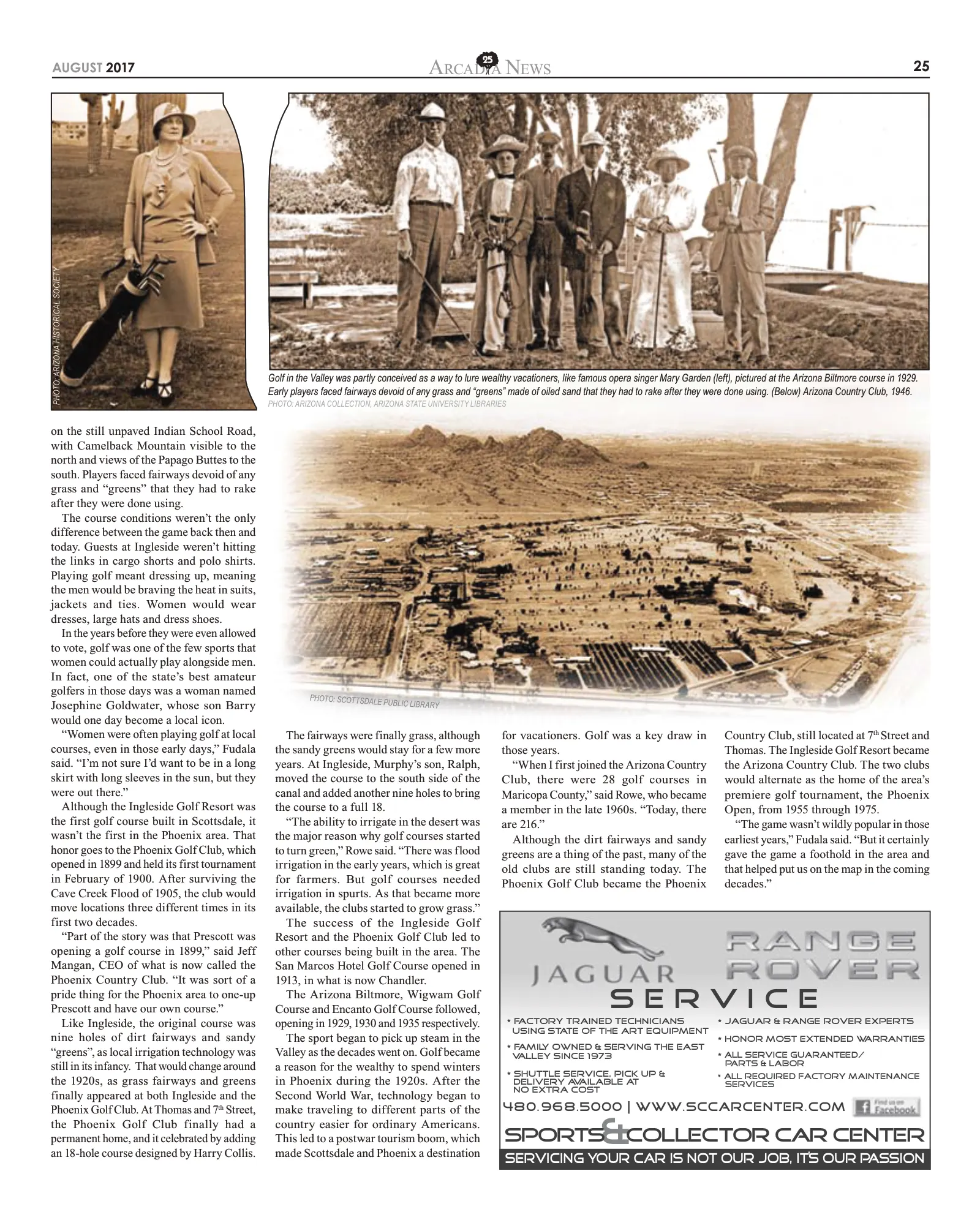
25 AUGUST 2017 ARCAD A NEWS on the still unpaved Indian School Road, with Camelback Mountain visible to the north and views of the Papago Buttes to the south. Players faced fairways devoid of any grass and “greens” that they had to rake after they were done using. The course conditions weren’t the only difference between the game back then and today. Guests at Ingleside weren’t hitting the links in cargo shorts and polo shirts. Playing golf meant dressing up, meaning the men would be braving the heat in suits, jackets and ties. Women would wear dresses, large hats and dress shoes. In the years before they were even allowed to vote, golf was one of the few sports that women could actually play alongside men. In fact, one of the state’s best amateur golfers in those days was a woman named Josephine Goldwater, whose son Barry would one day become a local icon. “Women were often playing golf at local courses, even in those early days,” Fudala said. “I’m not sure I’d want to be in a long skirt with long sleeves in the sun, but they were out there.” Although the Ingleside Golf Resort was the first golf course built in Scottsdale, it wasn’t the first in the Phoenix area. That honor goes to the Phoenix Golf Club, which opened in 1899 and held its first tournament in February of 1900. After surviving the Cave Creek Flood of 1905, the club would move locations three different times in its first two decades. “Part of the story was that Prescott was opening a golf course in 1899,” said Jeff Mangan, CEO of what is now called the Phoenix Country Club. “It was sort of a pride thing for the Phoenix area to one-up Prescott and have our own course.” Like Ingleside, the original course was nine holes of dirt fairways and sandy “greens”, as local irrigation technology was still in its infancy. That would change around the 1920s, as grass fairways and greens finally appeared at both Ingleside and the Phoenix Golf Club. At Thomas and 7 th Street, the Phoenix Golf Club finally had a permanent home, and it celebrated by adding an 18-hole course designed by Harry Collis. The fairways were finally grass, although the sandy greens would stay for a few more years. At Ingleside, Murphy’s son, Ralph, moved the course to the south side of the canal and added another nine holes to bring the course to a full 18. “The ability to irrigate in the desert was the major reason why golf courses started to turn green,” Rowe said. “There was flood irrigation in the early years, which is great for farmers. But golf courses needed irrigation in spurts. As that became more available, the clubs started to grow grass.” The success of the Ingleside Golf Resort and the Phoenix Golf Club led to other courses being built in the area. The San Marcos Hotel Golf Course opened in 1913, in what is now Chandler. The Arizona Biltmore, Wigwam Golf Course and Encanto Golf Course followed, opening in 1929, 1930 and 1935 respectively. The sport began to pick up steam in the Valley as the decades went on. Golf became a reason for the wealthy to spend winters in Phoenix during the 1920s. After the Second World War, technology began to make traveling to different parts of the country easier for ordinary Americans. This led to a postwar tourism boom, which made Scottsdale and Phoenix a destination for vacationers. Golf was a key draw in those years. “When I first joined the Arizona Country Club, there were 28 golf courses in Maricopa County,” said Rowe, who became a member in the late 1960s. “Today, there are 216.” Although the dirt fairways and sandy greens are a thing of the past, many of the old clubs are still standing today. The Phoenix Golf Club became the Phoenix Country Club, still located at 7 th Street and Thomas. The Ingleside Golf Resort became the Arizona Country Club. The two clubs would alternate as the home of the area’s premiere golf tournament, the Phoenix Open, from 1955 through 1975. “The game wasn’t wildly popular in those earliest years,” Fudala said. “But it certainly gave the game a foothold in the area and that helped put us on the map in the coming decades.” PHOTO: SCOTTSDALE PUBLIC LIBRARY Golf in the Valley was partly conceived as a way to lure wealthy vacationers, like famous opera singer Mary Garden (left), pictured at the Arizona Biltmore course in 1929. Early players faced fairways devoid of any grass and “greens” made of oiled sand that they had to rake after they were done using. (Below) Arizona Country Club, 1946. PHOTO: ARIZONA COLLECTION, ARIZONA STATE UNIVERSITY LIBRARIES PHOTO: ARIZONA HISTORICAL SOCIETY & SPORTS COLLECTOR CAR CENTER Servicing Your Car Is Not Our Job, It’s Our Passion • F actory Trained Technicians Using St ate of the Art Equipment • F amil y Owned & Serving The East V alley Since 1973 • Shuttle Service, Pick Up & Delivery A v ailable at no extra cost 480.968.5000 | www.sccarcenter.com • Jaguar & Range Rover Experts • Honor Most Extended W arranties • All Service Guaranteed/ Parts & Labor * All required factory maintenance Services S E R V I C E