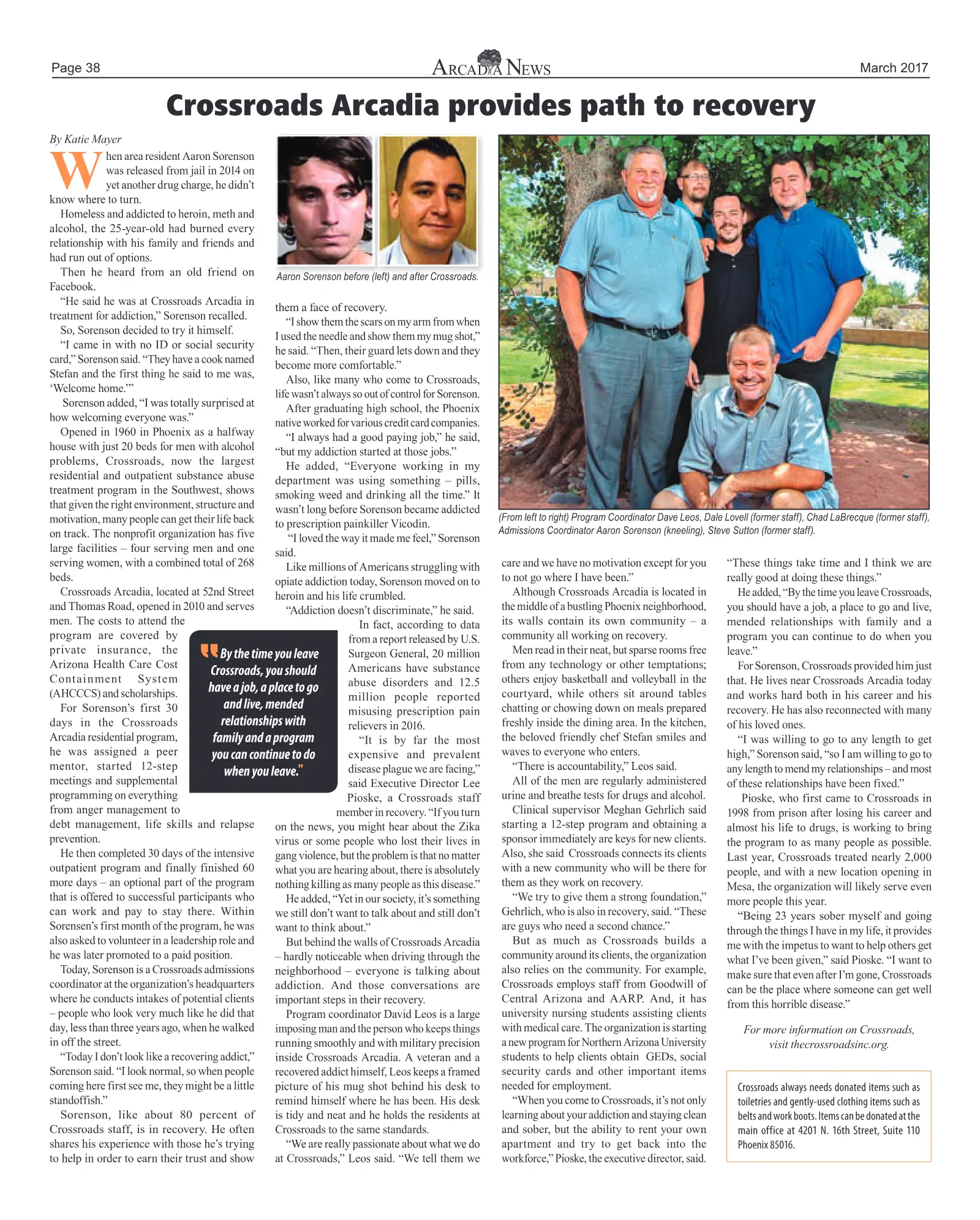
Page 38 March 2017 By Katie Mayer W hen area resident Aaron Sorenson was released from jail in 2014 on yet another drug charge, he didn’t know where to turn. Homeless and addicted to heroin, meth and alcohol, the 25-year-old had burned every relationship with his family and friends and had run out of options. Then he heard from an old friend on Facebook. “He said he was at Crossroads Arcadia in treatment for addiction,” Sorenson recalled. So, Sorenson decided to try it himself. “I came in with no ID or social security card,” Sorenson said. “They have a cook named Stefan and the first thing he said to me was, ‘Welcome home.’” Sorenson added, “I was totally surprised at how welcoming everyone was.” Opened in 1960 in Phoenix as a halfway house with just 20 beds for men with alcohol problems, Crossroads, now the largest residential and outpatient substance abuse treatment program in the Southwest, shows that given the right environment, structure and motivation, many people can get their life back on track. The nonprofit organization has five large facilities – four serving men and one serving women, with a combined total of 268 beds. Crossroads Arcadia, located at 52nd Street and Thomas Road, opened in 2010 and serves men. The costs to attend the program are covered by private insurance, the Arizona Health Care Cost Contain ment System (AHCCCS) and scholarships. For Sorenson’s first 30 days in the Crossroads Arcadia residential program, he was assigned a peer mentor, started 12-step meetings and supplemental programming on everything from anger management to debt management, life skills and relapse prevention. He then completed 30 days of the intensive outpatient program and finally finished 60 more days – an optional part of the program that is offered to successful participants who can work and pay to stay there. Within Sorensen’s first month of the program, he was also asked to volunteer in a leadership role and he was later promoted to a paid position. Today, Sorenson is a Crossroads admissions coordinator at the organization’s headquarters where he conducts intakes of potential clients – people who look very much like he did that day, less than three years ago, when he walked in off the street. “Today I don’t look like a recovering addict,” Sorenson said. “I look normal, so when people coming here first see me, they might be a little standoffish.” Sorenson, like about 80 percent of Crossroads staff, is in recovery. He often shares his experience with those he’s trying to help in order to earn their trust and show them a face of recovery. “I show them the scars on my arm from when I used the needle and show them my mug shot,” he said. “Then, their guard lets down and they become more comfortable.” Also, like many who come to Crossroads, life wasn’t always so out of control for Sorenson. After graduating high school, the Phoenix native worked for various credit card companies. “I always had a good paying job,” he said, “but my addiction started at those jobs.” He added, “Everyone working in my department was using something – pills, smoking weed and drinking all the time.” It wasn’t long before Sorenson became addicted to prescription painkiller Vicodin. “I loved the way it made me feel,” Sorenson said. Like millions of Americans struggling with opiate addiction today, Sorenson moved on to heroin and his life crumbled. “Addiction doesn’t discriminate,” he said. In fact, according to data from a report released by U.S. Surgeon General, 20 million Americans have substance abuse disorders and 12.5 million people reported misusing prescription pain relievers in 2016. “It is by far the most expensive and prevalent disease plague we are facing,” said Executive Director Lee Pioske, a Crossroads staff member in recovery. “If you turn on the news, you might hear about the Zika virus or some people who lost their lives in gang violence, but the problem is that no matter what you are hearing about, there is absolutely nothing killing as many people as this disease.” He added, “Yet in our society, it’s something we still don’t want to talk about and still don’t want to think about.” But behind the walls of Crossroads Arcadia – hardly noticeable when driving through the neighborhood – everyone is talking about addiction. And those conversations are important steps in their recovery. Program coordinator David Leos is a large imposing man and the person who keeps things running smoothly and with military precision inside Crossroads Arcadia. A veteran and a recovered addict himself, Leos keeps a framed picture of his mug shot behind his desk to remind himself where he has been. His desk is tidy and neat and he holds the residents at Crossroads to the same standards. “We are really passionate about what we do at Crossroads,” Leos said. “We tell them we care and we have no motivation except for you to not go where I have been.” Although Crossroads Arcadia is located in the middle of a bustling Phoenix neighborhood, its walls contain its own community – a community all working on recovery. Men read in their neat, but sparse rooms free from any technology or other temptations; others enjoy basketball and volleyball in the courtyard, while others sit around tables chatting or chowing down on meals prepared freshly inside the dining area. In the kitchen, the beloved friendly chef Stefan smiles and waves to everyone who enters. “There is accountability,” Leos said. All of the men are regularly administered urine and breathe tests for drugs and alcohol. Clinical supervisor Meghan Gehrlich said starting a 12-step program and obtaining a sponsor immediately are keys for new clients. Also, she said Crossroads connects its clients with a new community who will be there for them as they work on recovery. “We try to give them a strong foundation,” Gehrlich, who is also in recovery, said. “These are guys who need a second chance.” But as much as Crossroads builds a community around its clients, the organization also relies on the community. For example, Crossroads employs staff from Goodwill of Central Arizona and AARP. And, it has university nursing students assisting clients with medical care. The organization is starting a new program for Northern Arizona University students to help clients obtain GEDs, social security cards and other important items needed for employment. “When you come to Crossroads, it’s not only learning about your addiction and staying clean and sober, but the ability to rent your own apartment and try to get back into the workforce,” Pioske, the executive director, said. “These things take time and I think we are really good at doing these things.” He added, “By the time you leave Crossroads, you should have a job, a place to go and live, mended relationships with family and a program you can continue to do when you leave.” For Sorenson, Crossroads provided him just that. He lives near Crossroads Arcadia today and works hard both in his career and his recovery. He has also reconnected with many of his loved ones. “I was willing to go to any length to get high,” Sorenson said, “so I am willing to go to any length to mend my relationships – and most of these relationships have been fixed.” Pioske, who first came to Crossroads in 1998 from prison after losing his career and almost his life to drugs, is working to bring the program to as many people as possible. Last year, Crossroads treated nearly 2,000 people, and with a new location opening in Mesa, the organization will likely serve even more people this year. “Being 23 years sober myself and going through the things I have in my life, it provides me with the impetus to want to help others get what I’ve been given,” said Pioske. “I want to make sure that even after I’m gone, Crossroads can be the place where someone can get well from this horrible disease.” For more information on Crossroads, visit thecrossroadsinc.org. Crossroads Arcadia provides path to recovery (From left to right) Program Coordinator Dave Leos, Dale Lovell (former staff), Chad LaBrecque (former staff), Admissions Coordinator Aaron Sorenson (kneeling), Steve Sutton (former staff). Crossroads always needs donated items such as toiletries and gently-used clothing items such as belts and work boots. Items can be donated at the main office at 4201 N. 16th Street, Suite 110 Phoenix 85016. Aaron Sorenson before (left) and after Crossroads. By the time you leave Crossroads, you should have a job, a place to go and live, mended relationships with family and a program you can continue to do when you leave. ”
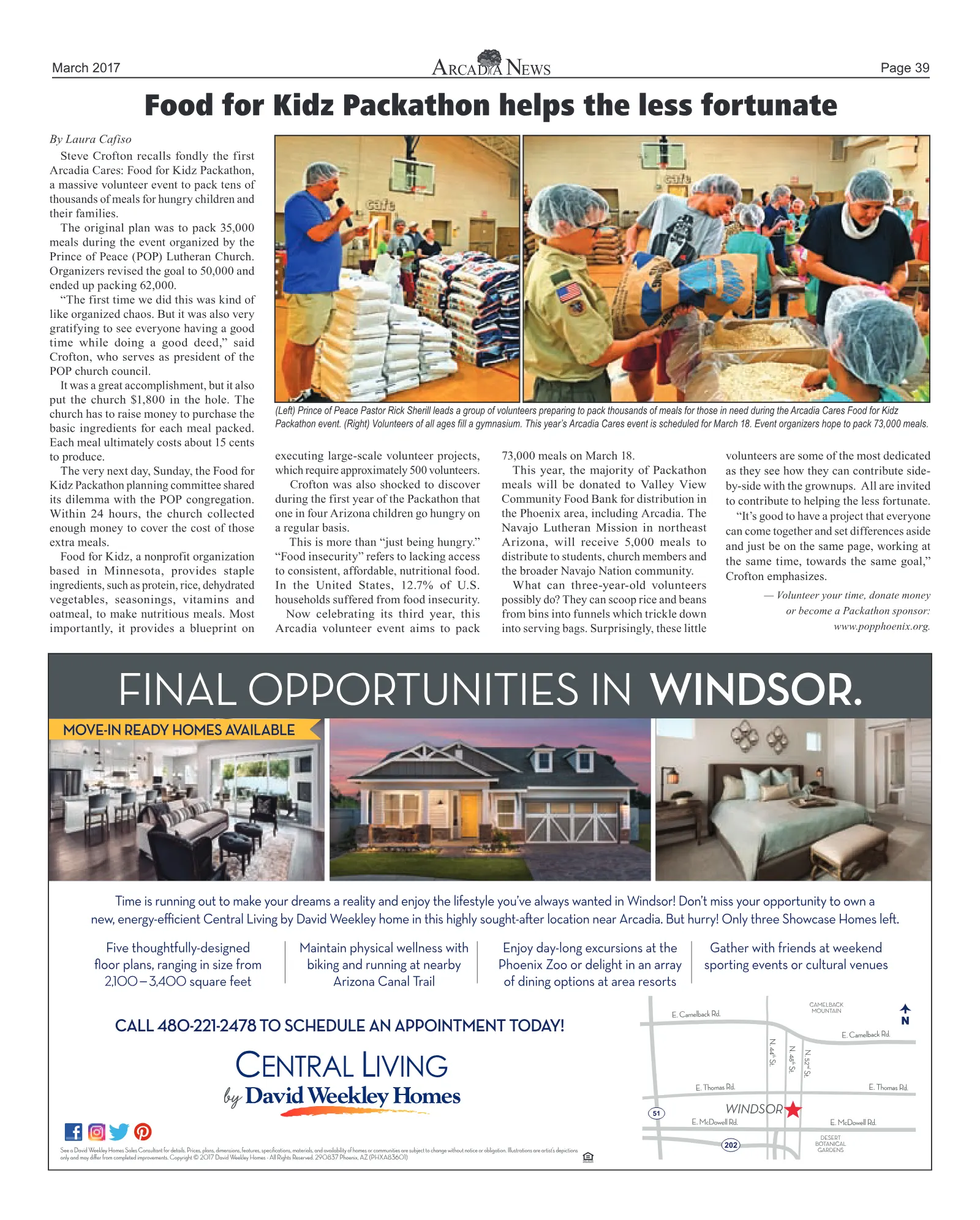
Page 39 March 2 0 1 7 FINAL OPPORTUNITIES IN WINDSOR. Time is running out to make your dreams a reality and enjoy the lifestyle you’ve always wanted in Windsor! Don’t miss your opportunity to own a new, energy-efficient Central Living by David Weekley home in this highly sought-after location near Arcadia. But hurry! Only three Showcase Homes left. CALL 480-221-2478 TO SCHEDULE AN APPOINTMENT TODAY! See a David Weekley Homes Sales Consultant for details. Prices, plans, dimensions, features, specifications, materials, and availability of homes or communities are subject to change without notice or obligation. Illustrations are artist’s depictions only and may differ from completed improvements. Copyright © 2017 David Weekley Homes - All Rights Reserved. 290837 Phoenix, AZ (PHXA83601) Five thoughtfully-designed floor plans, ranging in size from 2,100 – 3,400 square feet Maintain physical wellness with biking and running at nearby Arizona Canal Trail Enjoy day-long excursions at the Phoenix Zoo or delight in an array of dining options at area resorts Gather with friends at weekend sporting events or cultural venues MOVE-IN READY HOMES AVAILABLE E. Thomas Rd. E. Thomas Rd. 51 10 202 202 101 WINDSOR E. Camelback R d. E . C a melb a c k R d. E. McDowell Rd. E. McDowell Rd. N. 44 th St. N. 48 th St. N. 52 nd St. DESERT BOTANICAL GARDENS PHOENIX ZOO SKYHARBOR CAMELBACK MOUNTAIN ARIZONA BILTMORE By Laura Cafiso Steve Crofton recalls fondly the first Arcadia Cares: Food for Kidz Packathon, a massive volunteer event to pack tens of thousands of meals for hungry children and their families. The original plan was to pack 35,000 meals during the event organized by the Prince of Peace (POP) Lutheran Church. Organizers revised the goal to 50,000 and ended up packing 62,000. “The first time we did this was kind of like organized chaos. But it was also very gratifying to see everyone having a good time while doing a good deed,” said Crofton, who serves as president of the POP church council. It was a great accomplishment, but it also put the church $1,800 in the hole. The church has to raise money to purchase the basic ingredients for each meal packed. Each meal ultimately costs about 15 cents to produce. The very next day, Sunday, the Food for Kidz Packathon planning committee shared its dilemma with the POP congregation. Within 24 hours, the church collected enough money to cover the cost of those extra meals. Food for Kidz, a nonprofit organization based in Minnesota, provides staple ingredients, such as protein, rice, dehydrated vegetables, seasonings, vitamins and oatmeal, to make nutritious meals. Most importantly, it provides a blueprint on executing large-scale volunteer projects, which require approximately 500 volunteers. Crofton was also shocked to discover during the first year of the Packathon that one in four Arizona children go hungry on a regular basis. This is more than “just being hungry.” “Food insecurity” refers to lacking access to consistent, affordable, nutritional food. In the United States, 12.7% of U.S. households suffered from food insecurity. Now celebrating its third year, this Arcadia volunteer event aims to pack 73,000 meals on March 18. This year, the majority of Packathon meals will be donated to Valley View Community Food Bank for distribution in the Phoenix area, including Arcadia. The Navajo Lutheran Mission in northeast Arizona, will receive 5,000 meals to distribute to students, church members and the broader Navajo Nation community. What can three-year-old volunteers possibly do? They can scoop rice and beans from bins into funnels which trickle down into serving bags. Surprisingly, these little volunteers are some of the most dedicated as they see how they can contribute side- by-side with the grownups. All are invited to contribute to helping the less fortunate. “It’s good to have a project that everyone can come together and set differences aside and just be on the same page, working at the same time, towards the same goal,” Crofton emphasizes. — Volunteer your time, donate money or become a Packathon sponsor: www.popphoenix.org. Food for Kidz Packathon helps the less fortunate (Left) Prince of Peace Pastor Rick Sherill leads a group of volunteers preparing to pack thousands of meals for those in need during the Arcadia Cares Food for Kidz Packathon event. (Right) Volunteers of all ages fill a gymnasium. This year’s Arcadia Cares event is scheduled for March 18. Event organizers hope to pack 73,000 meals.