
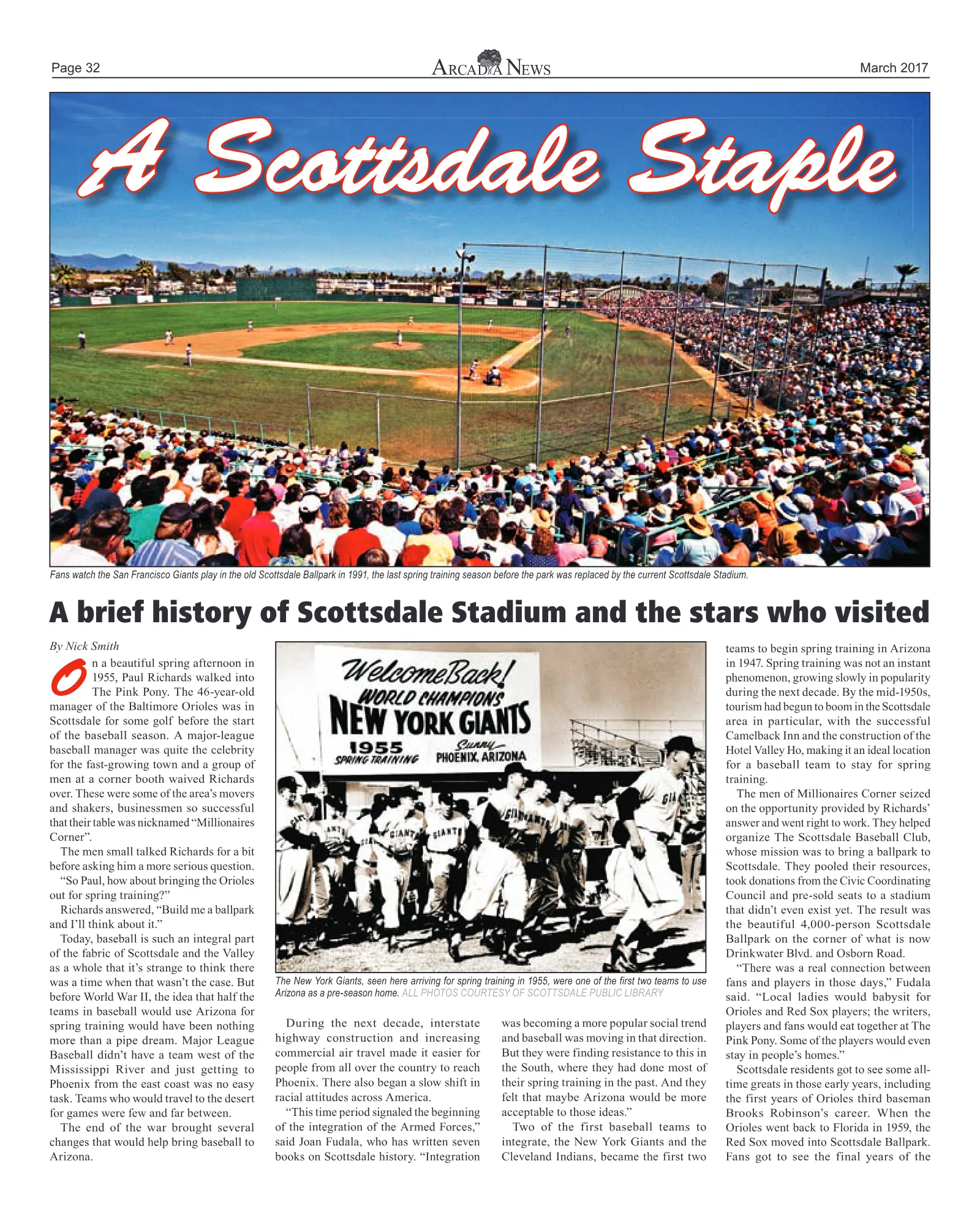
Page 32 March 2017 By Nick Smith O n a beautiful spring afternoon in 1955, Paul Richards walked into The Pink Pony. The 46-year-old manager of the Baltimore Orioles was in Scottsdale for some golf before the start of the baseball season. A major-league baseball manager was quite the celebrity for the fast-growing town and a group of men at a corner booth waived Richards over. These were some of the area’s movers and shakers, businessmen so successful that their table was nicknamed “Millionaires Corner”. The men small talked Richards for a bit before asking him a more serious question. “So Paul, how about bringing the Orioles out for spring training?” Richards answered, “Build me a ballpark and I’ll think about it.” Today, baseball is such an integral part of the fabric of Scottsdale and the Valley as a whole that it’s strange to think there was a time when that wasn’t the case. But before World War II, the idea that half the teams in baseball would use Arizona for spring training would have been nothing more than a pipe dream. Major League Baseball didn’t have a team west of the Mississippi River and just getting to Phoenix from the east coast was no easy task. Teams who would travel to the desert for games were few and far between. The end of the war brought several changes that would help bring baseball to Arizona. During the next decade, interstate highway construction and increasing commercial air travel made it easier for people from all over the country to reach Phoenix. There also began a slow shift in racial attitudes across America. “This time period signaled the beginning of the integration of the Armed Forces,” said Joan Fudala, who has written seven books on Scottsdale history. “Integration was becoming a more popular social trend and baseball was moving in that direction. But they were finding resistance to this in the South, where they had done most of their spring training in the past. And they felt that maybe Arizona would be more acceptable to those ideas.” Two of the first baseball teams to integrate, the New York Giants and the Cleveland Indians, became the first two teams to begin spring training in Arizona in 1947. Spring training was not an instant phenomenon, growing slowly in popularity during the next decade. By the mid-1950s, tourism had begun to boom in the Scottsdale area in particular, with the successful Camelback Inn and the construction of the Hotel Valley Ho, making it an ideal location for a baseball team to stay for spring training. The men of Millionaires Corner seized on the opportunity provided by Richards’ answer and went right to work. They helped organize The Scottsdale Baseball Club, whose mission was to bring a ballpark to Scottsdale. They pooled their resources, took donations from the Civic Coordinating Council and pre-sold seats to a stadium that didn’t even exist yet. The result was the beautiful 4,000-person Scottsdale Ballpark on the corner of what is now Drinkwater Blvd. and Osborn Road. “There was a real connection between fans and players in those days,” Fudala said. “Local ladies would babysit for Orioles and Red Sox players; the writers, players and fans would eat together at The Pink Pony. Some of the players would even stay in people’s homes.” Scottsdale residents got to see some all- time greats in those early years, including the first years of Orioles third baseman Brooks Robinson’s career. When the Orioles went back to Florida in 1959, the Red Sox moved into Scottsdale Ballpark. Fans got to see the final years of the A brief history of Scottsdale Stadium and the stars who visited A Scottsdale Staple Fans watch the San Francisco Giants play in the old Scottsdale Ballpark in 1991, the last spring training season before the park was replaced by the current Scottsdale Stadium. The New York Giants, seen here arriving for spring training in 1955, were one of the first two teams to use Arizona as a pre-season home. ALL PHOTOS COURTESY OF SCOTTSDALE PUBLIC LIBRARY
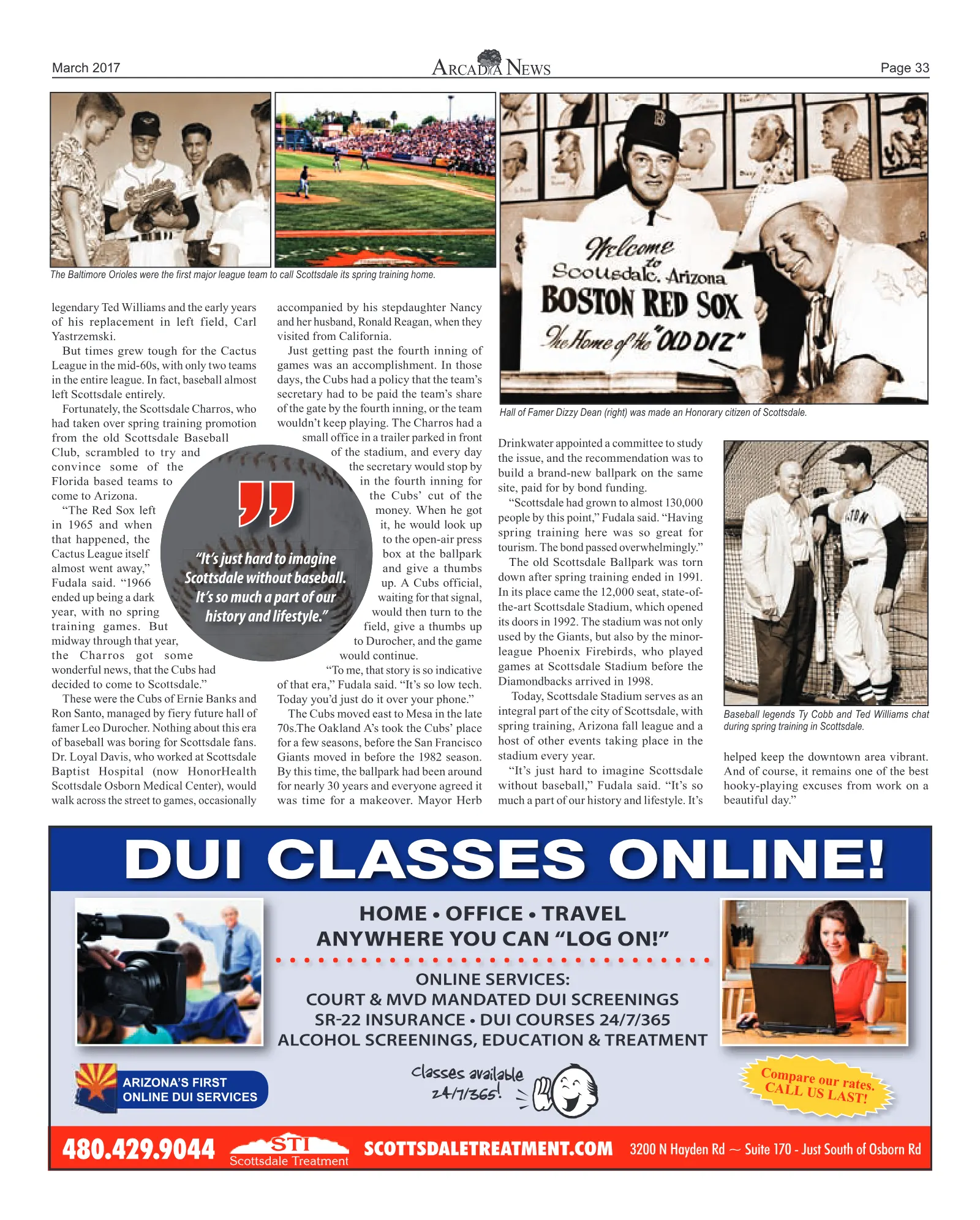
Page 33 March 2017 DUI CLASSES ONLINE! 3200 N Hayden Rd ~ Suite 170 - Just South of Osborn Rd 480.429.9044 SCOTTSDALETREATMENT.COM HOME • OFFICE • TRAVEL ANYWHERE YOU CAN “LOG ON!” ONLINE SERVICES: COURT & MVD MANDATED DUI SCREENINGS SR-22 INSURANCE • DUI COURSES 24/7/365 ALCOHOL SCREENINGS, EDUCATION & TREATMENT ARIZONA’S FIRST ONLINE DUI SERVICES Compare our rates. CALL US LAST! Classes available 24/7/365! ted legendary Ted Williams and the early years of his replacement in left field, Carl Yastrzemski. But times grew tough for the Cactus League in the mid-60s, with only two teams in the entire league. In fact, baseball almost left Scottsdale entirely. Fortunately, the Scottsdale Charros, who had taken over spring training promotion from the old Scottsdale Baseball Club, scrambled to try and convince some of the Florida based teams to come to Arizona. “The Red Sox left in 1965 and when that happened, the Cactus League itself almost went away,” Fudala said. “1966 ended up being a dark year, with no spring training games. But midway through that year, the Charros got some wonderful news, that the Cubs had decided to come to Scottsdale.” These were the Cubs of Ernie Banks and Ron Santo, managed by fiery future hall of famer Leo Durocher. Nothing about this era of baseball was boring for Scottsdale fans. Dr. Loyal Davis, who worked at Scottsdale Baptist Hospital (now HonorHealth Scottsdale Osborn Medical Center), would walk across the street to games, occasionally accompanied by his stepdaughter Nancy and her husband, Ronald Reagan, when they visited from California. Just getting past the fourth inning of games was an accomplishment. In those days, the Cubs had a policy that the team’s secretary had to be paid the team’s share of the gate by the fourth inning, or the team wouldn’t keep playing. The Charros had a small office in a trailer parked in front of the stadium, and every day the secretary would stop by in the fourth inning for the Cubs’ cut of the money. When he got it, he would look up to the open-air press box at the ballpark and give a thumbs up. A Cubs official, waiting for that signal, would then turn to the field, give a thumbs up to Durocher, and the game would continue. “To me, that story is so indicative of that era,” Fudala said. “It’s so low tech. Today you’d just do it over your phone.” The Cubs moved east to Mesa in the late 70s.The Oakland A’s took the Cubs’ place for a few seasons, before the San Francisco Giants moved in before the 1982 season. By this time, the ballpark had been around for nearly 30 years and everyone agreed it was time for a makeover. Mayor Herb Drinkwater appointed a committee to study the issue, and the recommendation was to build a brand-new ballpark on the same site, paid for by bond funding. “Scottsdale had grown to almost 130,000 people by this point,” Fudala said. “Having spring training here was so great for tourism. The bond passed overwhelmingly.” The old Scottsdale Ballpark was torn down after spring training ended in 1991. In its place came the 12,000 seat, state-of- the-art Scottsdale Stadium, which opened its doors in 1992. The stadium was not only used by the Giants, but also by the minor- league Phoenix Firebirds, who played games at Scottsdale Stadium before the Diamondbacks arrived in 1998. Today, Scottsdale Stadium serves as an integral part of the city of Scottsdale, with spring training, Arizona fall league and a host of other events taking place in the stadium every year. “It’s just hard to imagine Scottsdale without baseball,” Fudala said. “It’s so much a part of our history and lifestyle. It’s helped keep the downtown area vibrant. And of course, it remains one of the best hooky-playing excuses from work on a beautiful day.” The Baltimore Orioles were the first major league team to call Scottsdale its spring training home. Hall of Famer Dizzy Dean (right) was made an Honorary citizen of Scottsdale. Baseball legends Ty Cobb and Ted Williams chat during spring training in Scottsdale. “It’s just hard to imagine Scottsdale without baseball. It’s so much a part of our history and lifestyle.”