
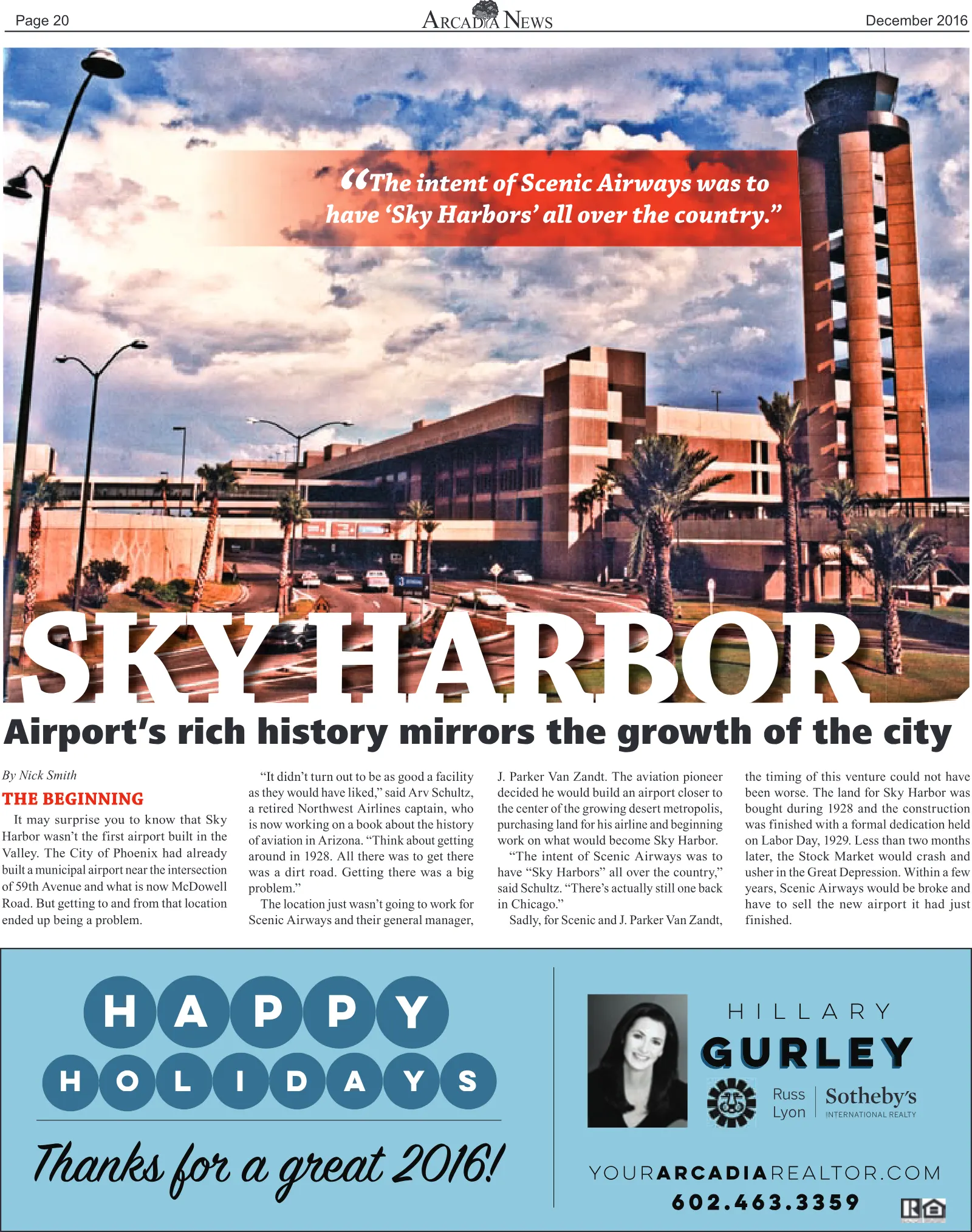
Page 20 December 2016 your ARcadia Realtor.com 602.463.3359 H i L L A R Y GURLEY GURLEY H A P P Y H O L s Y A D I Thanks for a great 2016! By Nick Smith THE BEGINNING It may surprise you to know that Sky Harbor wasn’t the first airport built in the Valley. The City of Phoenix had already built a municipal airport near the intersection of 59th Avenue and what is now McDowell Road. But getting to and from that location ended up being a problem. “It didn’t turn out to be as good a facility as they would have liked,” said Arv Schultz, a retired Northwest Airlines captain, who is now working on a book about the history of aviation in Arizona. “Think about getting around in 1928. All there was to get there was a dirt road. Getting there was a big problem.” The location just wasn’t going to work for Scenic Airways and their general manager, J. Parker Van Zandt. The aviation pioneer decided he would build an airport closer to the center of the growing desert metropolis, purchasing land for his airline and beginning work on what would become Sky Harbor. “The intent of Scenic Airways was to have “Sky Harbors” all over the country,” said Schultz. “There’s actually still one back in Chicago.” Sadly, for Scenic and J. Parker Van Zandt, the timing of this venture could not have been worse. The land for Sky Harbor was bought during 1928 and the construction was finished with a formal dedication held on Labor Day, 1929. Less than two months later, the Stock Market would crash and usher in the Great Depression. Within a few years, Scenic Airways would be broke and have to sell the new airport it had just finished. SKY HARBOR Airport’s rich history mirrors the growth of the city “ The intent of Scenic Airways was to have ‘Sky Harbors’ all over the country.”
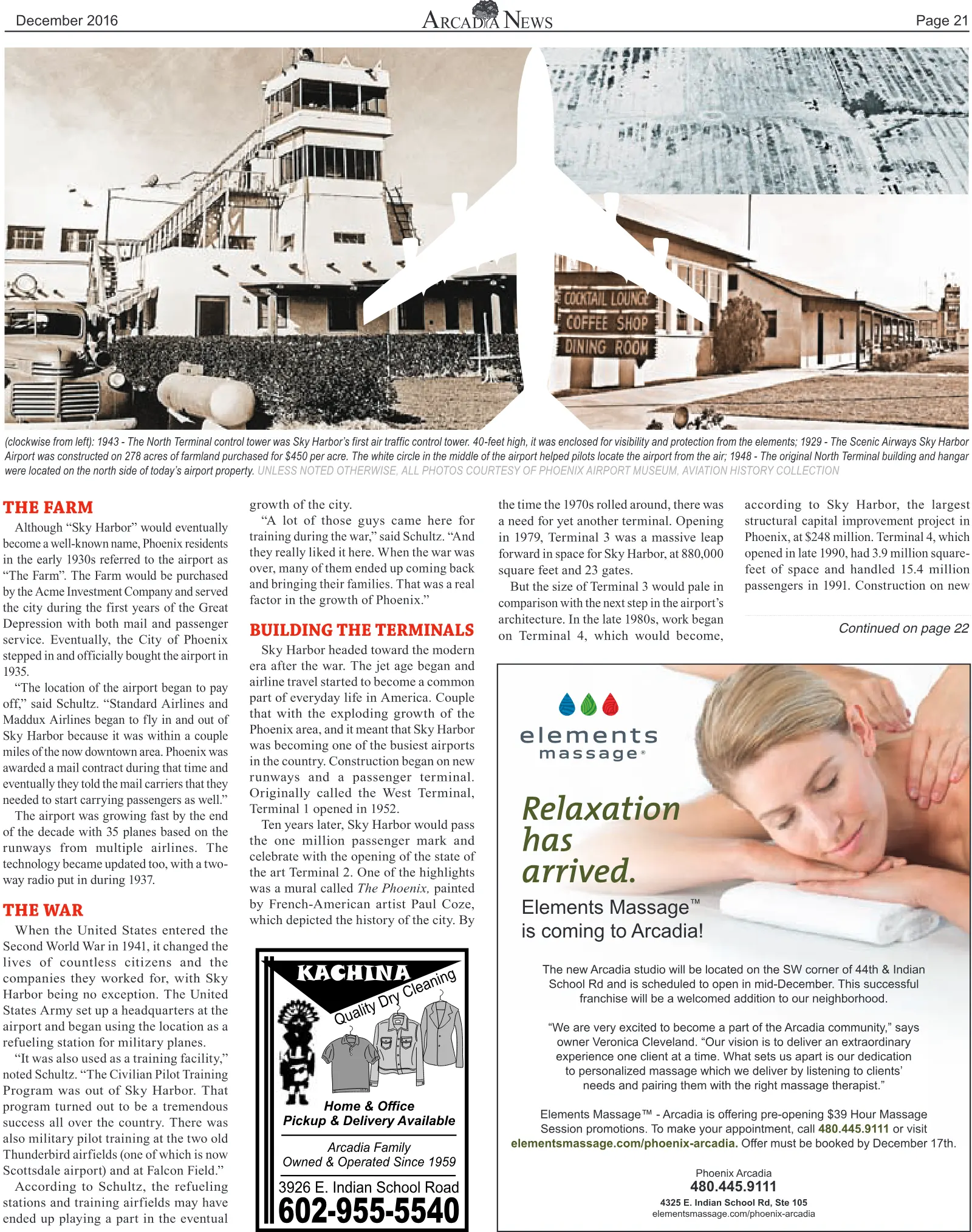
Page 21 December 2016 KACHINA Quality Dry Cleaning 602-955-5540 3926 E. Indian School Road Arcadia Family Owned & Operated Since 1959 Home & Office Pickup & Delivery Available THE FARM Although “Sky Harbor” would eventually become a well-known name, Phoenix residents in the early 1930s referred to the airport as “The Farm”. The Farm would be purchased by the Acme Investment Company and served the city during the first years of the Great Depression with both mail and passenger service. Eventually, the City of Phoenix stepped in and officially bought the airport in 1935. “The location of the airport began to pay off,” said Schultz. “Standard Airlines and Maddux Airlines began to fly in and out of Sky Harbor because it was within a couple miles of the now downtown area. Phoenix was awarded a mail contract during that time and eventually they told the mail carriers that they needed to start carrying passengers as well.” The airport was growing fast by the end of the decade with 35 planes based on the runways from multiple airlines. The technology became updated too, with a two- way radio put in during 1937. THE WAR When the United States entered the Second World War in 1941, it changed the lives of countless citizens and the companies they worked for, with Sky Harbor being no exception. The United States Army set up a headquarters at the airport and began using the location as a refueling station for military planes. “It was also used as a training facility,” noted Schultz. “The Civilian Pilot Training Program was out of Sky Harbor. That program turned out to be a tremendous success all over the country. There was also military pilot training at the two old Thunderbird airfields (one of which is now Scottsdale airport) and at Falcon Field.” According to Schultz, the refueling stations and training airfields may have ended up playing a part in the eventual growth of the city. “A lot of those guys came here for training during the war,” said Schultz. “And they really liked it here. When the war was over, many of them ended up coming back and bringing their families. That was a real factor in the growth of Phoenix.” BUILDING THE TERMINALS Sky Harbor headed toward the modern era after the war. The jet age began and airline travel started to become a common part of everyday life in America. Couple that with the exploding growth of the Phoenix area, and it meant that Sky Harbor was becoming one of the busiest airports in the country. Construction began on new runways and a passenger terminal. Originally called the West Terminal, Terminal 1 opened in 1952. Ten years later, Sky Harbor would pass the one million passenger mark and celebrate with the opening of the state of the art Terminal 2. One of the highlights was a mural called The Phoenix, painted by French-American artist Paul Coze, which depicted the history of the city. By the time the 1970s rolled around, there was a need for yet another terminal. Opening in 1979, Terminal 3 was a massive leap forward in space for Sky Harbor, at 880,000 square feet and 23 gates. But the size of Terminal 3 would pale in comparison with the next step in the airport’s architecture. In the late 1980s, work began on Terminal 4, which would become, according to Sky Harbor, the largest structural capital improvement project in Phoenix, at $248 million. Terminal 4, which opened in late 1990, had 3.9 million square- feet of space and handled 15.4 million passengers in 1991. Construction on new Continued on page 22 (clockwise from left): 1943 - The North Terminal control tower was Sky Harbor’s first air traffic control tower. 40-feet high, it was enclosed for visibility and protection from the elements; 1929 - The Scenic Airways Sky Harbor Airport was constructed on 278 acres of farmland purchased for $450 per acre. The white circle in the middle of the airport helped pilots locate the airport from the air; 1948 - The original North Terminal building and hangar were located on the north side of today’s airport property. UNLESS NOTED OTHERWISE, ALL PHOTOS COURTESY OF PHOENIX AIRPORT MUSEUM, AVIATION HISTORY COLLECTION