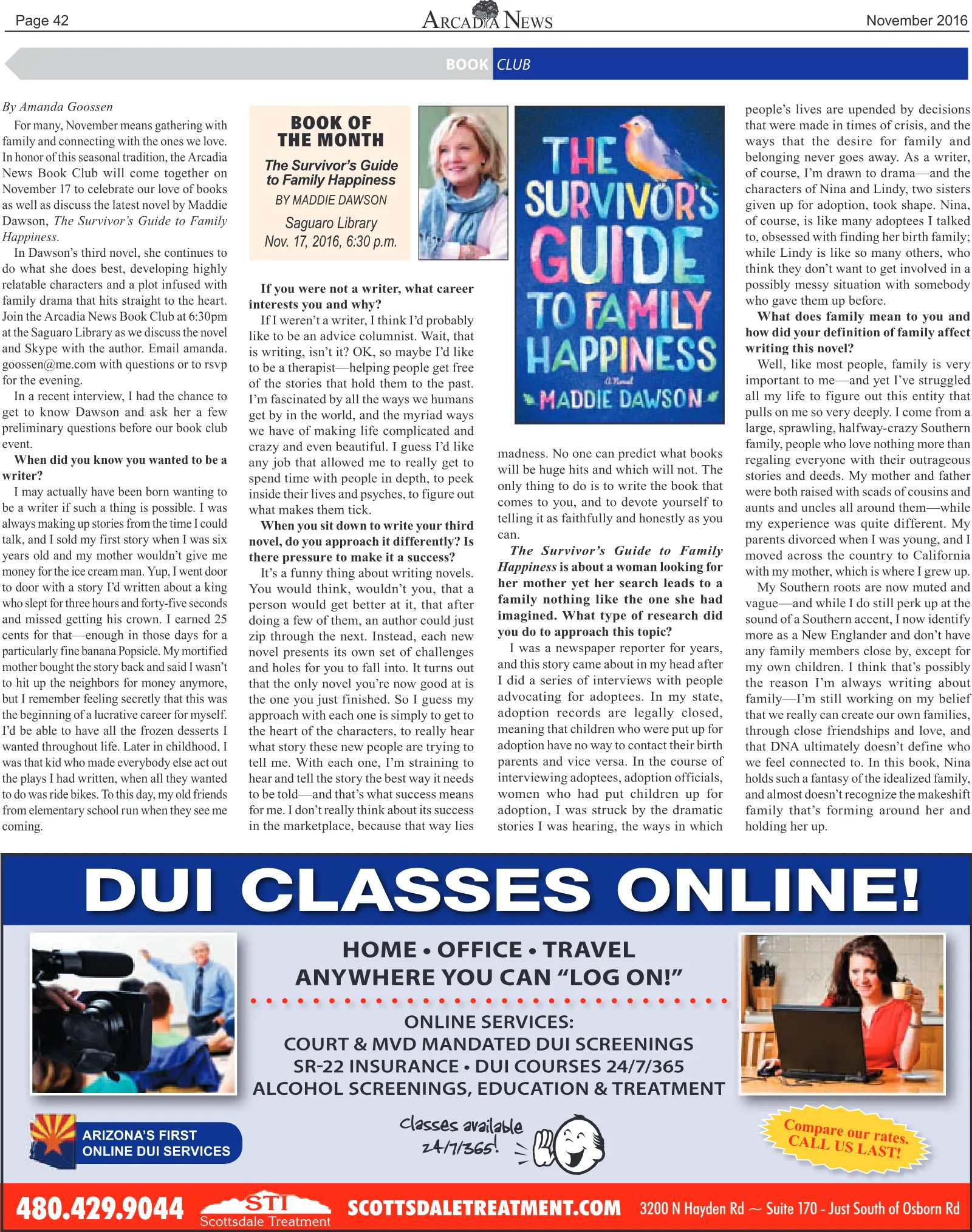

Page 42 November 2016 DUI CLASSES ONLINE! 3200 N Hayden Rd ~ Suite 170 - Just South of Osborn Rd 480.429.9044 SCOTTSDALETREATMENT.COM HOME • OFFICE • TRAVEL ANYWHERE YOU CAN “LOG ON!” ONLINE SERVICES: COURT & MVD MANDATED DUI SCREENINGS SR-22 INSURANCE • DUI COURSES 24/7/365 ALCOHOL SCREENINGS, EDUCATION & TREATMENT ARIZONA’S FIRST ONLINE DUI SERVICES Compare our rates. CALL US LAST! Classes available 24/7/365! By Amanda Goossen For many, November means gathering with family and connecting with the ones we love. In honor of this seasonal tradition, the Arcadia News Book Club will come together on November 17 to celebrate our love of books as well as discuss the latest novel by Maddie Dawson, The Survivor’s Guide to Family Happiness . In Dawson’s third novel, she continues to do what she does best, developing highly relatable characters and a plot infused with family drama that hits straight to the heart. Join the Arcadia News Book Club at 6:30pm at the Saguaro Library as we discuss the novel and Skype with the author. Email amanda. goossen@me.com with questions or to rsvp for the evening. In a recent interview, I had the chance to get to know Dawson and ask her a few preliminary questions before our book club event. When did you know you wanted to be a writer? I may actually have been born wanting to be a writer if such a thing is possible. I was always making up stories from the time I could talk, and I sold my first story when I was six years old and my mother wouldn’t give me money for the ice cream man. Yup, I went door to door with a story I’d written about a king who slept for three hours and forty-five seconds and missed getting his crown. I earned 25 cents for that—enough in those days for a particularly fine banana Popsicle. My mortified mother bought the story back and said I wasn’t to hit up the neighbors for money anymore, but I remember feeling secretly that this was the beginning of a lucrative career for myself. I’d be able to have all the frozen desserts I wanted throughout life. Later in childhood, I was that kid who made everybody else act out the plays I had written, when all they wanted to do was ride bikes. To this day, my old friends from elementary school run when they see me coming. If you were not a writer, what career interests you and why? If I weren’t a writer, I think I’d probably like to be an advice columnist. Wait, that is writing, isn’t it? OK, so maybe I’d like to be a therapist—helping people get free of the stories that hold them to the past. I’m fascinated by all the ways we humans get by in the world, and the myriad ways we have of making life complicated and crazy and even beautiful. I guess I’d like any job that allowed me to really get to spend time with people in depth, to peek inside their lives and psyches, to figure out what makes them tick. When you sit down to write your third novel, do you approach it differently? Is there pressure to make it a success? It’s a funny thing about writing novels. You would think, wouldn’t you, that a person would get better at it, that after doing a few of them, an author could just zip through the next. Instead, each new novel presents its own set of challenges and holes for you to fall into. It turns out that the only novel you’re now good at is the one you just finished. So I guess my approach with each one is simply to get to the heart of the characters, to really hear what story these new people are trying to tell me. With each one, I’m straining to hear and tell the story the best way it needs to be told—and that’s what success means for me. I don’t really think about its success in the marketplace, because that way lies madness. No one can predict what books will be huge hits and which will not. The only thing to do is to write the book that comes to you, and to devote yourself to telling it as faithfully and honestly as you can. The Survivor’s Guide to Family Happiness is about a woman looking for her mother yet her search leads to a family nothing like the one she had imagined. What type of research did you do to approach this topic? I was a newspaper reporter for years, and this story came about in my head after I did a series of interviews with people advocating for adoptees. In my state, adoption records are legally closed, meaning that children who were put up for adoption have no way to contact their birth parents and vice versa. In the course of interviewing adoptees, adoption officials, women who had put children up for adoption, I was struck by the dramatic stories I was hearing, the ways in which people’s lives are upended by decisions that were made in times of crisis, and the ways that the desire for family and belonging never goes away. As a writer, of course, I’m drawn to drama—and the characters of Nina and Lindy, two sisters given up for adoption, took shape. Nina, of course, is like many adoptees I talked to, obsessed with finding her birth family; while Lindy is like so many others, who think they don’t want to get involved in a possibly messy situation with somebody who gave them up before. What does family mean to you and how did your definition of family affect writing this novel? Well, like most people, family is very important to me—and yet I’ve struggled all my life to figure out this entity that pulls on me so very deeply. I come from a large, sprawling, halfway-crazy Southern family, people who love nothing more than regaling everyone with their outrageous stories and deeds. My mother and father were both raised with scads of cousins and aunts and uncles all around them—while my experience was quite different. My parents divorced when I was young, and I moved across the country to California with my mother, which is where I grew up. My Southern roots are now muted and vague—and while I do still perk up at the sound of a Southern accent, I now identify more as a New Englander and don’t have any family members close by, except for my own children. I think that’s possibly the reason I’m always writing about family—I’m still working on my belief that we really can create our own families, through close friendships and love, and that DNA ultimately doesn’t define who we feel connected to. In this book, Nina holds such a fantasy of the idealized family, and almost doesn’t recognize the makeshift family that’s forming around her and holding her up. BOOK CLUB BOOK OF THE MONTH The Survivor’s Guide to Family Happiness BY MADDIE DAWSON Saguaro Library Nov. 17, 2016, 6:30 p.m.
Page 43 November 2016 Arcadia Mortgage Experts. At work for you. Your next home will be second to none. You deserve a mortgage expert equally as impressive. One who knows the area and its intricacies. Discover how our concierge level service and industry expertise can accommodate all of your mortgage needs. • Jumbo Mortgages and Construction Loans • No Private Mortgage Insurance for Residential Loans • Streamlined Lending Process with Flexible and Creative Solutions midfirstprivatebank.com/arcadia 480.384.5750