
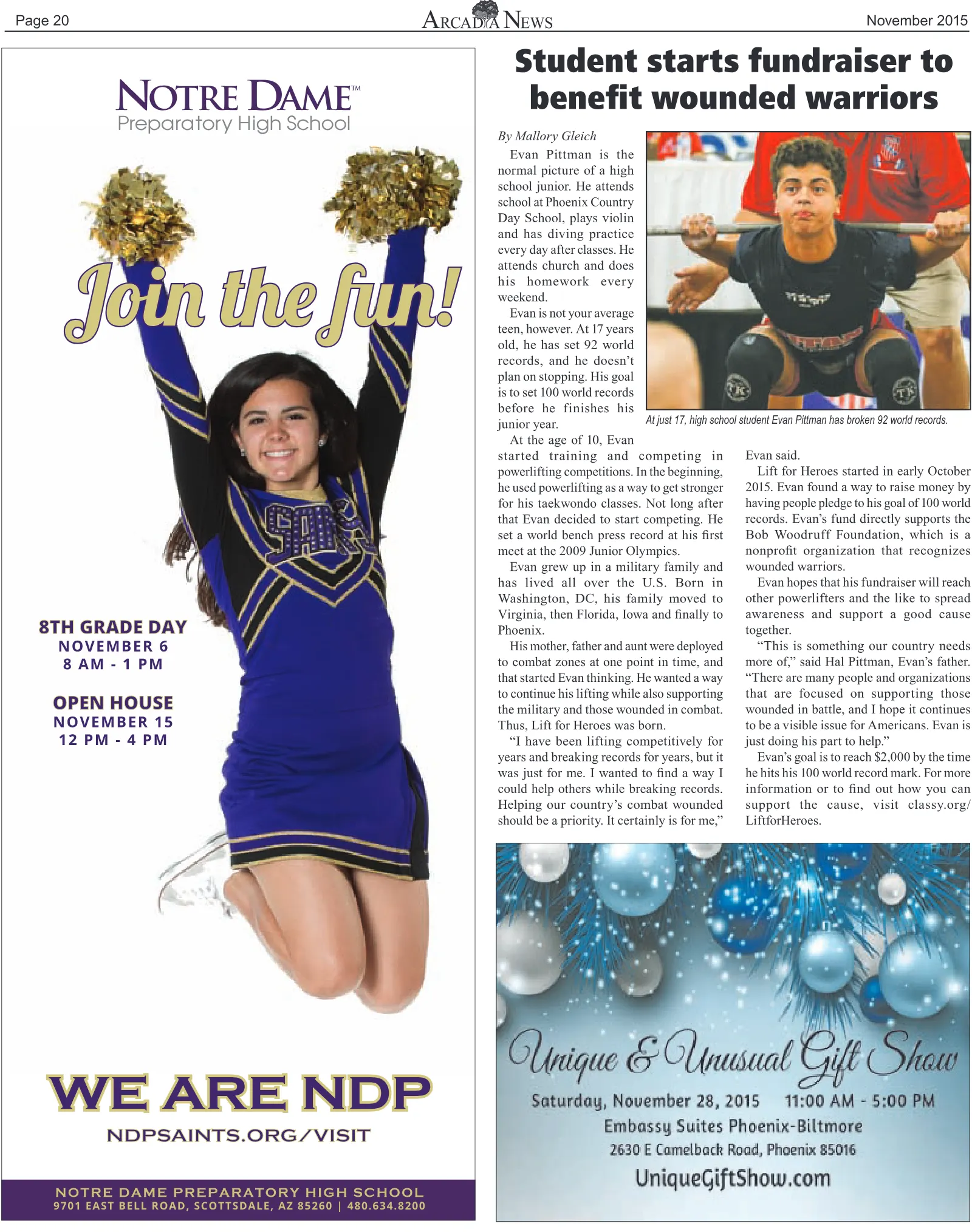
Page 20 November 2015 By Mallory Gleich Evan Pittman is the normal picture of a high school junior. He attends school at Phoenix Country Day School, plays violin and has diving practice every day after classes. He attends church and does his homework every weekend. Evan is not your average teen, however. At 17 years old, he has set 92 world records, and he doesn’t plan on stopping. His goal is to set 100 world records before he finishes his junior year. At the age of 10, Evan started training and competing in powerlifting competitions. In the beginning, he used powerlifting as a way to get stronger for his taekwondo classes. Not long after that Evan decided to start competing. He set a world bench press record at his first meet at the 2009 Junior Olympics. Evan grew up in a military family and has lived all over the U.S. Born in Washington, DC, his family moved to Virginia, then Florida, Iowa and finally to Phoenix. His mother, father and aunt were deployed to combat zones at one point in time, and that started Evan thinking. He wanted a way to continue his lifting while also supporting the military and those wounded in combat. Thus, Lift for Heroes was born. “I have been lifting competitively for years and breaking records for years, but it was just for me. I wanted to find a way I could help others while breaking records. Helping our country’s combat wounded should be a priority. It certainly is for me,” Evan said. Lift for Heroes started in early October 2015. Evan found a way to raise money by having people pledge to his goal of 100 world records. Evan’s fund directly supports the Bob Woodruff Foundation, which is a nonprofit organization that recognizes wounded warriors. Evan hopes that his fundraiser will reach other powerlifters and the like to spread awareness and support a good cause together. “This is something our country needs more of,” said Hal Pittman, Evan’s father. “There are many people and organizations that are focused on supporting those wounded in battle, and I hope it continues to be a visible issue for Americans. Evan is just doing his part to help.” Evan’s goal is to reach $2,000 by the time he hits his 100 world record mark. For more information or to find out how you can support the cause, visit classy.org/ LiftforHeroes. Student starts fundraiser to benefit wounded warriors At just 17, high school student Evan Pittman has broken 92 world records.
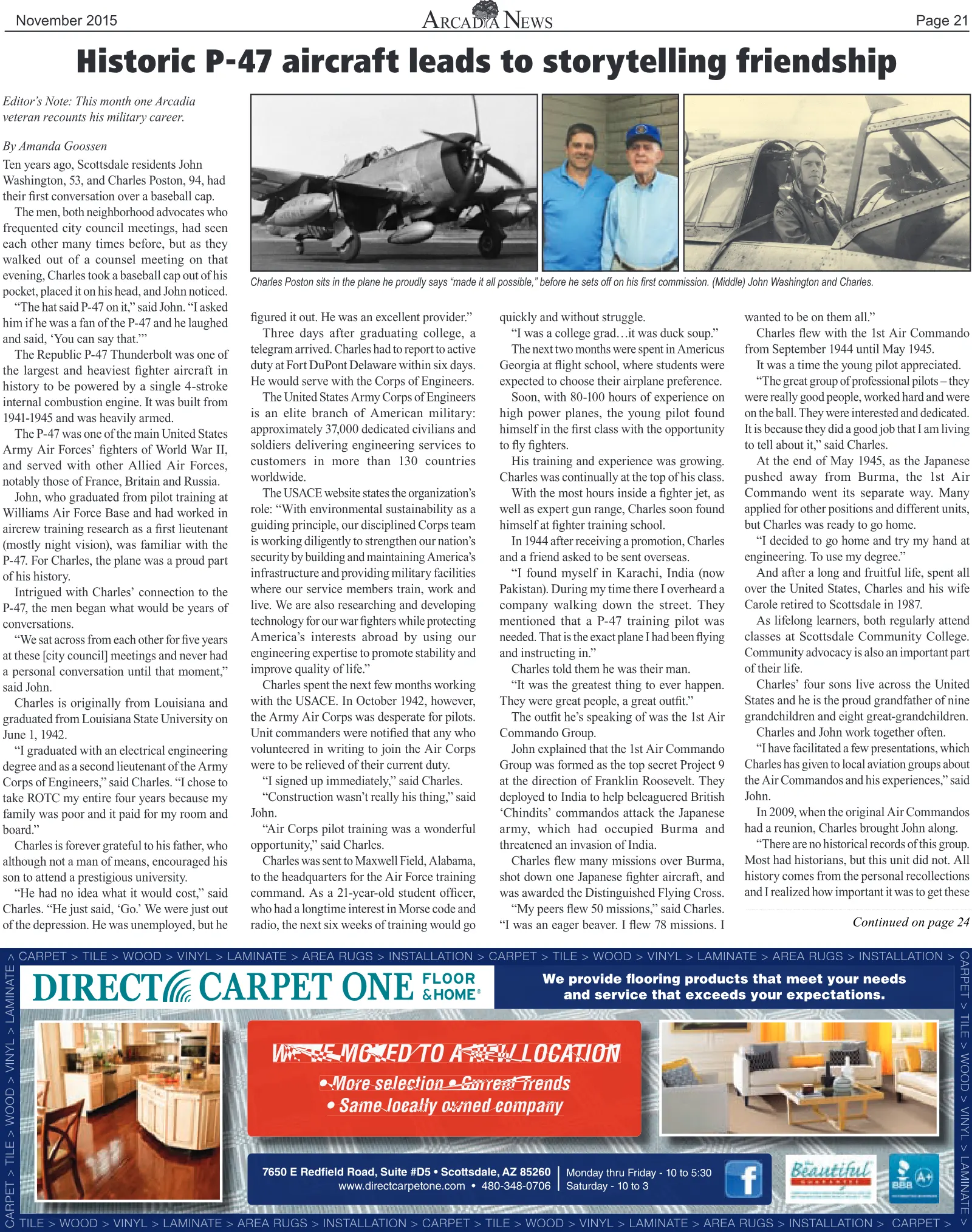
We provide flooring products that meet your needs and service that exceeds your expectations. WE’VE MOVED TO A NEW LOCATION • More selection • Current Trends • Same locally owned company 7650 E Redfield Road, Suite #D5 • Scottsdale, AZ 85260 www.directcarpetone.com • 480-348-0706 CARPET > TILE > WOOD > VINYL > LAMINATE > AREA RUGS > INSTALLATION > CARPET > TILE > WOOD > VINYL > LAMINATE > AREA RUGS > INSTALLATION > CARPET > TILE > WOOD > VINYL > LAMINATE > TILE > WOOD > VINYL > LAMINATE > AREA RUGS > INSTALLATION > CARPET > TILE > WOOD > VINYL > LAMINATE > AREA RUGS > INSTALLATION > CARPET > TILE > WOOD > VINYL > LAMINATE > AREA RUGS > INSTALLATION > CARPET > TILE > WOOD > VINYL > LAMINATE > AREA RUGS > INSTALLATION > CARPET > CARPET > TILE > WOOD > VINYL > LAMINATE > Monday thru Friday - 10 to 5:30 Saturday - 10 to 3 Page 21 November 2015 Editor’s Note: This month one Arcadia veteran recounts his military career. By Amanda Goossen Ten years ago, Scottsdale residents John Washington, 53, and Charles Poston, 94, had their first conversation over a baseball cap. The men, both neighborhood advocates who frequented city council meetings, had seen each other many times before, but as they walked out of a counsel meeting on that evening, Charles took a baseball cap out of his pocket, placed it on his head, and John noticed. “The hat said P-47 on it,” said John. “I asked him if he was a fan of the P-47 and he laughed and said, ‘You can say that.’” The Republic P-47 Thunderbolt was one of the largest and heaviest fighter aircraft in history to be powered by a single 4-stroke internal combustion engine. It was built from 1941-1945 and was heavily armed. The P-47 was one of the main United States Army Air Forces’ fighters of World War II, and served with other Allied Air Forces, notably those of France, Britain and Russia. John, who graduated from pilot training at Williams Air Force Base and had worked in aircrew training research as a first lieutenant (mostly night vision), was familiar with the P-47. For Charles, the plane was a proud part of his history. Intrigued with Charles’ connection to the P-47, the men began what would be years of conversations. “We sat across from each other for five years at these [city council] meetings and never had a personal conversation until that moment,” said John. Charles is originally from Louisiana and graduated from Louisiana State University on June 1, 1942. “I graduated with an electrical engineering degree and as a second lieutenant of the Army Corps of Engineers,” said Charles. “I chose to take ROTC my entire four years because my family was poor and it paid for my room and board.” Charles is forever grateful to his father, who although not a man of means, encouraged his son to attend a prestigious university. “He had no idea what it would cost,” said Charles. “He just said, ‘Go.’ We were just out of the depression. He was unemployed, but he figured it out. He was an excellent provider.” Three days after graduating college, a telegram arrived. Charles had to report to active duty at Fort DuPont Delaware within six days. He would serve with the Corps of Engineers. The United States Army Corps of Engineers is an elite branch of American military: approximately 37,000 dedicated civilians and soldiers delivering engineering services to customers in more than 130 countries worldwide. The USACE website states the organization’s role: “With environmental sustainability as a guiding principle, our disciplined Corps team is working diligently to strengthen our nation’s security by building and maintaining America’s infrastructure and providing military facilities where our service members train, work and live. We are also researching and developing technology for our war fighters while protecting America’s interests abroad by using our engineering expertise to promote stability and improve quality of life.” Charles spent the next few months working with the USACE. In October 1942, however, the Army Air Corps was desperate for pilots. Unit commanders were notified that any who volunteered in writing to join the Air Corps were to be relieved of their current duty. “I signed up immediately,” said Charles. “Construction wasn’t really his thing,” said John. “Air Corps pilot training was a wonderful opportunity,” said Charles. Charles was sent to Maxwell Field, Alabama, to the headquarters for the Air Force training command. As a 21-year-old student officer, who had a longtime interest in Morse code and radio, the next six weeks of training would go quickly and without struggle. “I was a college grad…it was duck soup.” The next two months were spent in Americus Georgia at flight school, where students were expected to choose their airplane preference. Soon, with 80-100 hours of experience on high power planes, the young pilot found himself in the first class with the opportunity to fly fighters. His training and experience was growing. Charles was continually at the top of his class. With the most hours inside a fighter jet, as well as expert gun range, Charles soon found himself at fighter training school. In 1944 after receiving a promotion, Charles and a friend asked to be sent overseas. “I found myself in Karachi, India (now Pakistan). During my time there I overheard a company walking down the street. They mentioned that a P-47 training pilot was needed. That is the exact plane I had been flying and instructing in.” Charles told them he was their man. “It was the greatest thing to ever happen. They were great people, a great outfit.” The outfit he’s speaking of was the 1st Air Commando Group. John explained that the 1st Air Commando Group was formed as the top secret Project 9 at the direction of Franklin Roosevelt. They deployed to India to help beleaguered British ‘Chindits’ commandos attack the Japanese army, which had occupied Burma and threatened an invasion of India. Charles flew many missions over Burma, shot down one Japanese fighter aircraft, and was awarded the Distinguished Flying Cross. “My peers flew 50 missions,” said Charles. “I was an eager beaver. I flew 78 missions. I wanted to be on them all.” Charles flew with the 1st Air Commando from September 1944 until May 1945. It was a time the young pilot appreciated. “The great group of professional pilots – they were really good people, worked hard and were on the ball. They were interested and dedicated. It is because they did a good job that I am living to tell about it,” said Charles. At the end of May 1945, as the Japanese pushed away from Burma, the 1st Air Commando went its separate way. Many applied for other positions and different units, but Charles was ready to go home. “I decided to go home and try my hand at engineering. To use my degree.” And after a long and fruitful life, spent all over the United States, Charles and his wife Carole retired to Scottsdale in 1987. As lifelong learners, both regularly attend classes at Scottsdale Community College. Community advocacy is also an important part of their life. Charles’ four sons live across the United States and he is the proud grandfather of nine grandchildren and eight great-grandchildren. Charles and John work together often. “I have facilitated a few presentations, which Charles has given to local aviation groups about the Air Commandos and his experiences,” said John. In 2009, when the original Air Commandos had a reunion, Charles brought John along. “There are no historical records of this group. Most had historians, but this unit did not. All history comes from the personal recollections and I realized how important it was to get these Historic P-47 aircraft leads to storytelling friendship Charles Poston sits in the plane he proudly says “made it all possible,” before he sets off on his first commission. (Middle) John Washington and Charles. Continued on page 24